Book Review: Snow Like Ashes

snow like ashesSnow Like Ashes
by Sara Raasch
YA Fantasy
422 pages
Published 2014

The world-building in this book is fascinating. At first, it seems like yet another YA novel about displaced royals trying to win back their kingdom, but this royal is in much more dire straits than most. Meira is a refugee living on the run with seven others, one of them her rightful King. All the rest of their people have been enslaved by the conquering country, and their kingdom’s link to the magic inherent in the land has been broken.

A little backdrop is needed. In Meira’s land, there are eight countries. The Rhythm countries, where seasons proceed as normal, and the Seasons – 4 countries locked in one season each. The rulers of each country have a magic conduit that lets them feed magic to their people – but the conduits are gender-locked. In four of the countries, only women can use the conduit; in the other four, only men. Meira and her little band are all that’s left of the free people of Winter. Spring invaded sixteen years ago, killed Winter’s queen, broke the locket that was their magic conduit (each ruler has one) and enslaved their people. Because the queen only had a son, he can’t wield Winter’s magic anyway. They’re still trying to find the two pieces of the locket so when he has a daughter, she can wield it. You’d think at this point, since he’s of age, he should be trying to get as many women pregnant as possible to up the odds of getting a royal heir who can wield the magic, but that…doesn’t come up.

The book does delve into the country’s people being oppressed, used as slaves, and being incredibly abused by the conquering country, and this is where I ran into a quandary. The Season’s people reflect their countries: Autumn’s people have copper skin, Spring’s citizens are blond-haired and green-eyed – and Winter’s people are white. Pale skin, snow-white hair, blue eyes. Writing white people as the oppressed people just rubs me the wrong way. (In that false “help I’m being oppressed because other people want equal rights!” kind of way.) Yes, this is fantasy, yes, it has nothing to do with our world’s politics – but it bothers me. It’s at least not white-savioring, as Meira’s trying to save her own people, but I don’t know. Is it better or worse to write white people as the oppressed protagonists?

That question aside, this was a well-written novel of fighting against an oppressor. There is definitely still work to be done at the end of the book, and there are two more books, as well as two short stories. While I am a little curious what ultimately happens, I don’t know if the series has earned more time on my reading list.

From the cover of Snow Like Ashes:

Sixteen years ago the Kingdom of Winter was conquered and its citizens enslaved, leaving them without magic or a monarch. Now the Winterians only hope for freedom is the eight survivors who managed to escape, and who have been waiting for the opportunity to steal back Winter’s magic and rebuild the kingdom ever since.

Orphaned as an infant during Winter’s defeat, Meira has lived her whole life as a refugee, raised by the Winterians’ general, Sir. Training to be a warrior – and desperately in love with her best friend and future king, Mather – she would do anything to help Winter rise to power again.

So when scouts discover the location of the ancient locket that can restore their magic, Meira decides to go after it herself. Finally, she’s scaling towers and fighting enemy soldiers just as she’s always dreamed she would. But the mission doesn’t go as planned, and Meira soon finds herself thrust into a world of evil magic and dangerous politics – and ultimately comes to realize that her destiny is not, never has been, her own.

Book Review: The Shape of Water

the shape of waterThe Shape of Water
by Daniel Kraus and Guillermo del Toro
Magical Realism
314 pages
Published 2018

Alright, so, with as much as I enjoy twists on mermaid stories, this was kind of inevitable, right? I’d heard a lot about the movie, but hadn’t yet seen it, so I figured I’d read the novelization. What I didn’t realize until reading the book, though, is that this isn’t actually a novelization of the movie. The movie and the book were written at the same time, about the same story, but tell different parts of it. (This article explains how both were written.) The book delves more into the mythology behind the creature, and gets into the thoughts and feelings of both the creature and Elisa. Those things are incredibly hard to communicate in film, especially when the characters can’t speak! So, far from “reading the book instead of seeing the movie,” now that I’ve read the book, I REALLY want to see the movie!

If you haven’t heard of the movie, the basic premise of both movie and book is Elisa, a mute janitor at a top secret research facility, is cleaning a lab when she sees what’s contained in it – an amphibious man-like creature kept in captivity and experimented on. She teaches him sign language and eventually falls in love with him and decides to break him out of the lab before the researchers kill him. The plot is set in the 60s, so there’s a lot more overt racism and sexism going on, as well as some Cold War spycraft.

It’s also set in Baltimore, which is another thing I didn’t know before reading the book!

There’s a pretty good amount of minority representation here – Elisa is mute, her two best friends are black (Zelda) and gay (Giles). Zelda worries about her place as “the black friend” of a white woman, but also sees Elisa as a little damaged and in need of her care. When Elisa gets tunnel vision on the merman, Zelda’s worries are mostly confirmed, but not for the reasons she thinks, since Elisa shuts out Giles too. There’s definitely something to be learned there about hurting your friends unintentionally when starting a new relationship!

A lot of people saw this plot as super weird, with the woman falling in love with the sea-creature, but how many mermaid films do we have where the man falls in love with the mermaid when she still has her fish tail? Sure, the merman here is fully scaled and can’t talk, but Ariel can’t talk in most versions of The Little Mermaid, either. I don’t see it as much different, other than it’s a women falling in love with someone who isn’t the typical image of masculinity. And at least in the book, there are a couple of chapters from his perspective. He’s sentient and consenting. (I hope that comes across in the movie, too.)

I really enjoyed this one, and I definitely need to watch the movie to get the rest of the story. The book is self-contained – nothing’s missing, exactly, but since it was written in both mediums at the same time, I feel like I need to see the movie to perhaps flesh out some things.

From the cover of The Shape of Water:

It’s 1962, and Elisa Esposito – mute her whole life, orphaned as a child – is struggling with her humdrum existence as a janitor working the graveyard shift at Baltimore’s Occam Aerospace Research Center. Were it not for Zelda, a protective coworker, and Giles, her loving neighbor, she doesn’t know how she’d make it through the day.

Then one fateful night, she sees something she was never meant to see, the Center’s most sensitive asset ever; an amphibious man, captured in the Amazon, to be studied for Cold War advancements. The creature is terrifying but also magnificent, capable of language and of understanding emotions . . . and Elisa can’t keep away. Using sign language, the two learn to communicate. Soon, affection turns into love, and the creature becomes Elisa’s sole reason to live.

But outside forces are pressing in. Richard Strickland, the obsessed soldier who tracked the asset through the Amazon, wants nothing more than to dissect it before the Russians get a chance to steal it. Elisa has no choice but to risk everything to save her beloved. With the help of Zelda and Giles, Elisa hatches a plan to break out the creature. But Strickland is onto them. And the Russians are, indeed, coming.

Developed from the ground up as a bold two-tiered release – one story interpreted  by two artists in the independent mediums of literature and film – The Shape of Water is unlike anything you’ve ever read or seen.

Book Review: Guardian Angels & Other Monsters

guardian angels other monstersGuardian Angels & Other Monsters
by Daniel H. Wilson
Sci-fi short stories
280 pages
Published 2018

So I obviously didn’t read the description of this book closely enough, because it wasn’t until I hit “One For Sorrow – A Clockwork Dynasty Story” that I realized this was the same author that wrote Clockwork Dynasty, a book I read last year! We’ll blame it on my goldfish memory. My goldfish memory is a large part of why I keep this blog, so I can look back and remember what I’ve read and what I thought about it! I randomly plucked this book off the New Book display while grabbing my holds from the library; I didn’t recognize the author’s name at the time. So I’m highly amused.

These stories are . . . hard to quantify.  Some of them I really enjoyed – “Miss Gloria” is probably my favorite – she’s a little girl with a robot guardian. When kidnappers disable the guardian and take her, the guardian’s programming jumps to the closest possible hardware – being the getaway car. From there to one of the kidnappers’ smart helmets, and so on. I very much disliked “The Blue Afternoon That Lasted Forever” but to say why would spoil it entirely. The Clockwork Dynasty short story was quite good – I’m still hoping he’ll write another full-length novel in that world.

I haven’t read his other novel, Robopocalypse, and I wasn’t thrilled with the short story from that universe, but the synopsis of it sounds amazing. I don’t know if I want to read it or not!

This was a fascinating, if weird, collection of stories. I like how he explores the possible consequences of things like teleportation, AIs, robots, and battle armor. As a race, our capacity for invention tends to outpace our consideration of the consequences. We try to figure out how to do a thing before stopping to consider if we should. In this book, over and over again, I feel that Wilson is asking us “Is this the future we want?” which has often been the case with truly visionary science fiction. That’s why people complaining about politics in science fiction make me laugh – science fiction has ALWAYS been political!

This is a book for mature audiences. There are deaths, sacrifices, pain, sex, war, and other mature themes – it’s definitely not the lightest of reads. But it’s good.

From the cover of Guardian Angels & Other Monsters:

From the New York Times bestselling author of Robopocalypse and The Clockwork Dynasty comes an enthralling and fantastic collection of stories that explores complex emotional and intellectual landscapes at the intersection of artificial intelligence and human life.

In “ALL KINDS OF PROOF,”  a down-and-out drunk makes the unlikeliest of friends when he is hired to train a mail-carrying robot; in “BLOOD MEMORY, ” a mother confronts the dangerous reality that her daughter will never assimilate in this world after she is the first child born through a teleportation device; in “THE BLUE AFTERNOON THAT LASTED FOREVER,” a physicist rushes home to be with his daughter after he hears reports of an atmospheric anomaly that he knows to be a sign of the end of Earth; in “MISS GLORIA,” a robot comes back to life in many different forms on a quest to save a young girl. Showcasing the brilliance and depth of Daniel H. Wilson’s imagination, Guardian Angels & Other Monsters is a masterful collection that probes the profound impact of the rise of digital intelligence in a human world.

Friday 56 – Snow Like Ashes

snow like ashesThe Friday 56 is hosted by Freda’s Voice. The rules are simple – turn to page 56 in your current read (or 56% in your e-reader) and post a few non-spoilery sentences.

Today’s quote is from Snow Like Ashes by Sara Raasch, a story about four countries locked in permanent seasons – Winter, Spring, Summer, and Autumn. Spring has gone on the warpath, and Winter was the first to fall under their boots.

Spring has their own mines in their section of the Klaryns, but theirs produce deadly powders that fuel their cannons, the only mines in the world that harbor it. That’s what we thought the war was about – Spring wanted to expand their mine holdings. But when they won, they didn’t tear into our mines. They just boarded them all up, like their goal was simply to destroy Winter piece by piece, spirit by spirit, by making us sit back and watch Winter’s most valued possession fall into decay.

Once Angra kills us all, he’ll probably reopen the mines. But as long as we live, it’s more valuable to dangle our useless mines in our faces, taunt us and distract us into making mistakes, getting caught, falling into his open hands. Or at least, that’s what we tell each other, to make it feel less like the war was all for nothing.

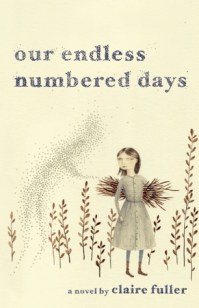
Book Review: our endless numbered days

our endless numbered daysour endless numbered days
by Claire Fuller
Contemporary Fiction
386 pages
Published 2015

I don’t like unreliable narrators. I didn’t realize, at first, that Peggy was one. Even though she mentions at the start of the book that a doctor said she had Korsakoff’s syndrome – meaning malnutrition has messed with her memories – I assumed that it was just because her experiences were so unbelievable that the doctor thought she’d made things up. I also don’t like unreliable narrators because the author obviously knows what truly happened. Leaving the reader in the dark about it seems rude.

Peggy’s narration does seem childlike, often. While at the beginning of the book, that can be excused because she is eight years old, by the end she is seventeen, yet still talking about things with a child’s understanding. I thought that was the effect of Korsakoff’s syndrome, not that she was entirely making some things up.

In our endless numbered days, Peggy is effectively kidnapped by her father when she is eight, and taken to some place deep in the German forest. She spends the next nine years alone in the forest with him, trapping squirrels, gathering roots and berries, and growing simple crops in a small vegetable patch. He tells her, repeatedly, making her repeat it back to him, that the rest of the world was destroyed in a massive storm. They are the last two people alive in their small, sheltered valley. She doesn’t question it until she sees a man in their forest, and that eventually leads her to find civilization again. The book is told in two timelines, flashing back and forth from her memories of her time in the forest, and the present where she’s attempting to re-acclimate to London.

I’m not really sure what to believe; Peggy’s memory or what her mother thinks happened. There are just enough oddities to make either story plausible. I think I prefer Peggy’s version. But that’s the trouble with unreliable narrators; there’s no way to actually know. I don’t like ending a book frustrated. Books should make you feel things, yes, but frustration is an odd emotion to aim for.

This book is odd.

From the cover of our endless numbered days:

Peggy Hillcoat is eight years old when her survivalist father, James, takes her from their home in London to a remote hut in the woods and tells her that the rest of the world has been destroyed. Deep in the wilderness, Peggy and James make a life for themselves. They repair the hut, bathe in water from the river, hunt and gather food in the summers, and almost starve in the harsh winters. They mark their days only by the sun and the seasons.

When Peggy finds a pair of boots in the forest and begins a search for their owner, she unwittingly unravels the series of events that brought her to the woods and, in doing so, discovers the strength she needs to go back to the home and mother she thought she’d lost.

After Peggy’s return to civilization, her mother begins to learn the truth of her escape, of what happened to James on the last night out in the woods, and of the secret that Peggy has carried with her ever since.


Library Loot Wednesday

I’ve only picked up 4 books this week, two of which I talked about in yesterday’s Fall TBR list.

Swastika Night – a dystopia where the Nazis won and women are relegated to breeding stock
Finding Yvonne – a young adult novel
Educated – Tara Westover’s memoir about being homeschooled
Call Me American – a Nigerian refugee’s memoir

I’m trying really hard to dedicate time to reading in the next couple of weeks, I currently have nineteen books checked out! Gotta whittle that pile down a bit!