 I only picked up one book this week, The Way You Make Me Feel. It looks like a cute YA romance centered on a summer spent working at a food truck.
Monthly Archives: May 2019
Book Review: The Complete Guide to Saving Seeds
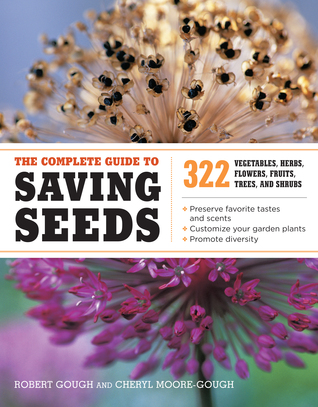 The Complete Guide to Saving Seeds: 322 Vegetables, Herbs, Flowers, Fruits, Trees, and Shrubs
by Robert Gough and Cheryl Moore-Gough
Gardening
310 pages
Published 2011
This is an amazing reference book. It begins with some general chapters on why you should save seeds, the anatomy of seeds, and some basic techniques for harvesting seeds, hand-pollinating, basic general principles of seed storage and the like. Then it dives into the real meat of the book, the chapters on the specific plants. They’re divided into the six broad categories listed in the subtitle: vegetables, herbs, flowers, fruits, trees, and shrubs. Within those chapters, each species is listed separately, with notes on the scientific name, the species family, the plant type (annual, biennial, perennial), seed viability, how many plants to save seed from, spacing for seed saving, and then a few paragraphs on flowering and pollination, any isolation requirements, and specifics on how to harvest, clean, and store the seeds for that species. It also has germination and transplanting notes for each species.
This would be an invaluable reference manual if you intend to save seeds from your plants and become self-sufficient, but it’s still useful if not, for its notes on the pollination of each species. The isolation requirements are especially interesting; there are some plants that will cross-pollinate with plants 10 miles away! The sidebar on pumpkins and squash was also fascinating – I didn’t know so many squash were technically the same species as pumpkins, just different cultivars. And that means they’ll cross-breed if you’re not careful! Even more fascinating, giant pumpkins aren’t the same species as jack o’lantern pumpkins, so they won’t cross breed.
I will absolutely be adding this book to my collection as a reference manual.
From the cover of The Complete Guide to Saving Seeds:
Improve the health and productivity of your garden season after season by saving seeds from your best plants. When you harvest seeds from your own garden, you will:
-Take another step toward food independence
-Save the money you’re spending on plants and seeds
-Enjoy a healthy garden filled with plants uniquely adapted to your own backyard
-Be able to swap seeds with other seed savers
-Preserve genetic diversity and regional favorites
-Ensure a safe and varied seed selection for future generations.
To begin saving seeds, choose healthy plants with desirable traits. Is pest resistance important to you? What about tomatoes that ripen early or spinach that’s slow to bolt? Do you have pink sweet peas whose color you want to replicate next year? Select for these traits and build your best garden ever. Plant-by-plant instructions guide you through all the seed-saving techniques specific to 322 plants.
Sunday Stuff
Today is my birthday! I’m now 37 years old, and I have a few friends coming over today to play board games and hang out. Yesterday my husband and I went to the airshow at Andrews Air Force Base, and had an absolute blast. It’s the first time in twelve years that the Thunderbirds and the Blue Angels have been at the same show, so it was really exciting. I used to go (or rather, get dragged to) airshows all the time when I was younger, but haven’t been to one in almost twenty years. I loved the Blue Angels when I was little, so it was really neat getting to see them again. My husband, despite being in the Marines for five years, had never been to an airshow, so it was neat both seeing him at an airshow for the first time, and getting to hear his stories about some of the aircraft we were seeing.
I took SO. MANY. PICTURES. I know I got some good ones. I’ll add some of the best to the end of this post.
After the airshow, we came home, and three of our friends came over to play a few board games, since they probably won’t make it tomorrow. (Mother’s Day and all.) Which means that at midnight on my birthday, I was laughing myself silly. Tears running down my face and everything. It was a great start to my birthday.
I’m a little sunburned from the airshow, despite putting sunscreen on and wearing long sleeves. It could be a lot worse, though. It was actually perfect weather for an airshow – semi-blue skies while the Thunderbirds (white planes) were flying, and overcast in time for the Blue Angels (dark blue planes) to fly against the light gray background. We managed to almost get to our car before the rain started, so all in all, great timing.
Photos!

A shot you don’t see very often. First show in twelve years to have both teams at the same time!

A C-5B Galaxy. The nose cone opens up as well as the gate in back, to allow loading and unloading of massive amounts of freight and vehicles. Like tanks. Husband flew out of Afghanistan in one of these and did a combat landing in Kyrgyzstan. Which is amazing given how MASSIVE these things are.

This was a rocket truck racing a small plane, with pyrotechnics. I wasn’t expecting the pyrotechnics, so this was a really lucky shot!

Thunderbirds against a spotty sky.

Blue Angels against a more overcast sky, three hours later. I thought I got better photos, but it appears some of them didn’t upload to Google Photos. I’ll have to look through my phone when I have some more time!

One of the other performance teams doing a cool scattering maneuver.
Book Review: Pride
 Pride
Pride
by Ibi Zoboi
Young Adult/Retelling/Romance
289 pages
Published September 2018
I have very mixed feelings about this one. I’ve read several retellings of Pride & Prejudice, but I think this is the first one that aged the characters down to teenagers. And I don’t think it works as well. In both The Lizzie Bennett Diaries and Unmarriageable, the main character and her older sister were in their twenties. They were still living at home, but they were graduating college, starting careers – a completely different stage of their lives from the characters in Pride. In Pride, Zuri is a senior in high school and Janae, her older sister, is home after her first year of college. Which makes their younger sister, Layla, thirteen. And if you know the plot of Pride & Prejudice, you know why that squicks me a little bit. (Zoboi did change that plot point slightly so it’s not quite as bad as it could be, but still. Ew.) This is a good example of what should be a New Adult story feeling forced into a Young Adult mold.
Age issues aside, I really liked the other changes made in this retelling; class differences are alive and well in the modern day, and I especially liked how it addressed neighborhood gentrification. Because yes, improving neighborhoods is a worthy goal; but when it raises rent without raising the income of the people living there, it forces people out who have lived in the neighborhood their entire lives. Gentrification is classist and, because our class system is racist, racist.
I enjoyed the Afro-Latino racial change; just like Unmarriageable‘s Pakistani setting, it brings a new cultural wrapping to the plot, and adds racial tension to the lessons on class that the story usually tells.
The book skims over a lot of the normal Pride & Prejudice plot, which I rather expected for a Young Adult book. Unmarriageable was much better in that regard, but Pride is still very enjoyable. It’s definitely a worthy addition to the Pride & Prejudice….pantheon? Shelf? Canon? I do think it would have been much better as a New Adult story, though. I’m still stuck on that.
From the cover of Pride:
Zuri Benitez has pride. Brooklyn pride, family pride, and pride in her Afro-Latino roots. But pride might not be enough to save her rapidly gentrifying neighborhood from becoming unrecognizable.
When the wealthy Darcy family moves in across the street, Zuri wants nothing to do with their two teenage sons, even as her older sister, Janae, starts to fall for the charming Ainsley. She especially can’t stand the judgmental and arrogant Darius. Yet as Zuri and Darius are forced to find common ground, their initial dislike shifts into an unexpected understanding.
But with four wild sisters pulling her in different directions, cute boy Warren vying for her attention, and college applications hovering on the horizon – Zuri fights to find her place in Bushwick’s changing landscape or lose it all.
In this timely update of Jane Austen’s Pride and Prejudice, critically acclaimed author Ibi Zoboi skillfully balances cultural identity, class, and gentrification against the heady magic of first love in her vibrant reimagining of this beloved classic.
Friday 56 – Pride
 The Friday 56 is hosted by Freda’s Voice. The rules are simple – turn to page 56 in your current read (or 56% in your e-reader) and post a few non-spoilery sentences.
This week’s quote is from Pride by Ibi Zoboi, a young adult Pride & Prejudice retelling.
“I saw you!” Madrina sings as she sits on her leather armchair and wipes down her unlit seven-day candles with a Florida-water-dampened white cloth. The whole basement smells like that sweet cologne. If the roof of my building is where Janae and I steal quiet moments, then the basement is where I dive deep into my own thoughts and dreams with Madrina and her claims of comunicando con los antepasados. To Madrina, and all her clients, the basement is home to Ochún, the orisha of love and all things beautiful. For them, this is a place of magic, love, and miracles.
These spirits and unseen things, as Madrina calls them, don’t make sense to me. Of course they don’t. I can’t see them. But it’s Madrina’s wisdom that unties the tight knots of my life, so I play along with what she does for a living and try to believe in these spirits.
Book Review: The Food Forest Handbook
 The Food Forest Handbook: Design and Manage a Home-Scale Perennial Polyculture Garden
by Darrell Frey & Michelle Czolba
Gardening
229 pages
Published 2017
Another book in my permaculture research, this in-depth guide is definitely going on my To-Buy list. (I always check these out from the library before spending money on personal copies.)
There is SO MUCH information in this book. Unlike some of the other books, there’s no big spreads of full-color, glossy photos (which can be useful, I’m not digging on those); The Food Forest Handbook is mostly text with a few black-and-white photos tucked in. There are spreadsheets and diagrams and lists, sidebars of useful information, how-to walkthroughs and case studies of specific plants. I’m not sure how they packed so much into a little over 200 pages, but this book is a treasure trove of permaculture strategies.
The book starts with a chapter on why permaculture is important; they explore past examples of permaculture, some present food forests, and why it could be useful to us going forward. The second chapter gets into designing a food forest to fit your needs – scoping out your site, determining what resources you have, all of the planning aspects. Then we have a short chapter on putting all that knowledge together and going “from concept sketch to detailed designs” – how to refine your research and plans into something you can work off of. Chapter 4 is about selecting the specific plants; going from “okay here I want a fruit tree and a nitrogen fixer” to “a peach and comfrey.” Plant varietals are discussed here, as well as the different needs of tree guilds.
The rest of the book gets into maintenance, harvesting, and propagating the food forest, and the last chapter is on a tour of established food forests in various climates, to see what’s possible.
This is definitely a book I want on my resource shelf; it can get a little dry at points, but there is so much knowledge here. One thing I really liked was the diagram of tree shapes – if one tree says it has a conical shape when full grown, and one has a pyramid shape, there’s a diagram that shows what exactly the difference is.
Overall an excellent, information-packed book, if a little difficult to read straight through.
From the cover of The Food Forest Handbook:
A Food Forest is a productive landscape developed around a mix of trees and perennials, helping increase biodiversity, protect valuable habitat for beneficial insects, and promote food security and resilience, all while providing an abundant annual harvest.
Rooted in permaculture principles, this integrated approach to gardening incorporates a variety of plants such as fruit and nut trees, shrubs, vines, and perennial herbs and vegetables. Authors Michelle Czolba and Darrell Frey bring years of experience building and maintaining food forests to provide this practical and accessible guide to creating your own food forest landscape, whether you’re urban, suburban, or rural.
 Goddess In The Stacks