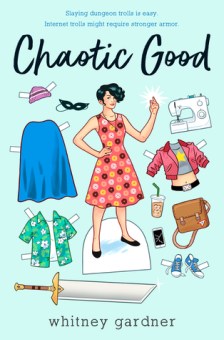
Book Review: Chaotic Good

Chaotic Good Comps14.inddChaotic Good
by Whitney Gardner
Young Adult / Contemporary Fiction
249 pages
Published 2018

Hoooooooo boy do I have some mixed feelings about this one!

First, the good:

The writing is great. The action flows, the dialogue is suitably nerdy, the affection between Cameron and her twin brother is evident. There are a few jumps from one scene to another, but I think they’re intended to be abrupt. The troll messages and online abuse Cameron gets simply for being a girl into cosplay are spot on. The descriptions of Eugene, Oregon – my hometown! – are also spot on. I am not sure which of the comics shops in Eugene inspired the one in the book, but I have definitely had Cameron’s experiences walking into more than one of the shops in town when I was younger. (I moved away over a decade ago.)

Really the only bad thing I have to say about this book is – Cameron dresses as a boy as an experiment, then finds she passes well enough to do it in a weekly D&D game – and when she’s eventually found out, it’s either “NO WAY” or “I knew it!” I would have liked one of the boys to shrug and say “I just thought he was trans” or something. SOME. MENTION. Of transgender or nonbinary as a possibility would have made this book so much better. I’m always slightly uncomfortable with a cross-dressing character and ABSOLUTELY NO MENTION of nonbinary gender identities.

Alright, no, there’s another bad point. The only other girl her age that Cameron has any contact with is Brina, dudebro-from-the-comic-shop’s crush, and Cameron honestly doesn’t treat her well. The first time they meet, Cameron is dressed as Boy Cameron, and doesn’t defend Brina when Brody pulls his dudebro shit. Which, okay, she was still getting used to being perceived as a dude, and instinct as a girl is to let that sort of thing slide off so as to not make it worse. I can give her a pass there. But near the end of the book, they run into each other again, as Girl Cameron this time, and when Brina extends a hand in friendship, Cameron brushes her off. Sure, she had a bad day, she’s stuck in her own head, but – GIRL. You’ve been dealing with toxic dudes on the internet the entire book, and dudebros you’re – trying to be friends with, for some reason, and you brush off a girl that loves your cosplay and wants to be friends? What the heck!

So – I don’t know. I honestly really enjoyed this book. The nerdy parts were glorious, even if their DM is a little railroad-y. The comic pages sprinkled into the text, showing the D&D adventure, was an inspired touch. But I just don’t like Cameron very much.

Her twin brother is gay, and there’s some drama with his ex, which is why I’ve tagged this GLBT. His storyline being treated just like a heterosexual storyline makes me wonder more why no mention is made of gender identities. IDK. It’s cute, but it’s problematic for what it omits.

From the cover of Chaotic Good:

Soon-to-be senior Cameron hopes to complete her costume portfolio away from the online abuse she has endured since winning a cosplay contest dressed as a character from a game she’s never played. Unfortunately, the only comic shop in her new town – her main destination for character reference – is staffed by a dudebro who challenges every girl who comes into the shop.

At her twin brother’s suggestion, Cameron borrows a set of his clothes and uses her costuming expertise to waltz into the shop as Boy Cameron, where she’s shocked at how easily she’s accepted into the nerd inner sanctum. Before she can say “Demogorgon,” Cameron finds herself drafted into a D&D campaign alongside the dudebro, a friendly (almost flirtatiously so) clerk, a handsome Dungeon Master, and her brother Cooper, dragged along for good measure.

But as her “secret identity” gets more and more entrenched, Cameron’s portfolio falls by the wayside – and her feelings for her DM threaten to make a complicated situation even more precarious. Cosplay, comic shops, and college applications collide in this geek-girl anthem from You’re Welcome, Universe author Whitney Gardner, complete with fully illustrated comic pages by Gardner herself.

Library Loot Wednesday

Three books this week; two YA and one nonfiction. Steel Tide is the sequel to Seafire, a sapphic pirate adventure, and Slay is about a young, black, female computer programmer. You Are Your Own is a book about being an ex-evangelical Christian and dealing with the fallout from that, which I am intimately familiar with.

TTT – Extraordinary Book Titles

Top Ten Tuesday is a weekly meme hosted by That Artsy Reader Girl. This week’s theme is books with extraordinary titles. I’m sure this is going to a hugely varied week; everyone’s definition of extraordinary is going to be different. For me, these are titles that made me sit up and take notice; They’re long, or strange sounding, or alliterative, or a little shocking.

First off, in the slightly shocking category, we have You Have The Right To Remain Fat and Headscarves and Hymens: Why The Middle East Needs a Sexual Revolution. Two nonfiction books about civil rights, sexual discrimination, and body positivity.

Next up are three young adult books: The Rules and Regulations for Mediating Myths & Magic, The Summer of Jordi Perez (and the Best Burger in Los Angeles) and The Astonishing Color of After. All three are excellent books.

The next three don’t fit neatly into a category; The Lady’s Guide to Celestial Mechanics is a sapphic Regency romance, And The Ocean Was Our Sky is 1/3 picture book, 2/3 text from the viewpoint of whales, and How Long ‘Til Black Future Month? is a fantastic short story collection from N. K. Jemisin.

The last two are from my TBR – The Order of the Pure Moon Reflected in Water comes out in 2020, and European Travel for the Monstrous Gentlewoman is the sequel to The Strange Case of the Alchemist’s Daughter. I want to read that entire series!

I can’t wait to see what everyone else picks this week; a good title can land a book on my radar faster than just about anything else.

Duology Review: The Girl From The Well / The Suffering

girl from the wellThe Girl From The Well
The Suffering
by Rin Chupeco
Young Adult / Horror
255 pages / 313 pages
Published 2014 / 2015

This duology claimed a spot in my Spooky October Reads because I ADORE this author’s later work, The Bone Witch trilogy. I’d heard great things about this set, and I’m so glad I finally read it. I don’t care for much horror, generally, and this was just the right amount of iffy morality and spooky ghost stuff.

The books are told from the viewpoint of Okiku, a 300-year-old ghost who drowned in a well but came back to take vengeance on her killer before continuing to hunt down killers of children. The other main characters are Tarquin, a half-Japanese boy with strange, unnerving tattoos, and his older cousin Callie. The mystery of who Tarquin’s mother really is, what happened when he was a toddler, and why she’s tried to kill him every time she’s seen him since, is at the heart of the first book. The pacing and reveals are expertly done, so I won’t say much more about the plot.

the sufferingOkiku is appropriately terrifying, and her backstory is equally tragic. We learn much more about what happened to her in the second half of the first book, and it’s fleshed out even further in the second book. The second book is largely Okiku and Tark having an adventure in Japan, and less about their individual histories. I think it was a great sequel, though, and definitely needed to finish Okiku and Tark’s story. It takes place almost entirely in Aokigahara, Japan’s “suicide forest.” The Suffering is also told from Tark’s point of view instead of Okiku’s, and definitely suffers for that.
Overall, the first book is better than the second, but the second is still good, and finishes the story. Terrifying ghosts, creepy dolls, ancient rituals, and secret societies abound in these two books, and they’re the perfect amount of spooky for a scaredy-cat like me. These definitely cement Rin Chupeco as a must-read author for me. She’s fantastic.

From the cover of The Girl From The Well:

The dead do not always rest . . . 

Okiku knows anger and pain. They are what she last felt before her life was brutally taken from her more than 300 years ago. Now a restless spirit, she wanders, seeking out those who viciously take the lives of children. Okiku always gets her vengeance. She has no remorse for the wicked.

Until she meets seventeen-year-old Tark . . . 

From the cover of The Suffering:

The darkness will find you.

Seventeen-year-old Tark knows what it is to be powerless. But Okiku changed that. A restless spirit who ended life as a victim and started death as an avenger, she’s groomed Tark to destroy the wicked. But when darkness pulls them deep into Aokigahara, known as Japan’s suicide forest, Okiku’s justice becomes blurred, and Tark is the one who will pay the price . . . 

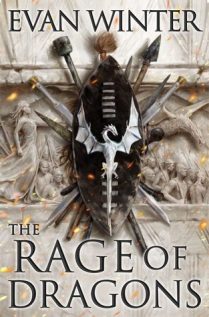
Book Review: The Rage of Dragons

rage of dragonsThe Rage of Dragons
by Evan Winter
Fantasy
535 pages
Published July 2019

You know how so many fantasy books have reluctant hero protagonists? This is not that. Well. The first couple of chapters are. But then Tau decides he’s going to be the BADDEST MOTHERFUCKER IN THIS LAND. Tau is, hands down, one of the most hard-core protagonists I’ve read in a very long time.

Content Warning: Brutal book. I’ll be talking about some of the imagery.

The Rage of Dragons is about determination, combat, and the will to live. I’ve always been wary of books based on “endless war” but this was actually very well thought out, and it makes sense. The Omehi were a people exiled from their homeland; they sailed across the sea to find a new land, and became colonizers. They are thoroughly outnumbered by the native Hedeni, but they have magic. They settle on a peninsula but are unable to push further into the mainland, even with their magic and dragons. The jacket copy says “a hundred thousand years” but the text picks up 186 cycles after the prologue (which covers the initial landing) and I assumed cycles meant years. Jacket copy often exaggerates things, so I’m going with 186 years, not a hundred thousand. It seems more likely.

So in two hundred years, neither side has managed to score a decisive victory over the other; the Omehi have held the territory they carved out for their people, built cities, and farmed land. The Hedeni continue to raid the edges, occasionally pushing further in and wreaking havoc.

The Omehi also have a rigid caste system; the only hint of upward mobility is the Gifted, who come from all castes, and the military, which glosses over some caste restrictions but not all. Tau is a Common who is tired of being shat on by the Nobles, and he sees the military as his ticket to getting vengeance. (Military members can challenge each other to blood duels without repercussions for defeating those of higher castes.)

An interesting point I’d like to make is though several people died to further the main character’s plot, which is usually known as fridging – they weren’t -killed-, exactly. They all had agency. They all took actions they knew could or would end in their deaths, and they did them anyway. So while it is death to motivate the main character, it did not rob them of agency in doing so, so I’m not sure it technically counts as fridging. Even if it does, it was masterfully done and I don’t actually mind it in this context.

There is A LOT of combat and gruesome death in this book. This is a BRUTAL society. People get hurt and even killed in training – hell, they get killed in the TRYOUTS for the military. In one of the first few chapters there is an off-page rape, then victim-blaming and revenge-killing. It’s also rape of a lower-caste by a higher-caste, so there is some brush off there of “oh it’s just a servant” variety. The book does NOT pull punches.

But it’s a truly great book. More than once I stared at the page and said, ALOUD, “Holy SHIT, Tau!” It was easy to see why something snapped in Tau’s soul, and I’m eager to see his character development in book two.

Brutal, vivid, hardcore book that grabs you by the throat and doesn’t let go until the last page.

From the cover of The Rage of Dragons:

The Omehi people have been fighting an unwinnable fight for a hundred thousand years. Their society has been built around war and only war. The lucky ones are born gifted. One in every two thousand women has the power to call down dragons. One in every hundred men is able to magically transform himself into a bigger, stronger, faster killing machine.

Everyone else is fodder, destined to fight and die in the endless war.

Young, gift-less Tau knows all of this, but he has a plan of escape. He’s going to get himself injured, get out early, and settle down tot he simple life: marriage, children, land.

Until those closest to him are brutally murdered, and his grief swiftly turns to anger. Fueled by thoughts of revenge, Tau dedicates himself to an unthinkable path: He’ll become the greatest swordsman to ever live. A man willing to die a hundred thousand times for the chance to kill the three who betrayed him.

Friday 56 – The Rage of Dragons

rage of dragonsThe Friday 56 is hosted by Freda’s Voice. The rules are simple – turn to page 56 in your current read (or 56% in your e-reader) and post a few non-spoilery sentences.

This week’s quote is from The Rage of Dragons, an African-inspired fantasy by Evan Winter.

It was one of the Gifted. Not the one who had skimmed Tau with her enervating blast and not the one directing the dragon. This Gifted had stood quiet and still, surrounded by soldiers, and far from combat. She was convulsing and coughing up blood, her skin bubbling and bursting. It looked like she was being torn to pieces from the inside out. It looked like what had happened to the hedena Jabari had captured and questioned.

A soldier took hold of her and, with tenderness, helped her to the ground. The other soldiers tightened the circle around her, blocking Tau’s view. he could still hear, though. He could hear her dying, and he started toward them, thinking to help, when a hand fell on his shoulder.