Book Review: Whispers Underground

whispersWhispers Underground
by Ben Aaronovitch
303 pages
Published 2012
Urban Fantasy

I picked up Whispers Underground mainly because of one paragraph on the back: “…the FBI has sent over a crack agent to help. She’s young, ambitious, beautiful . . . and a born-again Christian apt to view any magic as the work of the devil. Oh yeah – that’s going to go well.” expecting, well, just what that implied. Yay, a fiery woman who keeps contradicting the main character about things she doesn’t understand! Philosophical discussions! Sparks! ….I did not get any of that. Reynolds was not the main character’s temporary partner, as was implied. She had a bit part in the book. Her religion wasn’t even MENTIONED until very very near the end, and it was just an offhand “she went to go have Christmas dinner with her evangelical family” or something like that. She never dug her heels in and contradicted him. She accepted the idea of supernaturals pretty easily, honestly, and just said she couldn’t put it in her FBI report because she didn’t want a psych eval. WHERE IS MY CONFLICT?

I also did not realize at first that this wasn’t a one-off book or the first in the series – the only indication of that is that it mentions on the front cover that the author was also the author of Midnight Riot and Moon Over Soho. (And on the inside front cover, it turns out.) But there’s nothing about “a Rivers of London story” (incidentally, I had to get the name of the series from the Amazon page, it’s certainly not on the book anywhere!) or “Don’t miss the other books in the series” or anything like that. Realizing it’s the third book answered some of my other questions, like Why doesn’t the author say Toby is a freaking DOG until like the fifth time his name is mentioned? I spent most of the book wondering if Molly is a ghost or what the hell she is, and that was never explained. Peter’s actual partner had some accident happen to her face, and that’s mentioned briefly – that there was an accident – but it’s never explained. There’s very little magic in the books, all the non-humans look surprisingly human, and the “gruesome murder” described on the back of the cover is a pretty run-of-the-mill stabbing. Overall, disappointing.

The book attempts to be urban fantasy in the style of Dresden, but fails miserably, in my opinion. For only being 300 pages it DRAAAAAGGED on. Final verdict – don’t waste your time, not interested in the other books.

From the back of Whispers Underground:

It begins with a dead body at the far end of Baker Street tube station, all that remains of American exchange student James Gallagher – and the victim’s wealthy, politically powerful family is understandably eager to get to the bottom of the gruesome murder. The trouble is, the bottom – if it exists at all – is deeper and more unnatural than anyone suspects . . . except, that is, for London constable and sorcerer’s apprentice Peter Grant. With Inspector Nightingale, the last registered wizard in England, tied up in the hunt for the rogue magician known as “the Faceless Man,” it’s up to Peter to plumb the haunted depths of the oldest, largest, and – as of now – deadliest subway system in the world.

At least he won’t be alone. No, the FBI has sent over a crack agent to help. She’s young, ambitious, beautiful . . . and a born-again Christian apt to view any magic as the work of the devil. Oh yeah – that’s going to go well. 

Book Review: Revenge Wears Prada: The Devil Returns

pradaRevenge Wears Prada: The Devil Returns
by Lauren Weisberger
433 pages
Published 2013
Modern Fiction

I probably should have read The Devil Wears Prada first – I haven’t even seen the movie! I do know the basic premise, though, and reading this book does make me want to see the movie sometime soon. Perhaps I’ll check Netflix for it. (Though I just went to the library and brought home a new load of books, so perhaps not!)

It was an okay story, I suppose. Not my usual fare, though. Andy Sachs, the unfortunate assistant whose story was told in The Devil Wears Prada, returns, a decade after the events of the first book. She’s started a wedding magazine with her best friend, and it’s become wildly successful. Then Elias-Clark, the publishing company headed by Miranda Priestly (the “Devil” from the title), makes an offer to buy the magazine and it goes downhill from there.

I really was not thrilled by this book. Miranda only makes a few appearances, and while her influence is felt through the entire book, it’s more Andy’s fear of her that permeates the book rather than Miranda’s own driven personality. I wanted to see more of the Devil herself!

Reading other reviews on Amazon, I’m not alone, and apparently the first book was FAR better. Which is good to know, I suppose, but I still probably won’t bother to read it. I might watch the movie – I remember the previews were hysterical – but I won’t waste the time on the book. That’s also my recommendation for this sequel. Don’t waste your time.

From the back of Revenge Wears Prada:

Almost a decade has passed since Andy Sachs quit the job “a million girls would die for” working for Miranda Priestly at Runway magazine—a dream that turned out to be a nightmare. Andy and Emily, her former nemesis and co-assistant, have since joined forces to start a highend bridal magazine. The Plunge has quickly become required reading for the young and stylish. Now they get to call all the shots: Andy writes and travels to her heart’s content; Emily plans parties and secures advertising like a seasoned pro. Even better, Andy has met the love of her life. Max Harrison, scion of a storied media family, is confident, successful, and drop-dead gorgeous. Their wedding will be splashed across all the society pages as their friends and family gather to toast the glowing couple. Andy Sachs is on top of the world. But karma’s a bitch. The morning of her wedding, Andy can’t shake the past. And when she discovers a secret letter with crushing implications, her wedding-day jitters turn to cold dread. Andy realizes that nothing—not her husband, nor her beloved career—is as it seems. She never suspected that her efforts to build a bright new life would lead her back to the darkness she barely escaped ten years ago—and directly into the path of the devil herself…

Book Review: The Odyssey

odysseySo with John Green starting his second run of Crash Course Literature, I realized there are a few classics I’d never read. The Odyssey by Homer being one of them. I snagged Robert Fitzgerald’s translation from the library and became enthralled. I wasn’t expecting it to be so easy to read! For being a 462 page poem, it flowed incredibly well and kept my attention the entire way through.

The Odyssey is the story of Odysseus, the king of Ithaca, who went away to fight in the wars in Troy caused by the abduction of Helen. This story takes place after the war is over, when everyone – or almost everyone – has gone home. Odysseus, through a series of mistakes and misfortunes, has been marooned on an isle for many years, and his family has begun to think he’s dead. Sons of most of the nobles in Ithaca have taken residence in Odysseus’ palace, courting his queen while eating his food and drinking his wine. His queen still waits for him, and puts off her suitors in a variety of ways. (The most famous of which being her claim that she must finish a weaving before taking a suitor, and while she weaves every day, she unweaves her work at night, but the suitors figure that one out and make her finish it.)

One thing kept bugging me through the entire story, though – while much is made of Odysseus being gone, and his trials, and the people waiting for him at home – the fact that his ENTIRE CREW OF SHIPMATES, heroes all, dies on the journey is somewhat glossed over. Maybe it’s my history as a military spouse, but what about THEIR families? There are surely women and children waiting in Ithaca for them as well, but nary a mention is made of them. Only the King’s story is important enough to talk about. In a 400 page book, is a paragraph about the other families too much to ask? I suppose, given how long ago the book was written, the fact that Homer writes sympathetically (albeit briefly) about a woman’s suffering for her husband might have been revolutionary on its own, and asking for some concern for anyone lower than a Prince would be unheard of.

That aside, it’s an amazing story. Here’s John Green’s take on it:

Book Review: Meet Me at the Cupcake Cafe

cupcakeMeet Me at the Cupcake Cafe
by Jenny Colgan
410 pages
Published 2011 (UK) (2013 in the US)
General Fiction

This was a sweet book about a woman chasing her dreams. Issy gets let go from her real estate firm and decides to open a cupcake bakery, following in her grandfather’s footsteps. (He owned and operated three bread bakeries in his prime.) The book follows Issy’s troubles with opening the cafe, her romantic misadventures, and the slow decline of her beloved grandfather to dementia. Interspersed with the chapters are actual recipes, most in the form of letters written to Issy from her grandfather. And these recipes look DELICIOUS. I’m going to be writing a few of them down before I take this book back to the library!

The characters in the book are endearing, from Issy, to her acerbic flatmate Helena, to her employee Pearl and Pearl’s adorable son, Louis. Really, the only unlikable character in the book is Issy’s on-again, off-again douche of an ex, but he’s meant to be the villain of the story. Even Pearl’s erratic boyfriend is at least a nice sort. Set in London, there’s a kind of timeless quality to the story, so when Issy mentioned Facebook I was a little taken aback – I had not even realized it was set in modern times! I was thinking 1970s or so.

The book has a sequel, but unfortunately the reviews are all quite bad for it. People who loved this book say the second did not hold true to the characters, so I probably will not read it. There was another book mentioned in the back of this one, The Loveliest Chocolate Shop in Paris, that I may look into.

I love baking, so reading a book that centered on baking cakes, with recipes, was a lot of fun. From the sweet pink cover to the simple joy Issy takes in feeding sweets to people, I really loved this book.

From Meet Me at the Cupcake Cafe:

Issy Randall can bake. No, Issy can create stunning, mouthwateringly divine cakes. After a childhood spent in her beloved Grampa Joe’s bakery, she has undoubtedly inherited his talent. She’s much better at baking than she is at filing, so when she’s laid off from her desk job, Issy decides to open her own little cafe. But she soon learns that her piece-of-cake plan will take all her courage and confectionary talent to avert disaster.

Book Review: Medea

medeaMedea
by Kerry Greenwood
428 pages
Published 2011 (First US publishing in 2013)
Historical Fiction

Medea is the first of three “Delphic Women” novels to be published in the US by Australian author Kerry Greenwood. It tells the story of Medea from the legend of Jason and the Argonauts. The version that everyone knows involves Medea, as a witch, helping Jason to steal the Golden Fleece in return for marrying her. The story goes that some years later, when he attempts to put her aside, she not only kills his potential bride, but also the children that she’d borne him.

Medea tells a different story. She is a priestess of Hekate, the Black Mother goddess. The story details her fall from that religion, her marriage to Jason, the death of their children, and her life after her marriage. It is an utterly enthralling book, and I am eager to see Greenwood’s other Delphic Women novels, which appear to be about Cassandra and Electra. Greenwood has a talent for keeping the feel of ancient Greek mythology while also making the characters accessible for the modern reader. She includes a chapter after the end of the story, in which she explains why and how she came to the conclusion that Medea was NOT responsible for the death of her children, despite every other popular story saying she killed them.

While Medea has often been painted as the villain of the story, Greenwood had me cheering for her the entire book, from the first time she was brought to the dark caves of Hekate as a toddler to when she mourned over the deaths of her children and slowly learned to love again. I enjoyed seeing one of the ancient legends from a woman’s point of view; none of them are ever told that way! I also found it really interesting how the book portrayed Herakles; he turned out to be one of my favorite characters!

I’d definitely recommend this book if you like retellings of mythology or ancient legends.

Edit: 2 years after publishing this review, I’m updating links and discover Kerry Greenwood is also the author of the Phryne Fisher murder mystery series, which Miss Fisher’s Murder Mysteries is based on! I just finished marathoning that entire series on Netflix, it’s fantastic! What a crazy coincidence.

From Medea:

My mother gave birth to me in the darkness under the earth and died in doing so. I loved the velvety blanket of night before my dazzled eyes ever encountered light. And when I did, they say I wept, and the people said, “Here is a true daughter of Hekate!”

I am standing in the dark again, in the central room of my own place – no, of Hekate’s temple, which was once mine, before I went with Jason. Jason the thief, the pirate, the betrayer. Jason the stranger. I have left my own gods, my own tongue, my own beliefs, for too long….

The knife blade gleams, and I try the blade. I feel the sting as it slides along my thumb. It is very sharp. I can hear the children laughing as they play.

How did I come to this?

Book Review: The Iron Druid Chronicles

houndedHounded, Hexed, and Hammered
by Kevin Hearne
Published 2011
~300 pages each
Urban Fantasy

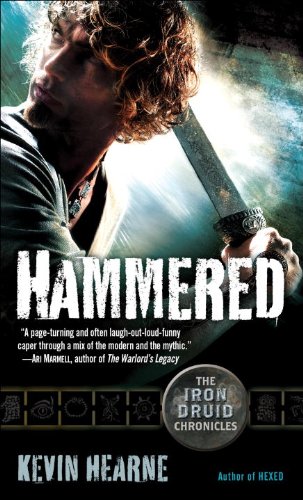
So when my husband first saw these at the library, he laughed and handed one to me, saying they “looked like trash” but “might be fun anyway.” Having read them, yes, they’re light reads, but SO MUCH FUN. They’re very reminiscient of Jim Butcher’s Dresden Files; Atticus is a total BAD ASS, is the last Druid, and is a total lady’s man to boot. (I mean, look at those covers, he’s a cute-as-hell Irish dude.)

Atticus may be a special snowflake (he’s 21 centuries old, and the last living Druid, so the Tuatha de Danann take an inordinate interest in his life) but he’s hilarious. It’s especially interesting to see how his morals (he freely admits they’re based in an Iron Age mentality) conflict with the morals of modern humanity, and with the morals of his gods.

Atticus has collected a crazy menagerie of friends and allies – his lawyers, a vampire and a werewolf, come from a firm run by werewolves. His vampire lawyer has a group of ghouls on speed-dial for easy disposal of bodies. Being a druid, he’s befriended a couple of elementals that help protect his house and himself. His wolfhound is unusually intelligent, with a wicked sense of humor, due to Atticus’ meddling.

These are only the first three in the series; the library had 1, 2, 3, and 5 on their shelves, but I’m waiting to read #5 until I get my hands on #4. (I’ve got a hold request on it.) #6 is on order at the library, and #7 is due out this summer. If you liked The Dresden Files, you’ll probably like these. (Also, if you like reading about sexy Irish dudes kicking ass.)

hexedThere was one scene that bothered me. I can’t remember whether it was in Hexed or Hammered (they blend together a bit) but at one point Atticus and the Morrigan raise some sex magic to repair Atticus’ missing ear. (He got a bit banged up in an earlier fight.) And the sex scene, while not explicit (god knows I don’t have a problem with explicit sex scenes!) was a bit…rapey. As in, the Morrigan quite literally magicked him into it, and by his own admission he felt pressured (how do you say no to your own goddess?) and it was NOT pleasurable in the least. So….yeah. He’s grateful to her for fixing his ear, but the entire scene made me really uncomfortable. It did make me think about gods having sex with mortals, though – there are many, many stories about Zeus taking any woman he pleased, whether she was willing or no. Even if one is “willing” – if a god asks you to have sex, how exactly can one say no? I guess it made me think about how there are laws against teachers and other authority figures taking advantage of those they have authority over. If a teacher-student relationship is rape, no matter how consensual, then how can a god-mortal relationship be anything else?

A review I read of the books mentioned they’re very sexist – in the reviewer’s opinion, all the female characters fall in to one of three roles – harmless sex object, laughably dangerous sex object, and unhinged psychotic actually dangerous sex object. While I can see where they were coming from, the books are told from Atticus’ point of view, and he is, self-admittedly, a ladies’ man and operating on Iron Age morality. So where does a book cross from portraying a sexist character to actually -being- sexist? I’m not sure. At about book three, Atticus does get a strong female apprentice. And while he is attracted to her, she’s definitely portrayed as having a mind of her own. (The reviewer also ignored the Widow who Atticus has a close friendship with – she’s not a sex object in the least.)

There are definitely problematic bits in these books, but if you’re willing to look past those, they are a rip-roaring good time. Just – enjoy with caution.

From Hounded:

Atticus O’Sullivan, last of the Druids, lives peacefully in Arizona, running an occult bookshop and shape-shifting in his spare time to hunt with his Irish wolfhound. His neighbors and customers think that this handsome, tattooed Irish dude is about twenty-one years old—when in actuality, he’s twenty-one centuries old. Not to mention: He draws his power from the earth, possesses a sharp wit, and wields an even sharper magical sword known as Fragarach, the Answerer.

Unfortunately, a very angry Celtic god wants that sword, and he’s hounded Atticus for centuries. Now the determined deity has tracked him down, and Atticus will need all his power—plus the help of a seductive goddess of death, his vampire and werewolf team of attorneys, a sexy bartender possessed by a Hindu witch, and some good old-fashioned luck of the Irish—to kick some Celtic arse and deliver himself from evil.

hammeredFrom Hexed:

Atticus O’Sullivan, last of the Druids, doesn’t care much for witches. Still, he’s about to make nice with the local coven by signing a mutually beneficial nonaggression treaty—when suddenly the witch population in modern-day Tempe, Arizona, quadruples overnight. And the new girls are not just bad, they’re badasses with a dark history on the German side of World War II.

With a fallen angel feasting on local high school students, a horde of Bacchants blowing in from Vegas with their special brand of deadly decadence, and a dangerously sexy Celtic goddess of fire vying for his attention, Atticus is having trouble scheduling the witch hunt. But aided by his magical sword, his neighbor’s rocket-propelled grenade launcher, and his vampire attorney, Atticus is ready to sweep the town and show the witchy women they picked the wrong Druid to hex.

From Hammered:

Thor, the Norse god of thunder, is worse than a blowhard and a bully—he’s ruined countless lives and killed scores of innocents. After centuries, Viking vampire Leif Helgarson is ready to get his vengeance, and he’s asked his friend Atticus O’Sullivan, the last of the Druids, to help take down this Norse nightmare.

One survival strategy has worked for Atticus for more than two thousand years: stay away from the guy with the lightning bolts. But things are heating up in Atticus’s home base of Tempe, Arizona. There’s a vampire turf war brewing, and Russian demon hunters who call themselves the Hammers of God are running rampant. Despite multiple warnings and portents of dire consequences, Atticus and Leif journey to the Norse plain of Asgard, where they team up with a werewolf, a sorcerer, and an army of frost giants for an epic showdown against vicious Valkyries, angry gods, and the hammer-wielding Thunder Thug himself.