Literary Landmarks: F. Scott Fitzgerald’s grave

FSF1It’s early November, the wind is blowing piles of leaves across the ground, and it’s cool and clear – which makes it perfect graveyard weather. Maybe I’m weird, but I enjoy wandering around graveyards, particularly very old graveyards. In my hometown we had the Pioneer Cemetery and the Masonic Cemetery, both very old cemeteries. Wandering among the peaceful trees, reading dates, and wondering what their lives were like was a very enjoyable pastime. Finding someone who lived into their 90s in the early 20s? Fascinating. Someone who died at 19, and then realizing the death date means he probably died in World War I – it’s things like that.

Now that I live on the east coast, there are even older cemeteries to investigate, and famous gravesites to visit. Especially living in the Baltimore/DC area. St. Mary’s Catholic Church, which holds F. Scott Fitzgerald‘s grave, is fifteen minutes from my house. FSF6So with nothing else to do today, the husband and I decided to go visit. The graveyard’s a little odd, in that Rockville Pike runs right beside it. So there’s a small patch of green, with huge oak trees and drifts of leaves, and on the other side of a small fence is a busy road and office buildings. The graveyard itself is beautiful, though.

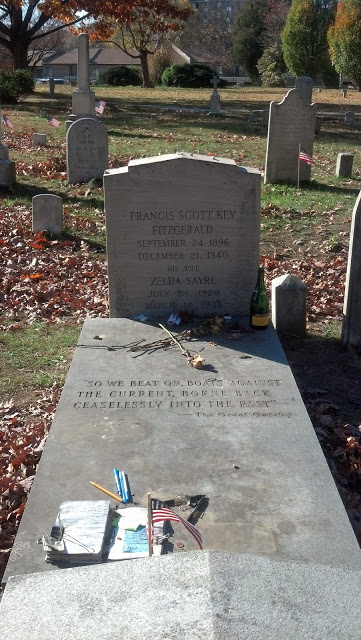
FSF3On the grave itself we found a few offerings; someone had left “Literary Miscellany” clipped open to the page about Fitzgerald’s grave. The gravestone has the last line of The Great Gatsby, Fitzgerald’s most famous work, inscribed on it. “So we beat on boats against the current, borne back ceaselessly into the past.” There were pens and pencils left beside the book, as well as dried roses and a wine bottle left near the headstone. I’m always curious about the stories behind the offerings – I suppose it’s pretty apt that a famous author’s grave inspires curiosity about more stories.
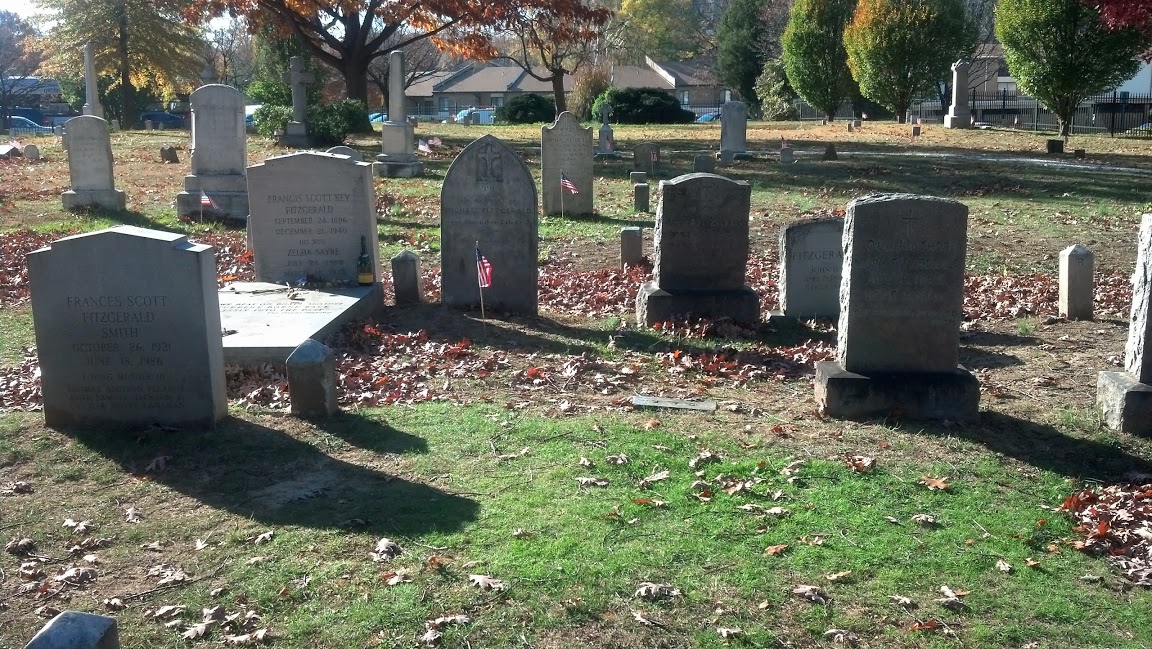
FSF2Fitzgerald is buried in a family plot; his wife, Zelda, is next to him, with children and other relatives close by. She was also an author, penning a semi-autobiographical novel called “Save me the Waltz,” published in 1932. Their marriage was not a happy one; at the time of F. Scott Fitzgerald’s death he hadn’t seen her in over a year, because she was in a mental hospital. F. Scott Fitzgerald actually died in Hollywood and Zelda in North Carolina; he was originally buried in Rockville Union Cemetery due to the Archdiocese of Baltimore ruling him a non-practicing Catholic. They were relocated to St Mary’s and the family plot in 1975, after the family lobbied to have them posthumously “re-Catholicized.” It seems weird to me that you can be baptized or accepted into a religion after you’re dead, but I suppose the dead person isn’t going to care.

FSF5

I really enjoyed visiting Fitzgerald’s grave, and I intend to make “Literary Landmarks” a series here on Goddess In The Stacks. They won’t all be graves; there are a plethora of local sites with literary meaning, from The Library of Congress and The National Archives to the Poe House in Baltimore to Uncle Tom’s Cabin. I’m trying to find more local literary landmarks; I have photos from Edgar Allan Poe’s grave in Baltimore, and we’ve been on a tour of the Poe House in Baltimore, but I don’t have photos of that. It’s currently closed, set to re-open soon, so we’ll have to make a trip up there again once it re-opens! I’m still trying to find more local Literary Landmarks, so if you know of one in the larger DC metro area, please let me know!

Book Review: Beka Cooper Trilogy (Tortall Legends)

terrierTerrier: The Legend of Beka Cooper #1
by Tamora Pierce
592 pages
Published 2007
Fantasy

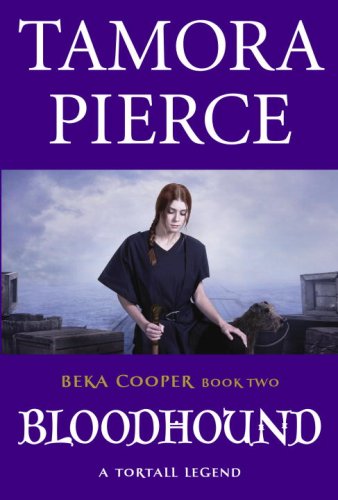
Bloodhound: The Legend of Beka Cooper #2
by Tamora Pierce
560 pages
Published 2009
Fantasy

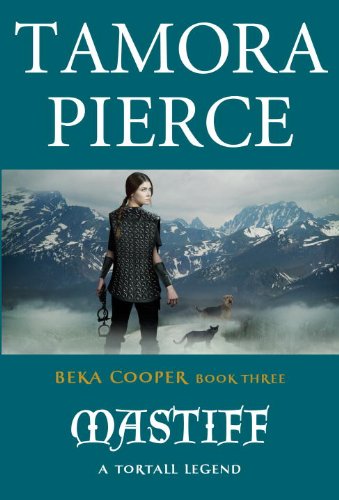
Mastiff: The Legend of Beka Cooper #3
by Tamora Pierce
608 pages
Published 2011
Fantasy

My husband has been saying for some time that I should read Tamora Pierce’s Tortall books, specifically the Alanna saga. While I haven’t gotten my hands on that yet, he did find this trilogy on a recent trip to the library and set them onto the library desk next to my stack with an expectant look. After reading them, I see why! These are GOOD. The world is well thought out and interesting, and the characters are lively. I will be looking into the other trilogies and sagas set into this world to see how characters and principles from these books wind their way through the other stories.

bloodhoundA little bit about the world and series as a whole, first. I believe the first series written about Tortall is Alanna’s story. The Song of the Lioness, as it’s called, is a set of four books. Alanna, basically, is a woman who decided to be a knight in a world where that simply isn’t done. So she disguises herself as a man in order to do it. The Beka Cooper trilogy, however, takes place about two hundred years prior to Alanna – in this time period, women are allowed to be knights and Guardswomen and any number of rough things. (In the third Beka Cooper book they talk more about the “Gentle Mother” religion that is starting to take hold, that says women are supposed to be gentle, sheltered things – I’m assuming by the time of Alanna that idea has taken root and spread much further.) Beka herself is a Guardswoman – or Dog, as they’re called. The Dogs of Tortall are guardsmen and women throughout the kingdom, usually based in cities. They call criminals “Rats”, men “coves”, and women “mots”. Having a unique vocabulary really serves to set the world apart. It’s not so many words that it’s hard to understand, but just enough that the first time or two they’re used you notice it.

In Terrier, Beka is serving as a “Puppy,” or Guardwoman-in-training. They spend their first year attached to a pair of senior Dogs, learning the ropes. By the end of the first book, Beka’s earned the nickname of “Terrier” for her refusal to let Rats go. She has some unique abilities to help her in her job – she can talk to ghosts and dust-spinners, learning things they’ve overheard to help her find guilty Rats. In Terrier she’s on the trail of the Shadow Snake, a Rat who’s stealing peoples’ children and killing them if they don’t ransom them back. Until the murdered children talk to Beka, most of the Dogs of the Lower City don’t think the disappearances are related to each other.

mastiffIn Bloodhound, Beka is a full-fledged Dog, and is sent to another city to track down a counterfeiter. A few years later, in Mastiff, she’s set on the trail of a kidnapped Prince and a far-reaching plot to cause the fall of the King. Throughout all three books she’s accompanied by Pounce, a black cat with purple, god-touched eyes. Pounce is no ordinary cat, but neither is Beka an ordinary Guardswoman! The books are written as Beka’s journals, read two hundred years later, to George Cooper, a descendant of hers who has a major role in Alanna’s saga.

The Epilogue of Mastiff has me itching to find and read the Song of the Lioness! The Song of the Lioness is not the only other set of books set in this world, either. The Immortals series follows the path of a Wild Mage in Tortall, while The Protector of the Small quartet follows the path of the first sanctioned lady knight after Alanna. The Trickster duology is the story of Alanna’s daughter. There’s also a book of short stories set in Tortall and other Lands, so I certainly have a lot of books to add to my to-read list!

From the back of Terrier:

Beka Cooper is a rookie with the law-enforcing Provost’s Guard, and she’s been assigned to the Lower City. It’s a tough beat that’s about to get tougher, as Beka’s limited ability to communicate with the dead clues her in to an underworld conspiracy. Someone close to Beka is using dark magic to profit from the Lower City’s criminal enterprises–and the result is a crime wave the likes of which the Provost’s Guard has never seen before.

From the back of Bloodhound:

Beka Cooper is finally a Dog—a full-fledged member of the Provost’s Guard, dedicated to keeping peace in Corus’s streets. But there’s unrest in Tortall’s capital. Counterfeit coins are turning up in shops all over the city, and merchants are raising prices to cover their losses. The Dogs discover that gamblers are bringing the counterfeit money from Port Caynn. In Port Caynn, Beka delves deep into the gambling world, where she meets a charming banking clerk named Dale Rowan. Beka thinks she may be falling for Rowan, but she won’t let anything—or anyone—jeopardize her mission. As she heads north to an abandoned silver mine, it won’t be enough for Beka be her usual “terrier” self. She’ll have to learn from Achoo to sniff out the criminals—to be a Bloodhound….

From the back of Mastiff:

This is the third book in the Beka Cooper trilogy, and Beka is a full-fledged Dog now, but it hasn’t made her job with the law-enforcing Provost’s Guard any easier. On this hunt, she’ll need all her resources, from her bare-knuckled fighting skills to her suspiciously intelligent cat, Pounce. 

Book Review: The Ruins of Lace

ruinsoflaceThe Ruins of Lace
by Iris Anthony
326 pages
Published 2012
Historical Fiction

The Ruins of Lace is told from 7 different points of view, and while at first they appear disconnected, they slowly touch each other, then weave in and out, like lace itself. The story revolves around the creation, sale, and smuggling of banned lace in 17th century France. The points of view are a lacemaker, her sister, a girl who once ruined a pair of lace cuffs, the man who loves her, a lace-smuggling dog, a border guard, and a petty noble fighting for his inheritance.

As much as I’ve read about 17th century France, the clandestine lace trade was one aspect I really didn’t know about, so it was interesting to see how it impacted common folk and nobles alike.

While not as spell-binding as some books I’ve read, The Ruins of Lace was definitely thought-provoking. What drives an otherwise good man to smuggle lace and risk his honor/title/fortune/life? Without the viewpoints of the lacemaker and the smuggler’s dog, you could imagine lace-smuggling to be a victimless crime. Including the viewpoints of those two was brilliant – you can’t say the man who needs the lace isn’t hurting anyone. If there wasn’t such demand for the banned lace, girls wouldn’t sit in convents and go blind making it 24/7.

All in all, a very good book on a little-known aspect of 17th-century France. The differing points of view are a little confusing at first, but once you settle in and know the characters, it’s fairly easy to follow the storyline.

From the back of The Ruins of Lace:

The mad passion for forbidden lace has infiltrated France, pulling soldier and courtier alike into its web. For those who want the best, Flemish lace is the only choice, an exquisite perfection of thread and air. For those who want something they don’t have, Flemish lace can buy almost anything – or anyone. 

For Lisette, lace begins her downfall, and the only way to atone for her sins is to outwit the noble who now demands an impossible length of it. To fail means certain destruction. But for Katharina, lace is her salvation. It is who she is; it is what she does. If she cannot make this stunning tempest of threads, a dreaded fate awaits. 

A taut, mesmerizing story, The Ruins of Lace explores the intricate tangle of fleeting beauty, mad obsession, and ephemeral hope.

Book Review: Ragnarok: The End of the Gods by A. S. Byatt

ragnarokRagnarok: The End of the Gods
by A. S. Byatt
171 pages
Published 2011
Fiction

This was an interesting little read. It’s short – I finished it in a little over an hour – but unique. It details the birth, life, and death of Scandinavian mythology, as seen through the eyes of a young girl reading the book “Asgard and the Gods” during World War 2. With her father away fighting the war, and her life turned upside down by a move to the country to avoid The Blitz, she finds comfort in the myths and stories she reads. It’s a very good summary and retelling of the myths, fueled by gorgeous descriptions and deeply personal connections to them. The “thin child” reading the myths is the author herself, so in a way it’s autobiographical. (Other reviewers have called it “a love letter to Asgard and the Gods.”)

If you know the Scandinavian myths very well, the book might not hold much interest for you, but if you have only a basic understanding of them, as I did, this book is absolutely spellbinding. There are parts that felt like they were talking about my childhood, too:

“She was a logical child, as children go. She did not understand how such a nice, kind, good God as the one they prayed to, could condemn the whole earth for sinfulness and flood it, or condemn his only Son to a disgusting death on behalf of everyone. This death did not seem to have done much good. There was a war on. Possibly there would always be war on. The fighters on the other side were bad and not saved, or possibly were human and hurt. The thin child thought that these stories – the sweet, cotton-wool meek and mild one, the barbaric sacrificial gloating one, were both human make-ups, like the life of the giants in the Riesengebirge. Neither aspect made her want to write, or fed her imagination. They numbed it. She tried to think she might be wicked for thinking these things. She might be like Ignorance, in Pilgrim’s Progress, who fell into the pit at the gate of heaven. She tried to feel wicked. But her mind veered away, to where it was alive.”

Ragnarok is part of a series retelling old fairytales and legends called The Canongate Myths. Each one is by a different author – The Penelopiad by Margaret Atwood, Dream Angus by Alexander McCall Smith, Weight by Jeanette Winterson. Ragnarok is listed as #17 in the series on Goodreads! I’m not going to list them all here, but you can find the full list on Goodreads. I may have to pick up a few more of them, if they’re all of the same quality as Ragnarok.

From the back of Ragnarok: The End of the Gods:

As the bombs of the Blitz rain down on Britain, one young girl is evacuated to the countryside. She is struggling to make sense of her new life, whose dark, war-ravaged days feel very removed from the peace and love being preached in church and at school. Then she is given a copy of Asgard and the Gods – a book of ancient Norse myths – and her inner and outer worlds are transformed. She feels an instant kinship with these vivid, beautiful, terrifying tales of the end of the gods – they seem far more real, far more familiar during these precarious days.

Book Review: Nightshifted by Cassie Alexander

nightshiftedNightshifted
by Cassie Alexander
341 pages
Published 2012
Urban Fantasy

Nightshifted in most ways is your typical urban fantasy book. It’s got the hidden supernatural world that most mortals don’t know about, with one mortal drawn in who must flounder her way around among vampires, shapeshifters, weres, zombies, and more. This one has a bit of an interesting twist to it, however. In most urban fantasy books, there’s some sort of hidden hospital, usually with a supernatural that was a doctor before they were turned to whatever flavor of supernatural they now are. In Nightshifted, that hidden hospital is Y4. Y4 is the bottom, hidden level of County Hospital. Here regular, mortal nurses take care of supernatural patients. One of those nurses is Edie Spence. She was offered the job by a mysterious, shadowy man, that told her if she took it, they’d make sure her junkie brother got clean, and stayed clean. Now she has a name badge that glows when something funky is going on, patients that sometimes require a tranq rifle, and a whole heap of troubles.

In Nightshifted, the first in the series, Edie accidentally leaves one arm of a patient unrestrained. In his delirium, he yanks out a vital tube and dies. The last thing he’d told her was “Save Anna.” Not knowing whether she’s under a Compulsion or doing it of her own free will, Edie sets out to find the mysterious Anna. She does eventually find her and kills one of the vampires holding her before they escape. The vampires decide she’s going to pay for that, and haul her in to a trial to decide her guilt and sentence. But Anna is more than she seems, and bringing Edie to trial may be more trouble than it’s worth…

The next book in the series is Moonshifted, followed by Shapeshifted, and, in December, Deadshifted. Due to the unique viewpoint of these books, I’ll definitely be looking for them.

There’s a tiny romance sub-plot, but it’s very much a SUB-plot and is secondary to the action in every way. Why don’t we get kick-ass, self-sufficient heroines in romance novels?

From the back of Nightshifted:

Nursing school prepared Edie Spence for a lot of things. Burn victims? No problem. Severed limbs? Piece of cake. Vampires? No way in hell. But as the newest nurse on Y4, the secret ward hidden in the bowels of County Hospital, Edie has her hands full with every paranormal patient you can imagine – from vamps and were-things to zombies and beyond…

Edie’s just trying to learn the ropes so she can get through her latest shift unscathed. But when a vampire servant turns to dust under her watch, all hell breaks loose. Now she’s haunted by the man’s dying word – Save Anna – and before she knows it, she’s on a mission to rescue some poor girl from the undead. Which involves crashing a vampire den, falling for a zombie, and fighting for her soul. Grey’s Anatomy was never like this….

Book Review: The Underworld Detection Agency Chronicles by Hannah Jayne

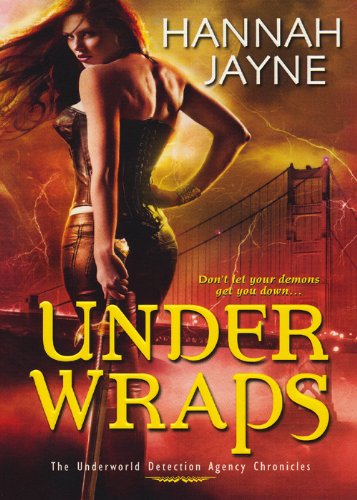
underwrapsUnder Wraps
by Hannah Jayne
343 pages
Published 2011

Under Attack
by Hannah Jayne
342 pages
Published 2011

Under Suspicion
by Hannah Jayne
347 pages
Published 2012
Urban Fantasy

So this is a series review, rather than a single book review. The Underworld Detection Agency Chronicles by Hannah Jayne revolves around Sophie Lawson, a human immune to magic, and her vampire roommate, Nina. They both work for the Underworld Detection Agency, an organization that licenses and keeps track of demons and supernatural creatures, providing things like health insurance and legal services that the mundane world simply wouldn’t be able to handle. (Who’s going to survive serving court-ordered papers to a dragon?)

The action was good in all three books; my main gripe is that for a book with a female lead who spends a lot of time fantasizing about men – there were no sex scenes until 40 pages from the end of the third book, and THAT was a fade to black after the kissing. I kinda feel like these books just teased me along for three books and then didn’t even bother to deliver! I mean, when in the FIRST CHAPTER of the FIRST BOOK you get this:

Hayes and I settled into identical plush leather cigar chairs opposite Mr. Sampson. I stifled a delighted Carrie Bradshaw grin and made a mental note to tell Nina about the hot-male sandwich I found myself in: Pete Sampson with his miles-deep, chocolate brown eyes, close-cropped ash blond hair, and GQ model build; and Detective Parker Hayes, rich blue eyes, chiseled jawline sprinkled with stubble, Roman god nose – I’d leave out the part about him being smug. 

One kind of expects that to GO somewhere! (Especially since the ogling goes on for several paragraphs…) Also, that’s not how you use a semi-colon.

underattack

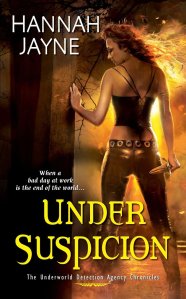
The other complaint I have is that the covers show her looking badass – redhead in a bustier, holding a pair of guns or a sword or a dagger – when in reality she’s anything but. Her only power is being immune to magic and having friends. She pukes when she sees her first corpse, is taught to shoot in the first book but when confronted with a home invader, rather than shoot him, she THROWS THE GUN AT HIM. This chick is ANYTHING but badass. She’s not even terribly smart. She is likable though, and I did enjoy the books. I was just disappointed they didn’t quite live up to my expectations.

From the back of Under Wraps:

As a human immune to magic, Sophie Lawson can help everyone from banshee to zombie transition into normal, everyday San Francisco life. With a handsome werewolf as her UDA boss and a fashionista vampire for a roommate, Sophie knows everything there is to know about the undead, the unseen, and the uncanny.

Until a rash of gruesome murders has demons and mortals running for cover, and Sophie finds herself playing sidekick to detective Parker Hayes. Dodging raging bloodsuckers, bad-tempered fairies, and love-struck trolls is one thing. But when Sophie discovers Parker isn’t what he seems, she’s got only one chance to figure out whom to trust. Because an evil hiding in plain sight is closing in… and about to make one wisecracking human its means to ultimate power.

From the back of Under Attack:

Sophie Lawson is a human immune to magic, which comes in handy for helping paranormal beings transition into everyday life. But fallen angel Alex Grace and his search for the Vessel of Souls is one curse she never saw coming. Suddenly an unexplainable string of killings and destruction has even San Francisco’s demons fearing for their immortal lives. And Sophie isn’t about to trust Alex’s all-too-vulnerable charm or his secret agenda. Now their hunt is revealing dangerous secrets about Sophie’s past, and a malevolent power hellishly close to turning one irreverent human into the ultimate supernatural weapon.

undersuspicion

From the back of Under Suspicion:

Being a human immune to magic helped Sophie Lawson get promoted. It’s also made her a major, very reluctant player in a game that stretches beyond even the Underworld. having handsome buttoned-down Englishman Will as her new guardian is one tempting blessing, especially since sexy fallen angel Alex is mysteriously MIA lately. But as a frightening number of demons start disappearing around the city, Sophie suspects that an Armageddon-level prophecy is about to become everyone’ nightmare. And her investigation is testing her bravery – and Will’s unexpected vulnerability – in ways neither could predict. Now Sophie and Will are fast running out of time as an unstoppable evil prepares to lay waste to demons and humans alike.

Having typed out the backs of these three books, I have a few more things to say. Specifically about the last one because it’s misleading as hell. There was no prophecy. Anywhere. Unless I COMPLETELY missed something. Final call: these books are decent fluff. I’m not going to bother with the rest of the series though.