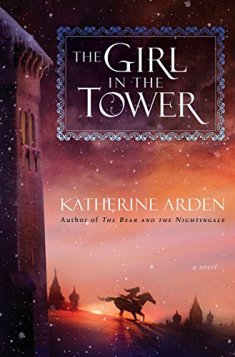
Book Review: The Girl in the Tower

girlinthetowerThe Girl in the Tower
Katherine Arden
Fantasy
384 pages
December 2017

The Girl in the Tower is the second in the Winternight Trilogy, after the acclaimed debut novel, The Bear and the Nightingale. It’s always hard to talk about sequels without giving too much away about the preceding books, so forgive me if I’m vague. One advantage to waiting so long to read The Bear and the Nightingale was that I got to jump straight into the sequel! Now I have to wait several months for the third.

The Girl in the Tower revisits our heroine, Vasya, from the first book. Now she has left home to begin her adventures – though her travels are curtailed pretty quickly, and she’s roped into going to Moscow with her brother and the Grand Prince, while disguised as a boy. While in Moscow she learns a little bit more about her family history, and I’m hoping the rest will be revealed in the third book this summer. (The Winter of the Witch is scheduled to release in August 2018.)

In this second book, Vasya has done some growing, and has learned to make use of the spirits she sees – she knows the hearth spirits can always find their families, and uses that trait to track a kidnapped girl when no one else can. So long as no one realizes what she’s doing, she’s fine. But Rus is in the crossover period between the old ways and the new, and if she’s found talking to spirits, she’ll be branded a witch all over again. She keeps her masquerade going through the first two-thirds of the book, but it’s obvious it’s going to fail eventually. The way in which it does is sudden and unexpected, and the repercussions are harsh.

And then there’s Morozko, the Frost Demon, the god of death. I love Morozko. He’s by necessity enigmatic – and in a rough position. I want he and Vasya to fall in love and have a happy ending – the attraction between them is impossible to miss – but immortal beings, in this world, can’t love. If they love they lose their immortality. And, possibly, their lives entirely. I hope the author has a solution in mind for these two, because I currently don’t see one.

I actually liked this one more than the first book, which is unusual. I liked the first one, but I wasn’t blown away. This one pulled me in and didn’t let me go. Amazing sequel, and I hope the third one lives up to this standard!

From the cover of The Girl in the Tower:

Katherine Arden’s enchanting first novel introduced readers to an irresistible heroine. Vasilisa has grown up at the edge of a Russian wilderness, where snowdrifts reach the eaves of her family’s wooden house and there is truth in the fairy tales told around the fire. Vasilisa’s gift for seeing what others do not won her the attention of Morozko—Frost, the winter demon from the stories—and together they saved her people from destruction. But Frost’s aid comes at a cost, and her people have condemned her as a witch.

Now Vasilisa faces an impossible choice. Driven from her home by frightened villagers, the only options left for her are marriage or the convent. She cannot bring herself to accept either fate and instead chooses adventure, dressing herself as a boy and setting off astride her magnificent stallion Solovey.

But after Vasilisa prevails in a skirmish with bandits, everything changes. The Grand Prince of Moscow anoints her a hero for her exploits, and she is reunited with her beloved sister and brother, who are now part of the Grand Prince’s inner circle. She dares not reveal to the court that she is a girl, for if her deception were discovered it would have terrible consequences for herself and her family. Before she can untangle herself from Moscow’s intrigues—and as Frost provides counsel that may or may not be trustworthy—she will also confront an even graver threat lying in wait for all of Moscow itself.
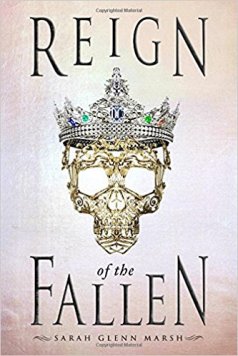
Book Review: Reign of the Fallen

fallenReign of the Fallen
by Sarah Glenn Marsh
YA Fantasy
379 pages
Published January 2018

One of my book-centered social networks, Litsy, does an occasional “24 in 48” where the goal is to spend 24 hours out of 48 hours reading. I’m almost never able to participate in these because my weekends are pretty busy – and I don’t want to ignore my husband for an entire weekend! However, he went out of town for one of the last weekends in February, and I was able to spend it doing my own personal 24 in 48. Reign of the Fallen is the first of many books I read that weekend!

Reign of the Fallen has a pretty interesting premise – there are a few different school of magic in this world, and our main character is a necromancer. (One of the side characters is a Beast Master, and another is a Healer. We also see Weather Mages.) Necromancers, far from being the mysterious evil mages we see in most fantasy, are revered and noble in this world; they bring souls back from the Deadlands, when they can, so they can continue “living” in the real world. “Living” is a loose term – they must make sure they are completely covered at all times – if a living person sees any of their flesh, they turn – immediately – into terrifying monsters that hunt and kill both the living and the Dead. And the more they kill, the more powerful they become. Thankfully, people are very, very careful, and so Shades are very rare! …..or they were. Now that someone has started to purposefully make them, shit’s hitting the fan.

Odessa and her friends – three other Necromancers, a Healer, a Beast Master, and a Princess – set out to solve this mystery and take out the shades wreaking havoc on the kingdom. Entwined in that plot is the near-breaking of Odessa’s spirit when one of her friends dies, and the recovery from that, as well as romances with people of both genders. Yay for bisexual representation! (One of her Necromancer friends is also in a homosexual relationship with the Healer, and it’s all perfectly normal. I love seeing so many fantasy YA books these days not treating that as something special or other. Yay for culture changing! Maybe someday it won’t even be so out-of-the-ordinary that I’ll feel the need to point it out!)

The book had a few technical problems – a few scenes where I was confused how a character had gotten someplace when I thought they were somewhere else, some confusion in how a scene was described – but those could be overlooked with how wonderful the rest of the book was.

The plot was wrapped up very nicely by the end of the book, so I don’t know if there will be a sequel or not, but I really enjoyed the world and would definitely read one if she writes it!

As a bonus, the author lives in Richmond, Virginia, so I’m counting this as a book by a local author for the PopSugar 2018 Challenge!

From the cover of Reign of the Fallen:

Without the dead, she’d be no one.

Odessa is one of Karthia’s master necromancers, catering to the kingdom’s ruling Dead. Whenever a noble dies, it’s Odessa’s job to raise them by retrieving their soul from a dreamy and dangerous shadow world called the Deadlands. But there is a cost to being raised: the Dead must remain shrouded. If even a hint of flesh is exposed, a grotesque transformation begins, turning the Dead into terrifying, bloodthirsty Shades.

A dramatic uptick in Shade attacks raises suspicions and fears around the kingdom. Soon, a crushing loss of one of her closest companions leaves Odessa shattered, and reveals a disturbing conspiracy in Karthia: Someone is intentionally creating Shades by tearing shrouds from the Dead–and training them to attack. Odessa is forced to contemplate a terrifying question: What if her magic is the weapon that brings the kingdom to its knees? 

Fighting alongside her fellow mages–and a powerful girl as enthralling as she is infuriating–Odessa must untangle the gruesome plot to destroy Karthia before the Shades take everything she loves.

Author Diversity

I’ve been trying to read more diverse books, and I think I’ve been succeeding, but I haven’t actually been keeping track of numbers. So in the next month I’m going to be going back through all of the entries on this blog and taking note of the authors’ ethnicities, to see how diverse I have actually been reading. I’m sure it will be skewed, since my efforts for diversity have only been in the last two years or so, and I’ve been posting book reviews for far longer than that. But hopefully soon I will have a pie chart up so I can see what I need to work on! Now to figure out the easiest way to make a pie chart of data….

Book Review: Dust Tracks on a Road

dust tracks on a roadDust Tracks on a Road
by Zora Neale Hurston
Autobiography/Memoir
300 pages
Originally Published 1942 (my copy published in the 90s, with a foreword by Maya Angelou.)

This is my last review specifically for Black History Month, though I still have some African American books to read and review – a book about the African Americans who have served in the White House kitchens, and a book about Southern Food Culture, among others.

Zora Neale Hurston’s most famous work is Their Eyes Were Watching God, which I read in high school – and hated. I also strongly disliked The Color Purple, by Alice Walker, and unfortunately I have blended the two in my mind so much that I can’t remember what I hated about which book. I think it was The Color Purple that was written in a strong vernacular, but I’m not positive of that. It was twenty years ago!

Anyway. So I knew I didn’t like her fiction, but memoirs can be very different from fiction so I thought I’d give this a go. I didn’t hate this. But I didn’t like it, either. Hurston rambles from one subject to the next, going into so much imaginative detail at times that I have to skip back to pick up the line of actual story again. She has some questionable ideas about racial discrimination, seeming to ignore the idea of institutional racism, and dismissing the notion that white people are responsible for what their ancestors did. Or at least that individuals – even individuals as closely related as grandchildren – could be held individually responsible for their slave-owning grandparents. She even trotted out the “I wasn’t even born then, how could I be responsible?” that is the cry of many white people today who deny their privilege.

Maya Angelou, in her foreword, mentions this briefly – that Hurston had lived through race riots, and Jim Crow, but doesn’t mention any unpleasant racial incidents in her book, which is very odd. She does mention one – but it’s perpetrated by a black man, when he comes into the barber shop/salon that Hurston worked at and demanded to be served. (Only white people were served at this particular shop, but the owner had another shop uptown that served black people.) Hurston largely takes a stand against the black customer, complaining that had they served him, the owner (another black man) would have been driven out of business, and all his black employees with him, so how dare the customer value equality over all those jobs? Which is a decent point, but ignores that it’s white people that would have wrongly put them out of business for the so-called crime.

I was very disappointed that Hurston never really talked about the Jim Crow era in her book. I would have liked to see that from her perspective. I do think I’d like to read more memoirs from that era, as Hurston makes it seem largely peaceful and happy. And I’m pretty sure that’s not the case.

It’s an interesting book, but it seems Hurston is at least a slightly unreliable narrator. So take that into account if you read it, and remember it was published in the 1940s, so the way she talks about the “primitive Negro” and the ease with which she tosses around the N word (including from white people) is a product of its time.

This is my PopSugar 2018 Challenge pick for the prompt “an author from a different ethnicity than you.”

From the cover of Dust Tracks on a Road:

First published in 1942 at the crest of her popularity as a writer, this is Zora Neale Hurston’s imaginative and exuberant account of her rise from childhood poverty in the rural South to a prominent place among the leading artists and intellectuals of the Harlem Renaissance. The very personal, perhaps larger-than-life portrait that Hurston paints of herself offers a rare, poignant, and often audacious glimpse of the public and private persona of a very public and private artist, writer, anthropologist, and champion of black heritage. Dust Tracks on a Road is a book full of the wit and wisdom of a proud and spirited woman who started off low and climbed high: “I have been in Sorrow’s kitchen and licked out all the pots. Then I have stood on the peaky mountain wrapped in rainbows with a harp and a sword in my hands.”

Book Review: The Last Black Unicorn

blackunicornThe Last Black Unicorn
by Tiffany Haddish
Comedy/Memoir
276 pages
Published December 2017

I’ve been wanting to read this book ever since I saw Haddish’s interview on The Daily Show with Trevor Noah. This woman is HILARIOUS. Somehow I didn’t realize she was in the movie Girls Night until I read about it in her book – I really do need to see that movie. That aside, this book was pretty great. It’s written in her speaking style, so it’s not technically correct grammar, but it SOUNDS right, which is more important in a memoir, in my opinion. It’s supposed to show the author’s personality, and this does.

I don’t know that I’d put this on quite the same level as Trevor Noah’s Born A Crime, or Jenny Lawson’s Furiously Happy, but it’s not far behind them. Haddish talks about her childhood in the foster system and then raised by her grandmother, her string of no-good boyfriends, and her abusive marriage. She’s had a rough life, but somehow she’s come out of it with a gift for comedy and a grounded personality.

Her swamp tour with Will Smith and Jada Pinkett-Smith is one of the most hilarious stories in the book, and one of the few that is purely funny. Most of them are underscored with a serious issue that make me feel a little bad for laughing at them, but Haddish laughs at them, so how can you not? It’s an interesting conflict that leaves me with slightly mixed feelings about the book.

It’s a pretty quick, easy, fun read, and if you like Tiffany Haddish, it definitely shows what she’s gone through to get where she is now.

From the cover of The Last Black Unicorn:

From stand-up comedian, actress, and breakout star of Girls Trip, Tiffany Haddish, comes The Last Black Unicorn, a sidesplitting, hysterical, edgy, and unflinching collection of (extremely) personal essays, as fearless as the author herself.

Growing up in one of the poorest neighborhoods of South Central Los Angeles, Tiffany learned to survive by making people laugh. If she could do that, then her classmates would let her copy their homework, the other foster kids she lived with wouldn’t beat her up, and she might even get a boyfriend. Or at least she could make enough money—as the paid school mascot and in-demand Bar Mitzvah hype woman—to get her hair and nails done, so then she might get a boyfriend.

None of that worked (and she’s still single), but it allowed Tiffany to imagine a place for herself where she could do something she loved for a living: comedy.

Tiffany can’t avoid being funny—it’s just who she is, whether she’s plotting shocking, jaw-dropping revenge on an ex-boyfriend or learning how to handle her newfound fame despite still having a broke person’s mind-set. Finally poised to become a household name, she recounts with heart and humor how she came from nothing and nowhere to achieve her dreams by owning, sharing, and using her pain to heal others.

By turns hilarious, filthy, and brutally honest, The Last Black Unicorn shows the world who Tiffany Haddish really is—humble, grateful, down-to-earth, and funny as hell. And now, she’s ready to inspire others through the power of laughter.

Book Review: All The Rage

alltherageAll The Rage
Courtney Summers
Young Adult fiction
337 pages
Published 2015

Wow. I finished this book, sat back, and stared at it in silence for a while. This is an emotional wringer of a book that more people should read. It’s also full of trauma triggers, so beware.

Trigger Warning. Rape and Recovery.

All The Rage is about a girl. It’s about rape culture. It’s about her trauma, and the aftermath. The book flashes back and forth a little – it includes a triggered flashback to her rape, and her memories of it. The font choices show how mixed up she is sometimes, and how hard it is for her to tell what’s really happening, what is a memory, and what is a flashback. Her rape is never written about in high detail. One Goodreads reviewer made a good point – the details being scant makes the shadows larger for the devil to hide in. (Her review is is posted in full on her blog, and it’s a powerful one.)

The book was an easy read, technically – I read it in an afternoon – but it was a very hard read, emotionally and mentally. The main character, Romy, talks about how no one prepares girls for this, and she’s right. As a society, we don’t. We tell girls how to avoid those kinds of situations, but not what to do when actually IN them. Or how to determine the best course of action. Because surviving an attack is usually the priority, and screaming and fighting isn’t always the best way to do that. Romy froze, and she blames herself for the failure to fight. But she also blames society for not teaching girls what to do. And once the unthinkable has happened, society abandons the victims. That was one of the hardest parts of the book – the victim-blaming. No one believes Romy. They call her a slut and a liar. Her high school classmates do horrible things to her.

The book is dark, but there are points of light. Leon is a coworker at the diner, and he’s sweet on Romy. The book uses the relationship to show how rape can affect any future intimacy. Romy can’t trust him, because her rapist seemed sweet, too. Until he wasn’t. Romy’s mother and mother’s boyfriend are both supportive, caring, and loving. They don’t understand what she’s going through, mostly because Romy won’t tell them, but they do their best anyway.

All The Rage is a really good book. It’s also a very important book, and personally I think it should be required reading in high school. (That will never happen, it’s too graphic and would offend parents, I’m sure. But it should.) If it’s something you’ve experienced personally, it’s very triggery and should maybe be avoided. But if it isn’t? Read this book. You need to know.

(The author of All The Rage is Canadian, which I didn’t realize until I was reading the blurb on the back, so this counts for my Read Canadian Challenge. Rape Culture is also a major problem facing the world today, so I’m counting this as “A book about a problem facing society today” for the PopSugar 2018 Challenge.)

My other Canadian reviews:
1. An Astronaut’s Guide to Life on Earth
2. The Red Winter Trilogy
3. Station Eleven
4. The Courier
5. The Last Neanderthal
6. American War
7. Next Year, For Sure
8. That Inevitable Victorian Thing
9. this book!
10. The Clothesline Swing
11. Saints and Misfits
12. Tomboy Survival Guide
13. The Wolves of Winter

From the cover of All The Rage:

The sheriff’s son, Kellan Turner, is not the golden boy everyone thinks he is, and Romy Grey knows that for a fact. Because no one wants to believe a girl from the wrong side of town, the truth about him has cost her everything-friends, family, and her community. Branded a liar and bullied relentlessly by a group of kids she used to hang out with, Romy’s only refuge is the diner where she works outside of town. No one knows her name or her past there; she can finally be anonymous. But when a girl with ties to both Romy and Kellan goes missing after a party, and news of him assaulting another girl in a town close by gets out, Romy must decide whether she wants to fight or carry the burden of knowing more girls could get hurt if she doesn’t speak up. Nobody believed her the first time-and they certainly won’t now-but the cost of her silence might be more than she can bear.

With a shocking conclusion and writing that will absolutely knock you out, Courtney Summers’ new novel All the Rage examines the shame and silence inflicted upon young women in a culture that refuses to protect them.