Book Review: The Shape of Water

the shape of waterThe Shape of Water
by Daniel Kraus and Guillermo del Toro
Magical Realism
314 pages
Published 2018

Alright, so, with as much as I enjoy twists on mermaid stories, this was kind of inevitable, right? I’d heard a lot about the movie, but hadn’t yet seen it, so I figured I’d read the novelization. What I didn’t realize until reading the book, though, is that this isn’t actually a novelization of the movie. The movie and the book were written at the same time, about the same story, but tell different parts of it. (This article explains how both were written.) The book delves more into the mythology behind the creature, and gets into the thoughts and feelings of both the creature and Elisa. Those things are incredibly hard to communicate in film, especially when the characters can’t speak! So, far from “reading the book instead of seeing the movie,” now that I’ve read the book, I REALLY want to see the movie!

If you haven’t heard of the movie, the basic premise of both movie and book is Elisa, a mute janitor at a top secret research facility, is cleaning a lab when she sees what’s contained in it – an amphibious man-like creature kept in captivity and experimented on. She teaches him sign language and eventually falls in love with him and decides to break him out of the lab before the researchers kill him. The plot is set in the 60s, so there’s a lot more overt racism and sexism going on, as well as some Cold War spycraft.

It’s also set in Baltimore, which is another thing I didn’t know before reading the book!

There’s a pretty good amount of minority representation here – Elisa is mute, her two best friends are black (Zelda) and gay (Giles). Zelda worries about her place as “the black friend” of a white woman, but also sees Elisa as a little damaged and in need of her care. When Elisa gets tunnel vision on the merman, Zelda’s worries are mostly confirmed, but not for the reasons she thinks, since Elisa shuts out Giles too. There’s definitely something to be learned there about hurting your friends unintentionally when starting a new relationship!

A lot of people saw this plot as super weird, with the woman falling in love with the sea-creature, but how many mermaid films do we have where the man falls in love with the mermaid when she still has her fish tail? Sure, the merman here is fully scaled and can’t talk, but Ariel can’t talk in most versions of The Little Mermaid, either. I don’t see it as much different, other than it’s a women falling in love with someone who isn’t the typical image of masculinity. And at least in the book, there are a couple of chapters from his perspective. He’s sentient and consenting. (I hope that comes across in the movie, too.)

I really enjoyed this one, and I definitely need to watch the movie to get the rest of the story. The book is self-contained – nothing’s missing, exactly, but since it was written in both mediums at the same time, I feel like I need to see the movie to perhaps flesh out some things.

From the cover of The Shape of Water:

It’s 1962, and Elisa Esposito – mute her whole life, orphaned as a child – is struggling with her humdrum existence as a janitor working the graveyard shift at Baltimore’s Occam Aerospace Research Center. Were it not for Zelda, a protective coworker, and Giles, her loving neighbor, she doesn’t know how she’d make it through the day.

Then one fateful night, she sees something she was never meant to see, the Center’s most sensitive asset ever; an amphibious man, captured in the Amazon, to be studied for Cold War advancements. The creature is terrifying but also magnificent, capable of language and of understanding emotions . . . and Elisa can’t keep away. Using sign language, the two learn to communicate. Soon, affection turns into love, and the creature becomes Elisa’s sole reason to live.

But outside forces are pressing in. Richard Strickland, the obsessed soldier who tracked the asset through the Amazon, wants nothing more than to dissect it before the Russians get a chance to steal it. Elisa has no choice but to risk everything to save her beloved. With the help of Zelda and Giles, Elisa hatches a plan to break out the creature. But Strickland is onto them. And the Russians are, indeed, coming.

Developed from the ground up as a bold two-tiered release – one story interpreted  by two artists in the independent mediums of literature and film – The Shape of Water is unlike anything you’ve ever read or seen.

Book Review: Guardian Angels & Other Monsters

guardian angels other monstersGuardian Angels & Other Monsters
by Daniel H. Wilson
Sci-fi short stories
280 pages
Published 2018

So I obviously didn’t read the description of this book closely enough, because it wasn’t until I hit “One For Sorrow – A Clockwork Dynasty Story” that I realized this was the same author that wrote Clockwork Dynasty, a book I read last year! We’ll blame it on my goldfish memory. My goldfish memory is a large part of why I keep this blog, so I can look back and remember what I’ve read and what I thought about it! I randomly plucked this book off the New Book display while grabbing my holds from the library; I didn’t recognize the author’s name at the time. So I’m highly amused.

These stories are . . . hard to quantify.  Some of them I really enjoyed – “Miss Gloria” is probably my favorite – she’s a little girl with a robot guardian. When kidnappers disable the guardian and take her, the guardian’s programming jumps to the closest possible hardware – being the getaway car. From there to one of the kidnappers’ smart helmets, and so on. I very much disliked “The Blue Afternoon That Lasted Forever” but to say why would spoil it entirely. The Clockwork Dynasty short story was quite good – I’m still hoping he’ll write another full-length novel in that world.

I haven’t read his other novel, Robopocalypse, and I wasn’t thrilled with the short story from that universe, but the synopsis of it sounds amazing. I don’t know if I want to read it or not!

This was a fascinating, if weird, collection of stories. I like how he explores the possible consequences of things like teleportation, AIs, robots, and battle armor. As a race, our capacity for invention tends to outpace our consideration of the consequences. We try to figure out how to do a thing before stopping to consider if we should. In this book, over and over again, I feel that Wilson is asking us “Is this the future we want?” which has often been the case with truly visionary science fiction. That’s why people complaining about politics in science fiction make me laugh – science fiction has ALWAYS been political!

This is a book for mature audiences. There are deaths, sacrifices, pain, sex, war, and other mature themes – it’s definitely not the lightest of reads. But it’s good.

From the cover of Guardian Angels & Other Monsters:

From the New York Times bestselling author of Robopocalypse and The Clockwork Dynasty comes an enthralling and fantastic collection of stories that explores complex emotional and intellectual landscapes at the intersection of artificial intelligence and human life.

In “ALL KINDS OF PROOF,”  a down-and-out drunk makes the unlikeliest of friends when he is hired to train a mail-carrying robot; in “BLOOD MEMORY, ” a mother confronts the dangerous reality that her daughter will never assimilate in this world after she is the first child born through a teleportation device; in “THE BLUE AFTERNOON THAT LASTED FOREVER,” a physicist rushes home to be with his daughter after he hears reports of an atmospheric anomaly that he knows to be a sign of the end of Earth; in “MISS GLORIA,” a robot comes back to life in many different forms on a quest to save a young girl. Showcasing the brilliance and depth of Daniel H. Wilson’s imagination, Guardian Angels & Other Monsters is a masterful collection that probes the profound impact of the rise of digital intelligence in a human world.

Book Review: our endless numbered days

our endless numbered daysour endless numbered days
by Claire Fuller
Contemporary Fiction
386 pages
Published 2015

I don’t like unreliable narrators. I didn’t realize, at first, that Peggy was one. Even though she mentions at the start of the book that a doctor said she had Korsakoff’s syndrome – meaning malnutrition has messed with her memories – I assumed that it was just because her experiences were so unbelievable that the doctor thought she’d made things up. I also don’t like unreliable narrators because the author obviously knows what truly happened. Leaving the reader in the dark about it seems rude.

Peggy’s narration does seem childlike, often. While at the beginning of the book, that can be excused because she is eight years old, by the end she is seventeen, yet still talking about things with a child’s understanding. I thought that was the effect of Korsakoff’s syndrome, not that she was entirely making some things up.

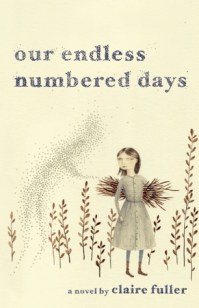
In our endless numbered days, Peggy is effectively kidnapped by her father when she is eight, and taken to some place deep in the German forest. She spends the next nine years alone in the forest with him, trapping squirrels, gathering roots and berries, and growing simple crops in a small vegetable patch. He tells her, repeatedly, making her repeat it back to him, that the rest of the world was destroyed in a massive storm. They are the last two people alive in their small, sheltered valley. She doesn’t question it until she sees a man in their forest, and that eventually leads her to find civilization again. The book is told in two timelines, flashing back and forth from her memories of her time in the forest, and the present where she’s attempting to re-acclimate to London.

I’m not really sure what to believe; Peggy’s memory or what her mother thinks happened. There are just enough oddities to make either story plausible. I think I prefer Peggy’s version. But that’s the trouble with unreliable narrators; there’s no way to actually know. I don’t like ending a book frustrated. Books should make you feel things, yes, but frustration is an odd emotion to aim for.

This book is odd.

From the cover of our endless numbered days:

Peggy Hillcoat is eight years old when her survivalist father, James, takes her from their home in London to a remote hut in the woods and tells her that the rest of the world has been destroyed. Deep in the wilderness, Peggy and James make a life for themselves. They repair the hut, bathe in water from the river, hunt and gather food in the summers, and almost starve in the harsh winters. They mark their days only by the sun and the seasons.

When Peggy finds a pair of boots in the forest and begins a search for their owner, she unwittingly unravels the series of events that brought her to the woods and, in doing so, discovers the strength she needs to go back to the home and mother she thought she’d lost.

After Peggy’s return to civilization, her mother begins to learn the truth of her escape, of what happened to James on the last night out in the woods, and of the secret that Peggy has carried with her ever since.


Book Review: Cinnamon and Gunpowder

cinnamon and gunpowderCinnamon and Gunpowder
by Eli Brown
Pirate Adventure
318 pages
Published 2013

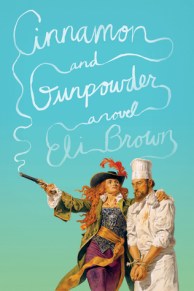
Cinnamon and Gunpowder reminds me a lot of Treasure Island. Or at least of my childhood memories of reading Treasure Island, as it’s been decades since I read it. The book is told from the viewpoint of Owen Wedgwood, a chef who finds himself kidnapped by a famous pirate and forced to cook gourmet meals for her in exchange for his life. As a home cook who’s had a small amount of actual training, I really enjoyed his descriptions of making do with only the cooking tools the ship has on hand and whatever rations he could lay his hands on. The creativity he displays in making amazing meals out of almost nothing is one of the best parts of the book. (And the descriptions of those meals – YUM.)

The formatting is set up as a kind of personal ship’s log, each part dated and written down after the events happen. Wedgwood (or “Spoons,” as the crew calls him) even mentions how he hides it and leaves out a decoy log, since he also writes down his dreams (and plans!) of escaping the pirates.

Some of the events in the book are incredibly predictable, but there are still a few surprises. I was a little disappointed when one thing in particular happened; I saw it coming but hoped that wasn’t where the author was going with it. I know that’s vague, but I don’t want to spoil anything!

I enjoyed learning about Mad Hannah’s background and why she’s a pirate; she’s fighting against the opium trade, and she actually gives Wedgwood a pretty accurate summary of the terrible things the opium trade was responsible for.

Any book that can combine sumptuous description of exotic meals with action and cannonballs will have my attention. And Brown does not shy away from proper action scenes. These are pirates, and fights get brutal. Men lose limbs if not their lives to storms and Navy bombardments. Keeping order on a pirate ship involves lashings and brute force. The book doesn’t shrink from those, but it also gets philosophical with Wedgwood’s description of flavors, and almost comedic with the images of using cannonballs as pestles for grinding herbs. It’s that contrast and variety that makes this book so much fun to read.

From the cover of Cinnamon and Gunpowder:

In Cinnamon and Gunpowder, the prizewinning author Eli Brown serves up the audacious tale of a fiery pirate captain, her reluctant chef, and their adventures aboard a battered vessel, the Flying Rose. As these unlikely shipmates traverse the oceans, intrigue, betrayal, and bloodshed churn the waters.

The year is 1819, and Owen Wedgwood, famed as the Caesar of Sauces, has been kidnapped by the ruthless captain Mad Hannah Mabbot. After using her jade-handled pistols on his employwer, lord of the booming tea trade, Mabbot announces to the terrified cook that he will be spared only as long as he puts an exquisite meal in front of her every Sunday without fail.

To appease the red-haired tyrant, Wedgwood works wonders with the meager supplies he finds on board, including weevil-infested cornmeal and salted meat he suspects was once a horse. His first triumph is that rarest of luxuries on a pirate ship: real bread, made from a sourdough starter that he keeps safe in a tin under his shirt. Soon he’s making tea-smoked eel and brewing pineapple-banana cider.

Even as she holds him hostage, Mabbot exerts a curious draw on the chef; he senses a softness behind the swagger and the roar. Stalked by a deadly privateer, plagued by a hidden saboteur, and outnumbered in epic clashes with England’s greatest ships of the line, Captain Mabbot pushes her crew past exhaustion in her hunt for the notorious King of Thieves. As Wedgwood begins to understand the method to Mabbot’s madness, he must rely on the bizarre crew members he once feared: Mr. Apples, the fearsome giant who loves to knit; Feng and Bai, martial arts masters sworn to defend their captain; and Joshua, the strangely mute cabin boy.

A giddy, anarchic tale of love and appetite, Cinnamon and Gunpowder is a wildly original feat of the imagination, deep and startling as the sea itself.

Book Review: The Girl Who Drank the Moon

girl who drank the moonThe Girl Who Drank the Moon
by Kelly Barnhill
YA Fantasy
388 pages
Published 2016

I adore this cover. It was what first caught my eye when people started talking about this book, and then to find out it was a fairytale about a girl, a witch, and a dragon? I was sold. The trouble was getting my hands on it! But it has finally worked its way through the long line of other people who wanted to read it at my library, and I got to check it out. I’ve labeled it YA Fantasy, but it’s actually pretty close to middle-grade Fantasy. Definitely something younger readers could understand, but enough meat in it for older readers who like fairy tales to enjoy it as well.

I would argue that the main character is not, in fact, the titular one, but the forest witch, Xan. Xan has been rescuing the babies left outside the Protectorate for many, many years, thinking the parents were abandoning them willfully, not that they were bullied into “sacrificing” wanted children. She’d cluck, take the babies, and deliver them to towns on the other side of the forest, where the villagers knew and loved her and cherished the children, calling them blessed and Star-Children. Meanwhile, the people of the Protectorate lived their days under a gray haze of misery, ruled by a Council who cared only for themselves and used Xan and the forest as a scare tactic.

Into this world Luna is born, and her mother refuses to give her up to be sacrificed, and goes “mad” when she is forced to. She is imprisoned in a tower, watched by fearsome nuns, while the oblivious Xan spirits her daughter away. On the journey, Xan winds up wandering instead of going straight to a village, and accidentally feeds Luna moonlight instead of starlight. Realizing the girl would be too much for a normal family to raise, she takes her home. (She also can’t bear the thought of giving this particular child up.) She raises Luna as a granddaughter.

But Luna’s mother wants her back, and some of the people of the Protectorate have started to wise up to the Council’s games, and the plot really begins.

I really enjoyed this book – the characters were fun, the emotional conflicts were realistic, and the world-building was cute. This would actually be an excellent book to read to a child as a bedtime story, one chapter a night. (My parents read to us that way, working through Laura Ingalls Wilder, The Chronicles of Narnia, Tolkien, and Anne of Green Gables.) Adorable book, gorgeous cover. Slightly simplistic, but it strikes a perfect balance between a middle-grade read and something adults will still enjoy.

From the cover of The Girl Who Drank the Moon:

Every year, the people of the Protectorate leave a baby as an offering to the witch who lives in the forest. They hope this sacrifice will keep her from terrorizing their town. But the witch in the Forest, Xan, is kind. She shares her home with a wise Swamp Monster and a Perfectly Tiny Dragon. Xan rescues the children and delivers them to welcoming families on the other side of the forest, nourishing the babies with starlight on the journey.

One year, Xan accidentally feeds a baby moonlight instead of starlight, filling the ordinary child with extraordinary magic. Xan decides she must raise this girl, whom she calls Luna, as her own. As Luna’s thirteenth birthday approaches, her magic begins to emerge – with dangerous consequences. Meanwhile, a young man from the Protectorate is determined to free his people by killing the witch. Deadly birds with uncertain intentions flock nearby. A volcano, quiet for centuries, rumbles just beneath the earth’s surface. And the woman with the Tiger’s heart is on the prowl . . .

The author of the highly acclaimed, award-winning novel The Witch’s Boy has written an epic coming-of-age fairy tale destined to be a modern classic.

Book Review: All’s Faire in Middle School

All's Faire in Middle SchoolAll’s Faire in Middle School
by Victoria Jamieson
Graphic Novel
248 pages
Published 2017

For those who didn’t know, I work at the Maryland Renaissance Festival, helping a friend of mine sell leather masks (and other leather goods). Throughout the year, I actually get to help her make them, including stitching the codpieces we sell at the Fair. So when I learned about this graphic novel set at a Renaissance Festival, I knew I had to grab it. I worked Labor Day Monday at Fair, so I popped over to the Fair’s bookshop, Page After Page, and picked up the book. (They even remembered I’d asked about the book over the summer to make sure they were going to carry it!)

Once I recovered from the heat and humidity at Fair on Monday, I cracked this book open and fell into it. It’s set at the Florida Ren Faire, and it captures the spirit of Rennies and the festival very, very well. One of my favorite parts was when Imogene announced she was going to middle school, and all the adults around her reply with variations of “MIDDLE SCHOOL SUCKED.” Imogene asks “Aren’t adults supposed to encourage kids to go to school?” and her dad replies “You got the wrong kind of adults, kid.” Oh, Rennies. There are D&D games, and thrift stores, and going to the store in garb, and speaking in accents while doing normal mundane things – yeah. This is a book about Rennies, alright.

I was a little disappointed in the adults not understanding the kind of pressure Imogene was under as the new girl at school. They all commiserated with middle school sucking, but didn’t give Imogene any slack for it, and in a couple of cases dismissed how important things were to her.

I loved seeing her go from school to Fair, and seeing the different environments contrasted. The art style is great. Each chapter begins with a page illustrated like a medieval manuscript, and a paragraph written like an epic story. “After months of preparations, including but not limited to careful outfit selection and triple-checking of school supplies, young Imogene is ready to embark on her journey into the Great Unknown. Like all explorers before her, our heroine has only one thought on her mind….”

I really loved this book. It would make a great gift for any kid headed to middle school who loves Ren Faires. (Or Rennie parents!)

From the cover of All’s Faire in Middle School:

Growing up with parents who work at the Renaissance Faire, Imogene has always been sure of who she is: a brave and noble knight. But now, after being homeschooled her whole life, she is about to embark on the epic adventure of . . . middle school!

Imogene will quickly discover that in real life there aren’t always clear-cut heroes and villains like there were at the Faire. How will she find her place (and new friends) in this strange and complicated land?