Book Review: Traitor to the Throne

traitor to the throneTraitor to the Throne
by Alwyn Hamilton
Fantasy
513 pages
Published March 2017

This is the sequel to Rebel of the Sands, which I read several weeks ago. The conclusion to the trilogy, Hero at the Fall, came out in March, and I’m waiting patiently for a copy from the library. (Okay, so maybe it’s impatiently, but I’m waiting!)

I love so much about this book. I always love non-western style fantasy, and this one is definitely middle-east inspired, with its djinni and deserts and fancy khalats. (A khalat is a loose, long-sleeved silk or cotton robe worn over the rest of your clothing.) The Demdji – the children of djinni and humans – are all fascinating, with interesting powers. And fantasy politics, at the highest of possible levels!

Amani is a fascinating main character, with her control over sand, her personal ethics, and her personal conflicts. She’s the daughter of a djinni, and we actually meet djinni for the first time in this book! I liked her love story better in Rebel of the Sands – it seemed very muted in this book, but they did spend most of the book apart. I am eager to see where that part of the plot goes in HatF.

There were a couple of twists that surprised me – who the titular traitor was, for one. The book was full of traitors of one kind or another. I also really liked seeing palace and harem life; the first book focused on desert backwaters and outlaws, so this was quite a change, and I liked it. I’m still half in love with Prince Ahmed, though we meet his half-brother Rahim in the palace, and he’s growing on me. The Sultan himself also surprised me; I expected a villainous, power-mad ruler, and he is not that. He seemed to surprise Amani, too.

I was excited to see the djinni actually make an appearance; I’d expected them to stay an abstract idea for the entire trilogy! They certainly never showed up in the first book. I mean, it was obvious they still came to humans, or Demdji couldn’t exist, but no one, even the mothers, ever spoke about seeing or interacting with them. Even to their half-djinni children. I’m hoping this means they’ll play a bigger role in the third book, because after the small glimpse we get here, I really want to know more about them!

Like most of the other reviews I’ve read, I agree that this wasn’t as strong as the first one, but middle books in trilogies rarely are. It is a solid volume, though, with lots of plot advancement and world-building and politicking. Can’t wait to get the concluding book!

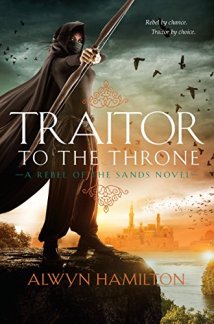
From the cover of Traitor to the Throne:

Mere months ago, gunslinger Amani al’Hiza fled her dead-end hometown on the back of a mythical horse with the mysterious foreigner Jin, seeking only her own freedom. Now she’s fighting to liberate the entire desert nation of Miraji from a bloodthirsty sultan who slew his own father to capture the throne. 

When Amani finds herself thrust into the epicenter of the regime—the Sultan’s palace—she’s determined to bring the tyrant down. Desperate to uncover the Sultan’s secrets by spying on his court, she tries to forget that Jin disappeared just as she was getting closest to him, and that she’s a prisoner of the enemy. But the longer she remains, the more she questions whether the Sultan is really the villain she’s been told he is, and who’s the real traitor to her sun-bleached, magic-filled homeland.

Forget everything you thought you knew about Miraji, about the rebellion, about djinni and Jin and the Blue-Eyed Bandit. In Traitor to the Throne, the only certainty is that everything will change.

Book Review: Bizarre Romance

bizarre romanceBizarre Romance
by Audrey Niffenegger and Eddie Campbell
Surreal short stories/comics
155 pages
Published March 2018

This was a wonderfully surreal collection of short stories and comics in various styles. All of the stories revolve around relationships, though not all are of the romantic kind. Audrey Niffenegger is the author of The Time Traveler’s Wife, which I read several years ago and really enjoyed. After reading the descriptions of her other books, and how much I enjoyed this one, I need to read those, too!

Bizarre Romance is hard to review partly because it is so weird. There are thirteen stories here – 7 comics and 6 short prose stories. Even the prose stories have illustrations scattered throughout them, mostly in slightly sketch-like style which lends itself well to the surreal nature of the subjects. I think my favorite is the guy who makes his fiance agree to leave him in the house alone, every Thursday night from 6pm to 8pm, before he’ll marry her. She’s okay with this at first, but eventually hires private investigators to find out what he’s doing on Thursday nights because she can’t stand not knowing. I won’t spoil the surprise, but I loved it. I also enjoyed “The Composite Boyfriend” which is written about a woman’s exes as if they were all the same person.

“I met him at the Isabella Stewart Gardner Museum in Boston, where he worked as a guard. I met him in a class I was taking. I met him at a school where we both taught. I met him at a party; we smiled at each other across a crowded room. We were introduced to each other by our mutual friend Paula, an Austrian immigrant who had escaped from the Nazis as a young girl.”

This is a really neat, beautiful little collection that explores different relationships, from father-daughter, to spouses, to exes, to female friendships. It’s a quick read, and I really enjoyed it.

From the cover of Bizarre Romance:

Once upon a time, a writer and an artist got married. “Let’s collaborate,” said the writer. “Ugh, no thanks, darling,” said the artist. But lo and behold, they collaborated and here is the result: thirteen stories about oddballs in love, infestations of angels, nefarious fairies, cats, spies, monsters, more cats, bibliophiles who just want a little extra reading time, magic mirrors, artists’ models who nap on the job, imperfect boyfriends, and daughters who are perhaps a little too dutiful. 

Book Review: As The Crow Flies

as the crow fliesAs The Crow Flies
by Melanie Gillman
Graphic Novel
272 pages
Published November 2017

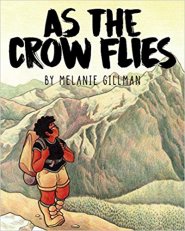
This book is GORGEOUS, y’all. It started as a webcomic about Charlie’s experience at a Christian backpacking youth camp. The book covers the first three days of camp, and the webcomic is currently on Day 4. I actually didn’t know it was a webcomic until I hit the end of the book, went “Wait, what?!” and started poking the internet to see if there was a Volume 2. I did find part of Day 4 posted on the webcomic site, but the last comic was posted in June of 2017. I found statements that there is a Volume 2 planned on her Tumblr and elsewhere on the Internet, though.

The main character, Charlie, is a queer black girl who’s gone to a Christian summer camp. When she walks in, she discovers EVERYONE else is white, except one half-Native American counselor. She’s immediately got her guard up, and when another counselor mentions “whitening their souls” as a metaphor for purification, her guard goes up further. I loved how her friendship developed with Sydney, another camper, and their conversations are HILARIOUS. They plan to disrupt the mysterious “ceremony” planned for when they reach the peak of the mountain, but they keep coming up with outlandish ideas like summoning pterodactyls or raccoons with palanquins and little driver hats. (You know those crazy conversations you come up with when you’re exhausted!)

Some of the Christian rhetoric in the book annoyed me, but it annoys Charlie, too, so I guess that’s okay, or even intentional. There’s a lot of White Feminism on display in the book; the tradition the camp follows relied on black women not participating and keeping homes running (read: being slaves) while the white women went off to their women’s retreat. Charlie is understandably pissed about how nonchalant the head counselor is about that, too.

The head counselor actually seriously rubs me the wrong way; at one point she tells one of the girls, who had sprained her ankle, that she only has enough supplies for one ankle injury, so if she uses it now, she won’t have it for anyone else. Lady, if you only brought enough supplies for one sprained ankle, for like ten people on a week-long hike? That is YOUR problem, not the fault of the poor 13-year-old in pain in front of you. You should have planned better. The same thing with not having enough painkillers to spare for the poor girl who starts her period. I’m not sure if the head counselor is supposed to be an antagonist or not, but she sure seems that way.

I really love Charlie and Sydney, and I really really want to see what the ceremony is and how they decide to disrupt it, so I will be keeping an eye out for the webcomic to start posting again, or for news of a Volume 2. And the art is, again, absolutely GORGEOUS. I will probably be looking for more of the author’s work – she calls herself a “queertoonist” which is great! She’s queer and nonbinary, by her Twitter bio. Which makes this an #ownvoices book as well, and perfect for Pride Month. You can find the rest of my Pride Month reads listed here.

From the cover of As The Crow Flies:

Charlie Lamonte is thirteen years old, queer, black, and questioning what was once a firm belief in God. So naturally, she’s spending a week of her summer vacation stuck at an all-white Christian youth backpacking camp. As the journey wears on and the rhetoric wears thin, she can’t help but poke holes in the pious obliviousness of this storied sanctuary with little regard for people like herself . . . or her fellow camper, Sydney.

Book Review: Little Bee, and World Refugee Day

little bee refugeeLittle Bee
by Chris Cleave
Contemporary Fiction
267 pages
Published 2009

Today is World Refugee Day. First observed in 2001, it is dedicated to raising awareness of the plight of refugees all across the world. African Refugee Day had been observed in some countries prior to the UN declaring it World Refugee Day, but the Organization of African Unity agreed to have the two days coincide.

To honor World Refugee Day, today I’m going to talk about Little Bee. Little Bee is a Nigerian refugee in the United Kingdom. She and her sister witnessed the destruction of their village by an oil company’s thugs, and were hunted down to eliminate the witnesses. In a chance encounter on a Nigerian beach, she met Sarah and Andrew, a couple from London trying to save their marriage by going on an exotic holiday. The encounter changes the lives of all three of them, and when Little Bee makes it to the United Kingdom, they are the only people she knows. She arrives at their home on the day of Andrew’s funeral, and Sarah takes her in.

The book switches between the viewpoints of Sarah and Little Bee, and it does suffer from that, a bit. I couldn’t wait for Sarah’s chapters to be done so I could get back to Little Bee. Her viewpoint – her voice – was enthralling. Some first-person views are just the person thinking to themselves, while some first-person views are the person talking to the reader. Sarah was the first type, and Little Bee the second. Reading her explanations of the differences between her old life and her new life, and how the girls from her village wouldn’t understand things, was amazing. I was hooked within the first ten pages of the book, specifically her note about scars:

I ask you right here please to agree with me that a scar is never ugly. That is what the scar makers want us to think. But you and I, we must make an agreement to defy them. We must see all scars as beauty. Okay? This will be our secret. Because take it from me, a scar does not form on the dying. A scar means, I survived.

The events Little Bee talks about having witnessed are horrifying. And she recognizes that. She could be bitter, she could be depressed, she could be insane, but she is not. She manages to have hope, and even joy. She sees other refugees around her commit suicide, and in fact always has a plan for how to kill herself “if the men come.” Because the stories of refugees always begin with “the men came and they…” and she’d rather kill herself than let herself be taken. Despite this, she has hope for a future. Or perhaps she simply takes joy in the present.

The book is not a happy one. Like Sing, Unburied, Sing, it’s an important book but not exactly an enjoyable one. There are enjoyable parts. But there are very hard parts, too. (I should note, here, a TRIGGER WARNING for a graphic description of rape, when Little Bee tells Sarah what happened to Little Bee’s older sister.) It did not end the way I wanted it to, though it ended in an unexpected way. I suppose it was too much to hope for a Happy Ever After when the vast majority of refugees don’t get one.

For all that there were very tough scenes to get through in this book, I’m still putting it on my Best of 2018 list. Little Bee’s voice and viewpoint is amazing, the story is well researched, and the plot absorbing. This is a book I’d like to have on my shelf.

This book fills the “book talked about in another book” (Tolstoy and the Purple Chair) prompt for PopSugar 2018, and the “refugee MC” prompt for Booked 2018.

From the cover of Little Bee:

We don’t want to tell you what happens in this book.

It is a truly special story and we don’t want to spoil it.

Nevertheless, you need to know enough to buy it, so we will just say this:

This is the story of two women. Their lives collide one fateful day, and one of them has to make a terrible choice, the kind of choice we hope you never have to face. Two years later, they meet again – the story starts there . . .

Once you have read it, you’ll want to tell your friends about it. When you do, please don’t tell them what happens. The magic is in how the story unfolds. 

Book Review: When Katie Met Cassidy

when katie met cassidyWhen Katie Met Cassidy
by Camille Perri
Contemporary Romance
262 pages
Releases June 19, 2018

This was one of my Book of the Month picks this month, so I got it a little early. It’s a very quick read, and a sweet story. Basically, it’s lesbian romance fluff. We need more fluff with non-heterosexual romances, so this is great stuff!

The book touches on gender issues – Cassidy is a woman, and seems happy to be so, but abhors feminine clothing and instead dresses solely in men’s suits. (The scene with her fabulously gay tailor was an absolute delight!) She flashes back a little onto her childhood when she wasn’t allowed to wear the clothing she felt best in. She also has a few conversations with Katie about gender roles. Katie is much more traditionally feminine, wearing dresses and heels and long hair.

I’m a little torn on whether I dislike the use of the trope “straight woman turned gay after breakup” or like the point that Katie isn’t sure she likes women, but she knows she likes Cassidy. Cassidy’s gender is secondary to her personality. And it’s not like Katie decided to go hit on women after her fiance cheated on her; she got practically dragged to the lesbian bar by Cassidy, who saw how much she was hurting and decided to help her.

I enjoyed seeing that Cassidy has casual sex partners, many of them former sex partners, who are still good friends with her. Granted, she has lots of one-night stands who are upset with her since she’s quite the player, but there are several women who she’s been involved with before the book opens, who are close friends of hers and care about her future. I wish we saw more relationships like this in heterosexual romantic fiction instead of only in GLBT fiction! These kinds of relationships do exist in heterosexual groups, but it seems like romantic fiction is always divided between “heterosexual monogamy” and “everything else.” I did read an exception in Next Year, For Sure, but I greatly disliked the ending.

I really loved this book. It was sweet, and light-hearted, and a pleasant breath of fresh air from a lot of what I’ve been reading recently!

You can find a list of all of my Pride Month reads here.

From the cover of When Katie Met Cassidy:

When it comes to Cassidy, Katie can’t think straight.

Katie Daniels, a twenty-eight-year-old Kentucky transplant with a strong set of traditional values, has just been dumped by her fiance when she finds herself seated across a negotiating table from native New Yorker Cassidy Price, a sexy, self-assured woman wearing a man’s suit. While at first Katie doesn’t know what to think, a chance meeting on a West Village street later that night leads them both to the Metropolis, a dimly lit lesbian dive bar that serves as Cassidy’s second home.

The night offers straightlaced Katie a glimpse into a wild yet fiercely tight-knit community, one in which barrooms may as well be bedrooms, and loyal friends fill in the spaces absent families leave behind. And in Katie, Cassidy finds a chance to open her heart in new ways. Soon their undeniable connection will bring into question everything each of them thought they knew about sex and love.

From the acclaimed author of The Assistants comes another gutsy book about the importance of women taking the reins – this time, when it comes to love, sex, and self-acceptance. Written with Camille Perri’s signature wry writ and charm, When Katie Met Cassidy is a fun, fast-paced romantic comedy about gender and sexuality, and the importance of figuring out who we are in order to go after what we truly want.

Book Review: The Kiss Quotient

kiss quotientThe Kiss Quotient
by Helen Hoang
Contemporary Romance
317 pages
Published June 2018

This was one of three books I got through Book of the Month this month – the other two were The Book of Essie and When Katie Met Cassidy. I’m reviewing this today instead of another Pride Month read because today is Autistic Pride Day! The Kiss Quotient both stars and is written by a woman on the autistic spectrum, so I thought today would be a fitting day to tell you about it!

So The Kiss Quotient is basically a gender-swapped Pretty Woman, as Hoang mentions in the Author’s Note. Our heroine, Stella Lane, books an escort to teach her about sex. Stella is thirty years old, has only had sex a couple of times, never enjoyed it, and is worried about not being good at it and therefore not being able to get or keep a boyfriend. She’s an incredibly successful econometrician, or someone who uses data and statistics to model and predict economic trends, in her case predicting what people will want to buy from clients. (She’s the kind of person responsible for those “Amazon started marketing baby products to me before I even knew I was pregnant!” incidents.) So she has more money than she knows what to do with, and offers Michael, an escort, $50,000 a month to teach her about sex and relationships.

Because this is a romance, we know what’s going to happen here. They fall in love with each other, but are sure that for the other one it’s just a business arrangement.

I was NOT expecting this book to be as explicit as it is! I think because it is a Book of the Month, I wasn’t expecting the standard trope of romance book with hot sex scenes. But that’s what I got! I can’t say I’m unhappy with that – god knows I like my guilty pleasure romance smut – but it was definitely unexpected. I’m not sure why it surprised me. The book’s premise is all about Stella wanting to learn about sex; if that wasn’t conducted on screen we’d lose a third of the book!

A sequel has already been announced, and it’s about the other autistic character in the book, the hero’s best friend’s little brother, Khai, who we only see in one scene. Who I’d also like to know more about is the best friend, Quan! So I’m holding out hope for a third book. (Update: a third book is on Goodreads, but without a title or synopsis. Hopefully it’s Quan! I have read and reviewed Khai’s book, The Bride Test.)

One last thing that I found important – in the Author’s Note, Hoang mentions her daughter was diagnosed with AS, and in reading about Autism, she realized she is also on the spectrum. This is something I’ve seen in three different books now. It’s so common for women, especially, to go undiagnosed. They might be better at modelling allistic (non-autistic) behavior, or their special interests might be more “acceptable” to allistics, or sometimes they just get looked at as introverts when they’re young instead of getting the help they might need. This is starting to change, as researchers and doctors are realizing Autism presents differently in women. But it seems autistic adult women are often discovering they’re autistic through a diagnosis of their children. I found that interesting.

I did really enjoy this book. I think it’s a great debut novel, and a great romance. I really like the recent trend of more diversity in lead characters in romance novels. Bring on the people of color! More disabled main characters! There’s got to be a romance somewhere with a deaf heroine, right? (Update 2: This is Kind of An Epic Love Story has a deaf hero.) More alternative sexualities and relationship structures! Everyone, everywhere, wants to be loved, and I want to read about it. The thing is, I’m sure these books exist, but they don’t get the kind of publicity they need for people to know about them. We have to actually go looking for them. I feel like I’ve been better about that recently, but it’s definitely a place where the publication industry could improve.

You can find my full list of Autism books, most of them by Autistic authors, here.

From the cover of The Kiss Quotient:

Stella Lane comes up with algorithms to predict customer purchases – a job that has given her more money than she knows what to do with, and way less experience in the dating department than the average thirty-year-old.

It doesn’t help that Stella has Asperger’s or that French kissing reminds her of a shark getting its teeth cleaned by pilot fish. Her conclusion: she needs lots of practice – with a professional – which is why she hires escort Michael Phan. With the looks of a K-drama star and the martial arts moves to match, the Vietnamese-Swedish stunner can’t afford to turn down Stella’s offer. And when she comes up with a lesson plan, he proves willing to help her check off all the boxes – from foreplay to more-than-missionary position.

Before long, Stella not only learns to appreciate his kisses, but to crave all of the other things he’s making her feel. Their no-nonsense partnership starts making a strange kind of sense. And the pattern that emerges will convince Stella that love is the best kind of logic…