Book Review: Wicked Fox

wicked foxWicked Fox
by Kat Cho
Young Adult / Romance / Fantasy
426 pages
Published June 2019

I loved everything about this book except the epilogue. But we’ll get to that. Wicked Fox is the story of Miyoung, a gumiho. Better known to most Westerners as a Kitsune, but this is Korea, not Japan. The difference is important, and evident. I really enjoyed all of the Korean culture included in this book; it’s not as common a setting as Japan or China. Americans often make the mistake of lumping all of eastern Asia together as far as culture, but they are very different. South Korea isn’t as unfamiliar to us as some East Asian cultures – like Mongolia, Taiwan, or North Korea – but China and Japan tend to overshadow the rest.

So in Seoul, we have Miyoung, whose nature drives her to absorb the life essence of humans to sustain her own. She tries to do this in the best way she can, by hunting evil men, but something goes wrong on one of her hunts, she saves a human boy’s life, and things unravel from there.

I loved Jihoon. The poor boy is thrust into the middle of an impossible situation, and tries to do his best by everyone involved. It’s easy to see why Miyoung is drawn to him, and I love the easy comradery between Jihoon and his friends, as well.

The book would easily be a perfect standalone were it not for the epilogue. I will probably just pretend to myself that the epilogue doesn’t exist, and be happy with the book as-is. I don’t think it needs a sequel, and it feels a little forced. Almost like the book was done and turned in and the publisher offered the author a sequel, and she decided she could make that happen and tacked on a few pages to lead us to the next book. It’s just – unneeded.

The epilogue aside, I adored this book.

From the cover of Wicked Fox:

Eighteen-year-old Gu Miyoung has a secret. She’s a gumiho – a nine-tailed fox who survives by consuming the energy of men. But she’s also half-human and has a soft spot for people. So she won’t kill indiscriminately. With the help of a shaman, Miyoung only takes the lives of men who have committed terrible crimes. Devouring their life force is a morbid kind of justice . . . or so she tells herself.

But killing men no one would ever miss in bustling modern-day Seoul also helps Miyoung keep a low profile. She and her mother protect themselves by hiding in plain sight. That is until Miyoung crosses paths with a handsome boy her age as he’s being attacked by a goblin in the woods. She breaks her mother’s cardinal rule – revealing herself and her nine tails – to save Jihoon from certain death. In the process, she loses her fox bead – her gumiho soul. Without it, she will die.

When Miyoung and Jihoon next meet, there’s no doubt they are drawn to each other. But their tenuous romance could be over before it even begins, as Miyoung’s efforts to restore her fox bead by the next full moon ensnares them in a generations-old feud, forcing Miyoung to choose between her immortal life and Jihoon’s.


Book Review: The Hundredth Queen

the hundredth queenThe Hundredth Queen
by Emily R. King
Young Adult / Fantasy / Romance
287 pages
Published 2017

This is the first book of a four-book series, and I already have the last three requested from the library, because this was a fun bit of fluff. HOWEVER. I’m a little ashamed that I enjoyed it so much, because there is SO MUCH WRONG HERE. Just off the top of my head, there’s fridging, instalove, women ritualistically competing for a man’s affection, and a woman who “isn’t pretty” and “isn’t special” yet beats other women in combat and has men obsessing over her. It reminds me a lot of Empress of All Seasons, except Empress wasn’t culturally appropriative, either! The author is white and lives in Utah, while writing about a culture that takes a lot from ancient India. (Though she says the religion is based on ancient Sumeria.)

The silly thing I keep coming back to is at the very beginning, Kalinda is gifted a carriage and horses as an engagement gift; yet they ditch the horses for camels to cross the desert on the last leg of their journey. Nice gift.

The world-building could use some work, but I expect that to be further explored in the rest of the series. I wish the romance had built more slowly and not been so instant; I always find it hard to believe the heroine can trust her lover so much when she DOESN’T EVEN REALLY KNOW HIM. Like – seriously?

While this is a fun, quick read, I can’t in good conscience recommend it.

From the cover of The Hundredth Queen:

HE WANTED A WARRIOR QUEEN. HE GOT A REVOLUTIONARY.

As an orphan ward of the Sisterhood, eighteen-year-old Kalinda is destined for nothing more than a life of seclusion and prayer. Plagued by fevers, she’s an unlikely candidate for even a servant’s position, let alone a courtesan or wife. Her sole dream is to continue living in peace in the Sisterhood’s mountain temple.

But a visit from the tyrant Rajah Tarek disrupts Kalinda’s life. Within hours, she is ripped from the comfort of her home, set on a desert trek, and ordered to fight for her place among the rajah’s ninety-nine wives and numerous courtesans. Her only solace comes in the company of her guard, the stoic but kind Captain Deven Naik.

Faced with the danger of a tournament to the death – and her growing affection for Deven – Kalinda has only one hope for escape, and it lies in an arcane, forbidden power buried within her.

Book Review: Naamah

naamahNaamah: A Novel
by Sarah Blake
Historical Fiction / LGBT
296 pages
Published April 2019

It took me until just now, staring at my screen, to realize those are supposed to be water droplets on the cover, distorting the image behind them. Fitting, with the huge part that water plays in this story. Most of the narrative takes place aboard the ark during the flood – water is ever-present and overwhelming.

Naamah is an odd novel. I can’t really explain why I chose to read it; I’d heard that Naamah was bisexual in the book, and I think maybe a queer, feminist retelling of a Bible story appealed to me? It then took me a month or so to get around to actually reading it because of the Bible story part!

The narrative, while always told from Naamah’s point of view, dips into her memories, where we learn about the widow Bethel, her lover before the flood, and into Naamah’s dreams, where we meet Sarai. Sarai, or Sarah, is Abraham’s wife in the future. Well. Naamah’s future. Our ancient past. Sarai shows Naamah the far future – our present – and claims to have ascended to near godhood. She seems to take pity on Naamah’s despair, trying to show her what her time on the ark begets later. It’s strange.

Naamah is clearly depressed, and sorting out her dreams from what is actually happening is difficult for both her and the reader, I think. The whole book is fuzzy and a little dream-like.

It’s interesting, but I can’t say I’d recommend it.

From the cover of Naamah:

With the coming of the Great Flood – the mother of all disasters – only one family is spared, left drifting on the endless waters, waiting for them to subside. We know the story of Noah, moved by divine word to build an ark and launch an escape. Now, in a work of astounding invention, Sarah Blake reclaims the story of his wife, Naamah, the matriarch who kept them alive. Here is the woman torn between faith and fury, lending her strength to her sons and their wives, caring for an unruly menagerie of restless creatures while silently mourning the lover she left behind. Here is the woman escaping into the unreceded waters, where a seductive angel tempts her to join a strange and haunted world. Here is the woman tormented by dreams and questions of her own – questions of devotion and self-determination, of history and memory, of the kindness or cruelty of fate.

In fresh and modern language, Blake revisits the story of the ark and discovers the agonizing burdens endured by the woman at the center of it all. Naamah is a parable for our time: a provocative fable of body, spirit, and resilience.

Book Review: Tell Me How You Really Feel

tell me how you really feelTell Me How You Really Feel
by Aminah Mae Safi
Young Adult / Romance / LGBT
309 pages
Published June 2019

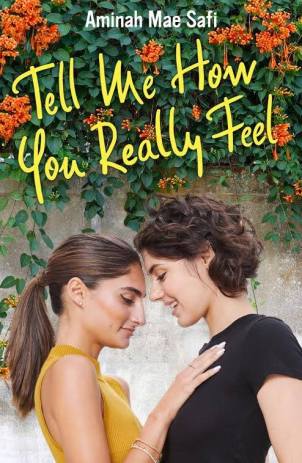
This book was alright. There was a lot of hype around it before it released and I…don’t really agree. I liked both characters. I enjoyed the plot. Okay, I enjoyed the entire book, except. Except. Rachel BLINDLY hates beautiful people. Which is ridiculous, given (at least on the cover) she’s far from ugly herself. I just don’t get her blind hatred of beautiful people. She’s spent the last three years hating Sana because, what? Sana had the guts to ask her out while being pretty? That plot point just kept pulling me out of the story. Which was otherwise really good! But two pretty girls on the cover and one of them hates pretty people but has no self-awareness that she is ALSO pretty? I don’t recall the text actually saying whether Rachel is pretty or not, but Sana obviously thinks so.

This might be an issue with whoever designed the cover not understanding the plot of the book; I know authors don’t always have full control over their covers. But it REALLY made that particular plot point confusing.

This book is also another example of the cover description being misleading. Rachel doesn’t “realize” that Sana is perfect for the role and try to cast her; her supervisor informs her that Sana will be in that role and she’ll just have to make it work. It’s a bit of a different dynamic.

Sooooo I don’t know whether to recommend the book or not. It was good, but I was annoyed by that plot point. Rachel and Sana were the only developed characters; everyone else was only there to further their story. Which is not always a bad thing; but I generally like the supporting cast to be a little bit more developed. They are people too, they shouldn’t solely exist to drive the romance between the two main characters.

As a lesbian romance, this was great. As a well-rounded book, not so much.

From the cover of Tell Me How You Really Feel:

The first time Sana Khan asked out a girl – Rachel Recht – it went so badly that she never did it again. Rachel is a film buff and an aspiring director, and she’s seen Carrie enough times to learn you can never trust cheerleaders (and beautiful people). Rachel was furious that Sana tried to prank her by asking her out on a date.

But when it comes time for Rachel to cast her senior project, she realizes that there’s no one more perfect than Sana – the girl she’s sneered at in the halls for the past three years – to play the lead role. And poor Sana – she says yes. She never did get over that first crush, even if Rachel can barely stand to be in the same room as her.

Told from alternating viewpoints and set against the backdrop of LA in the springtime, when the rainy season rolls in and the Santa Anas can still blow, these two girls are about to learn that in the city of dreams, anything is possible – even love.

Book Review: Technically, You Started It

technically you started itTechnically, You Started It
by Lana Wood Johnson
Young Adult Romance / LGBT
374 pages
Published June 2019

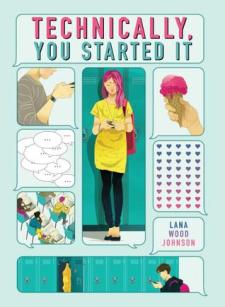
So the biggest reason for my recent hiatus was that I was having trouble reading. If I can’t read, I can’t review! And every time I tried to read a book, I fell asleep. I just couldn’t pay attention to pages of text. I knew, however, that this book had a demisexual protagonist, and I thought that might be enough to keep my attention. I opened the book, and found that the entire thing was written in text message format with speech bubbles, instead of giant blocks of text. Which was EXACTLY what I needed to hold my interest!

This is a precious book, told entirely via text messages between Haley, a demisexual girl, and Martin, a bisexual boy. Which, hi, that’s my life? Most of the bisexual men I’ve been reading lately have been in M/M relationships, so it’s nice to see a bisexual boy in a relationship with a girl. AND that they address the viewpoint of many people towards bi boys – that they’ll cheat. (That’s a biphobic attitude that is aimed at bi people of all genders, but it seems especially prevalent from women towards bi men.)

I love both of these characters; I love that they bring up that things can be so much easier to say via text than face-to-face. I love the far-reaching, random conversations the two have, and the in-jokes they create.

You’d think a romance would be hard to tell without description – only text is similar to only dialogue. But Johnson manages, and does it superbly.

This was the perfect book to break my reading slump, and I love it so much.

From the cover of Technically, You Started It:

Is This Haley Hancock from Mrs James’s US History class?

Yeah.
Who’s this?

Martin Nathaniel Munroe II

Which one?
You’re both in my US History class.

The good one.

When a guy named Martin Nathaniel Munroe II texts you, it should be obvious who you’re talking to. Except there’s two of them (it’s a long story), and Haley thinks she knows which one is “the good one.”

A question about a class project rapidly evolves into an all-consuming conversation. Haley finds that Martin is actually willing to listen to her weird facts and unusual obsessions, and Martin feels like Haley is the first person to really see who he is. Haley and Martin might be too awkward to hang out in real life, but over text, they’re becoming addicted to each other.

There’s just one problem: Haley doesn’t know who Martin is. And Martin doesn’t know that Haley doesn’t know. But they better figure it out fast before their meet-cute becomes an epic meet-disaster . . . 

Book Review: Dark Lycan

dark lycanDark Lycan
by Christine Feehan
Paranormal Romance
384 pages
Published 2013

Oof. It has been a weekend, folks. The husband woke up with severe vertigo Saturday morning, and we wound up in the ER most of Sunday for it. Verdict is an inner ear problem (go see a specialist!) and slight dehydration. That took seven hours? So after a full day of worrying about him Saturday, and seven hours ferrying him around a hospital Sunday, I am EXHAUSTED. So this is going to be a quick one.

Dark Lycan is the twenty-first (!!!) book in the Dark series, Christine Feehan’s epic world of Carpathians and vampires. And yes, they’re different. I don’t think that number counts her “Wild” books, on leopard shifters, even though they exist in the same world. Dark Lycan introduces (I think, it’s possible they were mentioned in an earlier book, but I don’t recall them) a new species, the Lycans. Lycans are to werewolves as Carpathians are to vampires.

I suppose I should explain that.

Vampires are Carpathians that have given up their souls. They are almost invariably men, because male Carpathians eventually lose the ability to feel emotions and see colors (the better to be hunters of vampires, often their former friends and family) unless they find their lifemate. This is where the paranormal romance comes in. Each book is a story of a Carpathian finding his lifemate and “claiming” her. It’s an ancient ritual that binds their souls together, giving them a telepathic and empathic connection and involves a lot of sex and exchanging blood and yadda yadda yadda basic vampire erotica.

The Dark series is a bit formulaic – dominant powerful hero, sassy heroine that doesn’t know what he’s capable of, outside danger to them both, instant love because she brings color back to his world and he has a primal need to bind her and have sex with her and yeah. I’d stopped reading several years back (and I had a TON of these books!) because I was a bit tired of the near-chauvinism and almost-forced sex storylines. But I wanted some mindless guilty pleasure and the Dragonseeker bloodline (a specific family line of Carpathians had always intrigued me. So I picked this up and was pleasantly surprised. Fenris didn’t force Tatijana – on the contrary, he didn’t want to bind them. (Maybe Feehan’s modernizing slightly?)

Feehan’s strength, I think, is in introducing characters whose love stories you want to read. In this book we see a bit more of Fenris’ brother and his lifemate, who is also not yet bound, and they’ve been a slow-burn through several books because I remember them from when I stopped reading, a couple books before this one! This book also introduces Tatijana’s sister, and the man who will be her lifemate – but he’s a Lycan, so that’s…strange. The normal formula is that the man is always a Carpathian, but the woman isn’t always. She can be converted (because they do work off standard vampire mythos) so I assume that’s what they’ll do to her lifemate? Anyway, I’ve learned those two couples are the next two books, so I’ve put holds on those at the library because now I’m hooked again!

Side note: I thought this was going to be a quick paragraph or two fired off, but then I started talking about the background and – well I used to really love these books. Apparently.

So. In Dark Lycan we introduce the Lycans, have a new, real partnership between equals, and actually have a bit LESS explicit sex than I’m used to seeing in the Dark books. Cool. The pacing was a little weird, but the combat with vampires is never really the point of the books, it’s the romance and the feelings and the sex, so whatever. These aren’t great literature. They’re hot fluff when you need to turn your brain off for a while (and maybe turn other things on).

If you like Paranormal Romance, and don’t mind your heroes very dominant and rather forceful, you’d probably enjoy this series. I’d recommend starting at the beginning, though, because all the characters and background history would be VERY confusing to someone that hasn’t learned it through the books. Goodreads has them listed in order.

From the cover of Dark Lycan:

Tatijana of the Dragonseekers spent centuries encased in ice with her sister, trapped in limbo between life and death, never speaking to a soul other than those who tormented her. Now, she has been freed from her frozen prison by an unknown descendant. Awakened in human form, Tatijana yearns to explore the modern world in which she now lives – a world with more mysteries than she is prepared for.

Fenris Dalka has returned to the Carpathian Mountains after a long absence to be with his brother. He is scarred by centuries of battle, and every hard-won victory has been stamped into his bones. But the real reason for his return home could prove deadly if discovered by the wrong man – or woman. Upon his arrival, he is compelled by a beautiful and enigmatic stranger who carries the scent of fresh earth, of forest, of the night itself.

In time Tatijana and Fenris will discover all that unites them – their secrets and pasts, their predators, and the hot flash of passion that stirs their souls. Yet just as surely, seduced into the silvery darkness of a full-moon night, they’ll also discover everything ancient and evil that exists to destroy them.