Book Review: Queens of Geek

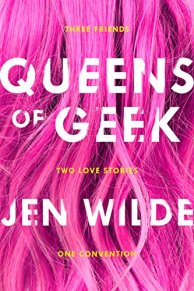
queens of geekQueens of Geek
by Jen Wilde
Contemporary YA
262 pages
Published 2017

THIS BOOK WAS GREAT. It was a fun, quick read, but it involved three BFFs, one of which is autistic with social anxiety, and her friends know this and are incredibly supportive. The second girl is openly bisexual. The third friend, the boy, is Hispanic. The three of them take an epic trip to a big Comicon in LA; the bisexual girl (Charlie) co-starred in a zombie movie, and is a popular Youtuber, so when she’s invited to the Con she drags her two BFFs with her. Once there, she meets an idol of hers, another Youtuber, and discovers that her idol has a crush on her! So while dealing with her douchebag ex (her co-star from the movie), the other Youtuber asks Charlie out, and the two girls start a romance.

Meanwhile, the autistic girl (Taylor) and the Hispanic boy (Jamie) have loved each other for ages but been too afraid to admit how they feel. Largely left on their own, because Charlie’s manager couldn’t get them VIP passes, they explore the Con, geeking out over things and meeting another autistic woman, a comic book artist who gives Taylor some amazing advice about being afraid but doing things anyway.

I really really loved this book. I loved seeing autistic characters treated by their peers as just regular people with quirks, like everyone has. Taylor’s friends support her when her brain freaks out, and make allowances for her needs, but don’t treat her like she’s disabled or fragile. I loved seeing how tight the bonds of friendship were between the three teens, and how excited for each other they were, even when good things happening meant less time to spend with each other.

This was just a really lovely, feel-good book with lots of minority representation, by an autistic author who knows what she’s talking about. This is one more book off my Autism Reading List, and my pick for a book about friendship from the Litsy Booked 2018 Challenge.

From the cover of Queens of Geek:

Charlie likes to stand out. She’s a vlogger and actress promoting her first movie at SupaCon, and this is her chance to show fans she’s over her public breakup with co-star Reese Ryan. When internet-famous cool-girl actress Alyssa Huntington arrives as a surprise guest, it seems Charlie’s long-time crush on her isn’t as one-sided as she thought.

Taylor likes to blend in. Her brain is wired differently, making her fear change. And there’s one thing in her life she knows will never change: her friendship with her best guy friend Jamie—no matter how much she may secretly want it to. But when she hears about a fan contest for her favorite fandom, she starts to rethink her rules on playing it safe.

Book Review: Circe

CirceCirce
by Madeline Miller
Mythological retelling
400 pages
Published April 2018

Circe was my April Book of the Month club pick, and WOW was it epic. I haven’t read Song of Achilles, but I just put a hold on it with my library, because this book was amazing. So amazing, in fact, that it sent me into a bit of a reading slump – what book could follow up this masterwork?

This is actually going to be a pretty short review because I’m just in awe of this book. Circe begins as a somewhat naive child in her father’s household, unaware of her own power until her brother points it out to her. For those powers, she is banished to a deserted island, but her powers only grow from there. We meet many figures of Greek mythology – from gods and goddesses to mortals and monsters like Scylla and the Minotaur.

I just don’t even know how to properly review this book other than it was amazing. If you like Greek mythology at ALL, you should read this book. It’s captivating.

From the cover of Circe:

In the house of Helios, god of the sun and mightiest of the Titans, a daughter is born. But Circe is a strange child–not powerful, like her father, nor viciously alluring like her mother. Turning to the world of mortals for companionship, she discovers that she does possess power–the power of witchcraft, which can transform rivals into monsters and menace the gods themselves.

Threatened, Zeus banishes her to a deserted island, where she hones her occult craft, tames wild beasts and crosses paths with many of the most famous figures in all of mythology, including the Minotaur, Daedalus and his doomed son Icarus, the murderous Medea, and, of course, wily Odysseus.

But there is danger, too, for a woman who stands alone, and Circe unwittingly draws the wrath of both men and gods, ultimately finding herself pitted against one of the most terrifying and vengeful of the Olympians. To protect what she loves most, Circe must summon all her strength and choose, once and for all, whether she belongs with the gods she is born from, or the mortals she has come to love.

With unforgettably vivid characters, mesmerizing language and page-turning suspense, Circe is a triumph of storytelling, an intoxicating epic of family rivalry, palace intrigue, love and loss, as well as a celebration of indomitable female strength in a man’s world.

Book Review: The Astonishing Color of After

astonishingcolorThe Astonishing Color of After
by Emily X. R. Pan
Fiction – Magical Realism
470 pages
Published March 2018

So I finally subscribed to the Book of the Month club. Every month they select several books, and you get to pick one or more. (It’s an extra $10 for each one past the first, but they are GORGEOUS hardcovers, it’s worth it!) So for my first box I chose The Astonishing Color of After and Eleanor Oliphant is completely fine, both books I’ve heard a lot of great things about. They’re also both debut novels, which is something I’ve had a lot of really good luck with. And that held true for this one, certainly!

Just WOW. The Astonishing Color of After is about a teenage girl, an artist, dealing with her mother’s depression and ensuing suicide. Part of what makes the book so fascinating is Leigh’s constant description of colors. She uses color as shorthand for emotions – her grandmother might have a vermilion expression on her face, or she might be feeling very orange while staring at her mother’s coffin at the funeral. Between colors-as-feelings and her insomnia-induced hallucinations (or magic – the book is deliberately, I think, noncommittal on whether some things only happen in her head or not) the entire book feels a little surrealistic. But grief and mourning DO feel surrealistic. The book is amazingly evocative and emotional and I absolutely adore it. This, along with City of Brass and Children of Blood and Bone, are definitely on my Best of 2018 list.

As an added bonus, the author is the American child of Taiwanese immigrants herself. So all the ghost traditions and folklore from Leigh’s journey to Taiwan are from her ancestry as well.

This book was gorgeous. It may need a trigger warning for depression and suicide. If you can handle those themes, read it.

From the cover of The Astonishing Color of After:

“I didn’t cry. That was not my mother. My mother is free in the sky. My mother is a bird.”

Leigh Chen Sanders is absolutely certain about one thing: When her mother died by suicide, she turned into a bird.

Leigh, who is half Asian and half white, travels to Taiwan to meet her maternal grandparents for the first time. There, she is determined to find her mother, the bird. In her search, she winds up chasing after ghosts, uncovering family secrets, and forging a new relationship with her grandparents. And as she grieves, she must try to reconcile the fact that on the same day she kissed her best friend and longtime secret crush, Axel, her mother was taking her own life.

Alternating between reality and magic, past and present, hope and despair, The Astonishing Color of After is a stunning and heartbreaking novel about finding oneself through family history, art, bravery, and love.

Book Review: City of Brass

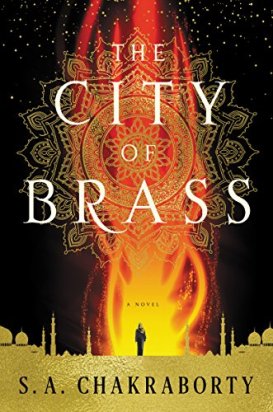
city of brassCity of Brass
S. A. Chakraborty
Fantasy
400 pages
Published November 2017

So much to say about this outstanding debut novel! First I’d like to address the issues around the author, then I’ll delve into the book itself. (It’s fantastic, though!)

So the book has been touted as an “own voices” novel, seemingly much to the author’s chagrin. She is Muslim, but she’s a white convert (Chakraborty is her married name). She has striven to correct the misconception about her ethnicity when she finds it, tweeting about it and talking about it in interviews. (This interview is a good example.) Because the book is pure fantasy, in a fantasy realm after the first few chapters, I’m not too worried about it not actually being written by a middle-eastern author. She does note in the interview I linked that she’s not qualified to write some stories because of her ethnicity, and I appreciate that recognition of privilege. As far as I can tell, (as a white person myself) she did justice to the bits of mythology that she included. (Given the reception by people who were so excited about it being an Own Voices book, I think I’m probably right.) Her twitter (@SChakrabs) is FULL of links to minority authors and retweets about their books. I am very impressed by the level of her advocacy for minority authors.

So that aside, I LOVED THIS BOOK. I almost always enjoy fantasy inspired by non-western mythology: Children of Blood and Bone was fantastic, and though Forest of a Thousand Lanterns had a western fairytale at its heart, being reimagined through an Asian lense was really neat to read. The Bear and The Nightingale and The Girl in the Tower were Russian inspired, as were The Crown’s Game/The Crown’s Fate. I really do try to pick up non-western inspired fantasy when I can. City of Brass scratched that itch perfectly.

City of Brass opens in Cairo, where our heroine, Nahri, is a con-woman with small healing magics. When a ritual goes awry, she’s thrust into the world of the djinn. It’s when Nahri and her accidental bodyguard, Dara, arrive at the Djinns’ city of Daevabad that the story really gets started.

I’m still a little confused about the difference between djinn and Daeva; Daeva seem to be one of the tribes but also the name for the entire race, and some of them get offended at being called djinn but some of them don’t? I’m not really sure about that distinction. There is a clear line between djinn and Ifrit, though – Ifrit are immensely powerful, immortal beings who refused to subject themselves to punishment many centuries ago. I’m not sure I actually see a downside to being Ifrit, other than the djinn all think they’re evil. The Ifrit, however, are out to get Nahri, and Dara’s not having any of THAT.

I love Dara – he’s a fascinating character, with a violent, mysterious backstory. I’m very eager to read more about him and figure out exactly what’s up with his background. Nahri is also awesome – a little arrogant, but by the end of the book she’s starting to learn she might need help from those around her. Unfortunately, also by the end of the book she doesn’t know who to trust. The naive djinn prince, Ali, is the third main character of the book, and while I can see him having an interesting story, his personality is still a little flat. Hopefully the second book will see advancement in all three of these characters’ personalities.

And I can’t WAIT for the second book! City of Brass didn’t exactly end on a cliffhanger, but it did leave many questions unanswered and our main characters’ fates uncertain. Unfortunately, I can’t find any information on the sequel, just that it’s being edited. No release date or title yet.

Read this book. It’s fantastic.

From the cover of City of Brass:

Nahri has never believed in magic. Certainly, she has power; on the streets of eighteenth-century Cairo, she’s a con woman of unsurpassed talent. But she knows better than anyone that the trades she uses to get by—palm readings, zars, and a mysterious gift for healing—are all tricks, both the means to the delightful end of swindling Ottoman nobles and a reliable way to survive. 

But when Nahri accidentally summons Dara, an equally sly, darkly mysterious djinn warrior, to her side during one of her cons, she’s forced to reconsider her beliefs. For Dara tells Nahri an extraordinary tale: across hot, windswept sands teeming with creatures of fire and rivers where the mythical marid sleep, past ruins of once-magnificent human metropolises and mountains where the circling birds of prey are more than what they seem, lies Daevabad, the legendary city of brass—a city to which Nahri is irrevocably bound.

In Daevabad, within gilded brass walls laced with enchantments and behind the six gates of the six djinn tribes, old resentments run deep. And when Nahri decides to enter this world, her arrival threatens to ignite a war that has been simmering for centuries. 

Spurning Dara’s warning of the treachery surrounding her, she embarks on a hesitant friendship with Alizayd, an idealistic prince who dreams of revolutionizing his father’s corrupt regime. All too soon, Nahri learns that true power is fierce and brutal. That magic cannot shield her from the dangerous web of court politics. That even the cleverest of schemes can have deadly consequences. 

After all, there is a reason they say to be careful what you wish for . . .