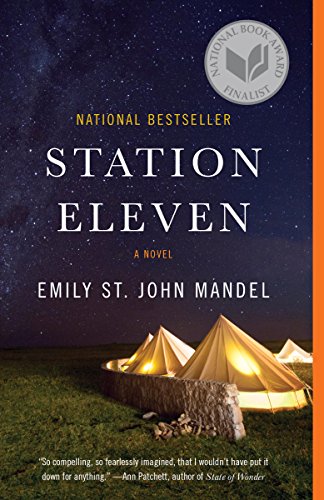
Station Eleven
by Emily St. John Mandel
Dystopia/Post Apocalypse
333 pages
Published 2014
This was marketed as a dystopia, but it’s really more post-Apocalypse fiction. There’s a fine line between the two – and sometimes things can straddle it – but I wouldn’t call this a dystopia. So I’m a little disappointed there. Otherwise, it was good. I’m left not really sure how I should feel about it, though. I prefer books that make me feel a certain way – romances make me happy, non-fiction usually makes me feel smarter, like I’ve learned something, graphic novels make me nostalgic. I’m even okay with books like The Fault in Our Stars, or The Crown’s Game, that left me a weeping mess. Station Eleven just left me with an “…o-kay?” Like, what am I supposed to do with this? Unlike most dystopias, I don’t feel like it was a social commentary because it’s post-apocalyptic. (In this case, a virus swept through and killed about 99% of Earth’s population.) But at the same time, because it details events both before and after the apocalypse, I feel like it was trying to be?
The book focuses on how Arthur Leander, a famous actor, touches lives both before and after the apocalypse. It’s a little ironic that it focuses so much on him since he died before it happened. Well. As it started to happen, really, but of a heart attack, not the virus. It rotates between a few different perspectives, but the one used most often is that of Kirsten, who was a child actor in Arthur’s last performance. She survives the apocalypse and ends up traveling with “The Traveling Symphony,” a band of actors and musicians who travel between far-flung settlements around the Great Lakes. The name refers to a comic book drawn by Arthur’s first wife. There’s a dozen little coincidences in the book, leading to people who knew Arthur meeting or almost meeting, but affecting each others’ lives. There are also flashbacks showing Arthur’s life before the apocalypse, and how those people knew him.
I don’t know. It didn’t jump around as much as Oryx and Crake did, it was much easier to follow, but it just left me – meh? It wasn’t a bad book, but I don’t think I’d recommend it. I know other people have given it glowing reviews, so I might just be the odd person out.
A large part of the book takes place in Toronto and British Columbia, and the author is Canadian, so this book is my #3 for the Read Canadian Challenge!
My Read Canadian Book Reviews:
- An Astronaut’s Guide to Life on Earth
- The Red Winter Trilogy
- this book
- The Courier
- The Last Neanderthal
- American War
- Next Year, For Sure
- That Inevitable Victorian Thing
- All The Rage
- Saints and Misfits
- Tomboy Survival Guide
- The Clothesline Swing
- The Wolves of Winter
From the cover of Station Eleven:
An audacious, darkly glittering novel set in the eerie days of civilization’s collapse, Station Eleven tells the spellbinding story of a Hollywood star, his would-be savior, and a nomadic group of actors roaming the scattered outposts of the Great Lakes region, risking everything for art and humanity.
One snowy night Arthur Leander, a famous actor, has a heart attack onstage during a production of King Lear. Jeevan Chaudhary, a paparazzo-turned-EMT, is in the audience and leaps to his aid. A child actress named Kirsten Raymonde watches in horror as Jeevan performs CPR, pumping Arthur’s chest as the curtain drops, but Arthur is dead. That same night, as Jeevan walks home from the theater, a terrible flu begins to spread. Hospitals are flooded, and Jeevan and his brother barricade themselves inside an apartment, watching out the window as cars clog the highways, gunshots ring out, and life disintegrates around them.
Fifteen years later, Kirsten is an actress with the Traveling Symphony. Together, this small troupe moves between the settlements of an altered world, performing Shakespeare and music for scattered communities of survivors. Written on their caravan, and tattooed on Kirsten’s arm, is a line from Star Trek: “Because survival is insufficient.” But when they arrive in St. Deborah by the Water, they encounter a violent prophet who digs graves for anyone who dares to leave.
Spanning decades, moving back and forth in time, and vividly depicting life before and after the pandemic, this suspenseful, elegiac novel is rife with beauty. As Arthur falls in and out of love, as Jeevan watches the newscasters say their final good-byes, and as Kirsten finds herself caught in the crosshairs of the prophet, we see the strange twists of fate that connect them all. A novel of art, memory, and ambition, Station Eleven tells a story about the relationships that sustain us, the ephemeral nature of fame, and the beauty of the world as we know it.


 Goddess In The Stacks