Book Review: The Ruins of Lace

ruinsoflaceThe Ruins of Lace
by Iris Anthony
326 pages
Published 2012
Historical Fiction

The Ruins of Lace is told from 7 different points of view, and while at first they appear disconnected, they slowly touch each other, then weave in and out, like lace itself. The story revolves around the creation, sale, and smuggling of banned lace in 17th century France. The points of view are a lacemaker, her sister, a girl who once ruined a pair of lace cuffs, the man who loves her, a lace-smuggling dog, a border guard, and a petty noble fighting for his inheritance.

As much as I’ve read about 17th century France, the clandestine lace trade was one aspect I really didn’t know about, so it was interesting to see how it impacted common folk and nobles alike.

While not as spell-binding as some books I’ve read, The Ruins of Lace was definitely thought-provoking. What drives an otherwise good man to smuggle lace and risk his honor/title/fortune/life? Without the viewpoints of the lacemaker and the smuggler’s dog, you could imagine lace-smuggling to be a victimless crime. Including the viewpoints of those two was brilliant – you can’t say the man who needs the lace isn’t hurting anyone. If there wasn’t such demand for the banned lace, girls wouldn’t sit in convents and go blind making it 24/7.

All in all, a very good book on a little-known aspect of 17th-century France. The differing points of view are a little confusing at first, but once you settle in and know the characters, it’s fairly easy to follow the storyline.

From the back of The Ruins of Lace:

The mad passion for forbidden lace has infiltrated France, pulling soldier and courtier alike into its web. For those who want the best, Flemish lace is the only choice, an exquisite perfection of thread and air. For those who want something they don’t have, Flemish lace can buy almost anything – or anyone. 

For Lisette, lace begins her downfall, and the only way to atone for her sins is to outwit the noble who now demands an impossible length of it. To fail means certain destruction. But for Katharina, lace is her salvation. It is who she is; it is what she does. If she cannot make this stunning tempest of threads, a dreaded fate awaits. 

A taut, mesmerizing story, The Ruins of Lace explores the intricate tangle of fleeting beauty, mad obsession, and ephemeral hope.

Book Review: Ragnarok: The End of the Gods by A. S. Byatt

ragnarokRagnarok: The End of the Gods
by A. S. Byatt
171 pages
Published 2011
Fiction

This was an interesting little read. It’s short – I finished it in a little over an hour – but unique. It details the birth, life, and death of Scandinavian mythology, as seen through the eyes of a young girl reading the book “Asgard and the Gods” during World War 2. With her father away fighting the war, and her life turned upside down by a move to the country to avoid The Blitz, she finds comfort in the myths and stories she reads. It’s a very good summary and retelling of the myths, fueled by gorgeous descriptions and deeply personal connections to them. The “thin child” reading the myths is the author herself, so in a way it’s autobiographical. (Other reviewers have called it “a love letter to Asgard and the Gods.”)

If you know the Scandinavian myths very well, the book might not hold much interest for you, but if you have only a basic understanding of them, as I did, this book is absolutely spellbinding. There are parts that felt like they were talking about my childhood, too:

“She was a logical child, as children go. She did not understand how such a nice, kind, good God as the one they prayed to, could condemn the whole earth for sinfulness and flood it, or condemn his only Son to a disgusting death on behalf of everyone. This death did not seem to have done much good. There was a war on. Possibly there would always be war on. The fighters on the other side were bad and not saved, or possibly were human and hurt. The thin child thought that these stories – the sweet, cotton-wool meek and mild one, the barbaric sacrificial gloating one, were both human make-ups, like the life of the giants in the Riesengebirge. Neither aspect made her want to write, or fed her imagination. They numbed it. She tried to think she might be wicked for thinking these things. She might be like Ignorance, in Pilgrim’s Progress, who fell into the pit at the gate of heaven. She tried to feel wicked. But her mind veered away, to where it was alive.”

Ragnarok is part of a series retelling old fairytales and legends called The Canongate Myths. Each one is by a different author – The Penelopiad by Margaret Atwood, Dream Angus by Alexander McCall Smith, Weight by Jeanette Winterson. Ragnarok is listed as #17 in the series on Goodreads! I’m not going to list them all here, but you can find the full list on Goodreads. I may have to pick up a few more of them, if they’re all of the same quality as Ragnarok.

From the back of Ragnarok: The End of the Gods:

As the bombs of the Blitz rain down on Britain, one young girl is evacuated to the countryside. She is struggling to make sense of her new life, whose dark, war-ravaged days feel very removed from the peace and love being preached in church and at school. Then she is given a copy of Asgard and the Gods – a book of ancient Norse myths – and her inner and outer worlds are transformed. She feels an instant kinship with these vivid, beautiful, terrifying tales of the end of the gods – they seem far more real, far more familiar during these precarious days.

Book Review: Nightshifted by Cassie Alexander

nightshiftedNightshifted
by Cassie Alexander
341 pages
Published 2012
Urban Fantasy

Nightshifted in most ways is your typical urban fantasy book. It’s got the hidden supernatural world that most mortals don’t know about, with one mortal drawn in who must flounder her way around among vampires, shapeshifters, weres, zombies, and more. This one has a bit of an interesting twist to it, however. In most urban fantasy books, there’s some sort of hidden hospital, usually with a supernatural that was a doctor before they were turned to whatever flavor of supernatural they now are. In Nightshifted, that hidden hospital is Y4. Y4 is the bottom, hidden level of County Hospital. Here regular, mortal nurses take care of supernatural patients. One of those nurses is Edie Spence. She was offered the job by a mysterious, shadowy man, that told her if she took it, they’d make sure her junkie brother got clean, and stayed clean. Now she has a name badge that glows when something funky is going on, patients that sometimes require a tranq rifle, and a whole heap of troubles.

In Nightshifted, the first in the series, Edie accidentally leaves one arm of a patient unrestrained. In his delirium, he yanks out a vital tube and dies. The last thing he’d told her was “Save Anna.” Not knowing whether she’s under a Compulsion or doing it of her own free will, Edie sets out to find the mysterious Anna. She does eventually find her and kills one of the vampires holding her before they escape. The vampires decide she’s going to pay for that, and haul her in to a trial to decide her guilt and sentence. But Anna is more than she seems, and bringing Edie to trial may be more trouble than it’s worth…

The next book in the series is Moonshifted, followed by Shapeshifted, and, in December, Deadshifted. Due to the unique viewpoint of these books, I’ll definitely be looking for them.

There’s a tiny romance sub-plot, but it’s very much a SUB-plot and is secondary to the action in every way. Why don’t we get kick-ass, self-sufficient heroines in romance novels?

From the back of Nightshifted:

Nursing school prepared Edie Spence for a lot of things. Burn victims? No problem. Severed limbs? Piece of cake. Vampires? No way in hell. But as the newest nurse on Y4, the secret ward hidden in the bowels of County Hospital, Edie has her hands full with every paranormal patient you can imagine – from vamps and were-things to zombies and beyond…

Edie’s just trying to learn the ropes so she can get through her latest shift unscathed. But when a vampire servant turns to dust under her watch, all hell breaks loose. Now she’s haunted by the man’s dying word – Save Anna – and before she knows it, she’s on a mission to rescue some poor girl from the undead. Which involves crashing a vampire den, falling for a zombie, and fighting for her soul. Grey’s Anatomy was never like this….

Book Review: The Underworld Detection Agency Chronicles by Hannah Jayne

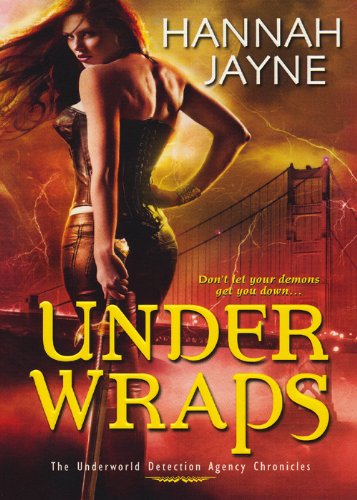
underwrapsUnder Wraps
by Hannah Jayne
343 pages
Published 2011

Under Attack
by Hannah Jayne
342 pages
Published 2011

Under Suspicion
by Hannah Jayne
347 pages
Published 2012
Urban Fantasy

So this is a series review, rather than a single book review. The Underworld Detection Agency Chronicles by Hannah Jayne revolves around Sophie Lawson, a human immune to magic, and her vampire roommate, Nina. They both work for the Underworld Detection Agency, an organization that licenses and keeps track of demons and supernatural creatures, providing things like health insurance and legal services that the mundane world simply wouldn’t be able to handle. (Who’s going to survive serving court-ordered papers to a dragon?)

The action was good in all three books; my main gripe is that for a book with a female lead who spends a lot of time fantasizing about men – there were no sex scenes until 40 pages from the end of the third book, and THAT was a fade to black after the kissing. I kinda feel like these books just teased me along for three books and then didn’t even bother to deliver! I mean, when in the FIRST CHAPTER of the FIRST BOOK you get this:

Hayes and I settled into identical plush leather cigar chairs opposite Mr. Sampson. I stifled a delighted Carrie Bradshaw grin and made a mental note to tell Nina about the hot-male sandwich I found myself in: Pete Sampson with his miles-deep, chocolate brown eyes, close-cropped ash blond hair, and GQ model build; and Detective Parker Hayes, rich blue eyes, chiseled jawline sprinkled with stubble, Roman god nose – I’d leave out the part about him being smug. 

One kind of expects that to GO somewhere! (Especially since the ogling goes on for several paragraphs…) Also, that’s not how you use a semi-colon.

underattack

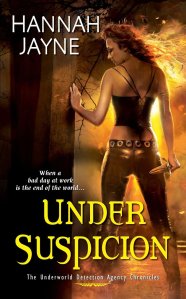
The other complaint I have is that the covers show her looking badass – redhead in a bustier, holding a pair of guns or a sword or a dagger – when in reality she’s anything but. Her only power is being immune to magic and having friends. She pukes when she sees her first corpse, is taught to shoot in the first book but when confronted with a home invader, rather than shoot him, she THROWS THE GUN AT HIM. This chick is ANYTHING but badass. She’s not even terribly smart. She is likable though, and I did enjoy the books. I was just disappointed they didn’t quite live up to my expectations.

From the back of Under Wraps:

As a human immune to magic, Sophie Lawson can help everyone from banshee to zombie transition into normal, everyday San Francisco life. With a handsome werewolf as her UDA boss and a fashionista vampire for a roommate, Sophie knows everything there is to know about the undead, the unseen, and the uncanny.

Until a rash of gruesome murders has demons and mortals running for cover, and Sophie finds herself playing sidekick to detective Parker Hayes. Dodging raging bloodsuckers, bad-tempered fairies, and love-struck trolls is one thing. But when Sophie discovers Parker isn’t what he seems, she’s got only one chance to figure out whom to trust. Because an evil hiding in plain sight is closing in… and about to make one wisecracking human its means to ultimate power.

From the back of Under Attack:

Sophie Lawson is a human immune to magic, which comes in handy for helping paranormal beings transition into everyday life. But fallen angel Alex Grace and his search for the Vessel of Souls is one curse she never saw coming. Suddenly an unexplainable string of killings and destruction has even San Francisco’s demons fearing for their immortal lives. And Sophie isn’t about to trust Alex’s all-too-vulnerable charm or his secret agenda. Now their hunt is revealing dangerous secrets about Sophie’s past, and a malevolent power hellishly close to turning one irreverent human into the ultimate supernatural weapon.

undersuspicion

From the back of Under Suspicion:

Being a human immune to magic helped Sophie Lawson get promoted. It’s also made her a major, very reluctant player in a game that stretches beyond even the Underworld. having handsome buttoned-down Englishman Will as her new guardian is one tempting blessing, especially since sexy fallen angel Alex is mysteriously MIA lately. But as a frightening number of demons start disappearing around the city, Sophie suspects that an Armageddon-level prophecy is about to become everyone’ nightmare. And her investigation is testing her bravery – and Will’s unexpected vulnerability – in ways neither could predict. Now Sophie and Will are fast running out of time as an unstoppable evil prepares to lay waste to demons and humans alike.

Having typed out the backs of these three books, I have a few more things to say. Specifically about the last one because it’s misleading as hell. There was no prophecy. Anywhere. Unless I COMPLETELY missed something. Final call: these books are decent fluff. I’m not going to bother with the rest of the series though.

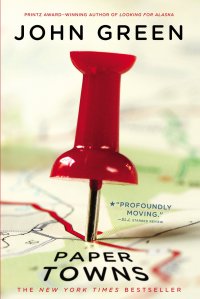
Book Review: Paper Towns by John Green

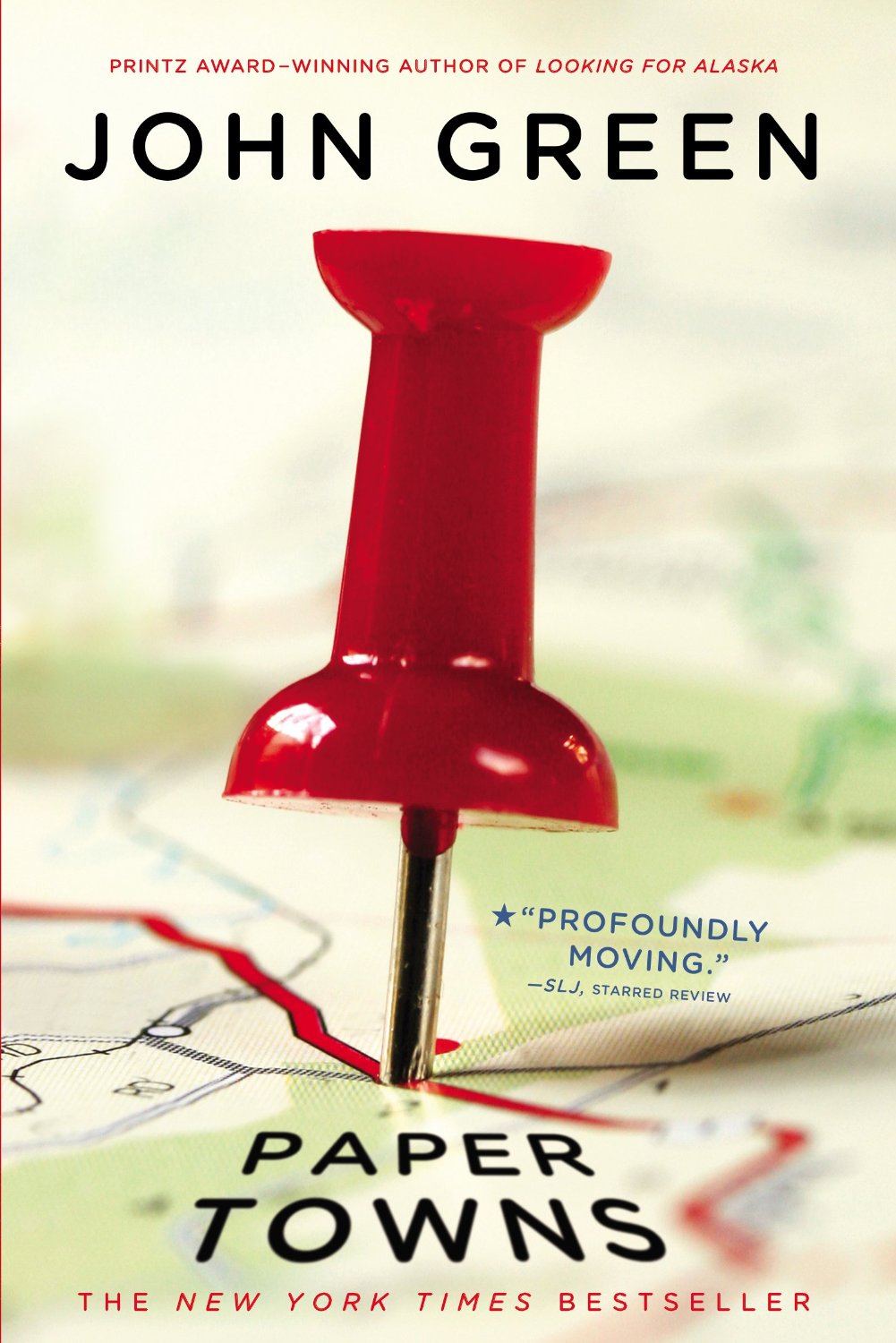
papertownsPaper Towns
by John Green
305 pages
Published 2008
Young Adult

So this is the last of John Green’s books that I hadn’t read. And it, like the others, boils down to much the same plot. Boy meets Girl, Girl affects Boy’s life in a profound way, Boy loses Girl and has to deal with the changes she’s wrought AND her absence. On one hand, I feel like Green needs to branch out and find a new plot, on the other hand, he writes this plot so well. And even within this plot he writes such different books. The Fault in Our Stars was slightly different, in that Girl lost Boy and had to deal with it. Unlike Looking For Alaska, in Paper Towns Girl didn’t die, but Boy still lost her nonetheless. In Will Grayson, Will Grayson, the plot was changed to “Boy meets Boy, Boy changes Boy’s world, Boy loses Boy and has to deal with the loss and the changes.” But in all four books the protagonist winds up dealing with something John Green has mentioned repeatedly in his vlogbrothers videos: imagining people complexly.

What does that mean?

It means not making preconceived notions of what people are or how they think. That woman who was rude to you yesterday, she’s a bitch, right? Instead of just deciding “well she’s rude and mean” imagine her complexly. Maybe she has a migraine, maybe she overslept and her entire morning was a cascade of failure. Maybe she has a sick kid and an out-of-work husband at home and they’re struggling to make ends meet on her minimum wage income. Imagine her complexly and you’ll realize that she has problems of her own, and maybe what you interpreted as a rude, mean-spirited remark was simply a tired tone of voice from a stressed-out woman. Maybe she was rude, maybe she looked at you as simply someone in her way because she didn’t imagine you complexly. Imagining people complexly is another way of saying “treat people like PEOPLE and not just bit players in your own little drama.” That can be a hard task when not everyone is doing it.

In Paper Towns, Margo Roth Spiegelman is an enigma, even to the boy who’s been her neighbor for sixteen years and from whose perspective the book is written. She’s been a different person to every person in high school, letting no one see the real Margo until she runs away and leaves a trail of clues for Quentin, her neighbor, to find. Quentin’s had a crush on her since he was ten, but it’s only in following her clues that he begins to see Margo as Margo, and not as the idea of Margo he had constructed.

It’s an important lesson, and maybe the reason it shows up in all of John Green’s books is because it is so incredibly important and yet so rare to find and so difficult to do. John talks about the concept in a speech he gave at the Alan Conference but the important part is here, I think:

“Let me tell you what is, in my opinion, the central problem of human existence: I am stuck in my body, in my consciousness, seeing out of my eyes. I am the only me I ever get to be, and so I am the only person I can imagine endlessly complexly. That’s not the problem, actually. The problem is you. You are so busy taking in your own wondrousness that you can’t be bothered to acknowledge mine.

When I was a kid, I believed in an embarrassingly total way that I was the only human being in the world and that all the other people, including my brother and parents and everybody, was in fact an alien, and that the aliens had created the entire world to do a series of controlled experiments on how a human child—me—would respond to various forms of trial and tribulation. And when I wasn’t around, they would take off their human costumes—the aliens had very advanced costuming technology, naturally—and they would do alien stuff. You know, go to the alien zoo and watch the alien local news and whatever else. I really believed this.

And obviously, on some level, this indicated the kind of massively narcissistic worldview that would later require decades of therapy to adjust. But in a way, I was right. I am the only person whose existence I can directly attest to. By the way, when I’ve talked about this in the past I’ve seen people nodding, like they also believed in their childhoods that they were the only real person in the world, and I would imagine that right now, some such people are probably feeling the comfort we feel when we learn that our delusions are shared, that we are not alone even in our darkest corners.

… I will acknowledge that you are all likely to be people. The probability that I am the only person in the world is extremely small—it is that number that infinitely approaches zero but isn’t zero. And yet. On some level, I have to take it on faith that you are as complex as I am, that your pain and joy and grief are as real and as meaningful as my own.”

The entire speech is very much worth reading. John Green is extremely eloquent (as good writers must be!) and his perspectives on things are usually worth reading.

From the back of Paper Towns:

Quentin Jacobsen has spent a lifetime loving the magnificently adventurous Margo Roth Spiegelman from afar. So when she cracks open a window and climbs back into his life – dressed like a ninja and summoning him for an ingenious campaign of revenge – he follows. 

After their all-nighter ends and a new day breaks, Q arrives at school to discover that Margo, always an enigma, has now become a mystery. But Q soon learns that there are clues – and they’re for him. Urged down a disconnected path, the closer he gets, the less Q sees the girl he thought he knew.

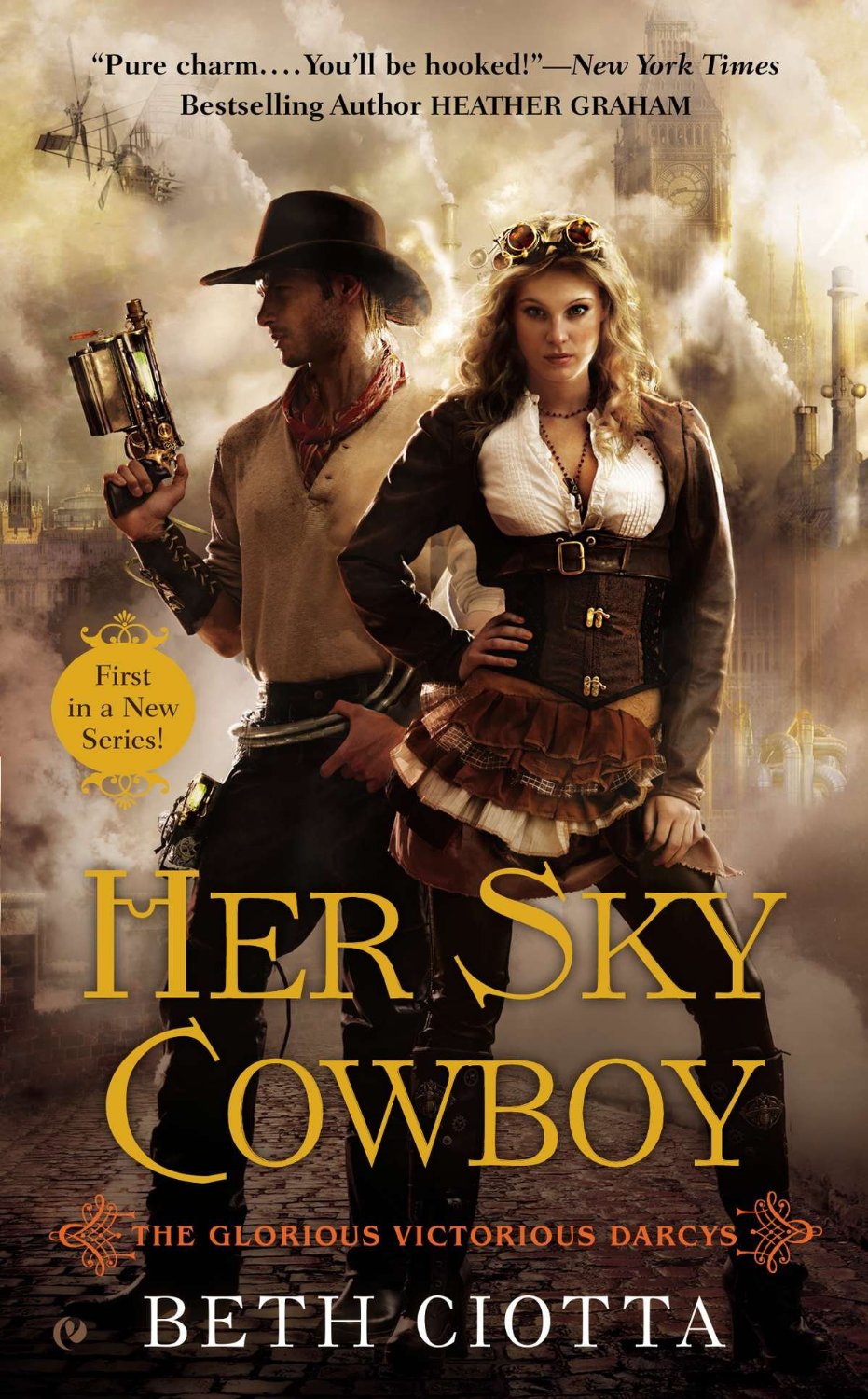
Book Review: Her Sky Cowboy

herskycowboyHer Sky Cowboy
by Beth Ciotta
342 pages
Published 2012
Steampunk

This book is FANTASTIC. It’s the closest thing to a feminist, egalitarian romance I’ve seen in quite some time, and the romance subplot is expertly woven into the main treasure hunt plot. With it all set against the steampunk backdrop of a time-travel-altered Europe, this is a spectacularly fun read.

The book is set in 1887, 31 years after the “Peace Rebels” traveled back in time from 1969. They came back to warn the world of the dangers of technology – they had stories of Hiroshima, and the Holocaust, and the horrors visited on the human race by nuclear bombs and tear gas and pollution and other terrible things. Their travel had a consequence, though – they apparently came from another dimension. They’re still human, but when “Mods” have children with “Vics” (Moderns vs Victorians), their children then get labeled “Freaks.” Freaks have kaleidoscope eyes – they’re said to look like time travel, or what the Mods saw when they traveled back to 1887. And Freaks all have some sort of ability – the main Freak in the book is a healer. Others can read minds, or control weather. The danger of this is that no Freak is older than 31 years old; no one knows what they’re truly capable of, not even themselves.

Mods came back in time to warn of the dangers of technology, but at the same time, some of them couldn’t resist re-inventing some of the things they’d left behind. And spreading their knowledge. So the setting is Victorian Europe (Britain, mostly) but with varying amounts of steam power, electric power, gas power – dirigibles and air-cycles and the rumors of a lost time-machine.

Among all of this lies the Darcy family. The Darcys have a family connection to the man that built the first time machine, and as such are somewhat rejected from society, since a lot of people are not very happy with the sudden technology and blame them for bringing it upon them. Baron Darcy is an eccentric inventor who can never focus on one thing long enough to see it through. His three children, Amelia (the heroine of this book) and her twin brothers, Simon and Jules, are all equally brilliant, but it’s Amelia that’s taken after her father the most. She dreams of captaining her own airship someday. When Baron Darcy dies and leaves the family destitute, their only hope to regain the family fortune (and respect from their countrymen) is a contest for Queen Victoria’s Golden Jubilee. They each receive a personal invitation to join the hunt for “lost or legendary technological inventions of historical significance.” (Future books follow Simon and Jules’ adventures in this quest, and I WILL be looking for those!)

Amelia’s quest leads her to run into Tucker Gentry, a notorious ex-Air Marshal from America. Convicted of a crime he didn’t commit and sentenced to hang, his crew rescued him and ran to Europe. Amelia and Tucker immediately strike sparks on each other and soon fall in love. And their love story is one of the best I’ve read recently. It’s repeatedly noted that it’s her mind and personality that drives Tucker wild – her aptitude with aeronautics, her sass, her ability to do things for herself. It’s also repeatedly demonstrated that she CAN, indeed, take care of herself. She rebuilds her air-cycle on his ship – or almost does, until one of his crew members takes over and adds a bunch of new stuff to it as thanks for saving his life. When she’s abducted he finds her having dinner with her captor, bargaining for her own release. She’s the one that leads them to the treasure, putting together the clues and finding the secret cave. It’s that self-sufficient streak that really captures Tucker’s heart: “By marrying you, I’m gaining the wife of my dreams, a woman who’ll share the wheel with me, soar the skies, experience adventures.”

Looking back on it, there were a few times where Tucker soared to her rescue, but I never noticed it while I was reading. They were equals throughout the entire book, and that’s not something you see often in a book with a strong romantic sub-plot. Even in the sex scenes, of which there are two or three, she takes an equal, demanding role. I was extremely impressed, and I cannot WAIT to read more about “The Glorious Victorious Darcys,” as the series is called. This is one hell of a book, and if you like steampunk and don’t mind a romantic sub-plot, you should DEFINITELY pick this up.

So far there are two more in the series, His Clockwork Canary (Simon’s story) and His Broken Angel (a novella about Doc, the Freak from Her Sky Cowboy.)

From the back of Her Sky Cowboy:

Amelia Darcy has no interest in marrying well. Her heart belongs to the sky and the dirigibles of brass and steel that swoop over Victorian England. But when her father, an eccentric inventor, dies, the Darcy siblings are left with scrap metal—and not a penny to their names. Their only hope to save the family name and fortune is to embark on a contest to discover an invention of historical importance in honor of Queen Victoria.   
Armed with only her father’s stories of a forgotten da Vinci workshop, a mechanically enhanced falcon, and an Italian cook, Amelia takes flight for Florence, Italy. But her quest is altered when her kitecycle crashes into the air ship of ex–Air Marshal—and scandalous dime novel hero—Tucker Gentry. 
  
Challenged by political unrest, a devious sky pirate, and their own sizzling attraction, Amelia and Tuck are dragged into an international conspiracy that could change the course of history…again.