Book Review: Tomboy Survival Guide

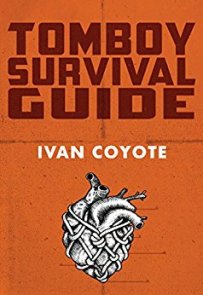
tomboy survival guideTomboy Survival Guide
by Ivan Coyote
Memoir
208 pages
Published 2016

This is the second book I read for my personal 24 in 48 challenge, and it was excellent. Ivan is a natural storyteller – each chapter flows seamlessly into the next, even though each is a separate vignette from their life, and they aren’t chronological. I was never confused about where in the timeline we were; it was just like they were sitting down telling stories about their life, and that naturally ebbs and flows as people are reminded of different things that have happened to them.

It’s not really fully clear whether Ivan is a transman, or simply non-binary, not that it should matter. They use they/them pronouns, and straddle the androgynous line enough that bathrooms and dressing rooms are a constant issue for them, one they touch on repeatedly through the book. Maybe if our bathrooms weren’t so binary-focused, it wouldn’t be as much of an issue when someone is gender-nonconforming!

The book moves between stories of Ivan’s childhood in small-town Canada, their realization they are attracted to women, their experiences in largely male-dominated career fields, and their actual career as an author and public speaker. They talk about how their own family has been supportive of their transition (mostly) and how other parents have written them letters asking how to be supportive of their non-cisgender children. There are scenes of strangers being supportive, and scenes of shocking discrimination and transphobia.

The book is, overall, excellent, and a good introductory look at the life of a non-binary person. Ivan has written several other books, and I definitely want to track down Gender Failure, which they co-wrote with another non-binary person about, well, gender failure!

Ivan Coyote is Canadian, making this one of my Read Canadian Challenge books.

My other Canadian reviews:
1. An Astronaut’s Guide to Life on Earth
2. The Red Winter Trilogy
3. Station Eleven
4. The Courier
5. The Last Neanderthal
6. American War
7. Next Year, For Sure
8. That Inevitable Victorian Thing
9. All The Rage
10. The Clothesline Swing
11. Saints and Misfits
12. this book!
13. The Wolves of Winter

From the cover of Tomboy Survival Guide:

Ivan Coyote is a celebrated storyteller and the author of ten previous books, including Gender Failure(with Rae Spoon) and One in Every Crowd, a collection for LGBT youth. Tomboy Survival Guide is a funny and moving memoir told in stories, in which Ivan recounts the pleasures and difficulties of growing up a tomboy in Canada’s Yukon, and how they learned to embrace their tomboy past while carving out a space for those of us who don’t fit neatly into boxes or identities or labels.

Ivan writes movingly about many firsts: the first time they were mistaken for a boy; the first time they purposely discarded their bikini top so they could join the boys at the local swimming pool; and the first time they were chastised for using the women’s washroom. Ivan also explores their years as a young butch, dealing with new infatuations and old baggage, and life as a gender-box-defying adult, in which they offer advice to young people while seeking guidance from others. (And for tomboys in training, there are even directions on building your very own unicorn trap.)

Tomboy Survival Guide warmly recounts Ivan’s adventures and mishaps as a diffident yet free-spirited tomboy, and maps their journey through treacherous gender landscapes and a maze of labels that don’t quite stick, to a place of self-acceptance and an authentic and personal strength. These heartfelt, funny, and moving stories are about the culture of difference—a “guide” to being true to one’s self.

Book Review: The Clothesline Swing

clothesline swingThe Clothesline Swing
Ahmad Danny Ramadan
Fictional Memoir?
288 pages
Published April 2017

I had to force myself to finish this book. It was okay at the beginning – I was hoping it would get better, and it did not. The Clothesline Swing is the the story of two gay Syrian refugees. It’s an interesting framework; the narrator, one of the two, is telling stories to his husband to keep him in the world of the living. (The husband is dying from an unnamed illness.) There’s a catch, though – Death is also with them, as an actual presence that can be talked to and interacted with. He smokes a joint with the narrator at one point, and tells stories of his own – even plans a party – at another point. The story flicks back and forth between their past and their present with some unpredictability as the narrator tells his stories.

Because of the presence of Death, and the kind of hazy, in-between space that the stories reside in (between life and death, between awake and asleep, between fantasy and reality), the entire book is a little dream-like. I don’t particularly enjoy ever-shifting books that don’t have some kind of solid foundation for me to start on.

The book did a good job of showing the dangers of being gay in middle-eastern society, and also showed how hard it is to be a citizen of a country at war with itself. The list of friends who have died in violent ways is threaded through the entire book of stories. She was caught in a crossfire in an alley – he killed himself after being forced to marry a woman – he died when his office was shelled – she died from a car bomb.

I don’t know. It’s a strange book. I’m hesitant to say don’t waste your time, because it covers important topics, but the dreamy quality just ruined it for me.

Ramadan is a Syrian refugee living in British Columbia, making this book part of my Read Canadian Challenge. It’s also my pick for “book about death or mourning” for the Popsugar 2018 challenge, and “unconventional romance” for the Litsy Booked Challenge.

My other Canadian reviews:
1. An Astronaut’s Guide to Life on Earth
2. The Red Winter Trilogy
3. Station Eleven
4. The Courier
5. The Last Neanderthal
6. American War
7. Next Year, For Sure
8. That Inevitable Victorian Thing
9. All The Rage
10. this book!
11. Saints and Misfits
12. Tomboy Survival Guide
13. The Wolves of Winter

From the cover of The Clothesline Swing:

The Clothesline Swing is a journey through the troublesome aftermath of the Arab Spring. A former Syrian refugee himself, Ramadan unveils an enthralling tale of courage that weaves through the mountains of Syria, the valleys of Lebanon, the encircling seas of Turkey, the heat of Egypt and finally, the hope of a new home in Canada.

Inspired by One Thousand and One Nights, The Clothesline Swing tells the epic story of two lovers anchored to the memory of a dying Syria. One is a Hakawati, a storyteller, keeping life in forward motion by relaying remembered fables to his dying partner. Each night he weaves stories of his childhood in Damascus, of the cruelty he has endured for his sexuality, of leaving home, of war, of his fated meeting with his lover. Meanwhile Death himself, in his dark cloak, shares the house with the two men, eavesdropping on their secrets as he awaits their final undoing.

Book Review: Dust Tracks on a Road

dust tracks on a roadDust Tracks on a Road
by Zora Neale Hurston
Autobiography/Memoir
300 pages
Originally Published 1942 (my copy published in the 90s, with a foreword by Maya Angelou.)

This is my last review specifically for Black History Month, though I still have some African American books to read and review – a book about the African Americans who have served in the White House kitchens, and a book about Southern Food Culture, among others.

Zora Neale Hurston’s most famous work is Their Eyes Were Watching God, which I read in high school – and hated. I also strongly disliked The Color Purple, by Alice Walker, and unfortunately I have blended the two in my mind so much that I can’t remember what I hated about which book. I think it was The Color Purple that was written in a strong vernacular, but I’m not positive of that. It was twenty years ago!

Anyway. So I knew I didn’t like her fiction, but memoirs can be very different from fiction so I thought I’d give this a go. I didn’t hate this. But I didn’t like it, either. Hurston rambles from one subject to the next, going into so much imaginative detail at times that I have to skip back to pick up the line of actual story again. She has some questionable ideas about racial discrimination, seeming to ignore the idea of institutional racism, and dismissing the notion that white people are responsible for what their ancestors did. Or at least that individuals – even individuals as closely related as grandchildren – could be held individually responsible for their slave-owning grandparents. She even trotted out the “I wasn’t even born then, how could I be responsible?” that is the cry of many white people today who deny their privilege.

Maya Angelou, in her foreword, mentions this briefly – that Hurston had lived through race riots, and Jim Crow, but doesn’t mention any unpleasant racial incidents in her book, which is very odd. She does mention one – but it’s perpetrated by a black man, when he comes into the barber shop/salon that Hurston worked at and demanded to be served. (Only white people were served at this particular shop, but the owner had another shop uptown that served black people.) Hurston largely takes a stand against the black customer, complaining that had they served him, the owner (another black man) would have been driven out of business, and all his black employees with him, so how dare the customer value equality over all those jobs? Which is a decent point, but ignores that it’s white people that would have wrongly put them out of business for the so-called crime.

I was very disappointed that Hurston never really talked about the Jim Crow era in her book. I would have liked to see that from her perspective. I do think I’d like to read more memoirs from that era, as Hurston makes it seem largely peaceful and happy. And I’m pretty sure that’s not the case.

It’s an interesting book, but it seems Hurston is at least a slightly unreliable narrator. So take that into account if you read it, and remember it was published in the 1940s, so the way she talks about the “primitive Negro” and the ease with which she tosses around the N word (including from white people) is a product of its time.

This is my PopSugar 2018 Challenge pick for the prompt “an author from a different ethnicity than you.”

From the cover of Dust Tracks on a Road:

First published in 1942 at the crest of her popularity as a writer, this is Zora Neale Hurston’s imaginative and exuberant account of her rise from childhood poverty in the rural South to a prominent place among the leading artists and intellectuals of the Harlem Renaissance. The very personal, perhaps larger-than-life portrait that Hurston paints of herself offers a rare, poignant, and often audacious glimpse of the public and private persona of a very public and private artist, writer, anthropologist, and champion of black heritage. Dust Tracks on a Road is a book full of the wit and wisdom of a proud and spirited woman who started off low and climbed high: “I have been in Sorrow’s kitchen and licked out all the pots. Then I have stood on the peaky mountain wrapped in rainbows with a harp and a sword in my hands.”

Book Review: The Last Black Unicorn

blackunicornThe Last Black Unicorn
by Tiffany Haddish
Comedy/Memoir
276 pages
Published December 2017

I’ve been wanting to read this book ever since I saw Haddish’s interview on The Daily Show with Trevor Noah. This woman is HILARIOUS. Somehow I didn’t realize she was in the movie Girls Night until I read about it in her book – I really do need to see that movie. That aside, this book was pretty great. It’s written in her speaking style, so it’s not technically correct grammar, but it SOUNDS right, which is more important in a memoir, in my opinion. It’s supposed to show the author’s personality, and this does.

I don’t know that I’d put this on quite the same level as Trevor Noah’s Born A Crime, or Jenny Lawson’s Furiously Happy, but it’s not far behind them. Haddish talks about her childhood in the foster system and then raised by her grandmother, her string of no-good boyfriends, and her abusive marriage. She’s had a rough life, but somehow she’s come out of it with a gift for comedy and a grounded personality.

Her swamp tour with Will Smith and Jada Pinkett-Smith is one of the most hilarious stories in the book, and one of the few that is purely funny. Most of them are underscored with a serious issue that make me feel a little bad for laughing at them, but Haddish laughs at them, so how can you not? It’s an interesting conflict that leaves me with slightly mixed feelings about the book.

It’s a pretty quick, easy, fun read, and if you like Tiffany Haddish, it definitely shows what she’s gone through to get where she is now.

From the cover of The Last Black Unicorn:

From stand-up comedian, actress, and breakout star of Girls Trip, Tiffany Haddish, comes The Last Black Unicorn, a sidesplitting, hysterical, edgy, and unflinching collection of (extremely) personal essays, as fearless as the author herself.

Growing up in one of the poorest neighborhoods of South Central Los Angeles, Tiffany learned to survive by making people laugh. If she could do that, then her classmates would let her copy their homework, the other foster kids she lived with wouldn’t beat her up, and she might even get a boyfriend. Or at least she could make enough money—as the paid school mascot and in-demand Bar Mitzvah hype woman—to get her hair and nails done, so then she might get a boyfriend.

None of that worked (and she’s still single), but it allowed Tiffany to imagine a place for herself where she could do something she loved for a living: comedy.

Tiffany can’t avoid being funny—it’s just who she is, whether she’s plotting shocking, jaw-dropping revenge on an ex-boyfriend or learning how to handle her newfound fame despite still having a broke person’s mind-set. Finally poised to become a household name, she recounts with heart and humor how she came from nothing and nowhere to achieve her dreams by owning, sharing, and using her pain to heal others.

By turns hilarious, filthy, and brutally honest, The Last Black Unicorn shows the world who Tiffany Haddish really is—humble, grateful, down-to-earth, and funny as hell. And now, she’s ready to inspire others through the power of laughter.

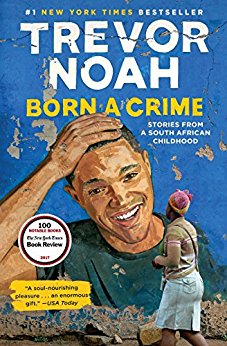
Book Review: Born a Crime

bornacrimeBorn a Crime: Stories from a South African Childhood
Trevor Noah
Memoir
285 pages
Published 2016

I read this book, though I’d really like to listen to the audio book version. It’s narrated by Trevor Noah himself, and apparently very, very good. I totally believe that – the man is hilarious on The Daily Show. I still really enjoyed the stories Noah told, though I wish he’d gotten more into his journey as a comedian, and not just his childhood and teenage years.

Noah has an uncanny way of explaining background information that you need to know while not giving away the (actually somewhat obvious in hindsight) punchline. Even the background information is told in an extremely entertaining way – you can feel Noah’s everpresent grin through the pages. Even though the book begins (and sort of ends) on a sad note, the book itself is a happy, optimistic one. I didn’t laugh myself silly, like the next book I read (Jenny Lawson’s Furiously Happy), but I did have to giggle and read parts to my husband. (And he actually laughed at them, instead of looking at me like I was insane, which is what happened with Furiously Happy.)

I’ve been a fan of Trevor Noah’s since shortly after he took over The Daily Show, and this was an interesting peek at his background, and the very different culture he grew up in. I highly recommend this book.

Incidentally, I spotted someone reading Born A Crime at the Atlanta airport on the way home from Christmas vacation in my hometown, so this one knocks off the PopSugar category “book that was being read by a stranger in a public place”! This is also my first review for Black History Month.

From the cover of Born A Crime:

Trevor Noah’s unlikely path from apartheid South Africa to the desk of The Daily Show began with a criminal act: his birth. Trevor was born to a white Swiss father and a black Xhosa mother at a time when such a union was punishable by five years in prison. Living proof of his parents’ indiscretion, Trevor was kept mostly indoors for the earliest years of his life, bound by the extreme and often absurd measures his mother took to hide him from a government that could, at any moment, steal him away. Finally liberated by the end of South Africa’s tyrannical white rule, Trevor and his mother set forth on a grand adventure, living openly and freely and embracing the opportunities won by a centuries-long struggle.

Born a Crime is the story of a mischievous young boy who grows into a restless young man as he struggles to find himself in a world where he was never supposed to exist. It is also the story of that young man’s relationship with his fearless, rebellious, and fervently religious mother—his teammate, a woman determined to save her son from the cycle of poverty, violence, and abuse that would ultimately threaten her own life.

The stories collected here are by turns hilarious, dramatic, and deeply affecting. Whether subsisting on caterpillars for dinner during hard times, being thrown from a moving car during an attempted kidnapping, or just trying to survive the life-and-death pitfalls of dating in high school, Trevor illuminates his curious world with an incisive wit and unflinching honesty. His stories weave together to form a moving and searingly funny portrait of a boy making his way through a damaged world in a dangerous time, armed only with a keen sense of humor and a mother’s unconventional, unconditional love.

Book Review: Furiously Happy

furiouslyhappyFuriously Happy: a Funny Book about Horrible Things
Jenny Lawson
Memoir?
353 pages
Published 2015

How do you even begin to explain a Jenny Lawson book? Known as The Bloggess on the internet, Lawson is one of the most laugh-out-loud, hysterically funny, off-the-wall-crazy-pants writers I’ve ever come across. From her antics with taxidermied animals to the bizarre arguments she has with her husband to the weird tangents her brain goes on, Lawson is one of the most entertaining people on the internet. In Furiously Happy, she explores her lifelong fight with mental illness, from depression to anxiety to a number of manias, and she does so in a lovely, non-judgmental way. She does get serious – she talks about her “folder of 24” – 24 letters from suicidal people telling her that she, and the community she’s built, are the reason they’re still here. Lawson tackles the topic of depression head on, and by writing down the bizarre things that go through her head, lets people know THEY’RE NOT ALONE, and that’s incredibly important.

As the subtitle of the book says, it might be a book about a serious topic, but oh. my. is it funny. Between sneaking a taxidermied ecstatically happy raccoon into view of her husband’s video conferences, and trying to snuggle koalas in Australia while dressed in a full-body koala costume, Lawson also talks about waking up in the middle of the night thinking her arms have fallen off, and being stalked by carnivorous swans. Lawson’s blog is hilarious, and this book is one of the most insanely funny things I’ve ever read, and now I have to track down her other two books. (Let’s Pretend This Never Happened and You Are Here)

From the cover of Furiously Happy:

In Furiously Happy, a humor memoir tinged with just enough tragedy and pathos to make it worthwhile, Jenny Lawson examines her own experience with severe depression and a host of other conditions, and explains how it has led her to live life to the fullest:

“I’ve often thought that people with severe depression have developed such a well for experiencing extreme emotion that they might be able to experience extreme joy in a way that ‘normal people’ also might never understand. And that’s what Furiously Happy is all about.”

Jenny’s readings are standing room only, with fans lining up to have Jenny sign their bottles of Xanax or Prozac as often as they are to have her sign their books. Furiously Happy appeals to Jenny’s core fan base but also transcends it. There are so many people out there struggling with depression and mental illness, either themselves or someone in their family―and in Furiously Happy they will find a member of their tribe offering up an uplifting message (via a taxidermied roadkill raccoon). Let’s Pretend This Never Happened ostensibly was about embracing your own weirdness, but deep down it was about family. Furiously Happy is about depression and mental illness, but deep down it’s about joy―and who doesn’t want a bit more of that?