Book Review: Number One Chinese Restaurant

number one chinese restaurantNumber One Chinese Restaurant
by Lillian Li
Contemporary Fiction/Family Drama
288 pages
Published June 2018

I don’t tend to read a lot of contemporary fiction, but I had several on my beach read/summer reading list, and this one is set in Rockville, Maryland, which is pretty close to where I live. Having read it finally, I wouldn’t call it a beach read, though!

Number One Chinese Restaurant follows the owners and staff of The Beijing Duck House before and after a devastating fire. There’s a lot of chinese culture revealed in the book, from familial obligation to amending names with an Ah- prefix, to the immigration process to America, to knowing what region someone is from by their accent and forming opinions of them based on that. (Although I suppose we do that in the US, too – that last one might be universal.)

We start with the two brothers, Jimmy and Johnny. Jimmy is the current owner of the Duck House, while Johnny is out of the country for the first part of the book. The two brothers are opposites in most ways, with Jimmy being the back-of-house hardliner and Johnny being the diplomatic schmoozer.

(Speaking of back-of-house, this book PEGGED restaurant life. I’ve worked in food service quite a lot, and from the chaos of rushes to the drug and alcohol abuse, to the confusion between front and back of house but at the same time feeling like you’re all in it together – yeah. This book NAILS it.)

From Jimmy and Johnny, we have their strong-willed mother, Feng, and her cousin, “Uncle” Pang, who has mysterious connections and can get things done but isn’t exactly benevolent about it. The last member of the immediate family is Annie, Johnny’s daughter. There is a staff chart in the inside cover of the book to help keep everyone straight, and it’s quite handy, because then we get into the staff. There’s really two main plotlines going, though they revolve around each other and intertwine in places. There’s Johnny’s efforts to open a new restaurant, and then there’s Nan and Ah-Jack.

Nan and Ah-Jack have both been working at the Duck House for thirty years, and have married other people but have always adored each other. As the restaurant enters crisis, so do their personal lives, and things get messy.

In order for me to like contemporary fiction, there have to be personal hooks that interest me, and this book hit food service, minorities, and the local area. That was more than enough to make it an enjoyable read.

From the cover of Number One Chinese Restaurant:

The Beijing Duck House in Rockville, Maryland, is not only a go-to solution for hunger pangs and a beloved setting for celebrations; it is its own world, inhabited by waiters and kitchen staff who have been fighting, loving, and aging within its walls for decades. When disaster strikes, this working family’s controlled chaos is set loose, forcing each of them to confront the conflicts that fast-paced restaurant life has kept at bay.

Owner Jimmy Han hopes to leave his late father’s homespun establishment for a fancier one. Jimmy’s older brother, Johnny, and Johnny’s daughter, Annie, ache to return to a time before a father’s absence and a teenager’s silence pushed them apart. Nan and Ah-Jack, longtime Duck House employees, are tempted to turn their thirty-year friendship into something else, even as Nan’s son, Pat, struggles to stay out of trouble. And when Pat and Annie, caught in a mix of youthful lust and boredom, find themselves in a dangerous game that implicates them in the Duck House tragedy, their families must decide how much they are willing to sacrifice to help their children.

Generous in spirit, unaffected in its intelligence, multivoiced, poignant, and darkly funny, Number One Chinese Restaurant looks beyond red tablecloths and silk-screen murals to share an unforgettable story about youth and aging, parents and children, and all the ways that our families destroy us while also keeping us grounded and alive.

Book Review: One Person, No Vote

one person no voteOne Person, No Vote: How Voter Suppression Is Destroying Our Democracy
by Carol Anderson
Nonfiction/Politics/Civil Rights
270 pages
Published September 2018

I already knew a lot of the basics of voter suppression before picking up this book – the closing of polling centers, limiting early voting, requiring photo IDs that a lot of people don’t have, locating polling centers in hard-to-get-to places. I did not, however, fully grasp the extent of it. This book does an amazing job of supplying details and statistics without just being a mess of numbers and dates.

The book is much shorter than it appears – the last hundred pages are notes, index, and acknowledgments. Mostly notes, giving sources for every statistic and event and court case that is mentioned in the book. It still took me the better part of a week to read it; nonfiction always slows me down, and keeping this much information organized in my brain slowed me down further. I can’t just sit and read it straight through like I would with fiction!

The information in this book is appalling. From the history of voter suppression, the insidious ways that politicians have devised to keep minorities from voting, it’s bad. I learned where the term “gerrymandering” came from – some politician (governor, I think) of the last name Gerry made a district shaped like a salamander when he was making a new district map. Hence, a gerrymander.

Another horrifying factoid:

In 2016, the Economist Intelligence Unit, which had evaluated 167 nations on sixty different indicators, reported that the United States had slipped into the category of a “flawed democracy,” where, frankly, it had been “teetering for years.” Similarly, the Electoral Integrity Project, using a number of benchmarks and measurements, was stunned to find that when it applied those same calculations in the United States as it had in Egypt, Yemen, and Sudan, North Carolina was “no longer considered to be a fully functioning democracy.” Indeed, if it were an independent nation, the state would rank somewhere between Iran and Venezuela. The basic problem in North Carolina was that, despite the overt performance of ballots, precincts, and vote tallies, legislators and congressional representatives were actually selected for office rather than elected.

And that was in 2016! There have been so many more voter suppression laws passed in the last two years, I shudder to think of where we rank now. (Or where North Carolina ranks!)

As a white woman in a very blue state, I personally face little barrier to voting, but the book has still given me a new appreciation for the act. I’ve actually already voted – I took advantage of the week of early voting here in Maryland. If you’re a US citizen who hasn’t voted yet, Election Day is this Tuesday, November 6th, and for the sake of those that can’t, please, PLEASE GO VOTE. If you don’t have transportation to your polling place, Uber and Lyft are running free rides to and from polling places on Election Day.

Read this book and vote against voter suppression.

From the cover of One Person, No Vote:

In her New York Times bestseller White Rage, Carol Anderson laid bare an insidious history of policies that have systematically impeded black progress in America, from 1865 to our combustible present. With One Person, No Vote she chronicles a related history: the rollbacks to African American participation in the vote since the 2013 Supreme Court decision that eviscerated the Voting Rights Act of 1965. Known as the Shelby ruling, this decision effectively allowed districts with a demonstrated history of racial discrimination to change voting requirements without approval from the Department of Justice.

Focusing on the aftermath of Shelby, Anderson follows the astonishing story of government-dictated racial discrimination unfolding before our very eyes as more and more states adopt voter suppression laws. In gripping, enlightening detail she explains how voter suppression works, from photo ID requirements to gerrymandering to poll closures. And with vivid characters, she explores the resistance: the organizing, activism, and court battles to restore the basic right to vote to all Americans as the nation gears up for the 2018 midterm elections.

Book Review: To All The Boys I’ve Loved Before

to all the boys i've loved beforeTo All The Boys I’ve Loved Before
by Jenny Han
Young Adult
355 pages
Published 2014

I picked this up mostly because the trailer for the Netflix adaptation looked AMAZING. It’s the first book in a trilogy, and I really want to read the other two now! (Update: I’ve now read PS. I Still Love You.) Lara Jean is the middle daughter in a house of three daughters, being raised by their widower father. The relationships between the four of them play a large part in the book, as they are all adjusting to the eldest daughter being away at college. Everyone’s roles are changing, and in the middle of that, Lara Jean’s private love letters get mailed to the boys she wrote them to, throwing her love life into chaos as well.

I loved almost every character in this book – even Lara’s troublemaking best friend has a good heart. I definitely need to watch the Netflix show now, because I really want to see how Chris – aforementioned best friend – is represented!

The family scenes around Christmas really tugged at my heart – Christmas has always been my favorite holiday, and the author absolutely NAILED the nostalgic, slightly dreamy, loving holiday atmosphere.

To All The Boys I’ve Loved Before was a cute, sweet read, and really my only negative thing to say about it is the ending left me hanging! Which is part of why I really need to read the other two books, so I suppose it was a good strategy. But man I hate cliffhangers!

From the cover of To All The Boys I’ve Loved Before:

Lara Jean keeps her love letters in a hatbox her mother gave her. They aren’t love letters that anyone else wrote for her, these are ones she’s written. One for every boy she’s ever loved – five in all. When she writes, she can pour out her heart and soul and say all the things she would never say in real life, because her letters are for her eyes only. Until the day her secret letters are mailed, and suddenly Lara Jean’s love life goes from imaginary to out of control. 

Book Review: Like Water

like waterLike Water
by Rebecca Podos
YA LGBT Romance
312 pages
Published 2017

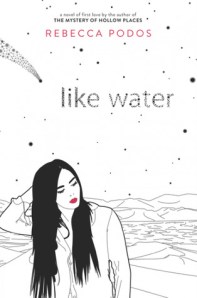
I’m always interested in queer young adult books, and this one especially caught my eye with its mention of “performing mermaids.” Because y’all know I love my mermaid books! So Savannah isn’t a real mermaid, she just plays one at a water park. But it was enough to make me pick up the book, and it’s a good book. Young adult books about discovering your identity are always needed, and this book is about Savannah realizing she’s bisexual.

Much of the angst in this book comes from Savannah not knowing if she has the same disease her father does, and she’s not sure if she wants to know. Altogether, in this book we have chronic illness, hispanic teens, bisexual, lesbian, and genderqueer teens, small-town angst….there’s really a LOT of demographics covered in this book.

I like Savannah, but I don’t like her love interest, Leigh, very much. Leigh does NOT have her shit together, and between drinking and doing drugs, all while underage, she poses a very real threat to Savannah’s well-being.

I’m a little nonplussed by the ending of the book. It leaves a few questions unanswered, but not in a cliff-hanger-y way. It’s more of a possibilities-left-open kind of way. Which makes sense for a “first love” romance. It’s not necessarily a “true love” story. It reminds me of John Green novels in that way.

So – it’s a great book for representation, but don’t expect a tidy, wrapped-up ending. You won’t find that here.

From the cover of Like Water:

In Savannah Espinoza’s small New Mexico hometown, kids either flee after graduation or they’re trapped there forever. Vanni never planned to get stuck – but that was before her father was diagnosed with Huntington’s disease, leaving her and her mother to care for him. Now she doesn’t have much of a plan at all: living at home, working as a performing mermaid at a second-rate water park, distracting herself with one boy after another.

That changes the day she meets Leigh. Disillusioned with small-town life and looking for something greater, Leigh is not a “nice girl.” She is unlike anyone Vanni has met, and a friend when Vanni desperately needs one. Soon enough, Leigh is much more than a friend. But caring about another person threatens the walls Vanni has carefully constructed to protect herself and brings up the big questions she’s hidden from for so long.

With her signature stunning writing, Rebecca Podos, author of The Mystery of Hollow Places, has crafted an unforgettable story of two girls navigating the unknowable waters of identity, millennial anxiety, and first love.

Book Review: The Shape of Water

the shape of waterThe Shape of Water
by Daniel Kraus and Guillermo del Toro
Magical Realism
314 pages
Published 2018

Alright, so, with as much as I enjoy twists on mermaid stories, this was kind of inevitable, right? I’d heard a lot about the movie, but hadn’t yet seen it, so I figured I’d read the novelization. What I didn’t realize until reading the book, though, is that this isn’t actually a novelization of the movie. The movie and the book were written at the same time, about the same story, but tell different parts of it. (This article explains how both were written.) The book delves more into the mythology behind the creature, and gets into the thoughts and feelings of both the creature and Elisa. Those things are incredibly hard to communicate in film, especially when the characters can’t speak! So, far from “reading the book instead of seeing the movie,” now that I’ve read the book, I REALLY want to see the movie!

If you haven’t heard of the movie, the basic premise of both movie and book is Elisa, a mute janitor at a top secret research facility, is cleaning a lab when she sees what’s contained in it – an amphibious man-like creature kept in captivity and experimented on. She teaches him sign language and eventually falls in love with him and decides to break him out of the lab before the researchers kill him. The plot is set in the 60s, so there’s a lot more overt racism and sexism going on, as well as some Cold War spycraft.

It’s also set in Baltimore, which is another thing I didn’t know before reading the book!

There’s a pretty good amount of minority representation here – Elisa is mute, her two best friends are black (Zelda) and gay (Giles). Zelda worries about her place as “the black friend” of a white woman, but also sees Elisa as a little damaged and in need of her care. When Elisa gets tunnel vision on the merman, Zelda’s worries are mostly confirmed, but not for the reasons she thinks, since Elisa shuts out Giles too. There’s definitely something to be learned there about hurting your friends unintentionally when starting a new relationship!

A lot of people saw this plot as super weird, with the woman falling in love with the sea-creature, but how many mermaid films do we have where the man falls in love with the mermaid when she still has her fish tail? Sure, the merman here is fully scaled and can’t talk, but Ariel can’t talk in most versions of The Little Mermaid, either. I don’t see it as much different, other than it’s a women falling in love with someone who isn’t the typical image of masculinity. And at least in the book, there are a couple of chapters from his perspective. He’s sentient and consenting. (I hope that comes across in the movie, too.)

I really enjoyed this one, and I definitely need to watch the movie to get the rest of the story. The book is self-contained – nothing’s missing, exactly, but since it was written in both mediums at the same time, I feel like I need to see the movie to perhaps flesh out some things.

From the cover of The Shape of Water:

It’s 1962, and Elisa Esposito – mute her whole life, orphaned as a child – is struggling with her humdrum existence as a janitor working the graveyard shift at Baltimore’s Occam Aerospace Research Center. Were it not for Zelda, a protective coworker, and Giles, her loving neighbor, she doesn’t know how she’d make it through the day.

Then one fateful night, she sees something she was never meant to see, the Center’s most sensitive asset ever; an amphibious man, captured in the Amazon, to be studied for Cold War advancements. The creature is terrifying but also magnificent, capable of language and of understanding emotions . . . and Elisa can’t keep away. Using sign language, the two learn to communicate. Soon, affection turns into love, and the creature becomes Elisa’s sole reason to live.

But outside forces are pressing in. Richard Strickland, the obsessed soldier who tracked the asset through the Amazon, wants nothing more than to dissect it before the Russians get a chance to steal it. Elisa has no choice but to risk everything to save her beloved. With the help of Zelda and Giles, Elisa hatches a plan to break out the creature. But Strickland is onto them. And the Russians are, indeed, coming.

Developed from the ground up as a bold two-tiered release – one story interpreted  by two artists in the independent mediums of literature and film – The Shape of Water is unlike anything you’ve ever read or seen.

Book Review: Her Body and Other Parties

her body and other partiesHer Body and Other Parties
by Carmen Maria Machado
Fantasy/Magical Realism Short Stories
241 pages
Published 2017

This is another book off my Wronged Women list – women who have been part of the #metoo movement. Specifically the ones that have come out against Junot Diaz and Sherman Alexie, but I hope to expand it to others as well. Her Body and Other Parties is a collection of eight surreal stories. Magical Realism is probably the best categorization for them, as they’re not really fantasy. Real World stories with a touch of magic, or events that we’re not sure whether they could be magic or are just in the narrator’s head.

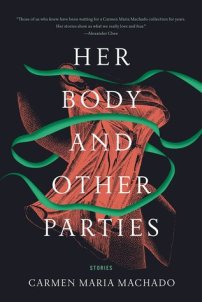
The Husband Stitch is the first story, and it’s a retelling of an old children’s story that I recently saw being discussed on Twitter – the one with the woman who had a green ribbon tied around her neck. Her husband always wanted to ask about it, but she refused to answer any questions about it, and wouldn’t let him touch it until she was on her deathbed. In Machado’s version, it isn’t just the narrator that has one. Every woman does. It’s different colors, in different places, but it’s still never talked about. I think she means it as a metaphor for trauma. It works well.

Eight Bites is a particularly haunting piece about self-hate, body acceptance, and peer pressure. It’s probably my second favorite story after The Husband Stitch.

The only one I didn’t love was Especially Heinous. It was written as episode synopses of a television show, and it was interesting, but it just went on too long.

All of the stories are written well, though, and each one makes a different point. I think this would make an amazing Book Club book, because I’d love to discuss the meanings of the stories with other people. Other women, specifically. It would definitely be a great book for discussion.

From the cover of Her Body and Other Parties:

In her electrifying debut, Carmen Maria Machado blithely demolishes the borders between psychological realism and science fiction, comedy and horror, fantasy and fabulism. Here are eight startling stories that map the realities of women’s lives and the violence visited upon their bodies. Earthy and otherworldly, antic and sexy, queer and caustic, comic and deadly serious, Her Body and Other Parties enlarges the possibilities of contemporary fiction.