Book Review: Georgia Peaches and Other Forbidden Fruit

georgia peaches and other forbidden fruitGeorgia Peaches and Other Forbidden Fruit
by Jaye Robin Brown
Young Adult/Romance/LGBT
432 pages
Published 2016

This is a sweet, southern f/f romance. Set in Georgia, it deals with a lot of things young lesbians might have to deal with in the south – religion, bigotry, the stress of coming out or not coming out (or being forced back in the closet by a move to a small town)! It doesn’t deal with any outright violence against our lesbian protagonists, and it just barely touches on drug use, eating disorders, and abusive relationships. Joanna has a mostly supportive family, even if they do ask her to hide her sexuality for her senior year in the new town. Jo reluctantly agrees to do so, but doesn’t count on falling in love with a girl at her new school.

The book deals a LOT with religion and sexuality; Jo’s father is a radio preacher, and she attends a baptist church in town with her stepmother and new grandparents. At one point – one of my favorite scenes in the book – she snaps, and calls out her classmates for thinking homosexuality is a sin, while they eat shellfish and have premarital sex.

I liked the book, but I’m not sure I’d recommend it. I grew up Christian; I’m familiar with all the concepts in the book, but rather than progress to a kinder, more loving version of Christianity, I left it behind altogether. I’m glad that some people can reconcile religion with progressive values, but I can’t. So it might be a good book for some, but not for me.

From the cover of Georgia Peaches and Other Forbidden Fruit:

It’s going to take a miracle for Joanna Gordon to get through senior year. 

Despite being the daughter of a well-known radio evangelist, Jo has never hidden the fact that she’s gay, and her dad has always supported her. But that was back in Atlanta. Now her dad the reverend has married wife number three, and they’ve all moved to small-town Rome, Georgia. When Jo’s dad asks her to lie low for the rest of the year in the hopes that it will help him and his new wife settle in, Jo reluctantly agrees. 

Although when God closes a closet door, he opens a window. Everything becomes so easy for Jo once she rebrands herself as a straight girl. No one gives her odd looks. Her new stepfamily likes her. She even gets in with the popular crowd.

And that’s how she meets Mary Carlson, the ultimate temptation. Even though Jo knows this girl is completely off-limits, she just can’t get her out of her mind. But Jo couldn’t possibly think of breaking her promise to her dad. Even if Jo’s starting to fall for Mary Carlson. Even if there’s a chance Mary Carlson might be interested in her, too. Right?

Lord, have mercy.

Jo’s in for one hell of a year.
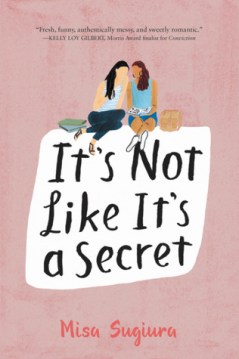
Book Review: It’s Not Like It’s A Secret

its not like its a secretIt’s Not Like It’s A Secret
by Misa Sugiura
Young Adult/Romance/LGBT
394 pages
Published 2017

Before I dive in I want to explain that I’ve tagged this with polyamory not for the main characters, but for a few side characters. If you’re looking for a poly romance, this is absolutely not it. This is a teenage lesbian romance, with a side of racial issues.

Sana is a California transplant from Wisconsin; both her parents are immigrants from Japan, so despite feeling like she’s a midwesterner, none of her friends think of her as one. There’s a cringe-y scene early in the book where she cheers with her friends about being “midwestern farmer’s daughters” and they tell her she’s cute for thinking that, but she’s Japanese, obv. I felt really bad for her. When her family moves to California, suddenly she’s not the only Asian girl in a sea of whiteness. It’s an interesting mix of having a place with your own people but also fighting the stereotypes of sticking with your own ethnicity. It’s assumed she’ll be friends with the other Asian kids, which annoys her, but she also finds to be true; having not had the opportunity to have friends like her before, she finds she really likes it. (See my Friday 56 quote about it.) But she also tries to break that mold and be friends with people she’s not assumed to like – like Jamie Ramirez and her Hispanic friends, and Caleb and his white goth friends.

The book also explores the way racism hits races differently; the Hispanic kids get hassled by cops while the Asian kids don’t – though they also have things expected of them that the Hispanic kids don’t. The book gets into cultural expectations as well – PDAs are not really a thing in Sana’s world, so she’s reluctant to be public about her affections at school, which drives misunderstandings.

It’s only in the last few chapters that all the secrets come out, and Sana struggles to put things right.

One thing I really liked about the book is the narrative structure. At the beginning of the school year, Sana’s English teacher gives them a project, which is to keep a journal to transcribe poems into and talk about what they mean to you. Chapters from Sana’s poetry journal are interspersed with chapters of the narrative, and give some nice insight to how she’s feeling. Her love interest, Jamie, also loves poetry, and it plays a large part in their relationship.

I quite enjoyed this book.

From the cover of It’s Not Like It’s A Secret:

Sixteen-year-old Sana Kiyohara has too many secrets. Some are small, like how it bothers her when her friends don’t invite her to parties. Some are big, like the fact that she’s pretty sure her father’s having an affair. And then there is the one that she barely even admits to herself, the one about how she might have a crush on her best friend.

When Sana and her family move to California, she begins to wonder if it’s finally time for her to be honest with her friends and family, especially after she meets Jamie Ramirez. Jamie is beautiful and smart and unlike anyone Sana’s ever known before. The only problems are: Sana is pretty sure Jamie’s friends hate her, Jamie’s ex isn’t totally out of the picture, Sana’s new friend Caleb has more-than-friendly feelings for her, and things with her dad feel like they’re coming to a head. She always figured that the hardest thing would be to tell people that she wanted to date a girl, but as Sana quickly learns, telling the truth is easy . . . what comes after it, though, is a whole lot more complicated. 

Book Review: Pride

pridePride
by Ibi Zoboi
Young Adult/Retelling/Romance
289 pages
Published September 2018

I have very mixed feelings about this one. I’ve read several retellings of Pride & Prejudice, but I think this is the first one that aged the characters down to teenagers. And I don’t think it works as well. In both The Lizzie Bennett Diaries and Unmarriageable, the main character and her older sister were in their twenties. They were still living at home, but they were graduating college, starting careers – a completely different stage of their lives from the characters in Pride. In Pride, Zuri is a senior in high school and Janae, her older sister, is home after her first year of college. Which makes their younger sister, Layla, thirteen. And if you know the plot of Pride & Prejudice, you know why that squicks me a little bit. (Zoboi did change that plot point slightly so it’s not quite as bad as it could be, but still. Ew.) This is a good example of what should be a New Adult story feeling forced into a Young Adult mold.

Age issues aside, I really liked the other changes made in this retelling; class differences are alive and well in the modern day, and I especially liked how it addressed neighborhood gentrification. Because yes, improving neighborhoods is a worthy goal; but when it raises rent without raising the income of the people living there, it forces people out who have lived in the neighborhood their entire lives. Gentrification is classist and, because our class system is racist, racist.

I enjoyed the Afro-Latino racial change; just like Unmarriageable‘s Pakistani setting, it brings a new cultural wrapping to the plot, and adds racial tension to the lessons on class that the story usually tells.

The book skims over a lot of the normal Pride & Prejudice plot, which I rather expected for a Young Adult book. Unmarriageable was much better in that regard, but Pride is still very enjoyable. It’s definitely a worthy addition to the Pride & Prejudice….pantheon? Shelf? Canon? I do think it would have been much better as a New Adult story, though. I’m still stuck on that.

From the cover of Pride:

Zuri Benitez has pride. Brooklyn pride, family pride, and pride in her Afro-Latino roots. But pride might not be enough to save her rapidly gentrifying neighborhood from becoming unrecognizable. 

When the wealthy Darcy family moves in across the street, Zuri wants nothing to do with their two teenage sons, even as her older sister, Janae, starts to fall for the charming Ainsley. She especially can’t stand the judgmental and arrogant Darius. Yet as Zuri and Darius are forced to find common ground, their initial dislike shifts into an unexpected understanding. 

But with four wild sisters pulling her in different directions, cute boy Warren vying for her attention, and college applications hovering on the horizon – Zuri fights to find her place in Bushwick’s changing landscape or lose it all. 

In this timely update of Jane Austen’s Pride and Prejudice, critically acclaimed author Ibi Zoboi skillfully balances cultural identity, class, and gentrification against the heady magic of first love in her vibrant reimagining of this beloved classic. 

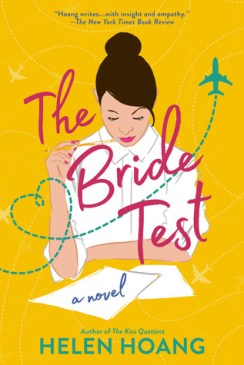
Book Review: The Bride Test

the bride testThe Bride Test
by Helen Hoang
Romance
300 pages
Published May 7, 2019

I received The Bride Test on Saturday, a few days before today’s release date, through Book of the Month. I’ve been really excited about this one, because it’s another adult romance with an autistic main character, like the first book, The Kiss Quotient. (The author is also autistic.) There’s actually a lot of #ownvoices representation here; Hoang has an author’s note at the end talking about how much of Esme’s personality and struggles are based on her own mother, who immigrated from Vietnam as a refugee at the end of the Vietnam war. I love that in writing the book, Hoang grew closer to her mother as she learned about her history. Definitely don’t miss the author’s note at the end of this book, if you read it!

I have mixed feelings about this one, but unfortunately the part I really have mixed feelings about is very spoilery, so I can’t talk about it without ruining major plot points! Overall, I did really like the book, and Khai showed a lot of the same traits my husband does. The first book’s autistic character is female, so it was nice to see a character so similar to my husband this time. The characters from The Kiss Quotient do make a token appearance in The Bride Test, and I’m hoping Hoang will finally write Quan’s story next! There is an untitled third book in the series due out in 2020, so I’m crossing fingers for Quan!

I absolutely adored Esme in this book. She is hardworking and strong-willed, and knows what she’s worth. I wish she’d been a little more honest with Khai, but I can understand being too afraid to be fully honest with someone who could have such control over your future. I did really enjoy this sequel, and I can’t wait to hear what the plot will be for the third book.

From the cover of The Bride Test:

Khai Diep has no feelings. Well, he feels irritation when people move his things or contentment when ledgers balance down to the penny, but he doesn’t experience big, important emotions like love and grief. Rather than believing he processes emotions differently due to being autistic, he concludes that he’s defective and decides to avoid romantic relationships. So his mother, driven to desperation, takes matters into her own hands and returns to Vietnam to find him the perfect mail-order bride.

As a mixed-race girl living in the slums of Ho Chi Minh City, Esme Tran has always felt out of place. When the opportunity to marry an American arises, she leaps at it, thinking that it could be the break her family needs. Seducing Khai, however, doesn’t go as planned. Esme’s lessons in love seem to be working . . . but only on herself. She’s hopelessly smitten with a man who believes he can never return her affection.

Esme must convince Khai that there is more than one way to love. And Khai must figure out the inner workings of his heart before Esme goes home and is an ocean away.

Book Review: When Dimple Met Rishi

when dimple met rishiWhen Dimple Met Rishi
by Sandhya Menon
Young Adult/Romance
380 pages
Published 2017

I’ve seen this book get raved about online, but it just didn’t sound that exceptional – yet another young adult romance. Contemporary, at that. But I finally read it for the Year of the Asian Challenge, and I am SO. GLAD. I DID.

Rishi Patel stole my heart. Which, as a demisexual, is completely unexpected. But he’s just the exact right combination of sweet, romantic, totally geeky, and confident. He is absolutely my favorite character in this book. I like Dimple. But I adore Rishi.

I loved that both Dimple and Rishi tried to help each other achieve their dreams. I wish they’d both been a little more communicative about how they did so, but it was still cute to see them so invested in each other’s life goals, as a couple should be!

This is a super cute romance, and it deserves all the rave reviews it got. I definitely need to read the sequel (about Rishi’s younger brother) now.

From the cover of When Dimple Met Rishi:

DIMPLE SHAH has it all figured out. With graduation behind her, she’s more than ready for a break from her family – and from Mamma’s inexplicable obsession with her finding the “Ideal Indian Husband.” Ugh. Dimple knows they must respect her principles on some level, though. If they truly believed she needed a husband right now, they wouldn’t have paid for her to attend a summer program for aspiring web developers . . . right?

RISHI PATEL is a hopeless romantic. So when his parents tell him that he and his future wife will be attending the same summer program – wherein he’ll have to woo her – he’s totally on board. Because as silly as it sounds to most people in his life, Rishi wants to be arranged, believes in the power of tradition, stability, and being a part of something much bigger than himself.

The Shahs and Patels didn’t mean to start turning the wheels on this “suggested arrangement” so early in their children’s lives, but when they noticed them both gravitating toward the same summer program, they figured, Why not?

Dimple and Rishi may think they have each other figured out. But when opposites clash, love works hard to prove itself in the most unexpected ways.

Book Review: Endless Water, Starless Sky

endless water starless skyEndless Water, Starless Sky
by Rosamund Hodge
Young Adult/Fantasy/Retelling
441 pages
Published 2018

This is the sequel to Bright Smoke, Cold Fire, in which we were introduced to Romeo Mahyanai and Juliet Catresou, and the city of Viyara. This book concentrates much more on Romeo and Juliet instead of Paris and Runajo/Rosaline, who were arguably the main characters of the first book.

So, as a quick recap, the city of Viyara/Verona is the last city anywhere in the world, as far as anyone in the city knows. A mystical event called The Ruining manifested as a white fog and spread over the entire world, killing everything in its path, and making the dead rise as zombies. The only reason Viyara stands is because some long-dead priestess managed to create mystical walls to protect it – but the walls are fueled by blood. Willing, sometimes coerced people are sacrificed on a regular basis to fuel the walls and keep the rest of the city safe. Juliet is not actually Juliet, but THE Juliet, a nameless girl raised and mystically bound to the clan of the Catresou, obedient to the head of the clan and bound to avenge any unnatural deaths of the family. She, however, falls in love with Romeo.

The first book plays out their love story, while seeing events around it through the eyes of Runajo and Paris. By the second book, Romeo and Juliet each think the other is dead, though Romeo has discovered that’s a lie, Runajo has ideas about how to save the city from the Ruining, and Romeo and Juliet have switched sides. Her mystical bindings have been transferred to Romeo’s clan, and Romeo, through guilt and remorse, has transferred his loyalties to Juliet’s clan.

The second book concentrates on saving the city, the last bastion of humanity. There are zombies, and sacrifices, and sword fights, and stolen kisses. Things really get complicated when Romeo accidentally kills a Mahyanai and Juliet’s mystical bindings kick in, compelling her to kill him. She operates under that compulsion for most of the last half of the book, while still being utterly in love with him and trying to fight the compulsion.

It’s hard to do this book justice; the web is very complex and, like any Romeo and Juliet story, only ends in death. In Hodge’s world, however, the mystical bindings on Juliet have made her a key to the land of death, allowing her to cross over while still alive. So we get a journey through Death’s kingdom, and it is fascinating.

I won’t say anymore, but if you like Shakespeare, and you like fantasy, you should totally read this duology.

From the cover of Endless Water, Starless Sky:

In the last days of the world, the walls of Viyara are still falling, and the dead are rising faster than ever.

Juliet is trapped – ordered by Lord Ineo of the Mahyanai to sacrifice the remaining members of her family, the Catresou, to stave off the end of the world. Though they’re certain his plan is useless, Juliet and her former friend Runajo must comply with Lord Ineo’s wishes unless they can discover a different, darker path to protecting Viyara.

Romeo is tortured. Finally aware that his true love is alive, he is at once elated and devastated, for his actions led directly to the destruction of her clan. The only way to redemption is to offer his life to the Catresou to protect and support them . . . even if it means dying to do so.

When Romeo and Juliet’s paths converge once again, only a journey into Death will offer answers and the key to saving them all – but is it a journey either of them will survive?