Book Review: Tortall and Other Lands

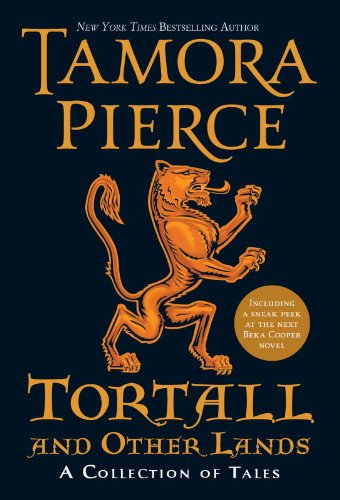
TortallTortall and Other Lands: A Collection of Tales
by Tamora Pierce
369 pages
Published 2011

This is a collection of Tamora Pierce’s short stories, some of which have been published in other collections. There are six stories set in Tortall, four fantasy stories set elsewhere, and one contemporary non-fantasy story. I really enjoyed getting glimpses into other parts of Tortall – seeing stories of a few ordinary people, not just the extraordinary ones that star in her sagas and trilogies.

In one story we revisit Numair and Daine from The Immortals quartet, and see their foster dragon, Kitten, get into trouble and rescue a wild mage and her son. In another we see an apple tree turned into a man as a consequence of Numair turning a man into an apple tree half a world away. Another story shows us the birth of Nawat and Aly’s children. (Aly is the daughter of Alanna from The Song of the Lioness quartet, and has her own duology, Trickster’s Choice and Trickster’s Queen.) We see a girl learn to fight by watching animals squabble, and another girl learn to become an adult by rescuing a baby dragon.

I very much enjoy collections of short stories for a few different reasons; collections by one author show glimpses into rarely-seen parts of their established worlds, while collections around a theme introduce me to new authors. I also don’t feel bad about setting the book down between stories to go to bed! Tortall and Other Lands was a wonderful addition to the stories of Tortall, and has me even more eager to read The Immortals quartet and the Trickster set.

From the back of Tortall and Other Lands:

Years ago, the novel Alanna introduced fantasy lovers to the magical kingdom of Tortall. In Tamora Pierce’s subsequent fifteen books set in this medieval realm, readers have gotten to know generations of families; legions of friends, foes, and fantastical creatures; and much about the history, magic, and spirit of this extraordinarily well-drawn locale.

But epics do not always provide the smaller, more intimate tales. Collected here are six wondrous shorter tales from the land of Tortall, featuring previously unknown characters as well as old friends. These stories, some of which have never been published before, will lead old fans and new readers more deeply into one of the most intricately constructed worlds of modern fantasy. There are four more fantasy tales not set in Tortall. Two are historical and set in an unknown town; one takes place in a remote desert; and one is set in a very well-known town, New York City, in our time. 

And as a bonus, there’s one nonfantasy set in contemporary Idaho that proves that Pierce’s multilayered characters, finesse with dialogue, and impeccable storytelling are not limited to lands inhabited by dragons and magic. 

Book Review: The Song of the Lioness quartet

alanna1Song of the Lioness quartet
by Tamora Pierce
Young Adult Fantasy

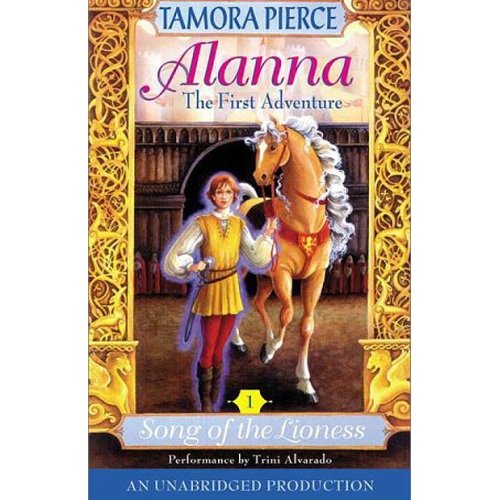
Alanna: the First Adventure
308 pages
Published 1983

In the Hand of the Goddess
288 pages
Published 1984

The Woman Who Rides Like a Man
304 pages
Published 1986

Lioness Rampant
400 pages
Published 1988

Alanna2The Song of the Lioness quartet is Tamora Pierce’s first set of books. I read her latest trilogy (the Beka Cooper trilogy) first, which didn’t exactly prepare me for The Song of the Lioness. It’s obvious, going from the latest trilogy to her first writing, how much her writing has matured since the 80s. My first thought upon completing Alanna: the First Adventure was “I’m very glad she’s gotten better at writing!” The story itself is still interesting and worth reading, but the style is a little difficult to read when I KNOW how well she writes now. The characters are mostly one-dimensional; few of the side characters seem to have plots going or events happening to them when they’re not with Alanna. Characters pop up, have a significant interaction with Alanna, and are gone again, with no indication they exist outside of their usefulness to the main character. This is in stark contrast to her latest work, where every character that has a significant role to play has a history of their own, and thoughts and feelings of their own. They’re much more fleshed out in her recent books.

Alanna3That complaint aside, the Alanna books are really the foundation that the rest of Tortall was built upon. It’s interesting to see how Pierce has fleshed out some of the concepts she touched on in the Alanna saga, and it’s fun to see where some of the things from the Beka Cooper trilogy originated. It also pays to keep in mind that though the Alanna books were written first, the Beka Cooper trilogy is based two hundred years earlier. We learn a lot more about the office of The Rogue in the Beka Cooper trilogy, something that isn’t explained very well in the Alanna quartet, even though one of Alanna’s main romantic interests is George Cooper (yes, a descendant of Beka!), the Rogue. Pierce also never explains the origins of Alanna’s cat, Faithful, in the actual Alanna books. That explanation lies in the Beka Cooper books as well.

The Song of the Lioness quartet is the story of a girl who decides to rebel against tradition and follow her heart to become a knight. In her time, ladies simply do NOT become knights. They learn to organize households and marry well. Alanna, however, is lucky enough to have a twin brother who does not want to become a knight; instead Thom wants to be a mage. So when they’re sent off to face their futures, they switch places, with Alanna becoming “Alan”, the younger twin. (Thom stays Thom; the school that ladies are sent to is the same school mages start at.)

Alanna4Alan/Alanna begins as a page, then moves to squire, and eventually a knight. Her secret is discovered, but due to her influential friends, most of whom knew she was a girl by then, she is able to keep her status. Her adventures take her from uncovering a plot against the royal family, to being adopted by a desert tribe, to recovering a magic jewel of prosperity, with many small adventures in between.

I love reading Pierce’s heroines; both Alanna and Beka have problems reconciling their feminine natures with the work they’ve chosen. The scenes where Alanna’s love interests see her in a dress for the first time, instead of her normal boy-garb and armor, is heart-warming in one case, and sad in another. In both womens’ lives it’s the man who can accept all of their aspects who ultimately wins their heart, which is a wonderful message.

Ultimately, the technical flaws in the writing of the Alanna saga faded as I became absorbed in the story. I’ll be requesting more Tortall books from the library in the near future!

From the back of Alanna: the first Adventure:

“From now on I’m Alan of Trebond, the younger twin. I’ll be a knight.”

And so young Alanna of Trebond begins the journey to knighthood. Alanna has always craved the adventure and daring allowed only for boys; her twin brother, Thom, yearns to learn the art of magic. So one day they decide to switch places: Disguised as a girl, Thom heads for the convent; Alanna, pretending to be a boy, is on her way to the castle of King Roald to begin her training as a page. But the road to knighthood is not an easy one. As Alanna masters the skills necessary for battle, she must also learn to control her heart and to discern her enemies from her allies. Filled with swords and sorcery, adventure and intrigue, good and evil, Alanna’s first adventure begins—one that will lead to the fulfillment of her dreams and make her a legend in the land.

From the back of In the Hand of the Goddess:

Still disguised as a boy, Alanna becomes a squire to none other than the prince of the realm. Prince Jonathan is not only Alanna’s liege lord, he is also her best friend—and one of the few who knows the secret of her true identity. But when a mysterious sorcerer threatens the prince’s life, it will take all of Alanna’s skill, strength, and magical power to protect him—even at the risk of revealing who she really is…

From the back of The Woman who Rides like a Man:

Newly knighted, Alanna of Trebond seeks adventure in the vast desert of Tortall. Captured by fierce desert dwellers, she is forced to prove herself in a duel to the death—either she will be killed or she will be inducted into the tribe. Although she triumphs, dire challenges lie ahead. As her mythic fate would have it, Alanna soon becomes the tribe’s first female shaman—despite the desert dwellers’ grave fear of the foreign woman warrior. Alanna must fight to change the ancient tribal customs of the desert tribes—for their sake and for the sake of all Tortall.

From the back of Lioness Rampant:

Having achieved her dream of becoming the first female knight errant, Alanna of Trebond is not sure what to do next. She has triumphed in countless bloody battles, and her adventures are already legendary. Perhaps being a knight errant is not all that Alanna needs…but Alanna must push her uncertainty aside when she is challenged with the impossible. She must recover the Dominion Jewel, a legendary gem with enormous power for good—but only in the right hands. And she must work fast. Tortall is in great danger, and Alanna’s arch-enemy, Duke Roger, is back—and more powerful than ever. In this final book of the Song of the Lioness quartet, Alanna discovers through fierce combat and ceaseless searching that she indeed has a future worthy of her mythic past—both as a warrior and as a woman.
Book Review: Paper Towns by John Green

papertownsPaper Towns
by John Green
305 pages
Published 2008
Young Adult

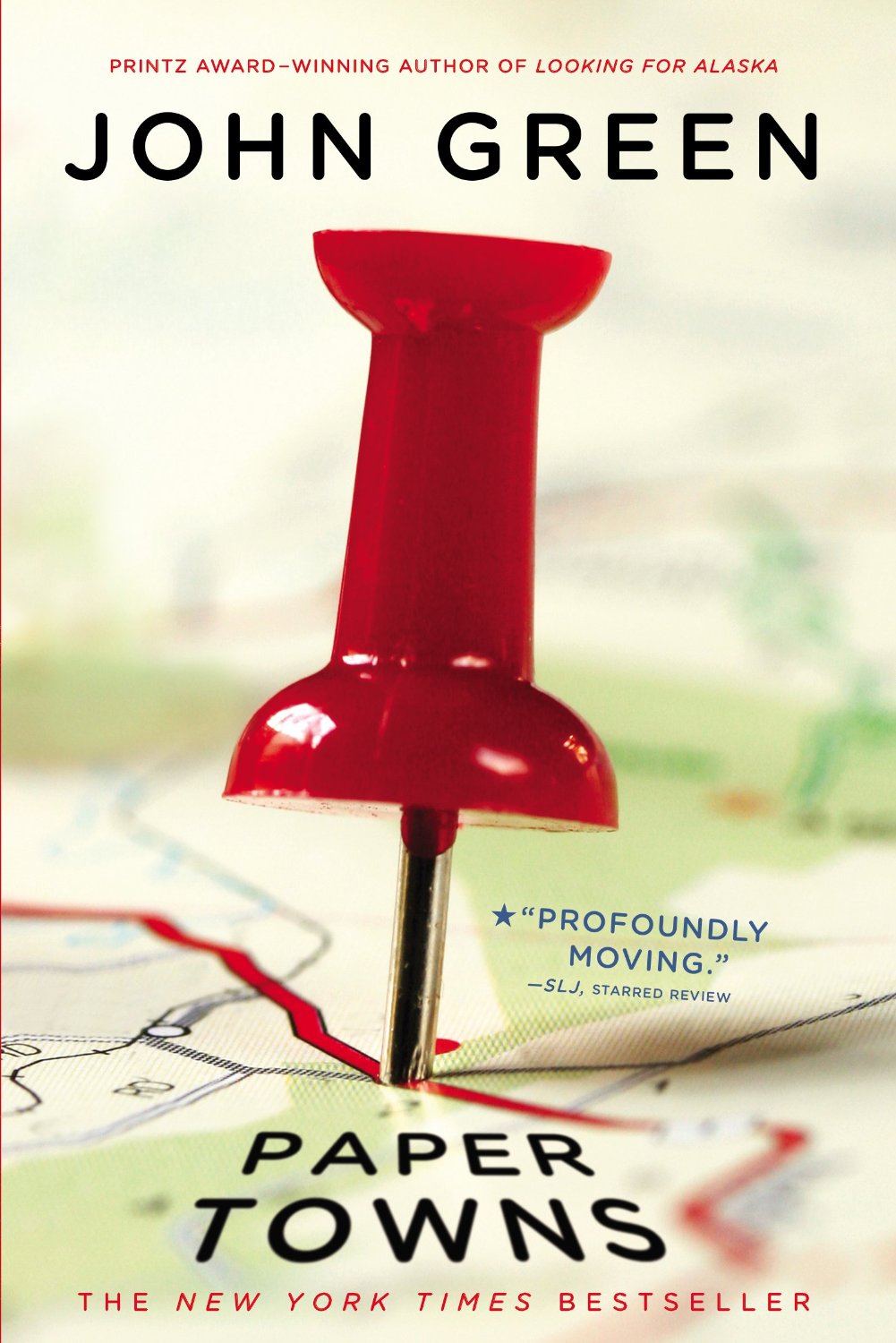
So this is the last of John Green’s books that I hadn’t read. And it, like the others, boils down to much the same plot. Boy meets Girl, Girl affects Boy’s life in a profound way, Boy loses Girl and has to deal with the changes she’s wrought AND her absence. On one hand, I feel like Green needs to branch out and find a new plot, on the other hand, he writes this plot so well. And even within this plot he writes such different books. The Fault in Our Stars was slightly different, in that Girl lost Boy and had to deal with it. Unlike Looking For Alaska, in Paper Towns Girl didn’t die, but Boy still lost her nonetheless. In Will Grayson, Will Grayson, the plot was changed to “Boy meets Boy, Boy changes Boy’s world, Boy loses Boy and has to deal with the loss and the changes.” But in all four books the protagonist winds up dealing with something John Green has mentioned repeatedly in his vlogbrothers videos: imagining people complexly.

What does that mean?

It means not making preconceived notions of what people are or how they think. That woman who was rude to you yesterday, she’s a bitch, right? Instead of just deciding “well she’s rude and mean” imagine her complexly. Maybe she has a migraine, maybe she overslept and her entire morning was a cascade of failure. Maybe she has a sick kid and an out-of-work husband at home and they’re struggling to make ends meet on her minimum wage income. Imagine her complexly and you’ll realize that she has problems of her own, and maybe what you interpreted as a rude, mean-spirited remark was simply a tired tone of voice from a stressed-out woman. Maybe she was rude, maybe she looked at you as simply someone in her way because she didn’t imagine you complexly. Imagining people complexly is another way of saying “treat people like PEOPLE and not just bit players in your own little drama.” That can be a hard task when not everyone is doing it.

In Paper Towns, Margo Roth Spiegelman is an enigma, even to the boy who’s been her neighbor for sixteen years and from whose perspective the book is written. She’s been a different person to every person in high school, letting no one see the real Margo until she runs away and leaves a trail of clues for Quentin, her neighbor, to find. Quentin’s had a crush on her since he was ten, but it’s only in following her clues that he begins to see Margo as Margo, and not as the idea of Margo he had constructed.

It’s an important lesson, and maybe the reason it shows up in all of John Green’s books is because it is so incredibly important and yet so rare to find and so difficult to do. John talks about the concept in a speech he gave at the Alan Conference but the important part is here, I think:

“Let me tell you what is, in my opinion, the central problem of human existence: I am stuck in my body, in my consciousness, seeing out of my eyes. I am the only me I ever get to be, and so I am the only person I can imagine endlessly complexly. That’s not the problem, actually. The problem is you. You are so busy taking in your own wondrousness that you can’t be bothered to acknowledge mine.

When I was a kid, I believed in an embarrassingly total way that I was the only human being in the world and that all the other people, including my brother and parents and everybody, was in fact an alien, and that the aliens had created the entire world to do a series of controlled experiments on how a human child—me—would respond to various forms of trial and tribulation. And when I wasn’t around, they would take off their human costumes—the aliens had very advanced costuming technology, naturally—and they would do alien stuff. You know, go to the alien zoo and watch the alien local news and whatever else. I really believed this.

And obviously, on some level, this indicated the kind of massively narcissistic worldview that would later require decades of therapy to adjust. But in a way, I was right. I am the only person whose existence I can directly attest to. By the way, when I’ve talked about this in the past I’ve seen people nodding, like they also believed in their childhoods that they were the only real person in the world, and I would imagine that right now, some such people are probably feeling the comfort we feel when we learn that our delusions are shared, that we are not alone even in our darkest corners.

… I will acknowledge that you are all likely to be people. The probability that I am the only person in the world is extremely small—it is that number that infinitely approaches zero but isn’t zero. And yet. On some level, I have to take it on faith that you are as complex as I am, that your pain and joy and grief are as real and as meaningful as my own.”

The entire speech is very much worth reading. John Green is extremely eloquent (as good writers must be!) and his perspectives on things are usually worth reading.

From the back of Paper Towns:

Quentin Jacobsen has spent a lifetime loving the magnificently adventurous Margo Roth Spiegelman from afar. So when she cracks open a window and climbs back into his life – dressed like a ninja and summoning him for an ingenious campaign of revenge – he follows. 

After their all-nighter ends and a new day breaks, Q arrives at school to discover that Margo, always an enigma, has now become a mystery. But Q soon learns that there are clues – and they’re for him. Urged down a disconnected path, the closer he gets, the less Q sees the girl he thought he knew.

Bridge to Terabithia by Katherine Paterson

terabithiaBridge to Terabithia
by Katherine Paterson
128 pages
Published 1977
Children’s/Young Adult

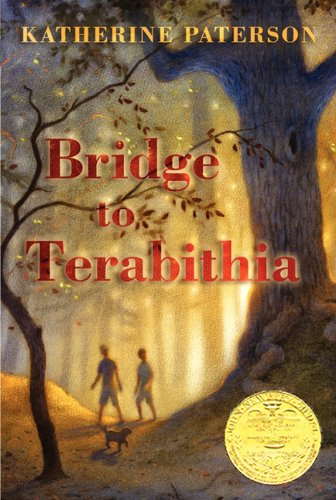
So let me just say up front: I’ve never read this book until today. I haven’t seen the movie. The little I knew about this book was “two children travel to a magical land and then something happens to one of them.” But my husband loved this book when he was young and kept pushing me to read it. I just did, and – it was not at all what I was expecting. I find it a little funny to say “it reminds me of Looking for Alaska,” when Looking for Alaska was written much later than Bridge to Terabithia. But I read LfA first. They do have some striking similarities. Boy meets Girl, Girl affects Boy’s life in a profound way, Boy loses Girl unexpectedly and has to deal with both losing her, and the changes she wrought in his life that can’t be undone. In Looking for Alaska, Miles went looking for his Great Perhaps and thought he’d found it in Alaska. In Bridge to Terabithia, Jess wasn’t looking until Leslie pushed herself into his world and brought that Great Perhaps with her.

Paterson paints a bleak picture of Jess’s life in the backwoods of somewhere-near-Washington DC. Surrounded by three sisters and his mother, while his father is gone all day working in DC, Jess appears neglected, stifled, and lonely. His family is very poor, but so are most of their neighbors. When Leslie and her parents move to the farm next door, tired of the big city and looking for a simpler life, Leslie brings Jess a window to the bigger world. Her parents tell him of things going on in far off places. And she takes him back into the dark woods behind their houses where they create an imaginary world called Terabithia. They reign as King and Queen of Terabithia, playing a game of pretend that starts as soon as they swing over the creek on a rope into a land that is solely theirs.

One thing that really stood out to me was Jess’s trip to the Smithsonian with his music teacher. Maybe it’s because I’m jaded, maybe it’s because the book was written in the 70s and it wasn’t considered a big thing, but – his young, pretty music teacher takes him, JUST him, to the Smithsonian museums. He’s 10, and has a bit of a crush on her as 10-year-olds are wont to do, so he’s constantly talking about her hair, her voice, the scent of her perfume – the whole scene was just creepy to me. A young female teacher taking a young boy on a solo trip? My husband said he didn’t notice anything wrong with the scene, but he was in 4th grade when he read the book! Nothing untoward actually happens between Jess and his music teacher, but the scene still just creeped me out.

Overall I can’t say I really have strong feelings about this book one way or another; it had a strong impact on my husband, but he read it when he was in the fourth grade. His comment was “the whole book is about being a child, and doing childish things, but not wanting adults to TREAT you like a child,” which does sound like something he dealt with, being an only child. Reading it as an adult just doesn’t have the same impact.

From the back of Bridge to Terabithia:

All summer, Jess pushed himself to be the fastest boy in the fifth grade, and when the year’s first school-yard race was run, he was going to win. But his victory was stolen by a newcomer, by a girl, one who didn’t even know enough to stay on the girls’ side of the playground. Then, unexpectedly, Jess finds himself sticking up for Leslie, for the girl who breaks rules and wins races. The friendship between the two grows as Jess guides the city girl through the pitfalls of life in their small, rural town, and Leslie draws him into the world of imagination – a world of magic and ceremony called Terabithia. Here, Leslie and Jess rule supreme among the oaks and evergreens, safe from the bullies and ridicule of the mundane world. Safe until an unforeseen tragedy forces Jess to reign in Terabithia alone, and both worlds are forever changed. 

Looking for Alaska, by John Green

alaskacover

Looking For Alaska
by John Green
221 pages
Published 2005
Young Adult Fiction

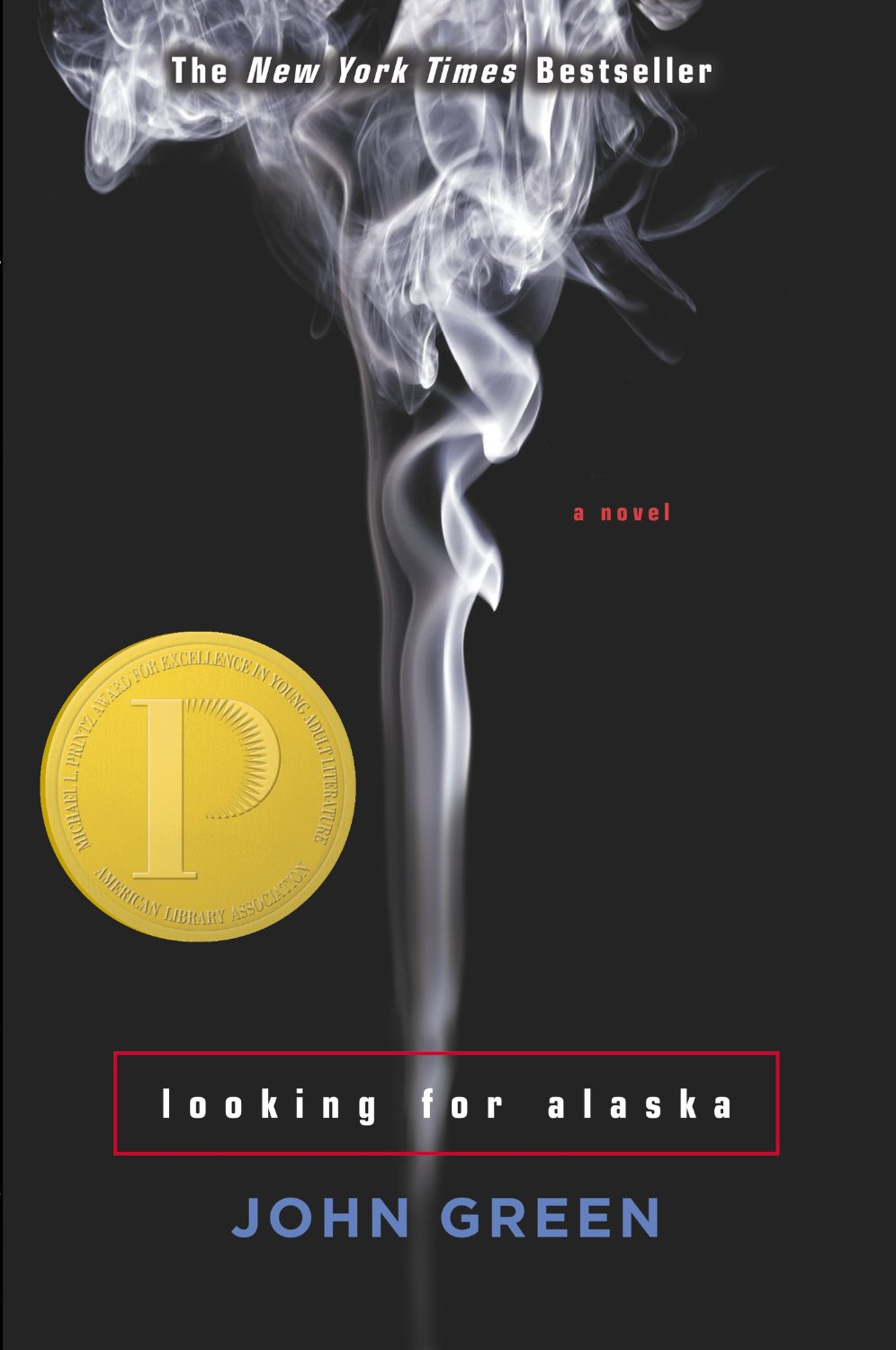
I just finished reading Looking for Alaska, making it the fifth John Green book I’ve read, after Will Grayson, Will Grayson, Let It Snow, The Fault In Our Stars, and An Abundance of Katherines. I enjoyed Looking for Alaska immensely, just like I did the other three. (My favorite being Let It Snow, which he wrote with two other authors as a set of three related short stories.) I haven’t made a habit out of reading young adult fiction, but for John Green I’ll definitely make an exception. I should also pick up some of Maureen Johnson‘s books; her contribution to Let It Snow was excellent.

I have a confession to make before I go any further: I am a Nerdfighter. I was introduced to John and Hank Green about two years ago by one of my best friends, by way of Crash Course. Since then I’ve (almost!) caught up on their Vlogbrother videos, watched most of the Crash Course videos (sorry Hank, I’m just not into chemistry) and started watching Sci Show. John and Hank are both extremely educated, well spoken, and yet extremely entertaining and fun to watch. Watching the vlogbrothers episodes where John talks about writing the books (as he’s writing them!) is what finally made me go pick up his books to read. And he’s GOOD.

In Looking for Alaska, Miles Halter goes away to boarding school at Culver Creek, his father’s alma mater. He’s in search of his “great perhaps,” his meaning for life. (The phrase comes from Francois Rabelais’ last words “I go to seek a Great Perhaps.” Miles doesn’t want to wait until he dies to go in search of his.) Culver Creek really marks a turning point in Miles’ life – from a friendless outcast in his old school to one of the closest friends of Alaska Young. Alaska is a bit of a bad girl (sneaking cigarettes and alcohol into school constantly and pulling ingenious pranks) but also an enigma. The entire school body loves her, but even to her closest friends she doesn’t reveal much about herself.

The book is divided into “before” and “after” and it wasn’t  until within a few pages till the end of the “before” section that I realized what the event was. “After” deals with the characters of the book coming to terms with their life-altering event.

In The Fault In Our Stars, John Green dealt with the lead up to a life-altering event that the characters knew was coming – a long, drawn-out sort of grief. Looking For Alaska deals with the fallout of an event no one knew was coming, and while the emotions are just as deep, they feel sharper somehow for being so unexpected.

I definitely recommend this book, and all of John Green’s books. He’s a very talented writer, and isn’t afraid to put “adult” themes into his “young adult” books. As if sex and alcohol and death and deep meaning-of-life questions aren’t things every teenager deals with? I like that he doesn’t pull his emotional punches. His books may be “young adult” but they’re not fluffy or “easy to read.” Easy in terms of grammar and flow perhaps, but not in content. I teared up reading parts of Looking For Alaska, and outright sobbed for a good portion of The Fault In Our Stars. (Which is now being made into a movie!)

John Green is definitely one of my favorite authors – I’m only missing one book of his, Paper Towns, and I’m picking that up from the library tonight. So a review will be up soon!

From the back of Looking For Alaska:

Miles Halter is fascinated by famous last words – and tired of his safe life at home. He leaves for boarding school to seek what the dying poet Francois Rabelais called the “Great Perhaps.” Much awaits Miles at Culver Creek, including Alaska Young. Clever, funny, screwed-up, and dead sexy, Alaska will pull Miles into her labyrinth and catapult him into the Great Perhaps.

DFTBA, my friends.