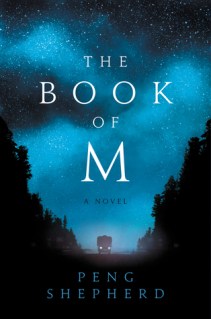
Book Review: The Book of M

the book of mThe Book of M
by Peng Shepherd
Dystopia/Magical Realism
485 pages
Published June 2018

What defines a person? Your experiences? Your personality? The emotional bonds you forge? What happens when you forget? Are you still you if you don’t remember who that is? The Book of M tackles these questions and takes an intimate look at what happens when some people forget but others remember.

We enter on Max and Ory in an abandoned hotel, running out of food and supplies. Max has lost her shadow, which means she will soon start forgetting. Everything. (There are rumors that Shadowless have died because they forgot to breathe or eat.) We learn it’s been a few years since the phenomenon started happening, and flashbacks tell us the story of those early months. Like any good dystopia, it is a world-altering process. Governments are gone because no one remembered to run them. Food and other supplies are dwindling because farmers, shippers, manufacturers forgot what they were doing and how to do it.

But with the forgetting comes – magic, of a sort. Ory comes across a deer in the forest that instead of antlers, has wings sprouting from its forehead. Because someone forgot that deer shouldn’t have wings – and so it happened. Forgetting that something can be destroyed can make it indestructible. Forgetting that you left a place can take you back to that place. Forgetting a place exists can make that place no longer exist. It’s not a very controllable kind of magic. And it’s dangerous – you can never be quite sure what you’ll forget, and you can affect other people with it.

And the forgetting starts with losing your shadow. Ory gives Max a tape recorder, so she can record things she might forget. He posts signs around their hideout to remind her of things, like “Let no one in. Ory has a key.” and “Don’t touch the guns or the knives.” But Max knows she is a danger to Ory, and so while she can still remember enough to function, she runs away.

The book mostly concerns Ory and Max’s journeys across the country; Max trying to find something she’s forgotten, and Ory trying to find Max. The adventure is gripping, heartbreaking, and at times confusing. (Mostly on Max’s end, as magic warps things around her.) There are a few side characters who also have viewpoint chapters. Naz Ahmadi is an Iranian girl training for the Olympics in the US – in archery, which comes in quite handy. We also have The One Who Gathers, a mysterious man in New Orleans who has gathered a flock of shadowless.

If you ever played the roleplaying game Mage: the Ascension, and remember the concept of Paradox, this book reminds me of that a lot. (Is it a surprise that I’m a tabletop RPG geek? It shouldn’t be. I own almost all of the old World of Darkness books, and currently play in a D&D game, and hopefully soon a second D&D game!) Anyway. Paradox. Where doing magic too far outside the bounds of acceptable reality punishes you, so you have to weigh the potential consequences against the magic you want to do.

I really enjoyed this debut novel; it is a very original take on a dystopia, and raised a lot of questions about personality, memories, and what makes a person the person you remember.

From the cover of The Book of M:

Set in a dangerous near-future world, The Book of M tells the captivating story of a group of ordinary people caught in an extraordinary catastrophe who risk everything to save the ones they love. This sweeping debut illuminates the power that memories have not only on the heart, but on the world itself.

One afternoon at an outdoor market in India, a man’s shadow disappears – an occurrence that science cannot explain. He is only the first. The phenomenon spreads like a plague, and while those afflicted gain a strange new power, the magic comes at a horrible price: the loss of all their memories.

Two years later, Ory and his wife, Max, have escaped the Forgetting by hiding in an abandoned hotel deep in the woods outside Arlington, Virginia. Their new life feels almost normal, until their greatest fear happens to them, and Max’s shadow disappears, too.

Knowing that the more she forgets, the more dangerous she will become to the person most precious to her, Max runs away while Ory is out foraging for supplies – but he refuses to give up what little time they have left together. Desperate to find Max before her memory disappears completely, Ory follows her trail across a perilous, unrecognizable world, braving the threat of roaming bandits, the call to a new war being waged amid the ruins of the capital, and the rise of a sinister cult that worships the shadowless.

On their separate journeys, each searches for answers: for Ory, about love, about survival, about hope; and for Max, about a mysterious new force growing in the south that may hold the cure.

Sunday Link Roundup

Just a few quick links this week!

A list of recent and upcoming LGBTQIAP+ books by Asian authors!

This AMAZING dissection of how offensive the 100 “best” fantasy and sci-fi novels are.

Two more articles on fixing Sci-fi’s women problem and questions to ask about beloved books that are problematic.

Book Review: Starless

StarlessStarless
by Jacqueline Carey
Fantasy
587 pages
Published June 2018

Jacqueline Carey has been a little hit or miss for me lately. I loved Kushiel’s Dart, read that years ago. Wasn’t fond of the second trilogy in that world. I read Miranda and Caliban a while back, and it was alright. This, though, blew me away. First, the idea that there are no stars in the sky. They have three moons and a sun, but no stars. Their mythology is that the Stars rebelled against their father, the Sun, and he threw them all to Earth, including one who hadn’t participated as it had been a babe in the womb during the rebellion! The stars now walk the earth as gods and goddesses, and we meet several in the book. (And hear about a few more.) The one god that hadn’t been part of the rebellion, but was punished anyway, has been nursing his hurt and resentment until, prophecy states, he will eventually wake and try to kill everyone. The problem is the prophecy was shattered into as many pieces as there are gods, and spread across the world. There are prophecy seekers that try to collect all the bits, but they’re not very successful.

In Khai’s country, the sacred twins are their gods. Pahrkun the Scouring Wind and Anamuht the Purging Fire. They can be seen on occasion striding across the desert. It is by Pahrkun’s will that Khai is bound to the youngest princess as her soul twin; very rarely the royal family gets one of these, and they are always meant to be bodyguards. So Khai is sent to the temple of Pahrkun’s warriors, deep in the desert, and trained in the many ways to kill. The warriors are all men, but Khai turns out to be non-binary, and this is what lets him guard the princess in a culture that includes harems and eunuchs. I love the relationship between Khai and Princess Zariya, and Zariya is no typical princess.

The book follows Khai and Zariya’s adventures in court intrigue, marriage proposals, sea battles, and prophecy-chasing. The action is perfect, the world breath-taking, and the people beautifully written. I’ve always enjoyed the fantasies where the gods show up commonly enough that people know how to identify them and how to treat them. From the Wind and Fire of Zharkoum’s arid country to the shape-changing Quellin and the terrifying Shambloth, the people that live near them build governments and societies around their gods, which makes each society stand out in their own way. World-building is definitely something that Carey is an expert at.

Starless is an amazing fantasy with a lovely queer romance at its heart. It’s full of varied cultures and enigmatic gods and goddesses and I just LOVE IT. Definitely one of my favorites this year.

From the cover of Starless:

“I was nine years old the first time I tried to kill a man . . .”

Destined from birth to serve as protector of the princess Zariya, Khai is trained in the arts of killing and stealth by a warrior sect in the deep desert; yet there is one profound truth that has been withheld from him.

In the court of the Sun-Blessed, Khai must learn to navigate deadly intrigue and his own conflicted identity . . . but in the far reaches of the western seas, the dark god Miasmus is rising, intent on nothing less than wholesale destruction.

If Khai is to keep his soul’s twin Zariya alive, their only hope lies with an unlikely crew of prophecy-seekers on a journey that will take them farther beneath the starless skies than anyone can imagine.

Friday 56 – Starless

StarlessThe Friday 56 is hosted by Freda’s Voice. The rules are simple – turn to page 56 in your current read (or 56% in your e-reader) and post a few non-spoilery sentences.

Today’s quote is from Starless, by Jacqueline Carey. Full review should be up tomorrow!

He touched the blade of his yakhan against the central prong of his kopar so lightly that it might almost have been an accident, except that he did it twice, tapping his left foot on the floor of the Dancing Bowl. Click-click-tap.

He did it again.

Click-click-tap.

It was a variant of the traditional tribal challenge of thunder and lightning against an unworthy opponent. One of the watching brothers chuckled, and I felt myself flush with anger and embarrassment.

“To first blood!” Brother Merik raised one arm, fist clenched. “Try not to maim each other, please. Go!”

Book Review: This Will Be My Undoing

this will be my undoingThis Will Be My Undoing: Living at the intersection of Black, Female, and Feminist in (White) America
by Morgan Jerkins
Memoir/Black Feminism
258 pages
Published 2018

I have a tough time reviewing books about Black Feminism. I enjoy reading them – well, maybe “enjoy” isn’t quite the right word. They can be tough. I am glad to have read them. But how to review them? I’m a white woman, it’s not really my place to critique these works. But it would be remiss of me to not talk about them – denying them the same space on my blog that I give to everything else I read is its own kind of erasure. I’m not sure how best to resolve this, but for this specific book, at least, I can talk about what I learned from it.

What I learned is that some of my childhood was straight-up racist. I always thought of my childhood as pretty idyllic – my parents were high school sweethearts, and to this day still adore each other. We lived in a house my parents owned. (My most formative years were actually spent in the house my mother grew up in; my parents bought it from my grandparents when I was seven.) We got to run around and play on a quiet neighborhood street where we knew all of our neighbors. We had pets of various species, we got technology fairly quickly since my father was a computer geek, we had a garden out back that Mom canned beans out of every year.

But I was homeschooled until eighth grade. (With Bob Jones and Abeka Books, notoriously Christian curriculum. I thought humans lived with dinosaurs well into my twenties.) We went to a conservative Christian church every Sunday. (And Tuesday. And some Fridays.) While my parents taught that I could be anything I wanted to be, the church definitely over rode that with “women should be subservient to men” and “don’t trust your own judgment, ask God/your parents/the elders.”

The incident that Jerkins’ book brought back to mind, though, was a party I went to. I’m pretty sure it was someone’s birthday party, but at a church. Not our church. There were a lot of people, though, so I could be wrong about the birthday party. It was this party where I got the tiny scar in my eyebrow – some kid broke the bat on the pinata and threw it behind him, where it hit me in the face. Before that, though, was the cake walk. There were footprints laid out on the concrete floor, and we paced around them while music played, kind of like musical chairs, I think. (I was younger than ten, my memory is a little fuzzy.) I won the cake! I thought nothing of this until reading This Will Be My Undoing.

“The cakewalk was a dance performed in the late nineteenth century at slave get-togethers. You lean or rear back and kick your feet out left and right or vice versa as you move forward……White people would watch them dance, fascinated by the exoticness of it all. These spectacles were purposeful humiliations. But the cakewalk evolved as slaves’ own form of subversion. While serving at large and fancy parties in the early 1800s, they would watch well-to-do white people perform strict and stiff dances, like cotillions and quadrilles, and mimic them, exaggerating the bowing and small skips and hops and adding some high steps and jumps. In diaries kept by white people in the antebellum South, the cakewalk is not depicted as a form of satire. After all, why would a sweet slave mock his benevolent master? To white people’s eyes, this imitation seemed like flattery. They were delighted that the slaves were attempting their civilized dances. In fact, they would hold competitions and the winning slaves would receive a cake, hence the name. Yet they were being mocked, right in front of their faces.”

WHY WAS THIS BEING HELD AT A CHURCH PARTY? I don’t recall if it was all white kids, but it probably was. My hometown was not very ethnically diverse. The more I learn – academically, politically, socially, secularly – the more I realize my childhood was pretty fucked up in a lot of different ways. I don’t know if it was more or less fucked up than most white kids’ childhoods – white supremacy is insidious. I was an ignorant child at the time, but to realize, decades later, how racist holding a cakewalk is, stopped me in my tracks. (Incidentally, this means that calling something “a cakewalk” has its roots in racism, like so many other things in our language. Cakewalks weren’t easy – but the best dancers made them look that way.)

So that’s what I can say about this book. I learned something about my childhood. Beyond that, all I will offer is that Jerkins is an excellent writer; the book flows well and is an easy read, despite the subject matter not being easy. Read it. It’s important.

From the cover of This Will Be My Undoing:

From one of the fiercest critics writing today, Morgan Jerkins’ highly-anticipated collection of linked essays interweaves her incisive commentary on pop culture, feminism, black history, misogyny, and racism with her own experiences to confront the very real challenges of being a black woman today—perfect for fans of Roxane Gay’s Bad Feminist, Rebecca Solnit’s Men Explain Things to Me, and Chimamanda Ngozi Adichie’s We Should All Be Feminists.

Morgan Jerkins is only in her twenties, but she has already established herself as an insightful, brutally honest writer who isn’t afraid of tackling tough, controversial subjects. In This Will Be My Undoing, she takes on perhaps one of the most provocative contemporary topics: What does it mean to “be”—to live as, to exist as—a black woman today? This is a book about black women, but it’s necessary reading for all Americans.

Doubly disenfranchised by race and gender, often deprived of a place within the mostly white mainstream feminist movement, black women are objectified, silenced, and marginalized with devastating consequences, in ways both obvious and subtle, that are rarely acknowledged in our country’s larger discussion about inequality. In This Will Be My Undoing, Jerkins becomes both narrator and subject to expose the social, cultural, and historical story of black female oppression that influences the black community as well as the white, male-dominated world at large.

Library Loot Wednesday!

Only two books this week – I have to slow down after last week! But R. F. Kuang’s The Poppy War and the Asian inspired anthology A Thousand Beginnings and Endings both came in this week, and I am SO EXCITED to read them! I’ve been looking forward to both of these for quite some time – a lot of the books that came out this summer have finally made it into the library system so I’ll probably be getting a lot of awesome reads in the next month or two!