Duology Review: The Girl From The Well / The Suffering

girl from the wellThe Girl From The Well
The Suffering
by Rin Chupeco
Young Adult / Horror
255 pages / 313 pages
Published 2014 / 2015

This duology claimed a spot in my Spooky October Reads because I ADORE this author’s later work, The Bone Witch trilogy. I’d heard great things about this set, and I’m so glad I finally read it. I don’t care for much horror, generally, and this was just the right amount of iffy morality and spooky ghost stuff.

The books are told from the viewpoint of Okiku, a 300-year-old ghost who drowned in a well but came back to take vengeance on her killer before continuing to hunt down killers of children. The other main characters are Tarquin, a half-Japanese boy with strange, unnerving tattoos, and his older cousin Callie. The mystery of who Tarquin’s mother really is, what happened when he was a toddler, and why she’s tried to kill him every time she’s seen him since, is at the heart of the first book. The pacing and reveals are expertly done, so I won’t say much more about the plot.

the sufferingOkiku is appropriately terrifying, and her backstory is equally tragic. We learn much more about what happened to her in the second half of the first book, and it’s fleshed out even further in the second book. The second book is largely Okiku and Tark having an adventure in Japan, and less about their individual histories. I think it was a great sequel, though, and definitely needed to finish Okiku and Tark’s story. It takes place almost entirely in Aokigahara, Japan’s “suicide forest.” The Suffering is also told from Tark’s point of view instead of Okiku’s, and definitely suffers for that.

Overall, the first book is better than the second, but the second is still good, and finishes the story. Terrifying ghosts, creepy dolls, ancient rituals, and secret societies abound in these two books, and they’re the perfect amount of spooky for a scaredy-cat like me. These definitely cement Rin Chupeco as a must-read author for me. She’s fantastic.

From the cover of The Girl From The Well:

The dead do not always rest . . . 

Okiku knows anger and pain. They are what she last felt before her life was brutally taken from her more than 300 years ago. Now a restless spirit, she wanders, seeking out those who viciously take the lives of children. Okiku always gets her vengeance. She has no remorse for the wicked.

Until she meets seventeen-year-old Tark . . . 

From the cover of The Suffering:

The darkness will find you.

Seventeen-year-old Tark knows what it is to be powerless. But Okiku changed that. A restless spirit who ended life as a victim and started death as an avenger, she’s groomed Tark to destroy the wicked. But when darkness pulls them deep into Aokigahara, known as Japan’s suicide forest, Okiku’s justice becomes blurred, and Tark is the one who will pay the price . . . 
Book Review: The Rage of Dragons

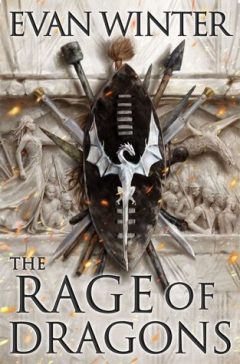
rage of dragonsThe Rage of Dragons
by Evan Winter
Fantasy
535 pages
Published July 2019

You know how so many fantasy books have reluctant hero protagonists? This is not that. Well. The first couple of chapters are. But then Tau decides he’s going to be the BADDEST MOTHERFUCKER IN THIS LAND. Tau is, hands down, one of the most hard-core protagonists I’ve read in a very long time.

Content Warning: Brutal book. I’ll be talking about some of the imagery.

The Rage of Dragons is about determination, combat, and the will to live. I’ve always been wary of books based on “endless war” but this was actually very well thought out, and it makes sense. The Omehi were a people exiled from their homeland; they sailed across the sea to find a new land, and became colonizers. They are thoroughly outnumbered by the native Hedeni, but they have magic. They settle on a peninsula but are unable to push further into the mainland, even with their magic and dragons. The jacket copy says “a hundred thousand years” but the text picks up 186 cycles after the prologue (which covers the initial landing) and I assumed cycles meant years. Jacket copy often exaggerates things, so I’m going with 186 years, not a hundred thousand. It seems more likely.

So in two hundred years, neither side has managed to score a decisive victory over the other; the Omehi have held the territory they carved out for their people, built cities, and farmed land. The Hedeni continue to raid the edges, occasionally pushing further in and wreaking havoc.

The Omehi also have a rigid caste system; the only hint of upward mobility is the Gifted, who come from all castes, and the military, which glosses over some caste restrictions but not all. Tau is a Common who is tired of being shat on by the Nobles, and he sees the military as his ticket to getting vengeance. (Military members can challenge each other to blood duels without repercussions for defeating those of higher castes.)

An interesting point I’d like to make is though several people died to further the main character’s plot, which is usually known as fridging – they weren’t -killed-, exactly. They all had agency. They all took actions they knew could or would end in their deaths, and they did them anyway. So while it is death to motivate the main character, it did not rob them of agency in doing so, so I’m not sure it technically counts as fridging. Even if it does, it was masterfully done and I don’t actually mind it in this context.

There is A LOT of combat and gruesome death in this book. This is a BRUTAL society. People get hurt and even killed in training – hell, they get killed in the TRYOUTS for the military. In one of the first few chapters there is an off-page rape, then victim-blaming and revenge-killing. It’s also rape of a lower-caste by a higher-caste, so there is some brush off there of “oh it’s just a servant” variety. The book does NOT pull punches.

But it’s a truly great book. More than once I stared at the page and said, ALOUD, “Holy SHIT, Tau!” It was easy to see why something snapped in Tau’s soul, and I’m eager to see his character development in book two.

Brutal, vivid, hardcore book that grabs you by the throat and doesn’t let go until the last page.

From the cover of The Rage of Dragons:

The Omehi people have been fighting an unwinnable fight for a hundred thousand years. Their society has been built around war and only war. The lucky ones are born gifted. One in every two thousand women has the power to call down dragons. One in every hundred men is able to magically transform himself into a bigger, stronger, faster killing machine.

Everyone else is fodder, destined to fight and die in the endless war.

Young, gift-less Tau knows all of this, but he has a plan of escape. He’s going to get himself injured, get out early, and settle down tot he simple life: marriage, children, land.

Until those closest to him are brutally murdered, and his grief swiftly turns to anger. Fueled by thoughts of revenge, Tau dedicates himself to an unthinkable path: He’ll become the greatest swordsman to ever live. A man willing to die a hundred thousand times for the chance to kill the three who betrayed him.

Friday 56 – The Rage of Dragons

rage of dragonsThe Friday 56 is hosted by Freda’s Voice. The rules are simple – turn to page 56 in your current read (or 56% in your e-reader) and post a few non-spoilery sentences.
This week’s quote is from The Rage of Dragons, an African-inspired fantasy by Evan Winter.

It was one of the Gifted. Not the one who had skimmed Tau with her enervating blast and not the one directing the dragon. This Gifted had stood quiet and still, surrounded by soldiers, and far from combat. She was convulsing and coughing up blood, her skin bubbling and bursting. It looked like she was being torn to pieces from the inside out. It looked like what had happened to the hedena Jabari had captured and questioned.

A soldier took hold of her and, with tenderness, helped her to the ground. The other soldiers tightened the circle around her, blocking Tau’s view. he could still hear, though. He could hear her dying, and he started toward them, thinking to help, when a hand fell on his shoulder.

Library Loot Wednesday

A rather eclectic mix of books this week. The Pumpkin Cookbook, because it’s fall and I love pumpkin spice, and so does my husband! Chaotic Good, because it’s about a geeky girl facing sexism, and it’s set in my hometown! And Frankly In Love because I’ve been hearing great things about it.

Book Review: The Lady’s Guide to Celestial Mechanics

lady's guide to celestial mechanicsThe Lady’s Guide to Celestial Mechanics
by Olivia Waite
Historical Romance / LGBT
322 pages
Published June 2019

This was one of two sweet, lighthearted romances I read to prepare myself for Margaret Atwood’s The Testaments – and it definitely helped. HEAs always lift my mood.

I was a little afraid, with the title, that we were going to be talking about astrology, but nope. Astronomy. Just from a Victorian point of view. Well. Slightly earlier, actually, as the book opens in 1816. It’s a true Regency romance, set twenty years before Victoria becomes Queen.

Lucy Muchelney, one of our two main characters, is left somewhat at loose ends after her father dies and her lover marries a man. She had been serving as her father’s assistant in astronomy calculations, but her brother, now in control of their finances, tells her she should get married and leave silly thoughts of science behind her. Then she finds a letter from one of her father’s patrons, the Countess of Moth, and runs off to London, hoping to convince the Countess she’s as good as her father.

The Countess, recently widowed, is intrigued by Lucy, and takes her on. Together they face the sexism of the exclusively male Polite Science Society, and privately struggle with a romance that can never be publicly acknowledged.

I really enjoyed this romance. I think it was actually less explicit than most of the adult romances I read, but I know LGBT romances in particular have to walk a fine line because people are all-too-ready to call them bad names as it is. It absolutely had sex scenes, just…not as dirty and detailed and prevalent as many romances I’ve read.

I liked that it dealt with issues surrounding the need to keep the relationship a secret. In that era, being gay was a crime, though usually only prosecuted against men. But it meant it couldn’t be publicly acknowledged; they couldn’t marry. So there’s a worry that there’s nothing legally binding them together, and if, say, the Countess were to get tired of Lucy, Lucy could be out on the street. The imbalance of power with no safety net puts Lucy on shaky ground, and that’s something the two women have to work out.

The bulk of the plotline outside of the romance deals with the sexism of the scientific society at the time; my Friday 56 this week quoted a particularly damning scene. Lucy gets her revenge eventually, and it’s a delight.

Fun little regency romance. There are a few authors writing diverse historical romance, and I’d love to see more!

From the cover of The Lady’s Guide to Celestial Mechanics:

As Lucy Muchelney watches her ex-lover’s sham of a wedding, she wishes herself anywhere else. It isn’t until she finds a letter from the Countess of Moth, looking for someone to translate a groundbreaking French astronomy text, that she knows where to go. Showing up at the Countess’ London home, she hoped to find a challenge, not a woman who takes her breath away.

Catherine St. Day looks forward to a quiet widowhood once her late husband’s scientific legacy is fulfilled. She expected to hand off the translation and wash her hands of the project—instead, she is intrigued by the young woman who turns up at her door, begging to be allowed to do the work, and she agrees to let Lucy stay. But as Catherine finds herself longing for Lucy, everything she believes about herself and her life is tested.

While Lucy spends her days interpreting the complicated French text, she spends her nights falling in love with the alluring Catherine. But sabotage and old wounds threaten to sever the threads that bind them. Can Lucy and Catherine find the strength to stay together or are they doomed to be star-crossed lovers?

Edgar Allan Poe Sunday!

So I THOUGHT I had written up a post a long time ago featuring our visit to Poe’s grave, and I was going to link it today in a post about the International Edgar Allan Poe Festival happening this weekend in Baltimore, but it turns out I never wrote that post!

So today will be a combo Festival recap and Literary Landmark post! I’d like to make these a sporadic feature, the only one I’ve done before was on F. Scott Fitzgerald’s grave in Rockville, Maryland.

20191005_1156333646090053923156367.jpg

The view down one leg (of two) of the Poe Festival.

First, the Poe Festival. I believe this is the second year they’ve held it; I didn’t make it to last year’s. It’s held in the street in front of the Poe House, which I sadly neglected to get pictures of, as I thought I’d taken pictures when we toured it several years ago. AGAIN I WAS MISTAKEN. The only Poe House I have pictures of is the one in Philadelphia. (Tell me I posted that one…*combs through old posts* Ah ha! I found it as part of my Philadelphia trip post.) So it looks like we’ll need to make time to tour the Baltimore Poe House again some time, and get pictures this time. We’ve also decided we really need to get down to Richmond and see their Poe museum, so we can complete the trifecta!

The Poe Festival wasn’t real big; it was basically two small blocks, with a writer’s stage and a performance stage, and a couple of food booths on the other side of the performance stage. I don’t know how big it was last year, but I’m hoping it will expand. (And we were only going to the free stuff, there were paid tours and a ball of some sort.) There was a lot of neat art, some local authors selling books, and a couple of Poe-themed beer companies. The Richmond museum had a booth there, as did the Poe Society, who had printed leaflets of lectures that have been given on the study of Poe’s works. What I did NOT see, surprisingly, was anyone selling complete copies of actual Poe. Isn’t that weird? I’m going to Barnes & Noble on Wednesday for Book Club, I’ll have to pick up one of their gorgeous collectible copies to match the others we have.

20191005_1144162362419438601252188.jpg

The Richmond Museum’s booth included a mini-exhibit on period coffins at the time of Poe’s death, including this one that they welcome people to step into. (Currently occupied by my husband, with his hands crossed over his Poe shirt, so you can’t see it!) It’s – rather claustrophobic. The man’s hand you see in the foreground with a ring is clasped around the top of a cane; I did not get a name, but he had amazing semi-period dress on, and I SHOULD have gotten a picture! I always realize later there are more things I should have gotten pictures of. I DID get a picture of this fantastic man with his art, though:

20191005_120806708424916606053899.jpg

That is a portrait of Poe overlaid with the text of The Raven! We bought a print to go in my reading nook, because it’s amazing. If you can’t read his contact information there, it’s @nicholasdamianschleif on Facebook and Instagram. He might still have some for sale on his Facebook if you want one for yourself!

A few more photos from the festival:

And since I never posted about Poe’s grave, some photos from Westminster graveyard, the site of Poe’s grave.

Poe Westminster

The church is gorgeous, with beautiful brickwork. It’s not as ornate as some churches in Baltimore, but it’s pretty magnificent nonetheless. The graveyard itself is really pretty, too:

Poe Westminster 2

There’s a crypt around the corner with some other interesting people in it, but Poe’s grave is what we’re here for, right? We have his original gravestone:

Poe Gravestone

And then at some point he was dug up and reburied next to his mother-in-law/aunt and his cousin/wife. There’s a big white monument for them:

Poe Monument

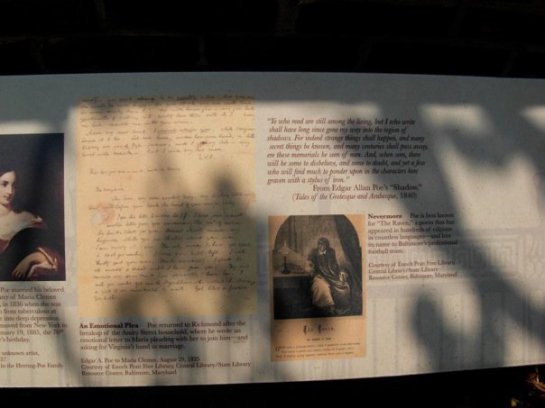
There are historical plaques all over the graveyard, but I didn’t get very good shots of them. I’ve gotten better at that over the years, but here’s a partial:

Poe Plaque

It was also summer, and shade wasn’t cooperating. It might be worth it to go visit sometime this winter when there won’t be any leaves on the trees to shade the signs!

We had a pretty fun day yesterday, and we’re at the Renaissance Festival again today, working at Tiger Torre Art. Feel free to come say hi if you’re in the area!