Book Review: A Whole New World

a whole new worldA Whole New World
by Liz Braswell
(#1 in the Twisted Tales series)
Fairy-Tale Retellings
376 pages
Published 2015

I’ve been wanting to read the Twisted Tales series for quite some time, and finally requested the first book. To be honest, I’m not thrilled. Aladdin was never my favorite Disney movie, though, so it might just be unfortunate that it’s the first book in the series. I’ll probably still try the rest.

The book actually sticks pretty closely to the Disney movie in descriptions, characters, and setting. Everyone looks like their Disney movie counterparts. I had to check the inside cover to find that the book is indeed an official Disney product. There’s no way they’d get away with it, otherwise; it’d be blatant copyright infringement, and Disney is rather strict about that.

Basically, the book takes the script of Aladdin and asks one question – what if Aladdin really did give Jafar the lamp instead of keeping it when he got stuck in the cave? We know what Jafar does with the lamp eventually, but what if he had it first, before Aladdin? A lot of the plot is familiar – Jasmine and her tiger, the hourglass with people stuck inside of it, the Sultan playing with his toys. It’s really interesting to see the plot elements deconstructed and put back together in new ways.

I’m not sure whether I like this plot or the movie plot more; I never had strong feelings about Aladdin so I’m probably not the best judge.

It’s alright. If you’re a fan of Aladdin you might like it more than I did. I’m withholding judgment of the entire series until I read a few more, though.

From the cover of A Whole New World:

What if Aladdin had never found the lamp?

Aladdin is a street rat. There’s really no getting around that. Like most, he’s just trying to survive another day in impoverished Agrabah.

Jasmine is a princess, one who is about to enter into an arranged marriage. All she wants is to escape her fate, to see what lies beyond the palace walls.

But everything changes when the sultan’s trusted adviser, Jafar, suddenly rises to power. With the help of an ancient lamp, Jafar becomes determined to break the laws of magic and gain control over love and death. Soon Aladdin and the deposed princess Jasmine must unite the people of Agrabah in rebellion to stop the power-mad ruler. But their fight for freedom grows costly when it threatens to tear the kingdom apart.

This isn’t the story you already know. This is a story about power. About revolutionaries. About love. And about one moment changing everything. 

Book Review: Snow Like Ashes

snow like ashesSnow Like Ashes
by Sara Raasch
YA Fantasy
422 pages
Published 2014

The world-building in this book is fascinating. At first, it seems like yet another YA novel about displaced royals trying to win back their kingdom, but this royal is in much more dire straits than most. Meira is a refugee living on the run with seven others, one of them her rightful King. All the rest of their people have been enslaved by the conquering country, and their kingdom’s link to the magic inherent in the land has been broken.

A little backdrop is needed. In Meira’s land, there are eight countries. The Rhythm countries, where seasons proceed as normal, and the Seasons – 4 countries locked in one season each. The rulers of each country have a magic conduit that lets them feed magic to their people – but the conduits are gender-locked. In four of the countries, only women can use the conduit; in the other four, only men. Meira and her little band are all that’s left of the free people of Winter. Spring invaded sixteen years ago, killed Winter’s queen, broke the locket that was their magic conduit (each ruler has one) and enslaved their people. Because the queen only had a son, he can’t wield Winter’s magic anyway. They’re still trying to find the two pieces of the locket so when he has a daughter, she can wield it. You’d think at this point, since he’s of age, he should be trying to get as many women pregnant as possible to up the odds of getting a royal heir who can wield the magic, but that…doesn’t come up.

The book does delve into the country’s people being oppressed, used as slaves, and being incredibly abused by the conquering country, and this is where I ran into a quandary. The Season’s people reflect their countries: Autumn’s people have copper skin, Spring’s citizens are blond-haired and green-eyed – and Winter’s people are white. Pale skin, snow-white hair, blue eyes. Writing white people as the oppressed people just rubs me the wrong way. (In that false “help I’m being oppressed because other people want equal rights!” kind of way.) Yes, this is fantasy, yes, it has nothing to do with our world’s politics – but it bothers me. It’s at least not white-savioring, as Meira’s trying to save her own people, but I don’t know. Is it better or worse to write white people as the oppressed protagonists?

That question aside, this was a well-written novel of fighting against an oppressor. There is definitely still work to be done at the end of the book, and there are two more books, as well as two short stories. While I am a little curious what ultimately happens, I don’t know if the series has earned more time on my reading list.

From the cover of Snow Like Ashes:

Sixteen years ago the Kingdom of Winter was conquered and its citizens enslaved, leaving them without magic or a monarch. Now the Winterians only hope for freedom is the eight survivors who managed to escape, and who have been waiting for the opportunity to steal back Winter’s magic and rebuild the kingdom ever since.

Orphaned as an infant during Winter’s defeat, Meira has lived her whole life as a refugee, raised by the Winterians’ general, Sir. Training to be a warrior – and desperately in love with her best friend and future king, Mather – she would do anything to help Winter rise to power again.

So when scouts discover the location of the ancient locket that can restore their magic, Meira decides to go after it herself. Finally, she’s scaling towers and fighting enemy soldiers just as she’s always dreamed she would. But the mission doesn’t go as planned, and Meira soon finds herself thrust into a world of evil magic and dangerous politics – and ultimately comes to realize that her destiny is not, never has been, her own.

Series Review: The Bone Witch

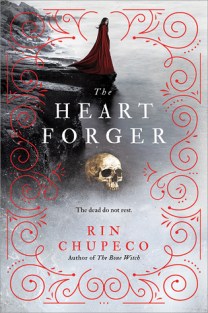
the bone witchThe Bone Witch/The Heart Forger
by Rin Chupeco
Young Adult Fantasy
411 pages/501 pages
Published 2017/2018

I’m reviewing the first two books of a trilogy here, The Bone Witch and The Heart Forger. The third book, The Shadowglass, is due out in March – but I wish it was out now!!

Both books are told in an alternating chapter format; short chapters, told from a nameless bard’s viewpoint as Tea tells him her story, and longer chapters told from Tea’s viewpoint, being the stories she’s telling the bard. All of the bard’s chapters take place over the course of a few weeks, while Tea’s story covers her entire life up to that point. So you get glimpses of what she’s currently doing, while getting backstory and explanation of why she’s doing it.

First thing I want to say is Tea is BADASS. The book opens on her raising a terrifying monster from the dead and making it into a pet. A PET. The bard she’s talking to is intimidated, to put it mildly. Then we launch into her story. Tea tells us how she went from farmgirl to Asha – think a geisha with magic and combat training, and you’ll get the picture. Tea’s world is fairly rigid on the gender roles – women with magic become asha, men with magic become Deathseekers. A significant side-plot revolves around a young boy with magic who wants to be an asha instead of a Deathseeker, and Tea’s efforts to help him. Tea turns out to be a rare kind of asha – a dark asha, or bone witch – whose powers are mostly concerned with raising the dead.

heart forgerA major point of this world is heartsglass – in several of the kingdoms (but not all of them) everyone wears a locket around their neck with their heartsglass inside. Heartsglass is basically a small ball of light summoned forth from a person’s soul when they come of age. It can’t be given away unwillingly, and the different colors of someone’s heartsglass means different things – whether they’re a magic user, or a bone witch, or an asha, or a heart forger. Or rather, whether they have the potential to become those things. Some people – the ashas, death seekers, any of the magic users, really – can see peoples’ emotions in their heartsglass, and can tell when people are lying, or guilty, or a number of useful things. People in love often trade their heartsglass with each other, literally holding each other’s hearts. This can be dangerous; the bone witch who trains Tea in the first book gave her heartsglass away, but her lover died without returning hers. And she doesn’t know where he hid it. Without a heartsglass, her powers – and life force – are dwindling.
I love Tea so much. She is incredibly powerful, but hurt and pissed off and out for vengeance. At the same time, she doesn’t want to be evil, so she is tempering her vengeance to a knifepoint so innocents aren’t caught in it needlessly. She’s doing horrifying things while you’re thinking “Oh. Yeah. That’s justified.” The writing in these books is excellent. The side characters are fleshed out with motivations of their own, the villains have interesting reasons for their villainy, strange events get revisited later and explained – it’s just amazingly well done.

Between raising the dead, flirting with princes, taking down army-destroying monsters, and taming dragons, the only bad thing I have to say is I HAVE TO WAIT UNTIL MARCH FOR THE THIRD BOOK?!

From the cover of The Bone Witch:

The beast raged; it punctured the air with its spite. BUT THE GIRL WAS FIERCER.

Tea is different from the other witches in her family. Her gift for necromancy makes her a bone witch, who are feared and ostracized in the kingdom. For theirs is a powerful, elemental magic that can reach beyond the boundaries of the living – and of the human.

Great power comes at a price, forcing Tea to leave her homeland to train under the guidance of an older, wiser bone witch. There, Tea puts all of her energy into becoming an asha, learning to control her elemental magic and those beasts who will submit by no other force. And Tea must be strong – stronger than she even believes possible. Because war is brewing in the eight kingdoms, war that will threaten the sovereignty of her homeland…and threaten the very survival of those she loves.

Lyrical and action packed, this new fantasy series by acclaimed author Rin Chupeco will leave you breathless.

From the cover of The Heart Forger:

Life isn’t fair. AND SOMETIMES, NEITHER IS DEATH.

No one knows death like Tea. A bone witch who can resurrect the dead, she has the power to take life…and return it. And she is done with her self-imposed exile. Her heart is set on vengeance, and she now possesses all she needs to command the mighty daeva. With the help of these terrifying beasts, she can finally enact revenge against the royals who wronged her – and took the life of her one true love.

But there are those who plot against her, those who would use Tea’s dark power for their own nefarious ends. Because you can’t kill someone who can never die…

War is brewing among the kingdoms, and when dark magic is at play, no one is safe.

Book Review: Eden Conquered

eden conqueredEden Conquered
by Joelle Charbonneau
Young Adult Fantasy
303 pages
Published June 2018

So much happens in this book. Actually, too much happens in this book. Eden Conquered falls victim to something a lot of fantasies fall victim to – too many events in too short of a time, with hand-waving to explain the timing. Princess Carys is supposedly “wandering the wilderness” after faking her death in the previous book, Dividing Eden. She’s also supposed to be recovering from the withdrawal effects of the drug she was taking to cover the pain of being semi-regularly beaten while at home. (I’m not even going to get into why she, a Princess, was regularly beaten…it’s weird.) And yet, beyond a few pages in the beginning, she doesn’t seem to have any issues with the withdrawal, and the “wilderness” is never more than two day’s horseback ride from anywhere she seems to need to get to. The “War” that we keep hearing about we never see in either book. The battlefield is…somewhere else. There’s no real sense of time or distance, when it really feels as if there SHOULD be.

That aside, it’s a pretty good sequel to Dividing Eden. I think it would have been more satisfying to have been a trilogy, with the second book about Carys wandering in exile and Andreus dealing with the treachery in his kingdom, and the third book about Carys coming back to Garden City and reuniting with her brother. Perhaps we could have delved more into what the Xhelozi monsters are, and why the city is based on “Virtues.” That’s another problem I had, actually – they say, more than once, that the Xhelozi are strong because the Virtue of the city is weak, but never explain that. We don’t really get into the mythology much. Had the duology been a trilogy, perhaps we could have explored their religion more as well. There’s so much interesting world-building dangled just out of sight! As is, with only 300 pages, a secret is barely dangled in front of us before it’s revealed, and tension doesn’t have a chance to build properly.

It’s a great story. It needed more space to be fleshed out.

From the cover of Eden Conquered:

The trials of Virtuous Succession have ended.

Prince Andreus is King – and Princess Carys is dead.

But even as he’s haunted by what he did to win the throne, Andreus discovers that his dream of ruling only brings new problems. The people love his twin even more in death than they did when she was alive. The Elders treat him as a figurehead, undermining him with their own rival agendas. And the winds of Eden are faltering, leaving both the city and Andreus’s authority vulnerable to attack.

Yet despite what everyone believes, Carys is alive. Exiled to the wilderness, Carys struggles to overcome the lingering effects of the Tears of Midnight and to control the powers that have broken free inside her. And as she grows stronger, so does her conviction that she must return to the Palace of the Winds, face her twin, and root out the treachery that began long before the first Trials started.

The Kingdom of Eden is growing darker with each passing day. Now brother and sister must decide whether some betrayals cut too deep to be forgiven.

Book Review: Sky in the Deep

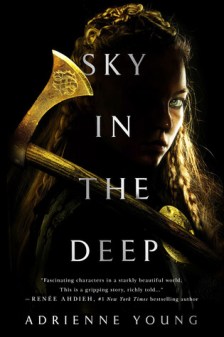
sky in the deepSky in the Deep
by Adrienne Young
Fantasy
335 pages
Published April 2018

Sky in the Deep came out in April to a LOT of hype. It’s mostly deserved. The plot is a little odd; the two clans come together every five years to fight in a blood feud between their gods. But they only fight every five years in a designated place – if you really hated each other, why wouldn’t you try to wipe out the other tribe all the time, instead of letting them rebuild their strength for five years? And then this third, mysterious tribe shows up and is enough for you to set aside all your anger at each other? I don’t know. It’s a little weird.

That oddness aside, I loved this story! I loved Eelyn’s fierceness, and also her willingness to see the Riki as people too. Eventually, of course. In Eelyn we have the definition of a strong female character. (She’s not the only one, either!) She is admired for her fierceness and strength, but not seen as any less female. Women are warriors in her culture too.

It’s a pretty straightforward book, with a few graphic scenes of violence in the fights. Everything happened pretty much as I expected it to, but I still enjoyed seeing Eelyn grow and change throughout the book. It’s also very atmospheric; I could almost hear the snow crunching beneath boots, the rushing roar of the mountain river, the quiet creaking of the frozen lake. Young’s writing style pulls you right into the book and doesn’t let you go.

Set aside your questions about the plot’s logic and just enjoy this book. It’s wonderful.

From the cover of Sky in the Deep:

Part Wonder Woman, part Vikings – and all heart

Raised to be a warrior, seventeen-year-old Eelyn fights alongside her Aska clansmen in an ancient rivalry against the Riki clan. Her life is brutal but simple: fight and survive. Until the day she sees the impossible on the battlefield – her brother, fighting with the enemy – the brother she watched die five years ago.

Faced with her brother’s betrayal, she must survive the winter in the mountains with the Riki in a village where every neighbor is an enemy, every battle scar possibly one she delivered. But when the Riki village is raided by a ruthless clan thought to be a legend, Eelyn is even more desperate to get back to her beloved family.

She is given no choice but to trust Fiske, her brother’s friend, who sees her as a threat. They must do the impossible: unite the clans to fight together, or risk being slaughtered one by one. Driven by a love for her clan and her growing love for Fiske, Eelyn must confront her own definition of loyalty and family while daring to put her faith in the people she’s spent her life hating.

Book Review: The Empress

the empressThe Empress
by S.J. Kincaid
Fantasy Space Opera
378 pages
Published 2017

The Empress is an excellent follow-up to The Diabolic; Tyrus and Nemesis have claimed the throne, but now they have to keep it. Due in part to ancient machines, that is harder than it sounds. Despite Nemesis’ cold practicality, she is also somewhat idealistic. She picks freeing the servitors (slaves, basically) as her big goal for when she becomes Empress – with shocking results.

Tyrus’ and Nemesis’ combined goal is to bring science back to the people; in the first book we were introduced to the concept of ruined space – space that had been torn apart by hyperspace jumps and now consumes everything it touches. But since the Helionic religion had banned all science, no one knew how to do anything about it other than avoid it. Their solution is to go to the head of the religion itself and talk him into reversing that decree. In doing so, we learn a lot more about why the empire is floating out in space, and why the decree was given.

It’s always hard to talk about middle books in trilogies without giving too much away about the first book, or the plot as a whole. So I’ll just say that, like the first book, this kept me guessing, and the twists of the plot came as incredibly shocking surprises. S.J. Kincaid has an amazing ability with plot twists. And the end of this book – oh man. I do not want to believe that things truly are as bad as they seem. I want this to be a redemption story. But at the same time, things have been done that can’t be undone.

If you read and liked The Diabolic, you should continue the trilogy with The Empress. However, while The Diabolic ends in a way that could leave it as a standalone, The Empress ends on a clear cliffhanger. The third book has neither a title nor a cover yet, but is supposed to release this fall? I’m guessing that will be delayed, which is bad, because I NEED IT.

From the cover of The Empress:

An Empress is GRACEFUL.

An Empress is a PARTNER.

But most important, an Empress is HUMAN.

It’s a new day in the Empire. With Tyrus on the throne and Nemesis at his side, they can find a new way forward – one without hiding or scheming or bloodshed. They can form a galaxy where science and information is shared with everyone and not just the elite.

But having power isn’t the same as keeping it, and change isn’t always welcome. There are those who have no intention of letting this teenage Emperor and Nemesis, who’s considered a mere killing machine, rule without a fight.

In order to protect Tyrus, Nemesis must prove her humanity to the Empire. But if this means she and Tyrus must do inhuman things, is the fight worth the cost of winning?