Book Review: The Invention of Wings

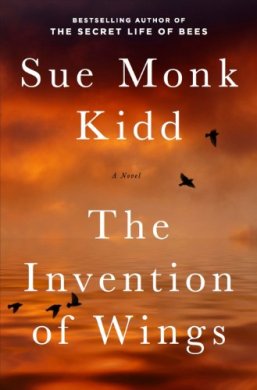
Sue Monk Kidd The Invention of WingsThe Invention of Wings
Sue Monk Kidd
Historical Fiction
369 pages
Published 2014

The Invention of Wings is one of my PopSugar Reading Challenge books, for the prompt “A Book from a Celebrity Book Club.” It was Oprah’s 3rd pick for Oprah’s Book Club 2.0. Oprah interviewed Sue Monk Kidd in the January 2014 issue of O Magazine.

I can definitely see why Oprah was so affected by this book; the two main characters are Sarah Grimké, an early abolitionist and women’s rights activist, and Hetty Handful, the slave gifted to her by her mother when she turned 11. In an afterword, Kidd explains that she did try to stay mostly historically accurate, and Handful was gifted to Sarah when she was 11, though she apparently died not long after. In Kidd’s book, however, Handful survives. Sarah and her younger sister, Angelina, were real people, and really did most of what is ascribed to them in the book, though Kidd passes a couple of their deeds from one sister to the other. The Grimkés were from Charleston, South Carolina, and born into an aristocratic, slave-owning family headed by a prestigious judge. Their abolitionist actions get them exiled from Charleston and from their church. Meanwhile, Hetty, her ownership having returned to Sarah’s mother, dreams of freedom and plots rebellions of her own.

I was a little wary going into this book; I’ve read a couple of Oprah’s picks before, and generally found them dry and uninteresting. This one, though, was very well written. The voices of both women came through clearly, as did some of the brutality of slavery. Kidd also wrote The Secret Life of Bees, which got a lot of attention. If it’s anything like this, I might have to finally read that as well.

(I know the author is white, but I thought, being about slavery and abolition, it would still qualify for Black History Month.)

From the cover of The Invention of Wings:

A triumphant story about the quest for freedom and empowerment, Sue Monk Kidd’s third novel presents the extraordinary journeys of two unforgettable women: Hetty “Handful” Grimké, an urban slave in early-nineteenth century Charleston, and Sarah, the Grimkés’ idealistic daughter. 

Inspired in part by the historic figure of abolitionist and suffragette Sarah Grimké, Kidd’s novel is set in motion on Sarah’s eleventh birthday, when she is given ownership of ten-year-old Handful. The Invention of Wings follows these two women over the next thirty-five years as both strive for lives of their own, dramatically shaping each other’s destinies and forming a complex relationship marked by guilt, defiance, estrangement, and the uneasy ways of love.
 

Book Review: Turtles All The Way Down

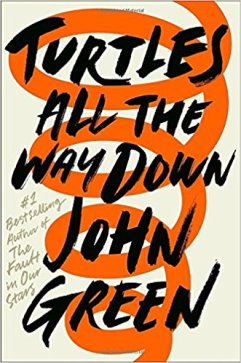
turtlesTurtles All The Way Down
John Green
Young Adult Fiction
298 pages
Published October 2017

So what the cover description of this book doesn’t explicitly mention is that Aza, the main character, has a pretty severe anxiety disorder. That’s really the core topic of the book – her thought spirals and dealing with life while caught in them. I trust John Green to write about these because he also suffers from severe anxiety. He’s talked about it in interviews and his vlogbrothers Youtube channel. (I’m a big Green brothers fan – what’s known as a nerdfighter.) So when John Green writes a character with anxiety, I believe that it’s a realistic portrayal. I loved the integration of technology in the story – two characters don’t just text each other, the text conversation is on the page, formatted differently, so it’s obvious these are text messages. I always love books that do that.

There’s not a whole lot I can say about the book without giving things away; a lot of John Green’s characters tend to wax eloquently about philosophy and things outside themselves, and Aza doesn’t do that because she’s so trapped within her own thoughts. She can’t think of the future or existential dread because she’s too worried about the microbes in her stomach getting out of control and giving her diseases. Definitely a departure from his usual story, though it does fit his standard MO of Main character meets other character who profoundly changes main character’s life in some way. (There’s a third part that is also consistent with most of John Green’s novels but it’s a spoiler.)

I think the book is a really good book for anyone who loves someone with anxiety. Or even for those who have anxiety themselves, to see that they’re not alone.

From the cover of Turtles All The Way Down:

Sixteen-year-old Aza never intended to pursue the mystery of fugitive billionaire Russell Pickett, but there’s a hundred-thousand-dollar reward at stake and her Best and Most Fearless Friend, Daisy, is eager to investigate. So together, they navigate the short distance and broad divides that separate them from Russell Pickett’s son, Davis.
   
Aza is trying. She is trying to be a good daughter, a good friend, a good student, and maybe even a good detective, while also living within the ever-tightening spiral of her own thoughts. 
 
In his long-awaited return, John Green, the acclaimed, award-winning author of Looking for Alaska and The Fault in Our Stars, shares Aza’s story with shattering, unflinching clarity in this brilliant novel of love, resilience, and the power of lifelong friendship.

Book Review: Kindred

kindredKindred
Octavia Butler
Historical Fiction
306 pages
Published 2004

I’m not really sure where to start with this book. It’s in that category of “classics that everyone should read” and having finally read it, I agree. It’s really, really, really good. It’s a hard read at times – it takes you right into the antebellum south and the heart of slavery. It’s actually set in Maryland, which is a little jarring for me – in today’s political climate, Maryland isn’t really considered part of “the south” – it’s far more liberal than most of the south. A blue state, where those are all red. But it WAS a slave state. It is below the Mason-Dixon line, and reading the wiki, slavery was actually legal here longer than it was in the south. (Mostly because the Emancipation Proclamation only covered the Confederate States, not the slave-holding Union states of Delaware, Kentucky, Missouri, and Maryland. That’s screwed up. You can’t have slaves, but it’s totally cool that the people that fought for us still keep them?)

So Kindred is set mostly in pre-Civil War Maryland, with a few scenes in modern-day California. The mystery of how Dana time-travels is never explained – but it doesn’t really need to be. That’s not the point of the story. The point of the story is a modern-day black woman transplanted to the antebellum south and learning to understand slavery in a very intimate manner. Dana mentions a couple of times how easy it is to forget that she has another life – that’s she’s a free black woman from the future – because the way they keep slaves in line doesn’t give you time to think past the present. You work too hard to think of the future, and if you don’t, all you can think about is the pain from your punishment for not working hard enough.

The book is a very visceral portrayal of a somewhat pampered slave’s life – she’s not a field hand, her masters are what passes for “kind.” Dana’s fellow slaves live in fear of being sold down south to Mississippi – they know Maryland is better. As hard as some of the scenes are to read, the book explicitly says it could be harder.

The conflict Dana feels between rescuing her white, slave-owning ancestor again and again, and standing back and letting nature take its course (but dooming herself) is one of the central points of the book. It’s a moral quandary that she never really answers.

Ultimately, there’s no way to do this book justice in a review. I think it should be required high school reading. More than that, I think it should be required reading for white people. And if you haven’t read it yet, you should. I knew on an intellectual level what slaves went through – but this book doesn’t look at it from a distance. It doesn’t divorce the reader from the violence. It puts the reader right there in the dirt of the yard with the whip exploding across Dana’s back.

I think it took me so long to get around to this book because it IS a classic. And so many classics I was forced to read in school were boring and dry and hard to read. I’m starting to find that some are classics because they’re just that good. Good and necessary and written about critically important topics. Kindred is one of them.

From the cover of Kindred:

Dana, a modern black woman, is celebrating her twenty-sixth birthday with her new husband when she is snatched abruptly from her home in California and transported to the antebellum South. Rufus, the white son of a plantation owner, is drowning, and Dana has been summoned to save him. Dana is drawn back repeatedly through time to the slave quarters, and each time the stay grows longer, more arduous, and more dangerous until it is uncertain whether or not Dana’s life will end, long before it has a chance to begin.

Book Review: The Bear and the Nightingale

thebearThe Bear and the Nightingale
Katherine Arden
Fairy-tale Retelling
330 pages
Published 2017

So I finally got around to reading this one – people have been raving about it all year long. And honestly – I don’t see what the fuss is about. It’s good, sure. But it’s not Girls Made of Snow and Glass, or The Crown’s Game, or Uprooted. It’s not The Golem and the Jinni. I enjoyed it, but I think the hype is a little undeserved. I am, however, always a sucker for Russian-themed fairytales. (Probably why I liked The Crown’s Game and The Crown’s Fate so much.) And I am looking forward to the sequel, The Girl in the Tower, which just came out. (I have a hold requested on it from my library.) The third book in the Winternight Trilogy appears to be The Winter of the Witch, and is scheduled to be published in August.

The Bear and the Nightingale is set in Rus – a Russia-like country, but with magic, of course. Vasilisa/Vasya is a granddaughter of a witch, and has some abilities herself. Mostly just the ability to see things that other can’t, and to talk to them. Through the course of the book, she avoids an arranged marriage, saves a priest, fights a priest, and tries like hell to save her village from the demons of winter. I loved her tenacity, and her love for the old spirits. The description of The Winter King and his home was absolutely enchanting. Overall a good book, but a bit overhyped.

From the cover of The Bear and the Nightingale:

Winter lasts most of the year at the edge of the Russian wilderness, and in the long nights, Vasilisa and her siblings love to gather by the fire to listen to their nurse’s fairy tales. Above all, Vasya loves the story of Frost, the blue-eyed winter demon. Wise Russians fear him, for he claims unwary souls, and they honor the spirits that protect their homes from evil.
 
Then Vasya’s widowed father brings home a new wife from Moscow. Fiercely devout, Vasya’s stepmother forbids her family from honoring their household spirits, but Vasya fears what this may bring. And indeed, misfortune begins to stalk the village. 
 
But Vasya’s stepmother only grows harsher, determined to remake the village to her liking and to groom her rebellious stepdaughter for marriage or a convent. As the village’s defenses weaken and evil from the forest creeps nearer, Vasilisa must call upon dangerous gifts she has long concealed—to protect her family from a threat sprung to life from her nurse’s most frightening tales.

Book Review: The Power

thepowerThe Power
Naomi Alderman
Dystopia
416 pages
Published October 2017

Holy shit. I sat and stared at my Kindle for several minutes after finishing this book. The Power belongs on the same shelf as The Handmaid’s Tale and American War. It’s just amazing. The book begins in our world – but then takes a twist sideways. Teenage girls start manifesting an electrical power. They can zap people, with varying degrees of strength. It can be a pleasing, arousing tingle, or a warning jolt, or a breath-stealing, heart-stopping (literally) bolt. They soon discover that older women can also manifest the ability, but it has to be kick-started by a jolt from someone who already has it. (Even later in the book it’s revealed that there’s actually a muscle – they call it the skein – that controls the electricity, and women have, in the last twenty years or so, evolved to have that muscle.)

The book revolves between the points of view of a few different women and one man. The man is a journalist reporting on the emergence of the new power, while the women are prominent figures in the new world order that is emerging. Allie – Eve – becomes the leader of a new religion, Roxy is the daughter of a crime syndicate boss, and Margot is a mayor climbing the political ranks. Margot’s daughter also gets a few chapters.

It’s been pointed out that perhaps men are afraid of women having equal rights because they can’t picture a world in which powerful women don’t treat men the way powerful men have always treated women. They can only imagine men and women interacting as oppressors and oppressed, not as equals. Whereas feminism wants a world where we are truly equals. The Power imagines a world where women do become the oppressors, and men are forced into the feminine role. This is enforced by the framework the novel is told in – the novel itself is bracketed by letters between the “author,” presenting his historical novel, and a woman supposedly editing his work. Through the letters, you discover the novel is a slightly embellished history of their world, with about five thousand years between the events of the novel and the time of the letters. In the tone of the letters, you see the stereotypes switched – the man is apologetic and unsure while the woman is authoritative, patronizing, and a little bit sexist. “Oh, you silly boy, imagining a world where men were dominant! What a naughty idea! Don’t you think men as soldiers is preposterous? Men are homemakers, women are the aggressive ones!” I think, if feminism achieves its goals through legislation, we will find true equality. If something like this were to happen – a drastic change, giving women a physical way to dominate suddenly, the outcome might indeed be more like the novel. Enough women have been traumatized that they’ll want – need – to avenge themselves, and violent upheaval will result.

By the last third of the novel, we see powerful women and societies acting just the same as powerful men always have – I’d like to think we’d have learned from the men’s mistakes, but humans are only human. Perhaps this is more realistic.

The book is NOT for the faint of heart. There are graphic rape, abuse, and violence scenes. They’re not gratuitous – they serve the author’s point – but they are still disturbing, as those scenes should be.

I’ll be thinking about this book for a while. It’s excellent, and I highly recommend it, if you can handle the dark themes.

From the cover of The Power:

In THE POWER, the world is a recognizable place: there’s a rich Nigerian boy who lounges around the family pool; a foster kid whose religious parents hide their true nature; an ambitious American politician; a tough London girl from a tricky family. But then a vital new force takes root and flourishes, causing their lives to converge with devastating effect. Teenage girls now have immense physical power–they can cause agonizing pain and even death. And, with this small twist of nature, the world drastically resets.

From award-winning author Naomi Alderman, THE POWER is speculative fiction at its most ambitious and provocative, at once taking us on a thrilling journey to an alternate reality, and exposing our own world in bold and surprising ways.

Book Review: The True Confessions of Charlotte Doyle

true confessions of charlotte doyle aviThe True Confessions of Charlotte Doyle
Avi
Middle-grade historical fiction
229 pages
Published 1990

This was my husband’s suggestion for “A Book Set At Sea,” one of the categories on the PopSugar Reading Challenge. It was a book he’d read as a child, and one I’d never heard of. It was a quick, easy read, as it was meant for children. Late elementary school, would be my guess. (Husband read it in fifth grade for a class.)

The book is set in the summer of 1832. Charlotte Doyle is setting sail across the Atlantic to return to America and rejoin the rest of her family, after finishing the school year at her boarding school. Things are a bit suspicious from the beginning of the voyage – the other two families that were supposed to be on board the ship didn’t make it, so it’s just Charlotte and the crew. Deckhands at the dock warned her away from the ship and refused to carry her things to it.

As the voyage winds on, Charlotte discovers that the crew intensely dislikes their captain and thinks he’s far too strict – he beat one of their number so badly on the last voyage that the crewman lost his arm. Torn between the “noble” captain, who represents everything she’s used to, and her own sense of right and wrong, she starts to notice how cruel he is to the crew. Ultimately, her life, and the lives of the crew, hinge on her decisions as the captain uses her to spy on the crew and report back to him.

My favorite passage from the book turned out to be my husband’s favorite, as well:


“What’s a hurricane?”
“The worst storm of all.”
“Can’t we sail around?”
Barlow again glanced at the helm, the sails and then at the sky above. He frowned. “I heard Mr. Hollybrass and Jaggery arguing about it. To my understanding,” he said, “I don’t think the captain wants to avoid it.”
“Why not?”
“It’s what Grimes has been saying. The captain’s trying to move fast. If he sets us right at the hurricane’s edge, it’ll blow us home like a pound of shot in a two-pound cannon.”
“What if he doesn’t get it right?”
“Two pounds of shot in a one-pound cannon.”

I quite enjoyed this little book, and it’s a great example of a girl bucking tradition and doing what she’s good at, gender roles be damned. There is a fair bit of violence – in one scene a man is severely whipped – but it’s not graphic. No sexual themes at all. Pretty suitable for kids as soon as they’re decent enough readers.

From the cover of The True Confessions of Charlotte Doyle:

The Seahawk looms against a darkening sky, black and sinister. Manned by an angry, motley crew at the mercy of a ruthless captain, the rat-infested ship reeks of squalor, despair…and mutiny! It is no place for the lone passenger, thirteen-year-old Charlotte Doyle, yet for her there is no turning back. At first a trapped and powerless young girl, Charlotte dares to become the center of a daring and deadly voyage that will challenge her courage, her loyalties, and her very will to survive!