Book Review: The Ruins of Lace

ruinsoflaceThe Ruins of Lace
by Iris Anthony
326 pages
Published 2012
Historical Fiction

The Ruins of Lace is told from 7 different points of view, and while at first they appear disconnected, they slowly touch each other, then weave in and out, like lace itself. The story revolves around the creation, sale, and smuggling of banned lace in 17th century France. The points of view are a lacemaker, her sister, a girl who once ruined a pair of lace cuffs, the man who loves her, a lace-smuggling dog, a border guard, and a petty noble fighting for his inheritance.

As much as I’ve read about 17th century France, the clandestine lace trade was one aspect I really didn’t know about, so it was interesting to see how it impacted common folk and nobles alike.

While not as spell-binding as some books I’ve read, The Ruins of Lace was definitely thought-provoking. What drives an otherwise good man to smuggle lace and risk his honor/title/fortune/life? Without the viewpoints of the lacemaker and the smuggler’s dog, you could imagine lace-smuggling to be a victimless crime. Including the viewpoints of those two was brilliant – you can’t say the man who needs the lace isn’t hurting anyone. If there wasn’t such demand for the banned lace, girls wouldn’t sit in convents and go blind making it 24/7.

All in all, a very good book on a little-known aspect of 17th-century France. The differing points of view are a little confusing at first, but once you settle in and know the characters, it’s fairly easy to follow the storyline.

From the back of The Ruins of Lace:

The mad passion for forbidden lace has infiltrated France, pulling soldier and courtier alike into its web. For those who want the best, Flemish lace is the only choice, an exquisite perfection of thread and air. For those who want something they don’t have, Flemish lace can buy almost anything – or anyone. 

For Lisette, lace begins her downfall, and the only way to atone for her sins is to outwit the noble who now demands an impossible length of it. To fail means certain destruction. But for Katharina, lace is her salvation. It is who she is; it is what she does. If she cannot make this stunning tempest of threads, a dreaded fate awaits. 

A taut, mesmerizing story, The Ruins of Lace explores the intricate tangle of fleeting beauty, mad obsession, and ephemeral hope.

Dark Angels by Karleen Koen

darkangelsDark Angels
by Karleen Koen
530 pages
Published 2006
Historical Fiction

I don’t read a lot of historical fiction, but what I do read tends to be based on medieval-to-renaissance England and France. The era of Kings and Queens and courtiers and courtly intrigue. Dark Angels fits solidly into that framework. It’s actually the prequel to a previously published book, Through A Glass Darkly, which I haven’t read yet but definitely will now! Koen weaves a masterfully written tale of a maid of honor to King Charles II of England‘s queen. Alice Verney is incredibly intelligent, cunning, and ambitious. At the same time, she has friends, and she will go out of her way to protect them as long as they don’t betray her. When the Princess of England, her current Lady, falls ill and dies in France, Alice returns to England to a court she hasn’t been part of for two years. Some things have changed, some haven’t, and Alice must muddle her way through politics that have been shaped without her hand in order to find her footing again. Between the raising of a new King’s mistress, a sudden wedding, the murder of a notorious transgender Madam, and the possibility of war, the book is a volatile tale that drew me in and kept me there.

I wrote and scheduled two reviews for this blog, in order to give myself a couple of days to read this longer, more substantial book, and then promptly stayed up until 4 am to finish it in one go! The glittering court of Koen’s imagination held me spellbound from the first page until the last. I loved Alice, then hated her, then loved her again. Koen had me both laughing with Alice and crying with her when tragedy struck. Alice is, at turns, arrogant, vulnerable, jaded, and a girl in love. She is an enchanting protagonist and one I look forward to seeing more of.

If you enjoy historical fiction, if you enjoy reading about the royal courts of England and France, I highly recommend Dark Angels. Koen reminds me of Philippa Gregory, though more vibrant.

From the back of Dark Angels:

Alice Verney is a young woman intent on achieving her dreams. Having left Restoration England in the midst of a messy scandal, she has been living in Louis XIV’s Baroque, mannered France for two years. Now she is returning home to England and anxious to re-establish herself quickly. First, she will regain her former position as a maid of honor to Charles II’s queen. Then she will marry the most celebrated Duke of the Restoration, putting herself in a position to attain power she’s only dreamed of. As a duchess, Alice will be able to make or break her friends and enemies at will.

But all is not as it seems in the rowdy, merry court of Charles II. Since the Restoration, old political alliances have frayed, and there are whispers that the king is moving to divorce his barren queen, who some wouldn’t mind seeing dead.  But Alice, loyal only to a select few, is devoted to the queen, and so sets out to discover who might be making sinister plans, and if her own father is one of them. When a member of the royal family dies unexpectedly, and poison is suspected, the stakes are raised. Alice steps up her efforts to find out who is and isn’t true to the queen, learns of shocking betrayals throughout court, and meets a man that she may be falling in love with – and who will spoil all of her plans. With the suspected arrival of a known poison-maker, the atmosphere in the court electrifies, and suddenly the safety of the king himself seems uncertain. Secret plots are at play, and war is on the horizon – but will it be with the Dutch or the French? And has King Charles himself betrayed his country for greed?

The Hangman’s Daughter by Oliver Pötzsch

hangman's daughter

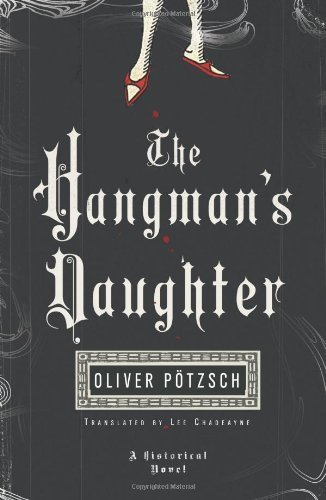
The Hangman’s Daughter
by Oliver Pötzsch
435 pages
Published 2010
Historical Fiction

I spent my entire day at the Maryland Renaissance Festival yesterday. (And man, do my feet hurt!) But it was an absolute blast; we watched the three sirens of “Sirena” sing some haunting melodies (and “steal” my husband’s soul and eat it as part of their act!), watched a couple of hilarious comedy shows (Fight School slayed me) and watched the final round of jousting. Did you know jousting is Maryland’s official sport? How cool is that?

On the way to the fair I finished The Hangman’s Daughter. The Hangman’s Daughter was originally written in German by Oliver Pötzsch, but my version was translated to English by Lee Chadeayne. I didn’t realize until I read the “About the Author” followed by “About the Translator” that it wasn’t written originally in English! It flowed exceptionally well. The story revolves around the mysterious deaths of three children, the midwife the town wants to pin it on, and a mystery surrounding the sabotage of the leper house being built just outside the walls of the town. The Hangman is actually one of the most sympathetic characters in the story, which I found unique. Usually the executioner/torturer is painted as evil. Along with his daughter and the town doctor’s son, an accomplished doctor himself, they attempt to solve the mystery of who’s killing children before the town can convict and sentence the midwife.

There are three more books in this series, The Dark MonkThe Beggar King, and The Poisoned Pilgrim. Definitely going to look for those!

(Edit: I have since read the aforementioned sequels, and reviewed them here. They were excellent!)

I REALLY enjoyed this book, and I will probably try to track down other English translations of this author’s work. I don’t read too many mysteries (though I do have a few more in the queue at the moment) but this book really swept me up and carried me along for the ride. It’s set in 17th century Bavaria, 70 years after the last witch craze. Jakob Kuisl is the town’s Hangman, and, as it turns out, one of the author’s ancestors! The author apparently wrote the novel as a way of connecting with his roots; he is descended from the Kuisls, who were Hangmen for generations.

I don’t want to say too much for fear of spoiling the mystery, so I’ll go straight to the back of the book.

From the back of The Hangman’s Daughter:

Simon turned the boy on his belly. With a vigorous tug he ripped open the shirt on the back as well. A groan went through the crowd.

Beneath one shoulder blade there was a palm-size sign of a kind that Simon had never seen before – a washed-out purple circle with a cross protruding from the bottom.

For a moment, there was total silence on the pier. Then the first screams rose. “Witchcraft! There’s witchcraft involved!” Somebody bawled: “The witches have come back to Schongau! They’re getting our kids!”