Book Review: This Will Be My Undoing

this will be my undoingThis Will Be My Undoing: Living at the intersection of Black, Female, and Feminist in (White) America
by Morgan Jerkins
Memoir/Black Feminism
258 pages
Published 2018

I have a tough time reviewing books about Black Feminism. I enjoy reading them – well, maybe “enjoy” isn’t quite the right word. They can be tough. I am glad to have read them. But how to review them? I’m a white woman, it’s not really my place to critique these works. But it would be remiss of me to not talk about them – denying them the same space on my blog that I give to everything else I read is its own kind of erasure. I’m not sure how best to resolve this, but for this specific book, at least, I can talk about what I learned from it.

What I learned is that some of my childhood was straight-up racist. I always thought of my childhood as pretty idyllic – my parents were high school sweethearts, and to this day still adore each other. We lived in a house my parents owned. (My most formative years were actually spent in the house my mother grew up in; my parents bought it from my grandparents when I was seven.) We got to run around and play on a quiet neighborhood street where we knew all of our neighbors. We had pets of various species, we got technology fairly quickly since my father was a computer geek, we had a garden out back that Mom canned beans out of every year.

But I was homeschooled until eighth grade. (With Bob Jones and Abeka Books, notoriously Christian curriculum. I thought humans lived with dinosaurs well into my twenties.) We went to a conservative Christian church every Sunday. (And Tuesday. And some Fridays.) While my parents taught that I could be anything I wanted to be, the church definitely over rode that with “women should be subservient to men” and “don’t trust your own judgment, ask God/your parents/the elders.”

The incident that Jerkins’ book brought back to mind, though, was a party I went to. I’m pretty sure it was someone’s birthday party, but at a church. Not our church. There were a lot of people, though, so I could be wrong about the birthday party. It was this party where I got the tiny scar in my eyebrow – some kid broke the bat on the pinata and threw it behind him, where it hit me in the face. Before that, though, was the cake walk. There were footprints laid out on the concrete floor, and we paced around them while music played, kind of like musical chairs, I think. (I was younger than ten, my memory is a little fuzzy.) I won the cake! I thought nothing of this until reading This Will Be My Undoing.

“The cakewalk was a dance performed in the late nineteenth century at slave get-togethers. You lean or rear back and kick your feet out left and right or vice versa as you move forward……White people would watch them dance, fascinated by the exoticness of it all. These spectacles were purposeful humiliations. But the cakewalk evolved as slaves’ own form of subversion. While serving at large and fancy parties in the early 1800s, they would watch well-to-do white people perform strict and stiff dances, like cotillions and quadrilles, and mimic them, exaggerating the bowing and small skips and hops and adding some high steps and jumps. In diaries kept by white people in the antebellum South, the cakewalk is not depicted as a form of satire. After all, why would a sweet slave mock his benevolent master? To white people’s eyes, this imitation seemed like flattery. They were delighted that the slaves were attempting their civilized dances. In fact, they would hold competitions and the winning slaves would receive a cake, hence the name. Yet they were being mocked, right in front of their faces.”

WHY WAS THIS BEING HELD AT A CHURCH PARTY? I don’t recall if it was all white kids, but it probably was. My hometown was not very ethnically diverse. The more I learn – academically, politically, socially, secularly – the more I realize my childhood was pretty fucked up in a lot of different ways. I don’t know if it was more or less fucked up than most white kids’ childhoods – white supremacy is insidious. I was an ignorant child at the time, but to realize, decades later, how racist holding a cakewalk is, stopped me in my tracks. (Incidentally, this means that calling something “a cakewalk” has its roots in racism, like so many other things in our language. Cakewalks weren’t easy – but the best dancers made them look that way.)

So that’s what I can say about this book. I learned something about my childhood. Beyond that, all I will offer is that Jerkins is an excellent writer; the book flows well and is an easy read, despite the subject matter not being easy. Read it. It’s important.

From the cover of This Will Be My Undoing:

From one of the fiercest critics writing today, Morgan Jerkins’ highly-anticipated collection of linked essays interweaves her incisive commentary on pop culture, feminism, black history, misogyny, and racism with her own experiences to confront the very real challenges of being a black woman today—perfect for fans of Roxane Gay’s Bad Feminist, Rebecca Solnit’s Men Explain Things to Me, and Chimamanda Ngozi Adichie’s We Should All Be Feminists.

Morgan Jerkins is only in her twenties, but she has already established herself as an insightful, brutally honest writer who isn’t afraid of tackling tough, controversial subjects. In This Will Be My Undoing, she takes on perhaps one of the most provocative contemporary topics: What does it mean to “be”—to live as, to exist as—a black woman today? This is a book about black women, but it’s necessary reading for all Americans.

Doubly disenfranchised by race and gender, often deprived of a place within the mostly white mainstream feminist movement, black women are objectified, silenced, and marginalized with devastating consequences, in ways both obvious and subtle, that are rarely acknowledged in our country’s larger discussion about inequality. In This Will Be My Undoing, Jerkins becomes both narrator and subject to expose the social, cultural, and historical story of black female oppression that influences the black community as well as the white, male-dominated world at large.
Book Review: Well, That Escalated Quickly

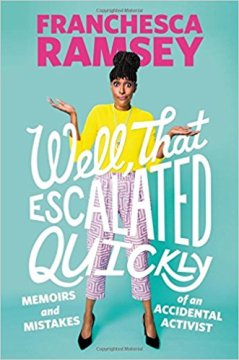
well that escalated quicklyWell, That Escalated Quickly: Memoirs and Mistakes of an Accidental Activist
by Franchesca Ramsey
Memoir/Comedy
244 pages
Published May 2018

This is the third comedic memoir I’ve read by a black comedian. I don’t really know what to make of that; I’ve certainly read non-comedic memoirs from African Americans, and comedic memoirs from white people, but three comedic memoirs from African-Americans in the last year seems a little surprising. They’re all fairly new, maybe it’s just what’s been getting published recently? Or maybe it’s just a coincidence and not yet a pattern. Or maybe it’s my way of giving my brain a bit of a break from current events while still trying to read inclusively. That last one might be it.

Anyway. While I didn’t like Ramsey’s book as much as I did Trevor Noah’s or Tiffany Haddish’s books, I did really enjoy it. I didn’t really know who Ramsey was before reading her book, and that might be why I didn’t like it quite as much. This book deal with internet culture a lot more than the other two do; and that pertains to my interests. What I really enjoyed is that she talks about her missteps, how she was criticized for them, and admits that she was wrong and much of the criticism was needed. She explains how she corrected her own behavior in response and strove to be better, and that’s something we don’t see a lot of. We see half-hearted apologies and no change in behavior from a lot of internet celebrities, and Ramsey definitely tries her best to rectify her mistakes. I really liked reading about her experiences with that, as it can be such a touchy issue. No one likes to be called out. But sometimes we need to be so we can learn to be better.

I really enjoyed this one. I wouldn’t say it dealt with racism more than Noah or Haddish’s books did, but it definitely dealt with combatting racism more than they did. It talked about the activist aspect of it, and how to help.

This is the third book I’ve read from my Summer TBR list.

From the cover of Well, That Escalated Quickly:

Franchesca Ramsey didn’t set out to be an activist. Or a commentator on identity, race, and culture, really. But then her YouTube video “What White Girls Say . . . to Black Girls” went viral. Twelve million views viral. Faced with an avalanche of media requests, fan letters, and hate mail, she had to make a choice: Go all in or step back and let others frame the conversation. After a crash course in social justice – and more than a few foot-in-mouth moments – she realized she had a passion for breaking down injustice in ways that could make people listen, laugh, and engage.

Ramsey uses her own experiences as an accidental activist to explore the ways we communicate with one another – from the highs of bridging gaps and making connections to the many pitfalls that accompany talking about race, power, sexuality, and gender in an unpredictable public space . . . the internet.

A sharp and timely collection of personal essays, WELL, THAT ESCALATED QUICKLY includes Ramsey’s advice on dealing with internet trolls and low-key racists, confessions about being a former online hater herself, and her personal hits and misses in activist debates with everyone from bigoted Facebook friends and misguided relatives to mainstream celebrities and YouTube influencers. Alongside useful guides to unfriending and a glossary of “not so simple concepts,” Ramsey shows readers that mistakes are inevitable, but what’s important is how we learn from them to make a better world.

Series Review: The Memoirs of Lady Trent

a natural history of dragons lady trentA Natural History of Dragons / The Tropic of Serpents / Voyage of the Basilisk / In The Labyrinth of Drakes / Within the Sanctuary of Wings
by Marie Brennan
Fictional Memoirs
300-350 pages each
Published 2013 / 2014 / 2015 / 2016 / 2017

I had been drooling over this series for quite some time. Every time I went to my local game store, I’d paw through their small fiction bookshelf, and these were always on it. I finally found the first four all at once at the library, and seized the chance. (I had to request the fifth.) I did not regret it. These are fantastic.

tropic of serpents lady trentThe Memoirs of Lady Trent, as one can expect, are told from the viewpoint of Isabella Camherst, who becomes Lady Trent partway through the books. (But since they are written as her memoirs, she is “remembering” back to her adventures before she became part of the peerage.) Lady Trent’s world is analogous to our own Victorian age, except they have dragons, and she is fascinated by them. In the first book, she maneuvers her husband, also an amateur scholar of dragons, into joining an expedition to go study mountain drakes, and manages to get herself brought along. That begins her career.

The representation in these books is excellent for the time period they are based on! In the second book we get an asexual character, who turns into a side character for much of the rest of the series. (In figuring herself out, she mentions she had also tried the affections of women before realizing she didn’t want that, either.) In the third we get a culture with a third gender, and mention from Lady Trent of men who love men back home.

lady trent voyage of the basiliskI actually quite enjoyed how these books treated other cultures. We see a lot of effects from Scirling (British) colonialism, but Lady Trent herself sees other cultures as interesting things to study and become part of temporarily, not as “savages” that need to be “civilized” (or just used) as so many Victorian-age naturalists did. (And, indeed, how the Scirling military sees them.) Her ultimate goal is always the dragons, but if that means becoming part of a jungle or island tribe, and tending camp and hunting and traveling as the villagers do, then that is what she does. I could see the argument for painting Lady Trent as a white savior figure, but if she wasn’t part of one of the dominant cultures in this world, she wouldn’t have the means or access for all the different adventures described in the books. I suppose she could have been Akhian or Yengalese. (Arabian or Chinese, respectively, the other two dominant cultures.) She also forms genuine friendships with the people she lives among, and tries to do her best by them.
I enjoyed the introduction of the Akhian archeologist, and how that helped pull the focus of the books a little bit more onto the ancient culture of Draconeans, who Lady Trent had been largely uninterested in before. He soon became one of my favorite characters, so I was quite happy to see the events of the fourth book take Lady Trent to Akhia.

The fifth book unveiled quite a few surprises. We get to learn a lot more about the Draconeans, which was really cool. They also presented a culture with allowance for group marriage; at one point a villager asks Lady Trent if all four men she’s travelling with are her husbands!

The five books altogether were a really interesting progression in the history of the study of dragons, and I quite enjoyed them. They were definitely unique.

From the cover of A Natural History of Dragons:

Marie Brennan begins a thrilling new fantasy series in A Natural History of Dragons, combining adventure with the inquisitive spirit of the Victorian Age.

“You, dear reader, continue at your own risk. It is not for the faint of heart—no more so than the study of dragons itself. But such study offers rewards beyond compare: to stand in a dragon’s presence, even for the briefest of moments—even at the risk of one’s life—is a delight that, once experienced, can never be forgotten. . . .”

All the world, from Scirland to the farthest reaches of Eriga, know Isabella, Lady Trent, to be the world’s preeminent dragon naturalist. She is the remarkable woman who brought the study of dragons out of the misty shadows of myth and misunderstanding into the clear light of modern science. But before she became the illustrious figure we know today, there was a bookish young woman whose passion for learning, natural history, and, yes, dragons defied the stifling conventions of her day.

Here at last, in her own words, is the true story of a pioneering spirit who risked her reputation, her prospects, and her fragile flesh and bone to satisfy her scientific curiosity; of how she sought true love and happiness despite her lamentable eccentricities; and of her thrilling expedition to the perilous mountains of Vystrana, where she made the first of many historic discoveries that would change the world forever.

Book Review: Seriously…I’m Kidding

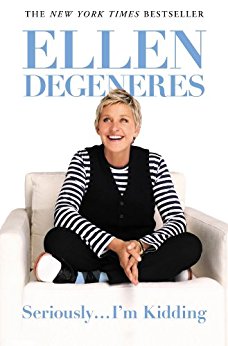
seriously i'm kiddingSeriously…I’m Kidding
by Ellen DeGeneres
Memoir/Comedy
241 pages
Published 2011

As part of Pride Month, I’m spotlighting books by or about GLBTQIA+ people. Ellen is one of the most prominent lesbians here in the US, between coming out on a sitcom, having her own daytime talk show, and her judging stint on American Idol. This is her third book, but the first one I’ve read. If the other two are like this one, I need to read them!

Seriously…I’m Kidding is a really funny book. It reads a little bit like an ADHD squirrel, but that’s part of its charm. I read the print version, but this is one book I might have to get the audio version of, mostly because of the one chapter she wrote specifically for the audio version:

“Anyway, since you have the benefit of being able to hear this, I thought I would include some bonus material of me making strange noises. For those of you who are reading this the old-fashioned way and can’t hear me, I’ve printed the noises below and I encourage you to use your imagination to think of what they might sound like coming out of my mouth.

Meeeeee
Faaaaaa
Cooooo
Gooooood Morning
Bowwwww
Babowwwww
Yelowwwww
(more strange noises listed)”

The book covers a lot of ground, from producing her show to judging on American Idol to coming out as lesbian to hosting dinner parties. It also varies wildly chapter to chapter, from brief short stories (less than a page) to haiku, to coloring book pages of odd things like toasters, to prose, wandering chapters that are an interesting look at Ellen’s thought process.

I really enjoyed this book, and it’s definitely worth reading because it’s just FUN.

You can find all my Pride Month reads listed here.

From the cover of Seriously…I’m Kidding:

Welcome to my third book. Inside this book you will find an assortment of wonderful things – words, pictures, advice, tidbits, morsels, shenanigans, and in some copies, four hundred dollars cash. So you might want to buy a few.

I’m so happy you’re holding this book in your hands right now and reading its jacket or flap or whatever you want to call this little extra part of the book. Jackap or Flacket or Flapjacket. Whatever, really.

I don’t have enough room on this flapjacket to tell you all the reasons why you should buy this book, but I can tell you this and it’s a guarantee: If you buy it, you will feel better, look better, be happier, grow taller, lose weight, get a promotion at work, have shinier hair, and fall madly, deeply in love.

And as an added bonus feature I’d like to point out that this flapjacket doubles as a bookmark. So you’re paying for a book and you’re getting a bookmark absolutely free. Where else are you going to find that kind of deal?

Now, before you begin reading, if you’d like to learn more about me please turn to the back flap. (Back flap sounds weird, doesn’t it? The more you say it the more it sounds like something you try to get rid of through exercise and eating right. Anyway, please read on.)

Friday 56 – Seriously…I’m Kidding

seriously i'm kidding

The Friday 56 is hosted by Freda’s Voice. The rules are simple – turn to page 56 in your current read (or 56% in your e-reader) and post a few non-spoilery sentences.

Today’s quote is from Seriously…I’m Kidding by Ellen DeGeneres. This book is hysterical and random!

I once went into work and showed some producers a little bruise I got. The next thing I knew it was like Girls Gone Wild in my office. People were lifting up their shirts, rolling up their pants. Socks were coming off. “you think that’s bad – I walked into a tree yesterday!” “I banged my hip on a car door!” “I sat on a fork!” Don’t need to see it.

This is one of my reads for Pride Month, and the review should be up in a few days!

Book Review: Pretending To Be Normal

pretending to be normal aspergerPretending To Be Normal (Expanded Edition)
by Liane Holliday Willey
Memoir
190 pages
Published 2014

First off, once again this is an older book that uses the term Asperger’s throughout. The book was originally published in 1999, but a few more chapters were added and it was republished in 2014.

Honestly I found it a little hard to get through. Unlike Nerdy, Shy, and Socially Inappropriate, it was pretty much entirely memoir, and didn’t really speak to the reader as if trying to have a conversation at all. It just told Willey’s story. Which is fine, it just wasn’t what I was expecting after reading Nerdy. The appendices are the only place that have tips and tricks for dealing with the neurotypical world as an autistic person, but there wasn’t really anything new or unique there.

I also just don’t think I like her writing style as much as I did the writing style in Nerdy, but that’s such a personal thing. It’s hard to make a recommendation based on that. Autistic people vary so widely in where their strengths and weaknesses are that it’s difficult to say which books will be useful to which people, in general.

So – it’s worth reading for yet another viewpoint on being autistic, and there are several parts on parenting as an autistic woman, so autistic parents might get more use out of the book than I did, as a childless spouse of an autistic man. But I personally did not like it nearly as much as Nerdy or The Journal of Best Practices.

From the cover of Pretending To Be Normal:

Compelling and witty, Liane Holliday Willey’s account of growing to adulthood as an undiagnosed ‘Aspie’ has been read by thousands of people on and off the autism spectrum since it was first published in 1999. Bringing her story up to date, including her diagnosis as an adult, and reflecting on the changes in attitude over 15 years, this expanded edition will continue to entertain (and inform) all those who would like to know a little more about how it feels to spend your life `pretending to be normal’.