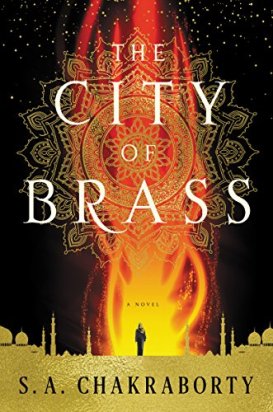
Book Review: City of Brass

city of brassCity of Brass
S. A. Chakraborty
Fantasy
400 pages
Published November 2017

So much to say about this outstanding debut novel! First I’d like to address the issues around the author, then I’ll delve into the book itself. (It’s fantastic, though!)

So the book has been touted as an “own voices” novel, seemingly much to the author’s chagrin. She is Muslim, but she’s a white convert (Chakraborty is her married name). She has striven to correct the misconception about her ethnicity when she finds it, tweeting about it and talking about it in interviews. (This interview is a good example.) Because the book is pure fantasy, in a fantasy realm after the first few chapters, I’m not too worried about it not actually being written by a middle-eastern author. She does note in the interview I linked that she’s not qualified to write some stories because of her ethnicity, and I appreciate that recognition of privilege. As far as I can tell, (as a white person myself) she did justice to the bits of mythology that she included. (Given the reception by people who were so excited about it being an Own Voices book, I think I’m probably right.) Her twitter (@SChakrabs) is FULL of links to minority authors and retweets about their books. I am very impressed by the level of her advocacy for minority authors.

So that aside, I LOVED THIS BOOK. I almost always enjoy fantasy inspired by non-western mythology: Children of Blood and Bone was fantastic, and though Forest of a Thousand Lanterns had a western fairytale at its heart, being reimagined through an Asian lense was really neat to read. The Bear and The Nightingale and The Girl in the Tower were Russian inspired, as were The Crown’s Game/The Crown’s Fate. I really do try to pick up non-western inspired fantasy when I can. City of Brass scratched that itch perfectly.

City of Brass opens in Cairo, where our heroine, Nahri, is a con-woman with small healing magics. When a ritual goes awry, she’s thrust into the world of the djinn. It’s when Nahri and her accidental bodyguard, Dara, arrive at the Djinns’ city of Daevabad that the story really gets started.

I’m still a little confused about the difference between djinn and Daeva; Daeva seem to be one of the tribes but also the name for the entire race, and some of them get offended at being called djinn but some of them don’t? I’m not really sure about that distinction. There is a clear line between djinn and Ifrit, though – Ifrit are immensely powerful, immortal beings who refused to subject themselves to punishment many centuries ago. I’m not sure I actually see a downside to being Ifrit, other than the djinn all think they’re evil. The Ifrit, however, are out to get Nahri, and Dara’s not having any of THAT.

I love Dara – he’s a fascinating character, with a violent, mysterious backstory. I’m very eager to read more about him and figure out exactly what’s up with his background. Nahri is also awesome – a little arrogant, but by the end of the book she’s starting to learn she might need help from those around her. Unfortunately, also by the end of the book she doesn’t know who to trust. The naive djinn prince, Ali, is the third main character of the book, and while I can see him having an interesting story, his personality is still a little flat. Hopefully the second book will see advancement in all three of these characters’ personalities.

And I can’t WAIT for the second book! City of Brass didn’t exactly end on a cliffhanger, but it did leave many questions unanswered and our main characters’ fates uncertain. Unfortunately, I can’t find any information on the sequel, just that it’s being edited. No release date or title yet.

Read this book. It’s fantastic.

From the cover of City of Brass:

Nahri has never believed in magic. Certainly, she has power; on the streets of eighteenth-century Cairo, she’s a con woman of unsurpassed talent. But she knows better than anyone that the trades she uses to get by—palm readings, zars, and a mysterious gift for healing—are all tricks, both the means to the delightful end of swindling Ottoman nobles and a reliable way to survive. 

But when Nahri accidentally summons Dara, an equally sly, darkly mysterious djinn warrior, to her side during one of her cons, she’s forced to reconsider her beliefs. For Dara tells Nahri an extraordinary tale: across hot, windswept sands teeming with creatures of fire and rivers where the mythical marid sleep, past ruins of once-magnificent human metropolises and mountains where the circling birds of prey are more than what they seem, lies Daevabad, the legendary city of brass—a city to which Nahri is irrevocably bound.

In Daevabad, within gilded brass walls laced with enchantments and behind the six gates of the six djinn tribes, old resentments run deep. And when Nahri decides to enter this world, her arrival threatens to ignite a war that has been simmering for centuries. 

Spurning Dara’s warning of the treachery surrounding her, she embarks on a hesitant friendship with Alizayd, an idealistic prince who dreams of revolutionizing his father’s corrupt regime. All too soon, Nahri learns that true power is fierce and brutal. That magic cannot shield her from the dangerous web of court politics. That even the cleverest of schemes can have deadly consequences. 

After all, there is a reason they say to be careful what you wish for . . .

Book Review: The Clothesline Swing

clothesline swingThe Clothesline Swing
Ahmad Danny Ramadan
Fictional Memoir?
288 pages
Published April 2017

I had to force myself to finish this book. It was okay at the beginning – I was hoping it would get better, and it did not. The Clothesline Swing is the the story of two gay Syrian refugees. It’s an interesting framework; the narrator, one of the two, is telling stories to his husband to keep him in the world of the living. (The husband is dying from an unnamed illness.) There’s a catch, though – Death is also with them, as an actual presence that can be talked to and interacted with. He smokes a joint with the narrator at one point, and tells stories of his own – even plans a party – at another point. The story flicks back and forth between their past and their present with some unpredictability as the narrator tells his stories.

Because of the presence of Death, and the kind of hazy, in-between space that the stories reside in (between life and death, between awake and asleep, between fantasy and reality), the entire book is a little dream-like. I don’t particularly enjoy ever-shifting books that don’t have some kind of solid foundation for me to start on.

The book did a good job of showing the dangers of being gay in middle-eastern society, and also showed how hard it is to be a citizen of a country at war with itself. The list of friends who have died in violent ways is threaded through the entire book of stories. She was caught in a crossfire in an alley – he killed himself after being forced to marry a woman – he died when his office was shelled – she died from a car bomb.

I don’t know. It’s a strange book. I’m hesitant to say don’t waste your time, because it covers important topics, but the dreamy quality just ruined it for me.

Ramadan is a Syrian refugee living in British Columbia, making this book part of my Read Canadian Challenge. It’s also my pick for “book about death or mourning” for the Popsugar 2018 challenge, and “unconventional romance” for the Litsy Booked Challenge.

My other Canadian reviews:
1. An Astronaut’s Guide to Life on Earth
2. The Red Winter Trilogy
3. Station Eleven
4. The Courier
5. The Last Neanderthal
6. American War
7. Next Year, For Sure
8. That Inevitable Victorian Thing
9. All The Rage
10. this book!
11. Saints and Misfits
12. Tomboy Survival Guide
13. The Wolves of Winter

From the cover of The Clothesline Swing:

The Clothesline Swing is a journey through the troublesome aftermath of the Arab Spring. A former Syrian refugee himself, Ramadan unveils an enthralling tale of courage that weaves through the mountains of Syria, the valleys of Lebanon, the encircling seas of Turkey, the heat of Egypt and finally, the hope of a new home in Canada.

Inspired by One Thousand and One Nights, The Clothesline Swing tells the epic story of two lovers anchored to the memory of a dying Syria. One is a Hakawati, a storyteller, keeping life in forward motion by relaying remembered fables to his dying partner. Each night he weaves stories of his childhood in Damascus, of the cruelty he has endured for his sexuality, of leaving home, of war, of his fated meeting with his lover. Meanwhile Death himself, in his dark cloak, shares the house with the two men, eavesdropping on their secrets as he awaits their final undoing.

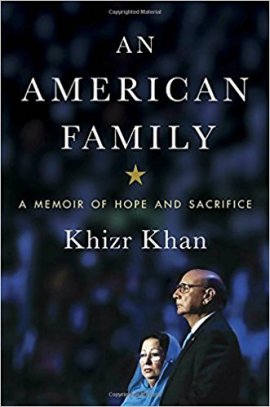
Book Review: An American Family

americanfamilyAn American Family: A Memoir of Hope and Sacrifice
by Khizr Khan
Memoir
271 pages
Published 2017

Like many people, I was inspired by the Khizr Khan’s speech at the Democratic Convention last year, and appalled by Trump’s reaction. As a Marine wife, the family members left behind when a service member dies get my utmost sympathy and compassion. That was my biggest fear while my husband was in the Marines, and it’s still a very emotional memory to look back on. So when I heard that Khan was writing a book, I knew I HAD to read it. I put a hold request in at the library before the book was published, and I’m glad I did. The book is definitely one of my favorites of 2017. (One of my next posts will be a round up of my favorites from this year.)

An American Family follows the Khans’ journey from Pakistan, to Dubai, to Texas, Maryland, and finally Virginia. And it’s fascinating. He says in the beginning of the book that he wrote it to answer the question he’s constantly asked: why do you love America? Why are you a Patriot? He couldn’t answer it in a few short sentences. This book is his answer, and what an answer it is. It’s impossible to summarize this book – it must be read.

It’s a very easy read – it flows beautifully, and Khan tells a story well. It’s easy, at least, until you get to the point where their son dies in action. Perhaps it wouldn’t have such an emotional effect on someone else, but that, and its aftermath, was pretty hard for me to read about. The event is important, however. Its repercussions ripple out through the Khans’ lives and affect everything they touch.

I can’t recommend this book highly enough. Especially if you’re American, and no matter where on the political spectrum you fall, this book is important. It might give you a different view on immigrants.

From the cover of An American Family:

“I am an American patriot not because I was born here but because I was not. I embraced American freedoms, raised my children to cherish and revere them, and lost a son who swore an oath to defend them, because I come from a place where they do not exist.”

In fewer than three hundred words, Muslim American Gold Star father Khizr Khan electrified viewers around the world when he took the stage at the 2016 Democratic National Convention. And when he offered to lend Donald Trump his own much-read and dog-eared pocket Constitution, his gesture perfectly encapsulated the feelings of millions. But who was that man, standing beside his wife, extolling the promises and virtues of the U.S. Constitution?

In this urgent and timeless immigrant story, we learn that Khizr Khan has been many things. He was the oldest of ten children born to farmers in Pakistan, and a curious and thoughtful boy who listened rapt as his grandfather recited Rumi beneath the moonlight. He was a university student who read the Declaration of Independence and was awestruck by what might be possible in life. He was a hopeful suitor, awkwardly but earnestly trying to win the heart of a woman far out of his league. He was a brilliant and diligent young family man who worked tow jobs to save enough money to put himself through Harvard Law School. He was a loving father who, having instilled in his children the ideals that brought him and his wife to America – the sense of shared dignity and mutual responsibility – tragically lost his son, an Army captain killed while protecting his base camp in Iraq. He was and is a patriot, and a fierce advocate for the rights, dignities, and values enshrined in the American system.

An American Family shows us who Khizr Khan and millions of other American immigrants are, and why – especially in these tumultuous times – we must not be afraid to step forward for what we believe in when it matters most.

Book Review: A Hundred Veils

hundredveilsA Hundred Veils
Rea Keech
Historical Fiction/Memoir-ish
307 pages
Published 2017

I picked this book up as part of my effort to read more diverse books. It centers on a young American English teacher who falls in love with an Iranian girl at the University of Tehran in the 70s. It wasn’t until I’d finished reading it, and finally read the About the Author, that I discovered the author is actually local to me. And I mean VERY local. As in my county library system had an event starring him THREE DAYS PRIOR to my reading the book! So I’m a little annoyed that I missed that, as I’d love to know just how much of the storyline was based on his experience in Iran. (He did actually spend some time in Iran with the Peace Corps, and the book is based off that.)

The book is also the winner of the 2017 Maryland Writers’ Association Novel Contest for their Literary/Mainstream category. (And now that I know that’s a thing, I might have to read the winners of the other five categories!)

On to the actual review! So the book is set at the very beginning of the Iranian Revolution – Marco is an American English teacher who’s come to Iran for a year. While there, he falls in love with his roommate’s cousin. The book is really their love story, while surrounded by political and religious unrest.

The writing is excellent. I’m sure I would get more out of the book if I could read Farsi, as each chapter is begun by a few lines of poetry in Farsi, written in both Arabic script and English letters. But the pacing is perfect, the descriptions apt – I really enjoyed this book except for one thing.

He sleeps with the girl he loves, without having made a decision as to if they’ll actually be together. He’s not sure he wants to stay in Iran. She doesn’t want to leave. And he sleeps with her anyway. My immediate thought was “You might love her, but you don’t care about her very much.” At the time, it seems like it was more of a dishonor, rather than an outright death sentence for the girl, but it still would basically condemn her to a life of prostitution at best, if he declined to marry her.

Perhaps I’m more aware of how dire those consequences are than most people who might read the book – though the shame she could face is mentioned in the book. My husband was an Arabic linguist in the military, and spent years learning about their culture. He’d come home and talk about things he’d learned, so I absorbed a lot of it as well. So the fact that the main character slept with her with no plan for their future kind of pissed me off. It wouldn’t be HIM that faced consequences for it, after all.

And yes, it was the 70s, before a lot of the religious extremism took hold – there was, in fact, a lot of enforced secularism. Women at the University were banned from wearing chadors in class, and shared classes with men. It’s actually really disturbing, seeing how secular a lot of the Middle East was in the 70s, and then to see how far they regressed socially in the following decades.

Besides the thoughtlessness of Marco in this matter, I really enjoyed the book. It reminded me a lot of the things my husband told me about Afghanistan. I’d really like to get a chance to ask the author some questions, so I’ll have to keep an eye out for any other events he might do.

From the cover of A Hundred Veils:

A young American teacher at the University of Tehran falls in love with a beautiful Iranian girl and gets caught up in the social, political, and religious turmoil of the times.

What ecstasy to fly through the sky
Tearing a hundred veils with every breath.
–Rumi