Book Review: Reign of the Fallen

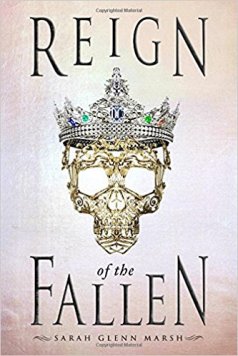
fallenReign of the Fallen
by Sarah Glenn Marsh
YA Fantasy
379 pages
Published January 2018

One of my book-centered social networks, Litsy, does an occasional “24 in 48” where the goal is to spend 24 hours out of 48 hours reading. I’m almost never able to participate in these because my weekends are pretty busy – and I don’t want to ignore my husband for an entire weekend! However, he went out of town for one of the last weekends in February, and I was able to spend it doing my own personal 24 in 48. Reign of the Fallen is the first of many books I read that weekend!

Reign of the Fallen has a pretty interesting premise – there are a few different school of magic in this world, and our main character is a necromancer. (One of the side characters is a Beast Master, and another is a Healer. We also see Weather Mages.) Necromancers, far from being the mysterious evil mages we see in most fantasy, are revered and noble in this world; they bring souls back from the Deadlands, when they can, so they can continue “living” in the real world. “Living” is a loose term – they must make sure they are completely covered at all times – if a living person sees any of their flesh, they turn – immediately – into terrifying monsters that hunt and kill both the living and the Dead. And the more they kill, the more powerful they become. Thankfully, people are very, very careful, and so Shades are very rare! …..or they were. Now that someone has started to purposefully make them, shit’s hitting the fan.

Odessa and her friends – three other Necromancers, a Healer, a Beast Master, and a Princess – set out to solve this mystery and take out the shades wreaking havoc on the kingdom. Entwined in that plot is the near-breaking of Odessa’s spirit when one of her friends dies, and the recovery from that, as well as romances with people of both genders. Yay for bisexual representation! (One of her Necromancer friends is also in a homosexual relationship with the Healer, and it’s all perfectly normal. I love seeing so many fantasy YA books these days not treating that as something special or other. Yay for culture changing! Maybe someday it won’t even be so out-of-the-ordinary that I’ll feel the need to point it out!)

The book had a few technical problems – a few scenes where I was confused how a character had gotten someplace when I thought they were somewhere else, some confusion in how a scene was described – but those could be overlooked with how wonderful the rest of the book was.

The plot was wrapped up very nicely by the end of the book, so I don’t know if there will be a sequel or not, but I really enjoyed the world and would definitely read one if she writes it!

As a bonus, the author lives in Richmond, Virginia, so I’m counting this as a book by a local author for the PopSugar 2018 Challenge!

From the cover of Reign of the Fallen:

Without the dead, she’d be no one.

Odessa is one of Karthia’s master necromancers, catering to the kingdom’s ruling Dead. Whenever a noble dies, it’s Odessa’s job to raise them by retrieving their soul from a dreamy and dangerous shadow world called the Deadlands. But there is a cost to being raised: the Dead must remain shrouded. If even a hint of flesh is exposed, a grotesque transformation begins, turning the Dead into terrifying, bloodthirsty Shades.

A dramatic uptick in Shade attacks raises suspicions and fears around the kingdom. Soon, a crushing loss of one of her closest companions leaves Odessa shattered, and reveals a disturbing conspiracy in Karthia: Someone is intentionally creating Shades by tearing shrouds from the Dead–and training them to attack. Odessa is forced to contemplate a terrifying question: What if her magic is the weapon that brings the kingdom to its knees? 

Fighting alongside her fellow mages–and a powerful girl as enthralling as she is infuriating–Odessa must untangle the gruesome plot to destroy Karthia before the Shades take everything she loves.

Book Review: Dust Tracks on a Road

dust tracks on a roadDust Tracks on a Road
by Zora Neale Hurston
Autobiography/Memoir
300 pages
Originally Published 1942 (my copy published in the 90s, with a foreword by Maya Angelou.)

This is my last review specifically for Black History Month, though I still have some African American books to read and review – a book about the African Americans who have served in the White House kitchens, and a book about Southern Food Culture, among others.

Zora Neale Hurston’s most famous work is Their Eyes Were Watching God, which I read in high school – and hated. I also strongly disliked The Color Purple, by Alice Walker, and unfortunately I have blended the two in my mind so much that I can’t remember what I hated about which book. I think it was The Color Purple that was written in a strong vernacular, but I’m not positive of that. It was twenty years ago!

Anyway. So I knew I didn’t like her fiction, but memoirs can be very different from fiction so I thought I’d give this a go. I didn’t hate this. But I didn’t like it, either. Hurston rambles from one subject to the next, going into so much imaginative detail at times that I have to skip back to pick up the line of actual story again. She has some questionable ideas about racial discrimination, seeming to ignore the idea of institutional racism, and dismissing the notion that white people are responsible for what their ancestors did. Or at least that individuals – even individuals as closely related as grandchildren – could be held individually responsible for their slave-owning grandparents. She even trotted out the “I wasn’t even born then, how could I be responsible?” that is the cry of many white people today who deny their privilege.

Maya Angelou, in her foreword, mentions this briefly – that Hurston had lived through race riots, and Jim Crow, but doesn’t mention any unpleasant racial incidents in her book, which is very odd. She does mention one – but it’s perpetrated by a black man, when he comes into the barber shop/salon that Hurston worked at and demanded to be served. (Only white people were served at this particular shop, but the owner had another shop uptown that served black people.) Hurston largely takes a stand against the black customer, complaining that had they served him, the owner (another black man) would have been driven out of business, and all his black employees with him, so how dare the customer value equality over all those jobs? Which is a decent point, but ignores that it’s white people that would have wrongly put them out of business for the so-called crime.

I was very disappointed that Hurston never really talked about the Jim Crow era in her book. I would have liked to see that from her perspective. I do think I’d like to read more memoirs from that era, as Hurston makes it seem largely peaceful and happy. And I’m pretty sure that’s not the case.

It’s an interesting book, but it seems Hurston is at least a slightly unreliable narrator. So take that into account if you read it, and remember it was published in the 1940s, so the way she talks about the “primitive Negro” and the ease with which she tosses around the N word (including from white people) is a product of its time.

This is my PopSugar 2018 Challenge pick for the prompt “an author from a different ethnicity than you.”

From the cover of Dust Tracks on a Road:

First published in 1942 at the crest of her popularity as a writer, this is Zora Neale Hurston’s imaginative and exuberant account of her rise from childhood poverty in the rural South to a prominent place among the leading artists and intellectuals of the Harlem Renaissance. The very personal, perhaps larger-than-life portrait that Hurston paints of herself offers a rare, poignant, and often audacious glimpse of the public and private persona of a very public and private artist, writer, anthropologist, and champion of black heritage. Dust Tracks on a Road is a book full of the wit and wisdom of a proud and spirited woman who started off low and climbed high: “I have been in Sorrow’s kitchen and licked out all the pots. Then I have stood on the peaky mountain wrapped in rainbows with a harp and a sword in my hands.”

Book Review: The Last Black Unicorn

blackunicornThe Last Black Unicorn
by Tiffany Haddish
Comedy/Memoir
276 pages
Published December 2017

I’ve been wanting to read this book ever since I saw Haddish’s interview on The Daily Show with Trevor Noah. This woman is HILARIOUS. Somehow I didn’t realize she was in the movie Girls Night until I read about it in her book – I really do need to see that movie. That aside, this book was pretty great. It’s written in her speaking style, so it’s not technically correct grammar, but it SOUNDS right, which is more important in a memoir, in my opinion. It’s supposed to show the author’s personality, and this does.

I don’t know that I’d put this on quite the same level as Trevor Noah’s Born A Crime, or Jenny Lawson’s Furiously Happy, but it’s not far behind them. Haddish talks about her childhood in the foster system and then raised by her grandmother, her string of no-good boyfriends, and her abusive marriage. She’s had a rough life, but somehow she’s come out of it with a gift for comedy and a grounded personality.

Her swamp tour with Will Smith and Jada Pinkett-Smith is one of the most hilarious stories in the book, and one of the few that is purely funny. Most of them are underscored with a serious issue that make me feel a little bad for laughing at them, but Haddish laughs at them, so how can you not? It’s an interesting conflict that leaves me with slightly mixed feelings about the book.

It’s a pretty quick, easy, fun read, and if you like Tiffany Haddish, it definitely shows what she’s gone through to get where she is now.

From the cover of The Last Black Unicorn:

From stand-up comedian, actress, and breakout star of Girls Trip, Tiffany Haddish, comes The Last Black Unicorn, a sidesplitting, hysterical, edgy, and unflinching collection of (extremely) personal essays, as fearless as the author herself.

Growing up in one of the poorest neighborhoods of South Central Los Angeles, Tiffany learned to survive by making people laugh. If she could do that, then her classmates would let her copy their homework, the other foster kids she lived with wouldn’t beat her up, and she might even get a boyfriend. Or at least she could make enough money—as the paid school mascot and in-demand Bar Mitzvah hype woman—to get her hair and nails done, so then she might get a boyfriend.

None of that worked (and she’s still single), but it allowed Tiffany to imagine a place for herself where she could do something she loved for a living: comedy.

Tiffany can’t avoid being funny—it’s just who she is, whether she’s plotting shocking, jaw-dropping revenge on an ex-boyfriend or learning how to handle her newfound fame despite still having a broke person’s mind-set. Finally poised to become a household name, she recounts with heart and humor how she came from nothing and nowhere to achieve her dreams by owning, sharing, and using her pain to heal others.

By turns hilarious, filthy, and brutally honest, The Last Black Unicorn shows the world who Tiffany Haddish really is—humble, grateful, down-to-earth, and funny as hell. And now, she’s ready to inspire others through the power of laughter.

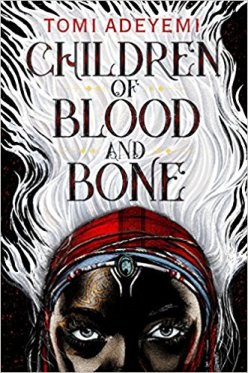
Book Review: Children of Blood and Bone

childrenChildren of Blood and Bone
Tomi Adeyemi
Fantasy
600 pages
Release date March 6, 2018

Have you ever reached the end of a book and yelled “NOOOOO!!!”? Because I just did. Children of Blood and Bone ends on a HUGE cliffhanger, and I’m even more upset about that than I would be normally – I got this book as an advanced reader’s copy through Goodreads. So not only do I have to wait for the sequel to come out, THIS BOOK ISN’T EVEN OUT YET. *screams internally*

That massive frustration aside, I LOVED THIS BOOK. African-inspired fantasy novels are starting to crop up, along with other non-European based fantasy, and I’m loving it. (You can find Russian inspired fantasy that I’ve read previously here and here, and Jewish/Arab fantasy here.) Adeyemi is a Nigerian-American author, and this is her debut novel. It definitely shows some hallmarks of a debut novel – the dialogue is a bit stilted in places, and it’s a little bit formulaic – but the world building is excellent.

Children of Blood and Bone is a story of oppression, and the sparks of a rebellion. I assume the rest of the trilogy will deal with the actual rebellion, but given the cliffhanger it ends on, I’m not actually sure of that. When Zélie, the main character, was very young, magic failed, and the king, who was afraid of maji, took the opportunity to kill every maji in his kingdom before they could find a way to regain their powers. Since then, every person who could have become a maji as they grew (they’re marked by their white hair) has been treated as a second-class citizen. They’re forced into slums, used as slave labor, kicked around by nobility and guards, made to pay higher taxes, and forbidden to breed with the other classes. They don’t have magic – and they have no way to get it – but they’re treated as trash by the king that hates them, and accordingly by the rest of his subjects.

At the beginning of the book, a magical artifact resurfaces that restores magic to any diviner (potential maji) that touches it. This, of course, is not okay with the king, and most of the book is about the race to use the magical artifact while being chased by the king’s son and his guards who are trying to destroy it. The conflicted prince has secrets of his own, though, and as the book weaves through jungles, mountains, and seas, he wavers in his mission.

It’s always difficult to review books without giving too much away about the plot, so I won’t say much more about the events. I really enjoyed that they rode giant cats – leopanaires. Zélie and her allies ride a lion leopanaire, which is apparently somewhat unusual. Most of the guards ride leopards or cheetahs, while the royal family rides snow leopanaires. The magic is unique, the gods and religion are beautifully fleshed out, and overall I just really loved this world, and I’m very sad it will be so long before I can dive back into it.

This is also my “Book published in 2018” for the Popsugar Reading Challenge.

From the cover of Children of Blood and Bone:

Zélie Adebola remembers when the soil of Orïsha hummed with magic. Burners ignited flames, Tiders beckoned waves, and Zélie’s Reaper mother summoned forth souls.

But everything changed the night magic disappeared. Under the orders of a ruthless king, maji were targeted and killed, leaving Zélie without a mother and her people without hope.

Now Zélie has one chance to bring back magic and strike against the monarchy. With the help of a rogue princess, Zélie must outwit and outrun the crown prince, who is hell-bent on eradicating magic for good.

Danger lurks in Orïsha, where snow leopanaires prowl and vengeful spirits wait in the waters. yet the greatest danger may be Zélie herself as she struggles to control her powers – and her growing feelings for an enemy.

Book Review: The Rules of Magic

rulesofmagicThe Rules of Magic
Alice Hoffman
Contemporary Fantasy
385 pages
Published 2017

So I actually didn’t know that Practical Magic the movie was based on a book. But when I saw The Rules of Magic billed as the prequel to a movie I had loved, I knew I had to read it. And I’m so glad I did. The Rules of Magic is, well, magical. Magical and nostalgic and spell-binding. Most book worlds feel different than their respective movie-worlds, but this felt like a logical prequel. (It may be because I haven’t seen the movie in some time – I intend to remedy that soon, and I might just have to read the book as well.)

Practical Magic, the well known movie with Sandra Bullock and Nicole Kidman, centers around the two girls and their elderly aunts. The Rules of Magic is the aunts’ story. And what a story. It begins in New York, as the older of the two aunts is turning 17. On an Owens’ girl’s seventeenth birthday, they receive an invitation to spend the summer at the Owens home in Massachusetts. Frances, the older of the two girls, receives the invitation, and her two siblings won’t let her go alone, so all three of them (yes, three, the movie doesn’t mention their brother that I recall, though I suppose Bullock and Kidman’s characters had to come from somewhere!) pack up and head to Massachusetts, where they meet their Aunt Isabelle. Over the course of the summer, they learn their family history, and get verification that they are indeed witches. (They’d had certain powers throughout childhood, though their mother tried to deny it.)

It was Vincent’s storyline that intrigued me, since I knew where Frances and Jet ended up. There was an unexpected curveball that I won’t spoil here, but I enjoyed it. It was Jet and Frances’ storylines that had me crying at the end of the book, though. Not the very last chapter – it ended on a hopeful note – but the few chapters preceding it had me in tears. (It was midnight, and everyone else was asleep, so I had myself a good cry over my book, and then had to try to sleep on a wet pillow.)

If you enjoyed Practical Magic the movie, you should read this book. It’s a perfect prequel.

From the cover of The Rules of Magic:

Find your magic.

For the Owens family, love is a curse that began in 1620, when Maria Owens was charged with witchery for loving the wrong man.

Hundreds of years later, in New York City at the cusp of the sixties, when the whole world is about to change, Susanna Owens knows that her three children are dangerously unique. Difficult Franny, with skin as pale as milk and blood red hair, shy and beautiful Jet, who can read other people’s thoughts, and charismatic Vincent, who began looking for trouble on the day he could walk.

From the start Susanna sets down rules for her children: No walking in the moonlight, no red shoes, no wearing black, no cats, no crows, no candles, no books about magic. And most importantly, never, ever, fall in love. But when her children visit their Aunt Isabelle, in the small Massachusetts town where the Owens family has been blamed for everything that has ever gone wrong, they uncover family secrets and begin to understand the truth of who they are. Back in New York City each begins a risky journey as they try to escape the family curse.

The Owens children cannot escape love even if they try, just as they cannot escape the pains of the human heart. The two beautiful sisters will grow up to be the revered, and sometimes feared, aunts in Practical Magic, while Vincent, their beloved brother, will leave an unexpected legacy. Thrilling and exquisite, real and fantastical, The Rules of Magic is a story about the power of love reminding us that the only remedy for being human is to be true to yourself.

Book Review: Kindred

kindredKindred
Octavia Butler
Historical Fiction
306 pages
Published 2004

I’m not really sure where to start with this book. It’s in that category of “classics that everyone should read” and having finally read it, I agree. It’s really, really, really good. It’s a hard read at times – it takes you right into the antebellum south and the heart of slavery. It’s actually set in Maryland, which is a little jarring for me – in today’s political climate, Maryland isn’t really considered part of “the south” – it’s far more liberal than most of the south. A blue state, where those are all red. But it WAS a slave state. It is below the Mason-Dixon line, and reading the wiki, slavery was actually legal here longer than it was in the south. (Mostly because the Emancipation Proclamation only covered the Confederate States, not the slave-holding Union states of Delaware, Kentucky, Missouri, and Maryland. That’s screwed up. You can’t have slaves, but it’s totally cool that the people that fought for us still keep them?)

So Kindred is set mostly in pre-Civil War Maryland, with a few scenes in modern-day California. The mystery of how Dana time-travels is never explained – but it doesn’t really need to be. That’s not the point of the story. The point of the story is a modern-day black woman transplanted to the antebellum south and learning to understand slavery in a very intimate manner. Dana mentions a couple of times how easy it is to forget that she has another life – that’s she’s a free black woman from the future – because the way they keep slaves in line doesn’t give you time to think past the present. You work too hard to think of the future, and if you don’t, all you can think about is the pain from your punishment for not working hard enough.

The book is a very visceral portrayal of a somewhat pampered slave’s life – she’s not a field hand, her masters are what passes for “kind.” Dana’s fellow slaves live in fear of being sold down south to Mississippi – they know Maryland is better. As hard as some of the scenes are to read, the book explicitly says it could be harder.

The conflict Dana feels between rescuing her white, slave-owning ancestor again and again, and standing back and letting nature take its course (but dooming herself) is one of the central points of the book. It’s a moral quandary that she never really answers.

Ultimately, there’s no way to do this book justice in a review. I think it should be required high school reading. More than that, I think it should be required reading for white people. And if you haven’t read it yet, you should. I knew on an intellectual level what slaves went through – but this book doesn’t look at it from a distance. It doesn’t divorce the reader from the violence. It puts the reader right there in the dirt of the yard with the whip exploding across Dana’s back.

I think it took me so long to get around to this book because it IS a classic. And so many classics I was forced to read in school were boring and dry and hard to read. I’m starting to find that some are classics because they’re just that good. Good and necessary and written about critically important topics. Kindred is one of them.

From the cover of Kindred:

Dana, a modern black woman, is celebrating her twenty-sixth birthday with her new husband when she is snatched abruptly from her home in California and transported to the antebellum South. Rufus, the white son of a plantation owner, is drowning, and Dana has been summoned to save him. Dana is drawn back repeatedly through time to the slave quarters, and each time the stay grows longer, more arduous, and more dangerous until it is uncertain whether or not Dana’s life will end, long before it has a chance to begin.