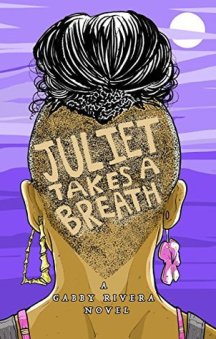
Book Review: Juliet Takes a Breath

juliet takes a breathJuliet Takes a Breath
by Gabby Rivera
Young Adult / LGBT / Contemporary Fiction / Feminist
264 pages
Published 2016

Ohhhhhh my. This is a short book, and a quick read, but MAN is it great. It tackles racism, microaggressions, white feminism, coming out, “it’s just a phase!”, polyamory, breaking up, trans-exclusive language…and so much more.

The plot revolves around Juliet’s summer internship with an author in Portland, Harlowe Brisbane. Many of the chapters begin with an excerpt from Brisbane’s fictional treatise on feminism, Raging Flower: Empowering Your Pussy by Empowering Your Mind. One of these excerpts in particular took my breath away:

Read everything you can push into your skull. Read your mother’s diary. Read Assata. Read everything Gloria Steinem and bell hooks write. Read all of the poems your friends leave in your locker. Read books about your body written by people who have bodies like yours. Read everything that supports your growth as a vibrant, rebel girl human. Read because you’re tired of secrets.

Juliet reminds me a lot of me when I was detaching myself from Christianity and the conservatism I grew up with. Devouring books, learning about historical figures that I should have known about and was stunned that I’d never heard of. So I totally understand her wonder and shock at an entirely new world opening up before her.

Through Harlowe and her primary partner, Maxine, Juliet learns about polyamory. It’s a remarkably good example; even though Harlowe and Maxine have their issues, their arguments are reasonably healthy, and despite disagreeing on some topics, they still love each other and say as much.

In Harlowe, we have an example of a white feminist who tries to be intersectional, at least a little, but can still be blind to a lot of her own microaggressions. Maxine, her partner, is a woman of color, as are most of the other characters in the book, so Juliet has lots of opportunities to see how white feminism can be ignorant of issues and blind to its own faults.

As a white feminist myself, I took this portrayal for the warning it really is. I do my best to lift up voices of color by reviewing books by and about minorities on this blog as often as I can. I try to be as intersectional as possible, but I know I will make missteps, and I can always be better. But this book, though it’s meant for the other side of the equation, is a reminder to feminists like me to keep trying to be better, and the costs to other people when we screw up.

From the cover of Juliet Takes a Breath:

Juliet Milagros Palante is leaving the Bronx and headed to Portland, Oregon. She just came out to her family and isn’t sure if her mom will ever speak to her again. But Juliet has a plan, sort of, one that’s going to help her figure out this whole “Puerto Rican lesbian” thing. She’s interning with the author of her favorite book: Harlowe Brisbane, the ultimate authority on feminism, women’s bodies, and other gay-sounding stuff. 

Will Juliet be able to figure out her life over the course of one magical summer? Is that even possible? Or is she running away from all the problems that seem too big to handle?

With more questions than answers, Juliet takes on Portland, Harlowe, and most importantly, herself.

Book Review: The Rules and Regulations for Mediating Myths & Magic

rules and regulationsThe Rules & Regulations for Mediating Myths & Magic
by F. T. Lukens
Urban Fantasy / Young Adult / Romance / LGBT
287 pages
Published 2017

I loved this book. The wit is dry, the action easy to follow, the confusion of the main character absolutely warranted (Mermaids? in Lake Michigan?!), and it’s just wonderful. And it stars a bisexual teenage BOY. Male bisexuality could use more visibility, so this made me really happy. I picked this book for the M/M for Pride; I was really excited to find the main character is bisexual! It was a great surprise.

Bridger (an unusual name, but it fits him) is a senior in high school with a crush on his next door neighbor. He plans to go to school far away – Florida – where he can just BE himself instead of having to come out. But for that he needs money; so he answers an ad for an assistant doing….well he’s not sure exactly what. When he finally demands answers, he learns the truth about the world of myth and magic, and things snowball from there.

He wrestles with keeping it secret from his friends – because really, who would believe he saw mermaids in Lake Michigan? At the same time, he’s trying to wrap his head around his attraction to Leo, star football player, who just might like him back, and how to tell his mom he’s bisexual.

I loved Bridger, and his best friend, Astrid, who will kick the butt of anyone who looks wrong at Bridger, and Leo was an absolute dreamboat. I also want to know more about Pavel and his companions! I really really hope the author writes more books in this world, because I want to read them!

From the cover of The Rules & Regulations for Mediating Myths & Magic:

Desperate to pay for college, Bridger Whitt is willing to overlook the peculiarities of his new job – entering via the roof, the weird stacks of old books and even older scrolls, the seemingly incorporeal voices he hears from time to time – but it’s pretty hard to ignore being pulled under Lake Michigan by . . . mermaids? Worse yet, this happens in front of his new crush, Leo, the dreamy football star who just moved to town.

Fantastic.

When he discovers his eccentric employer Pavel Chudinov is an intermediary between the human world and its myths, Bridger is plunged into a world of pixies, werewolves, and Sasquatch. The realm of myths and magic is growing increasingly unstable, and it is up to Bridger to ascertain the cause of the chaos, eliminate the problem, and help his boss keep the real world from finding the world of myths.

Book Review: Ship It

ship itShip It
by Britta Lundin
Young Adult
375 pages
Published 2018

Claire’s an obsessed jerk. Let me just get that out ahead of everything else. Claire is one of two viewpoints in this book, and I won’t even call her a protagonist, because Forest, the male viewpoint character, is FAR more sympathetic. Yeah, he’s a touch homophobic at the beginning of the book, but he learns. Claire, on the other hand, has one goal that she’s obsessed with and Will. Not. Let. It. Go. Single-minded determination can be a great thing, but Claire doesn’t see or understand the harm she’s doing in pursuing her goal. The few times she does see, she doesn’t seem to care. Sure, she’s sixteen, but holy crap, girl. Maybe, when people tell you a thing can’t happen, you should stop and ask them why instead of stubbornly insisting it CAN happen if only they’ll let it.

Let me back up slightly. Claire is a superfan of a show called Demon Heart. In the show, a demon hunter and a demon-with-a-heart play off each other in what the fans see as a romantic manner. This comes as a huge surprise to at least one of the stars of the show, Forest Reed, who plays the demon hunter. Forest has a rather disastrous interaction with Claire at a Q&A (he’s an asshole about her question, which is about the two characters being gay) and the show decides, in order to salvage things, to have Claire travel with them to the next few public appearances, since she’s a big name in the fandom. Forest sees this as a job he has to put up with for a paycheck. Claire sees this as a chance to make her ship real, and goes to – well – ridiculous lengths to convince the showrunners and stars.

Ultimately, Claire is right that representation is incredibly important. And she’s probably even right that showrunners and stars should take risks with their careers to bring that representation to screen. But she’s such an asshole about it that I can’t even cheer her on. She’s even kind of a jerk to Tess, the cute fanartist she meets at the first convention (and keeps running into at the ensuing cons).

Claire aside, I actually enjoyed the book. There were a couple of twists at the end that I very much enjoyed.

One bit I did NOT enjoy was Tess identifying as pan “because bi means two.” That definition of bisexual – that it’s binary, only attracted to men and women – is biphobic and has NEVER been true. Bisexual means attracted to your own gender and others. That first definition tries to make bisexuals seem transphobic, and I’m frustrated that it persists. So it’s disappointing to see the statement made in the book go unchallenged.

There’s also an anxiety-inducing scene late in the book that I can’t say much about because it’s a major plot twist, but if you have issues with intimidating men, maayyyybe skip this one.

There is quite a bit of representation in the book, between Tess, the pansexual black girl, Claire, a questioning/queer white girl, and Forest, who is definitely questioning his sexuality, and learning about gender and sexuality representation issues from Claire. Oh, also Caty, a studio assistant, who is bisexual. (But who clarifies, unnecessarily, that she’s attracted to boys and girls.)

So I’m quite torn on this book. I liked it, but it has issues.

From the cover of Ship It:

Claire is a sixteen-year-old fangirl obsessed with the show Demon Heart. Forest is an actor on Demon Heart who dreams of bigger roles. When the two meet at a local Comic-Con panel, it’s a dream come true for Claire. Until the Q&A, that is, when Forest laughs off Claire’s assertion that his character is gay. Claire is devastated. After all, every last word of her super-popular fanfic revolves around the romance between Forest’s character and his male co-lead. She can’t believe her hero turned out to be a closed-minded jerk. Forest is mostly confused that anyone would think his character is gay. Because he’s not. Definitely not.

Unfortunately for Demon Heart, when the video of the disastrous Q&A goes viral, the producers have a PR nightmare on their hands. In order to help bolster their image within the LGBTQ+ community – as well as with their fans – they hire Claire to join the cast for the rest of the publicity tour. What ensues is a series of colorful Comic-Con clashes between the fans and the show that lead Forest to question his assumptions about sexuality and help Claire come out of her shell. But how far will Claire go to make her ship canon? To what lengths will Forest go to stop her and protect his career? And will Claire ever get the guts to make a move on Tess, the very cute, extremely cool fanartist she keeps running into? Ship It is a funny, tender, and honest look at all the feels that come with being a fan. 

Book Review: Her Royal Highness

her royal highnessHer Royal Highness
by Rachel Hawkins
Young Adult/Romance/LGBT
274 pages
Published May 2019

This is the sequel to Royals, which I reviewed a little while back. At the time, I wasn’t terribly enthused by Princess Flora, and that actually stuck through this book. I do, however, really like Millie. And I LOVE Rachel Hawkins. This woman writes sweet, fluffy romances that you know will have a happy ending, and makes them a joy to read. To see that approach with LGBT representation – lesbian and bisexual, in this specific case – is fantastic. Give us more! Hawkins still has several characters she could write stories about in this world, including the most eligible bachelor, Prince Sebastian. (Flora’s brother.) She could also write a prequel about the other Prince, since the first book was the romance between the Prince Alex’s fiancée’s sister and one of Sebastian’s best friends. Prince Alex and his fiancée were already a thing when the series opened. Daisy and Miles, the couple from the first book, do make an appearance in this one as well, as do Seb and the rest of the “Royal Wreckers.” (His posse of noble scoundrels.)

I liked that Millie explicitly likes both “lads and lasses, in the general sense” in the book; it’s not just implied. Far too often we’re just left to wonder, when a character dated or was married to one gender, but is shown loving a different gender, whether it’s because they discovered the new gender is their actual preference, or because they are bi/pan. Plenty of homosexuals were married to an opposite-gender partner before coming out. So it’s really nice to see explicitly bisexual rep!

I may have liked the side characters more than I liked Princess Flora. Lady Sakshi Worthington, especially, was great, and I may have been cheering more for her romance than for Millie and Flora!

My dislike of Flora aside, I really enjoyed this book. It was a quick, fun read, and Hawkins had better get working on the next story. I NEED Seb’s book!

From the cover of Her Royal Highness:

She’s her friend.
She’s her enemy.
She’s her . . . crush?

Millie Quint is devastated when she discovers that her sort-of-best-friend/sort-of-girlfriend has been kissing someone else. Heartbroken and ready for a change of pace, Millie decides to apply for scholarships to boarding schools . . . the farther from Houston the better.

Millie is thrilled when she is accepted into one of the world’s most exclusive schools, located in the rolling Highlands of Scotland.

The only problem: Millie’s roommate, Flora, is a total princess.

She’s also the actual princess. Of Scotland.

At first, the girls can’t stand each other, but before Millie knows it, she has another sort-of-best-friend/sort-of-girlfriend. Princess Flora could  be a new chapter in her love life, but Millie knows the chances of happily-ever-after are slim. After all, real life isn’t a fairy tale . . . or is it?

Book Review: We Set the Dark on Fire

we set the dark on fireWe Set the Dark on Fire
by Tehlor Kay Mejia
Young Adult / Dystopia / LGBT / Romance
364 pages
Published February 2019

We Set the Dark on Fire is an excellent example of how government-mandated relationship structures are oppressive. The core of the story revolves around an island society’s marriage structure; because of an old myth, each man – or at least each upper-class man – has two wives. One wife, the Primera, is expected to be his intellectual equal; she runs his affairs and household and manages his social engagements – the business side of the marriage, if you will – and a second wife who is his heart. The second wife, the Segunda, is expected to be emotional, passionate, and beautiful; she bears and raises his children. The wives are expected to get along and love each other like family.

This is really only the framework for the plot, though. The plot itself revolves around the idea of who belongs in society and who doesn’t. I’ve seen some people call it illegal immigration, and there IS a wall that it is illegal to come over; the unfortunates living outside the wall are uncared for by society and government alike. But I didn’t get the impression that they weren’t actually part of the same country. So I’m not 100% certain I agree that it counts as immigration in the story, though it does have a lot of the same principles, so it may as well be. There’s a lot of othering and dehumanizing, and deciding who deserves what based on their wealth, and government checkpoints to check residence papers, so even if it isn’t technically immigration – well. It’s still a major theme.

This sounds like it could be a book on polyamory; it is not. This is government-mandated female oppression. The government, and our main character’s new husband, specifically, are intent on crushing the resistance coming from the poor who live on the edges of the island. The resistance is called La Voz, or The Voice, and they help Daniela, our main character, out of a tight spot in the beginning of the book. In return, they expect her to spy for them on her new husband, a highly-placed government official. Not knowing who to trust, and afraid of her lies being discovered, she agrees.

What follows is the early stages of rebellion: protests, government cover-ups, undercover meetings, and military checkpoints. In the middle of it all, Daniela begins to fall in love with her Segunda, Carman, who seems to have secrets of her own.

I really really enjoyed this book, and I am very much looking forward to the second! It’s listed as a duology, so it should just be the two. I can’t wait!

From the cover of We Set the Dark on Fire:

At the Medio School for Girls, distinguished young women are trained for one of two roles in their polarized society. Depending on her specialization, a graduate will one day run her husband’s household or raise his children, but both wives are promised a life of comfort and luxury, far from the frequent political uprisings of the lower class.

Daniela Vargas is the school’s top student, but her bright future depends upon no one discovering her darkest secret – that her pedigree is a lie. Her parents sacrificed everything to obtain forged identification papers so Dani could rise above her station. Now that her marriage to an important politico’s son is fast approaching, she must keep the truth hidden or be sent back to the fringes of society, where famine and poverty rule supreme. 

On her graduation night, Dani seems to be in the clear, despite the surprises that unfold. But nothing prepares her for all the difficult choices she must make, especially when she is asked to spy for a resistance group desperately fighting to bring equality to Medio. Will Dani give up everything she’s strived for in pursuit of a free Medio – and a chance at a forbidden love?

The first in a sizzling fantasy duology from debut author Tehlor Kay Mejia, We Set the Dark on Fire is a boldly feminist look at freedom, family, and fighting the power.

Book Review: Georgia Peaches and Other Forbidden Fruit

georgia peaches and other forbidden fruitGeorgia Peaches and Other Forbidden Fruit
by Jaye Robin Brown
Young Adult/Romance/LGBT
432 pages
Published 2016

This is a sweet, southern f/f romance. Set in Georgia, it deals with a lot of things young lesbians might have to deal with in the south – religion, bigotry, the stress of coming out or not coming out (or being forced back in the closet by a move to a small town)! It doesn’t deal with any outright violence against our lesbian protagonists, and it just barely touches on drug use, eating disorders, and abusive relationships. Joanna has a mostly supportive family, even if they do ask her to hide her sexuality for her senior year in the new town. Jo reluctantly agrees to do so, but doesn’t count on falling in love with a girl at her new school.

The book deals a LOT with religion and sexuality; Jo’s father is a radio preacher, and she attends a baptist church in town with her stepmother and new grandparents. At one point – one of my favorite scenes in the book – she snaps, and calls out her classmates for thinking homosexuality is a sin, while they eat shellfish and have premarital sex.

I liked the book, but I’m not sure I’d recommend it. I grew up Christian; I’m familiar with all the concepts in the book, but rather than progress to a kinder, more loving version of Christianity, I left it behind altogether. I’m glad that some people can reconcile religion with progressive values, but I can’t. So it might be a good book for some, but not for me.

From the cover of Georgia Peaches and Other Forbidden Fruit:

It’s going to take a miracle for Joanna Gordon to get through senior year. 

Despite being the daughter of a well-known radio evangelist, Jo has never hidden the fact that she’s gay, and her dad has always supported her. But that was back in Atlanta. Now her dad the reverend has married wife number three, and they’ve all moved to small-town Rome, Georgia. When Jo’s dad asks her to lie low for the rest of the year in the hopes that it will help him and his new wife settle in, Jo reluctantly agrees. 

Although when God closes a closet door, he opens a window. Everything becomes so easy for Jo once she rebrands herself as a straight girl. No one gives her odd looks. Her new stepfamily likes her. She even gets in with the popular crowd.

And that’s how she meets Mary Carlson, the ultimate temptation. Even though Jo knows this girl is completely off-limits, she just can’t get her out of her mind. But Jo couldn’t possibly think of breaking her promise to her dad. Even if Jo’s starting to fall for Mary Carlson. Even if there’s a chance Mary Carlson might be interested in her, too. Right?

Lord, have mercy.

Jo’s in for one hell of a year.