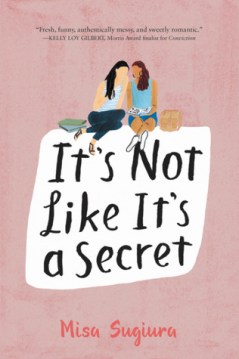
Book Review: It’s Not Like It’s A Secret

its not like its a secretIt’s Not Like It’s A Secret
by Misa Sugiura
Young Adult/Romance/LGBT
394 pages
Published 2017

Before I dive in I want to explain that I’ve tagged this with polyamory not for the main characters, but for a few side characters. If you’re looking for a poly romance, this is absolutely not it. This is a teenage lesbian romance, with a side of racial issues.

Sana is a California transplant from Wisconsin; both her parents are immigrants from Japan, so despite feeling like she’s a midwesterner, none of her friends think of her as one. There’s a cringe-y scene early in the book where she cheers with her friends about being “midwestern farmer’s daughters” and they tell her she’s cute for thinking that, but she’s Japanese, obv. I felt really bad for her. When her family moves to California, suddenly she’s not the only Asian girl in a sea of whiteness. It’s an interesting mix of having a place with your own people but also fighting the stereotypes of sticking with your own ethnicity. It’s assumed she’ll be friends with the other Asian kids, which annoys her, but she also finds to be true; having not had the opportunity to have friends like her before, she finds she really likes it. (See my Friday 56 quote about it.) But she also tries to break that mold and be friends with people she’s not assumed to like – like Jamie Ramirez and her Hispanic friends, and Caleb and his white goth friends.

The book also explores the way racism hits races differently; the Hispanic kids get hassled by cops while the Asian kids don’t – though they also have things expected of them that the Hispanic kids don’t. The book gets into cultural expectations as well – PDAs are not really a thing in Sana’s world, so she’s reluctant to be public about her affections at school, which drives misunderstandings.

It’s only in the last few chapters that all the secrets come out, and Sana struggles to put things right.

One thing I really liked about the book is the narrative structure. At the beginning of the school year, Sana’s English teacher gives them a project, which is to keep a journal to transcribe poems into and talk about what they mean to you. Chapters from Sana’s poetry journal are interspersed with chapters of the narrative, and give some nice insight to how she’s feeling. Her love interest, Jamie, also loves poetry, and it plays a large part in their relationship.

I quite enjoyed this book.

From the cover of It’s Not Like It’s A Secret:

Sixteen-year-old Sana Kiyohara has too many secrets. Some are small, like how it bothers her when her friends don’t invite her to parties. Some are big, like the fact that she’s pretty sure her father’s having an affair. And then there is the one that she barely even admits to herself, the one about how she might have a crush on her best friend.

When Sana and her family move to California, she begins to wonder if it’s finally time for her to be honest with her friends and family, especially after she meets Jamie Ramirez. Jamie is beautiful and smart and unlike anyone Sana’s ever known before. The only problems are: Sana is pretty sure Jamie’s friends hate her, Jamie’s ex isn’t totally out of the picture, Sana’s new friend Caleb has more-than-friendly feelings for her, and things with her dad feel like they’re coming to a head. She always figured that the hardest thing would be to tell people that she wanted to date a girl, but as Sana quickly learns, telling the truth is easy . . . what comes after it, though, is a whole lot more complicated. 
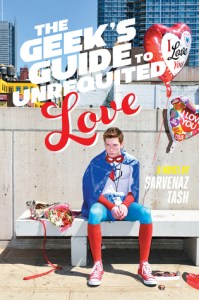
Book Review: The Geek’s Guide to Unrequited Love

3P JKT Geeks_Guide.inddThe Geek’s Guide to Unrequited Love
by Sarvenaz Tash
Young Adult
249 pages
Published 2016

The title of this book had me wary from the start, but I’d heard good things about it, and the author is a woman, so I hoped it wouldn’t be what it sounded like. Because seriously. We don’t need more books about angsty white guys complaining about the girl they love not liking them back.

Unfortunately that’s exactly what I got in this book.

First, the good points. The author has a very immersive writing style, and she captured the feeling of a Comic Con VERY impressively. I haven’t been to NYCC, but I’ve been to other nerdy cons, and the hectic pace of panels, and getting tickets, and standing in lines, but nerding out over ALL THE GEEKY STUFF – yeah, that was perfectly written. I really enjoyed that. The other characters – Casey and Felicia, specifically, and Samira, and the rest of Roxy and Graham’s families – those were also well done. The brief scene with Roxy’s Iranian family was especially nice, which is to be expected from an Iranian-American author!

But Graham irritated me. Roxy wasn’t well explored because we only saw things from Graham’s point of view, and her love interest Devin’s appeal wasn’t shown very well at ALL.

I spent most of the book wanting to yell at Graham to just TALK TO HER ALREADY. He’s all miffed that his plans aren’t going right and the obnoxious Brit is stealing his girl but he won’t. Just. TALK. To her.

I think the only reason I actually finished the book was because it was short. And for the description of Comic Con, that was actually really good. But the main character was just frustrating. I should have spent this time on another book.

From the cover of The Geek’s Guide to Unrequited Love:

Graham met his best friend, Roxy, when he moved into her neighborhood eight years ago and she asked him which Hogwarts house he’d be sorted into. Graham has been in love with her ever since. 

But now they’re sixteen, still neighbors, still best friends. And Graham and Roxy share more than ever – moving on from their Harry Potter obsession to a serious love of comic books.

When Graham learns that the creator of their favorite comic, The Chronicles of Althena, is making a rare appearance at this year’s New York Comic Con, he knows he must score tickets. And the event inspires Graham to come up with the perfect plan to tell Roxy how he really feels about her. He’s got three days to woo his best friend at the coolest, kookiest con full of superheroes and supervillains. But no one at a comic book convention is who they appear to be . . . even Roxy. And Graham is starting to realize his fictional love stories are way less complicated than real life ones. 

Book Review: Pride

pridePride
by Ibi Zoboi
Young Adult/Retelling/Romance
289 pages
Published September 2018

I have very mixed feelings about this one. I’ve read several retellings of Pride & Prejudice, but I think this is the first one that aged the characters down to teenagers. And I don’t think it works as well. In both The Lizzie Bennett Diaries and Unmarriageable, the main character and her older sister were in their twenties. They were still living at home, but they were graduating college, starting careers – a completely different stage of their lives from the characters in Pride. In Pride, Zuri is a senior in high school and Janae, her older sister, is home after her first year of college. Which makes their younger sister, Layla, thirteen. And if you know the plot of Pride & Prejudice, you know why that squicks me a little bit. (Zoboi did change that plot point slightly so it’s not quite as bad as it could be, but still. Ew.) This is a good example of what should be a New Adult story feeling forced into a Young Adult mold.

Age issues aside, I really liked the other changes made in this retelling; class differences are alive and well in the modern day, and I especially liked how it addressed neighborhood gentrification. Because yes, improving neighborhoods is a worthy goal; but when it raises rent without raising the income of the people living there, it forces people out who have lived in the neighborhood their entire lives. Gentrification is classist and, because our class system is racist, racist.

I enjoyed the Afro-Latino racial change; just like Unmarriageable‘s Pakistani setting, it brings a new cultural wrapping to the plot, and adds racial tension to the lessons on class that the story usually tells.

The book skims over a lot of the normal Pride & Prejudice plot, which I rather expected for a Young Adult book. Unmarriageable was much better in that regard, but Pride is still very enjoyable. It’s definitely a worthy addition to the Pride & Prejudice….pantheon? Shelf? Canon? I do think it would have been much better as a New Adult story, though. I’m still stuck on that.

From the cover of Pride:

Zuri Benitez has pride. Brooklyn pride, family pride, and pride in her Afro-Latino roots. But pride might not be enough to save her rapidly gentrifying neighborhood from becoming unrecognizable. 

When the wealthy Darcy family moves in across the street, Zuri wants nothing to do with their two teenage sons, even as her older sister, Janae, starts to fall for the charming Ainsley. She especially can’t stand the judgmental and arrogant Darius. Yet as Zuri and Darius are forced to find common ground, their initial dislike shifts into an unexpected understanding. 

But with four wild sisters pulling her in different directions, cute boy Warren vying for her attention, and college applications hovering on the horizon – Zuri fights to find her place in Bushwick’s changing landscape or lose it all. 

In this timely update of Jane Austen’s Pride and Prejudice, critically acclaimed author Ibi Zoboi skillfully balances cultural identity, class, and gentrification against the heady magic of first love in her vibrant reimagining of this beloved classic. 

Book Review: The Poet X

the poet xThe Poet X
by Elizabeth Acevedo
Young Adult/Poetry
357 pages
Published 2018

This is another much-hyped book – and oh man, did it stand up to the hype. Told entirely through poetry, this novel was extraordinarily powerful, and had me sobbing near the end. Xiomara is an amazing character, and her poetry shows us her emotions more than prose ever could.

I’ve always loved poetry for that reason; especially poetry that plays with formatting – spacing and line breaks and size of stanzas. It’s so much more evocative than simple paragraphs of prose. (My favorite poet is probably e.e. cummings, who is rather infamous for unusual formatting.)

Acavedo does similar things, making Xiomara’s poetry explode across the page when necessary, and ordering it into simpler stanzas in calmer moments. It’s not rhyming, even poetry; this is written slam poetry. And I love it.

Xiomara is Dominican, living in Harlem, with a very strict, religious mother. Her twin brother is gay but not out to their parents; Xiomara is fine with this but knows their mother won’t be. Her poems cover her need to protect her brother and herself, both from their parents and from the outside world. She writes about street harassment and questioning God and falling in love with a boy, which is also against her mother’s rules. Her poems are at turns heartbreaking and joyous, but always beautiful.

This is an amazing book, and is the second book on my Best of the Year list. I am blown away.

From the cover of The Poet X:

Xiomara Batista feels unheard and unable to hide in her Harlem neighborhood. Ever since her body grew into curves, she has learned to let her fists and her fierceness do the talking.

But Xiomara has plenty she wants to say, and she pours her frustration onto the pages of a leather notebook, reciting the words to herself like prayers – especially after she catches feelings for a boy in her bio class. With Mami’s determination to force her daughter to obey the laws of the church, Xiomara understands that her thoughts are best kept to herself.

When she is invited to join her school’s slam poetry club, she knows that she could never get around Mami’s rules to attend, much less speak her words out loud. But still, she can’t stop thinking about performing her poems. 

Because in spite of a world that may not want to hear her, Xiomara refuses to be silent.

Book Review: When Dimple Met Rishi

when dimple met rishiWhen Dimple Met Rishi
by Sandhya Menon
Young Adult/Romance
380 pages
Published 2017

I’ve seen this book get raved about online, but it just didn’t sound that exceptional – yet another young adult romance. Contemporary, at that. But I finally read it for the Year of the Asian Challenge, and I am SO. GLAD. I DID.

Rishi Patel stole my heart. Which, as a demisexual, is completely unexpected. But he’s just the exact right combination of sweet, romantic, totally geeky, and confident. He is absolutely my favorite character in this book. I like Dimple. But I adore Rishi.

I loved that both Dimple and Rishi tried to help each other achieve their dreams. I wish they’d both been a little more communicative about how they did so, but it was still cute to see them so invested in each other’s life goals, as a couple should be!

This is a super cute romance, and it deserves all the rave reviews it got. I definitely need to read the sequel (about Rishi’s younger brother) now.

From the cover of When Dimple Met Rishi:

DIMPLE SHAH has it all figured out. With graduation behind her, she’s more than ready for a break from her family – and from Mamma’s inexplicable obsession with her finding the “Ideal Indian Husband.” Ugh. Dimple knows they must respect her principles on some level, though. If they truly believed she needed a husband right now, they wouldn’t have paid for her to attend a summer program for aspiring web developers . . . right?

RISHI PATEL is a hopeless romantic. So when his parents tell him that he and his future wife will be attending the same summer program – wherein he’ll have to woo her – he’s totally on board. Because as silly as it sounds to most people in his life, Rishi wants to be arranged, believes in the power of tradition, stability, and being a part of something much bigger than himself.

The Shahs and Patels didn’t mean to start turning the wheels on this “suggested arrangement” so early in their children’s lives, but when they noticed them both gravitating toward the same summer program, they figured, Why not?

Dimple and Rishi may think they have each other figured out. But when opposites clash, love works hard to prove itself in the most unexpected ways.

Book Review: All Out

all outAll Out: The No-Longer-Secret Stories of Queer Teens Throughout the Ages
Edited by Saundra Mitchell
Short Story Anthology/Young Adult/Historical Fiction
353 pages
Published 2018

I have no explanation for why young adult story anthologies are SO. GOOD. But they are. This particular one revolves around queer teens in historical times. That’s about the only commonality; the genres vary from normal fiction to fantasy to magical realism. There are gay, lesbian, transgender, and asexual teens represented. I am a little annoyed that there don’t seem to be any bisexual teens in the anthology; it could be argued that at least one if not more are bi simply because they had opposite-sex relationships before the same-sex romance in the story, but that’s also common before realizing your sexuality/coming out. No one is explicitly bisexual in this book. There were also two transmen but no transwomen.

There was a decent amount of cultural diversity while remaining mostly centered in the US; Chinatown in 1950s San Francisco, 1870s Mexico, Colonial New England, 1930s Hispanic New Mexico, Robin Hood-era Britain.

The stories were really good, I just wish they’d included a bisexual story and a transwoman. They did have an asexual girl, which is a sexuality often overlooked, so that was nice. (I posted an excerpt from her story on Friday.)

It’s a great collection of stories, just limited in scope. They could have cut a few F/F stories and added in bisexual, nonbinary, and transwomen, and lived up to the open umbrella of the “queer” label a bit more. I really enjoyed it, I think I’m just a little disappointed because I was expecting more of the spectrum.

From the cover of All Out:

Take a journey through time and genres and discover a past where queer figures live, love, and shape the world around them. Seventeen of the best young adult authors across the queer spectrum have come together to create a collection of beautifully written diverse historical fiction for teens.

From a retelling of Little Red Riding Hood set in war-torn 1870s Mexico featuring a transgender soldier, to two girls falling in love while mourning the death of Kurt Cobain, forbidden love in a sixteenth century Spanish convent or an asexual girl discovering her identity amid the 1970s roller-disco scene, All Out tells a diverse range of stories across cultures, time periods and identities, shedding light on an area of history often ignored or forgotten.