Friday 56 – The Girl with the Red Balloon

girl with the red balloonThe Friday 56 is hosted by Freda’s Voice. The rules are simple – turn to page 56 in your current read (or 56% in your e-reader) and post a few non-spoilery sentences.

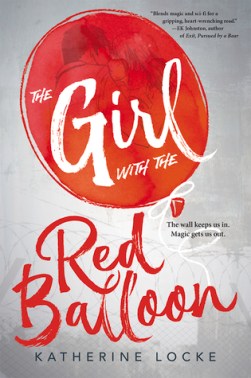
Today’s quote is from The Girl with the Red Balloon, set mostly in East Berlin. The Girl with the Red Balloon also happens to be “The Big Library Read” for October 1-15, too! The sequel, The Spy with the Red Balloon, just came out.

The Schöpfer workshop was underground through the subway tunnels. There were two entrances, but one was only for the Schöpfers who could use magic to hide themselves and bypass the guards. The only time we Runners used that entrance was to replace the helium tanks for the balloons, a magic written on our arms in our own blood to hide our comings and goings. The rest of the time, we went into the tunnels by one of the ghost stations beneath the death zone by the wall. The ghost stations used to work, I guess, before the wall and after the War, but now they were closed. The trains came by from West Berlin but didn’t stop. Couldn’t risk anyone wanting to leave.

Book Review: Summer Bird Blue

summer bird blueSummer Bird Blue
by Akemi Dawn Bowman
Queer YA
373 pages
Published September 2018

This is the second YA_Pride book club chat I’ve participated in – the last one was The Summer of Jordi Perez and the Best Burger in Los Angeles. (Which was great.) Summer Bird Blue was just as good, but where Jordi Perez was a lovely, lighthearted beach read, Summer Bird Blue is a tearjerker that you’ll want to read in private so you can sob the entire way through the book. Or at least that’s what I did.

Gorgeous and evocative are both words that could be applied here. Rumi’s grief over losing her sister is profound. She feels abandoned by her mother, sent to live with the aunt she barely knows in Hawaii. Rumi has absolutely lost everything – her sister/best friend is truly lost. She feels like she’s lost her mother, her home, any semblance of normality, and her musical ability. It’s a lot for a kid to deal with.

In the middle of all that, she’s trying to figure out her sexuality – she might be ace or demi; she spends most of the book questioning and trying to make sense of it. As we discussed in the Twitter chat, even if she doesn’t come to a conclusion on what her sexuality is, even having “questioning” as a sexuality is so important in YA books. Showing that you don’t need to have everything figured out is really important.

I loved Rumi’s relationships with the neighbors, both Kai and Mr. Watanabe. I wish Rumi had been nice to Mr. Watanabe in the beginning, but she comes around eventually. And she was dealing with A LOT, so I’ll give her a little slack. She was beginning to try my patience near the end of the book, though.

The one real disappointment I had with this book is that while Rumi is portrayed as this awesome musician whose lyrics and melodies are really good – the other characters say so – I don’t like her lyrics. Of course I have no way of knowing what her melodies sound like, but I just don’t think her lyrics are that good.

Other than that little quibble, this book is really, really good. But also really, really sad. Prepare to cry.

From the cover of Summer Bird Blue:

Rumi Seto spends a lot of time worrying she doesn’t have the answers to everything. What to eat, where to go, whom to love. But there is one thing she is absolutely sure of – she wants to spend the rest of her life writing music with her younger sister, Lea.

Then Lea dies in a car accident, and her mother sends Rumi away to live with her aunt in Hawaii while she deals with her own grief. Now thousands of miles from home, Rumi struggles to navigate the loss of her sister, being abandoned by her mother, and the absence of music from her life. With the help of the “boys next door” – a teenage surfer named Kai, who smiles too much and doesn’t take anything seriously, and an eighty-year-old named George Watanabe, who succumbed to his own grief years ago – Rumi attempts to find her way back to her music, to write the song she and Lea never had the chance to finish.

Aching, powerful, and unflinchingly honest, Summer Bird Blue explores big truths about insurmountable grief, unconditional love, and how to forgive even when it feels impossible.

Library Loot Wednesday

I got more books than I expected this week – went in to pick up three and there were six waiting for me! It turns out there should have been one more, so I sent my husband back to get it the next day, and he came home with another hold, but STILL not the one the system says is waiting for me, so I might have to go back in and ask the librarians what’s up with America For Beginners. My account says it’s waiting, but it’s apparently not on the shelf!


Like America for Beginners, A River of Stars and Number One Chinese Restaurant were on my Summer TBR list – I thought they’d release and make their way to me in time to read them this summer, but here it is October! If I’m dependent on library books, I may need to remember not to put New Releases on my seasonal TBR lists. Another “new” release that just got to me is Catwoman: Soulstealer. It’s the third in the DC Icons series, after Wonder Woman and Batman.


After hearing it recommended multiple times at the Baltimore Book Festival, I checked out Laini Taylor’s Daughter of Smoke and Bone. The other three books I checked out this week are Bob Woodward’s FEAR: Trump in the White House (which I know I won’t be able to renew, so it’s high up on my to-read list right now, and lord that cover is creepy), Carol Anderson’s One Person, No Vote: How Voter Suppression is Destroying Our Democracy, and Many Love: A Memoir of Polyamory and Finding Love(s) by Sophie Lucido Johnson. I now have quite a bit of heavy nonfiction out from the library that I need to sit down and read, so I may have to drop by the grocery store and get some crunchy snacks to help keep me awake!

Top Ten Tuesday – Longest Books I’ve Read

Top Ten Tuesday is hosted by That Artsy Reader Girl, and this week’s topic is the longest books I’ve ever read. I typically read books between 400 and 600 pages, so I tend towards the long end of the spectrum anyway, but when I start creeping towards 1000, that’s notable, even for me.

Knocking out 4 spots are books #2 through #5 of the Song of Ice and Fire. A Clash of Kings clocks in at 768 pages, A Feast For Crows is 753 pages, and A Storm of Swords is 973 pages, making it the third longest book I’ve ever read. The second longest book I’ve read is #5 in the series, A Dance with Dragons, clocking in 1056 pages!

The rest of these I’ll list in order of size. The longest book I’ve ever read – I think – is actually one long poetry book, Gooberz, by Linda Goodman, back when I was going through my astrology phase. It was 1081 pages! Inheritance by Christopher Paolini is the fourth-longest book I’ve read, at 849 pages. Power, Faith, and Fantasy by Michael B. Oren, on American’s involvement in the middle east, is 832 pages.

From here we drop back into the 700s, with Orcs by Stan Nicholls (769 pages), Harry Potter and the Deathly Hallows (759 pages), and Martha Stewart’s Homekeeping Handbook, at 752 pages.

I don’t think I’ve forgotten anything longer than these, but it is possible. There are several I’ve read in the lower 700s that only barely didn’t make the cut.

Update, after checking other people’s Top Tens: I should have included Patrick Rothfuss’s The Wise Man’s Fear! There also seems to be a lot of variance in actual page counts on some of these books. Harry Potter and the Order of the Phoenix seems to actually be longer than Deathly Hallows, by some counts. So that should have been on here too! Whoops.


Book Review: Educated

educated memoirEducated: a Memoir
by Tara Westover
Memoir
334 pages
Published 2018

I blurbed this on my Friday 56, but I actually read it a couple weeks ago. I had to take enough time to distance myself from the text before I could formulate my reaction into words. More than once, I had to set this book down and walk away because something hit me so hard I couldn’t continue. A phrase, a quote, or a chapter title would jump out and sucker-punch me.

Tara’s family was much more extremist than mine; though we were homeschooled until 8th grade (with public school after that), we had actual books and tests. Oregon actually has yearly required standardized tests for homeschoolers, so in that respect I was years ahead of Tara. (Though my science and history education were still very poor – I thought dinosaurs and humans existed at the same time until I was in my twenties.) We had birth certificates, and saw doctors regularly. We lived in town. But my family is conservative Christian, and learning that there are viewpoints outside that caused similar emotions to what Tara goes through. Educating myself out of bigotry, at the cost of a relationship with my family – THAT is what I have in common with this author.

Tara had a pretty horrific childhood. There were a lot of severe injuries among her family members that really should have been seen by a doctor, and never were. Her father’s bullheadedness (and undiagnosed bipolar disorder) probably led to several of the family’s injuries. Her father was more neglectful than abusive, though. It was one of Tara’s older brothers that was abusive.

Between her family, her isolation, her lack of education, and her poverty, Tara overcame so many issues to get into university. It’s really astounding. The pushback from her family is sadly unsurprising. What she’s done with her life is something to be proud of, not ashamed of.

And what I really mean by that is that I’m proud of my life and my beliefs, even if my family doesn’t understand them or me.

There are so many parts of this book that speak directly to me, from quotes like

Their voices were forceful, emphatic, absolute. It had never occurred to me that my voice might be as strong as theirs.

to the part where she devours the classic books of feminism in grad school because until that point, feminism had always been a bad thing. I’ve done that. I grew up on Rush Limbaugh yelling about feminazis. To realize that was wrong, and read the books of the first and second wave, is an awakening I know all too intimately.

I checked this book out from the library, but I’m going to buy my own copy. This is a book I need to keep around to remind me that I’m not alone in this journey – someone else has been through it too.

From the cover of Educated:

Tara Westover was seventeen the first time she set foot in a classroom. Born to survivalists in the mountains of Idaho, she prepared for the end of the world by stockpiling home-canned peaches and sleeping with her “head for the hills” bag. In the summer she stewed herbs for her mother, a midwife and healer, and in the winter she salvaged metal in her father’s junkyard.

Her father distrusted the medical establishment, so Tara never saw a doctor or nurse. Gashes and concussions, even burns from explosions, were all treated at home with herbalism. The family was so isolated from mainstream society that there was no one to ensure the children received an education, and no one to intervene when an older brother became violent.

When another brother got himself into college and came back with news of the world beyond the mountain, Tara decided to try a new kind of life. She taught herself enough mathematics, grammar, and science to take the ACT and was admitted to Brigham Young University. There, she studied psychology, politics, philosophy, and history, learning for the first time about pivotal world events like the Holocaust and the Civil Rights Movement. Her quest for knowledge transformed her, taking her over oceans and across continents, to Harvard and to Cambridge University. Only then would she wonder if she’d traveled too far, if there was still a way home.

Educated is an account of the struggle for self-invention. It is a tale of fierce family loyalty, and of the grief that comes from severing ties with those closest to you. With the acute insight that distinguishes all great writers, Westover has crafted a universal coming-of-age story that gets to the heart of what an education is and what it offers: the perspective to see one’s life through new eyes, and the will to change it.
Sunday Night Thoughts

So it’s Sunday evening, and I’m sitting here looking at No Is Not Enough and Bob Woodward’s Fear and One Person, No Vote, and Swastika Night – and reading Catwoman: Soulstealer and Rain: A Natural and Cultural History and Many Love instead. Sometimes it’s about self-care and taking a break. My review of Educated is going live in the morning, and that book took a lot out of me. The last week, the last month, the last two years have taken a lot out of me. The things keeping me going are A) my friends, B) books about rebelling and overthrowing governments (and I’ve been reading A LOT of those!), and C) honestly, this blog. For so many reasons.

It’s partly for me – my memory is NOT what it used to be, (thanks, thyroid!) and keeping this blog reminds me of what I’ve read, what I liked and didn’t like. And it’s partly seeing you reading and liking and commenting. For an introverted homebody like me, knowing people actually LIKE what I have to say is a tremendous ego boost. (The number of times I’ve turned to my husband in surprise and said “People like reading my shit!!” is kind of hilarious.)

Aaaaaaaand I’ve now had to oversee a Facebook comment thread on Kavanaugh that turned into a direct IM with the friend who just. wasn’t. getting it. And I am off for the night.