Book Review: What If It’s Us

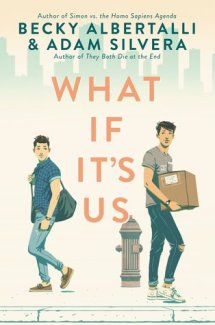
what if it's usWhat If It’s Us
by Becky Albertalli and Adam Silvera
Young Adult Gay Romance
437 pages
Published October 2018

This was a super cute gay romance that I read for YA_Pride’s Twitter Book Club. The authors have separately written some pretty popular YA books; Simon vs. the Homo Sapiens Agenda (Albertalli) and They Both Die at the End (Silvera), neither of which I have read yet, so I had no idea what to expect with this one!

The book alternates viewpoints between Arthur, a Georgia boy in New York for the summer who recently came out as gay but has not yet gone out on a date with anyone, and Ben, who recently broke up with the boy he lost his virginity with. The difference in experience between the two is a plot point, as is the temporary nature of Arthur’s visit to New York.

There is SO MUCH in this book. These are complex characters, and the romance between the two is simply the frame that the rest of the book revolves around. Arthur is still coming to terms with what being out means for him; he thinks his friends are being weird about it, his parents are fighting all the time, he’s never dated and doesn’t really know how to go about doing so. Ben is recovering from heartbreak with his first boyfriend. He’s Puerto Rican but can pass for white, so people forget and think he’s white, and that upsets him. His break up, and his best friend’s, has splintered up their friend group and he misses the group, and his best friend seems to have moved on and doesn’t have time for him anymore. He’s in summer school, with his ex, and is struggling to pass so he can continue to his senior year of high school, while Arthur is an amazing student who’s probably getting into Yale. All of this is set against the glittering backdrop of New York, seen as wondrous and new through Arthur’s eyes and boring and old through Ben’s. There’s just SO MUCH going on.

I did have to double-check a few times who was narrating the chapter I was reading, but Twitter said the audio book actually has separate narrators for Arthur and Ben. So if you like audiobooks, that might be the better way to go for this book.

I loved that this book didn’t just explore the romance between the two boys, but the friendships they had with each other and the people around them. More than a romance, I think this is a book about building your own family. People who will be there for you whether you’re dating them or not.

Twitter also mentioned that the book could be disappointing if you were reading it for either of the author’s signature styles. No one dies, and it’s not completely happy fluff. So definitely set aside any expectations based on their previous books. I hadn’t read them, so I enjoyed it for itself.

The next YA_Pride book club pick is This Is Kind Of An Epic Love Story, and we’ll be talking about it on Twitter at 8pm Eastern Time on Thursday, November 29th, using the hashtag #YAPrideBookClub. Join us!

From the cover of What If It’s Us:

ARTHUR
is only in New York for the summer, but if Broadway has taught him anything, it’s that the universe can deliver a showstopping romance when you least expect it.

BEN
thinks the universe needs to mind its business. If the universe had his back, he wouldn’t be on his way to the post office carrying a box of his ex-boyfriend’s things.

But when Arthur and Ben meet-cute at the post office, what exactly does the universe have in store for them?

Maybe nothing. After all, they get separated.

Maybe everything. After all, they get reunited.

But what if they can’t quite nail a first date . . . or a second first date . . . or a third?

What if Arthur tries too hard to make it work . . . and Ben doesn’t try hard enough?

What if life really isn’t like a Broadway show?

But what if it is?

Best friends Becky Albertalli and Adam Silvera combine their talents in this smart, funny, and heartfelt collaboration about two very different boys who can’t decide if the universe is pushing them together – or pulling them apart.

Book Review: Like Water

like waterLike Water
by Rebecca Podos
YA LGBT Romance
312 pages
Published 2017

I’m always interested in queer young adult books, and this one especially caught my eye with its mention of “performing mermaids.” Because y’all know I love my mermaid books! So Savannah isn’t a real mermaid, she just plays one at a water park. But it was enough to make me pick up the book, and it’s a good book. Young adult books about discovering your identity are always needed, and this book is about Savannah realizing she’s bisexual.

Much of the angst in this book comes from Savannah not knowing if she has the same disease her father does, and she’s not sure if she wants to know. Altogether, in this book we have chronic illness, hispanic teens, bisexual, lesbian, and genderqueer teens, small-town angst….there’s really a LOT of demographics covered in this book.

I like Savannah, but I don’t like her love interest, Leigh, very much. Leigh does NOT have her shit together, and between drinking and doing drugs, all while underage, she poses a very real threat to Savannah’s well-being.

I’m a little nonplussed by the ending of the book. It leaves a few questions unanswered, but not in a cliff-hanger-y way. It’s more of a possibilities-left-open kind of way. Which makes sense for a “first love” romance. It’s not necessarily a “true love” story. It reminds me of John Green novels in that way.

So – it’s a great book for representation, but don’t expect a tidy, wrapped-up ending. You won’t find that here.

From the cover of Like Water:

In Savannah Espinoza’s small New Mexico hometown, kids either flee after graduation or they’re trapped there forever. Vanni never planned to get stuck – but that was before her father was diagnosed with Huntington’s disease, leaving her and her mother to care for him. Now she doesn’t have much of a plan at all: living at home, working as a performing mermaid at a second-rate water park, distracting herself with one boy after another.

That changes the day she meets Leigh. Disillusioned with small-town life and looking for something greater, Leigh is not a “nice girl.” She is unlike anyone Vanni has met, and a friend when Vanni desperately needs one. Soon enough, Leigh is much more than a friend. But caring about another person threatens the walls Vanni has carefully constructed to protect herself and brings up the big questions she’s hidden from for so long.

With her signature stunning writing, Rebecca Podos, author of The Mystery of Hollow Places, has crafted an unforgettable story of two girls navigating the unknowable waters of identity, millennial anxiety, and first love.

Book Review: Catwoman – Soulstealer

catwoman soulstealerCatwoman: Soulstealer (DC Icons #3)
by Sarah J. Maas
Young Adult – Superheroes
358 pages
Published August 2018

So I needed a “book about a heist” for the PopSugar 2018 Reading Challenge, and naturally, Catwoman fits the bill. It wouldn’t be a Catwoman novel/cartoon/graphic novel without a heist! Several, in fact, in this instance. And she teams up with Poison Ivy and Harley Quinn to pull them off, even though she doesn’t seem to actually need the girls in this book. I love that Maas chose to include them, because Ivy/Harley/Catwoman is one of my all-time favorite team-ups. The book also delves into the relationship between Ivy and Harley, and Harley’s dysfunctional dependence on the Joker (who’s in Arkham for this book). I loved seeing that.

Interestingly, Batman doesn’t show, other than a few phone calls with Luke Fox, Lucius Fox’s son. Luke takes the traditional role of Batman-as-Catwoman’s-love-interest, but as Batwing, a sort-of Robin. (Maybe I read too many comics? Nah.) The switch was surprising; it’s always Catwoman and Batman, Selina and Bruce. Except when it’s Talia and Bruce, I suppose.

I do wonder if they’re going to do an ensemble cast novel after these first four books. (Wonder Woman: Warbringer, Batman: Nightwalker, and Superman: Dawnbreaker being the other three.) Superman doesn’t come out until January, but the first three have been very disconnected from one another. Wonder Woman wasn’t even mentioned in Batman or Catwoman. It seems odd to have them as a series, but never mention one another in each book? That, or the Superman book is going to tie the other three together, which seems like a disservice to Superman.

Anyway. I really liked Luke Fox as Batwing – the book touched, just a little bit, on racial issues, and how even as an obscenely rich black man he’s not entirely exempt from those. In one scene he worries about the color of his skin being seen through damage to his batsuit, and cops realizing he’s black. It’s a sober reminder that even in a city beset by evil clowns, it’s still set in the United States and we still have those racist systems in place.

The banter between Luke and Selina, and Selina and Harley and Ivy, is fantastic. I haven’t actually read any of Sarah J. Maas’ books – I know, I know – but if they’re like Catwoman, I should probably give in and do so. So far, Wonder Woman is still my favorite of the DC Icons series (which is no surprise, as I love Leigh Bardugo) but Catwoman is really good.

From the cover of Catwoman: Soulstealer:

SELINA KYLE IS A THIEF.
Two years after escaping Gotham city’s slums, Selina Kyle returns as the mysterious and wealthy Holly Vanderhees. She quickly discovers that with Batman away on a vital mission, Gotham City looks ripe for the taking.

LUKE FOX IS A HERO.
Luke wants to prove that as Batwing he has what it takes to help people. He targets a new thief on the prowl who has teamed up with Poison Ivy and Harley Quinn. Together, they are wreaking havoc. This Catwoman is clever – she may be Batwing’s undoing.

IN GOTHAM CITY, NOT EVERYONE IS WHAT THEY SEEM.
Selina is playing a desperate game of cat and mouse, forming unexpected friendships and entangling herself with Batwing by night and her devilishly handsome neighbor Luke Fox by day. But with a dangerous threat from the past on her tail, will she be able to pull off the heist that’s closest to her heart?

Book Review: Heart of Thorns

heart of thornsHeart of Thorns
by Bree Barton
Fantasy
438 pages
Published July 2018

I almost bailed on this book. It’s not bad, exactly, it’s just – mediocre. Mia discovers that she is the thing she’s been taught to hate, discovers that maybe they’re not all bad, that what she’s been taught is probably wrong, but, y’know, maybe not entirely wrong – it’s just one trope after another. It was rather predictable.

And there’s this problem with the world. If every woman is suspected of being a witch, (sorry, Gwyrach) and they work their magic through touch – how is anyone having kids? Sure, women are required to wear gloves in public, but – the touch-magic doesn’t keep men from abusing women. Not like in The Power, where men start getting actually scared to touch women for fear of what could happen.

The only character in this book that I actually LIKED was Prince Quin. And maybe Dom, the flirtatious gay boy. Mia was rather thoroughly unlikable. First she blindly accepts that she should hate and kill Gwyrach, then is appalled to find out she (and her mother) are/were Gwyrach, and refuses to accept that because of course she can’t possibly be one of those reviled women. She refuses to take Quin into her confidence, despite him showing blind trust in her for most of the book. What does he have to do to prove himself to you, woman?

I’ve read much better feminist dystopias. This is oppressed-women-finding-their-hidden-powers-and-fighting-back clothed in a fantasy instead of a dystopia, and it’s not nearly as good as it could be. Despite ending on a cliffhanger, I don’t care enough about these characters to read the next book.

From the cover of Heart of Thorns:

Mia Rose wants only one thing: revenge against the Gwyrach who killed her mother.

In a world where only women can possess magic – and every woman is suspected of having it – the half-girl, half-god Gwyrach are feared, reviled, and hunted. After training under her father and his infamous Hunters, Mia is determined to scour the four kingdoms and enact the Hunters’ Creed: Heart for a heart, life for a life.

But then her father announces a quite different future: She will marry Prince Quin, heir to the throne. Just like that, smart, headstrong Mia is thrust into the last role she ever wanted: pretty, wifely bauble to the future king.

So on the eve of her wedding, Mia plots a daring escape, only to discover the unimaginable: She has magic. She may be a Huntress, but she’s also a Gwyrach.

As the truth comes to light, Mia must untangle the secrets of her own past. Friends darken into foes and logic begins to fray – as do the rules she has always played by. If Mia wants to survive, she must learn to trust her heart . . . even if it kills her.

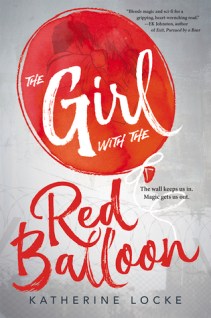
Book Review: The Girl with the Red Balloon

girl with the red balloonThe Girl with the Red Balloon
by Katherine Locke
Young Adult/Magical Realism/Alternate History
277 pages
Published 2017

I’ve actually had this out from the library for a while, but when discussing Summer Bird Blue with the YA_Pride Twitter Book Club, I learned the person behind the book club is none other than Katherine Locke, the author of this book! I was amused that I actually had her book beside me without knowing that, and pushed it up my TBR list. I’m glad I did, because the sequel, The Spy with the Red Balloon, just came out. And oh man, do I want to read that now! The Girl with the Red Balloon is also “The Big Library Read” for October 1-15th, which I didn’t realize. Happy little coincidences!

So the premise for this book is that Ellie Baum, Jewish schoolgirl on a trip to Germany, grabs a magic balloon and is transported back to East Berlin after WW II. I’m always a little cautious when time travel is involved. This is quite well done, however! Even the magicians are like “this shouldn’t be possible!” As a Jewish girl in possession of a magic balloon used to take escapees over the Berlin Wall, she’s immediately in great danger in East Berlin. Luckily she is spotted by one of the people responsible for the balloons. Somewhat unluckily, she’s soon drawn into a deadly plot to rewrite history and has to figure out who to trust.

I really enjoyed this book, especially the depictions of the wall. The East Berliners’ surprise when she tells them the other side is covered in graffiti and street art is not something I’d thought of. I’ve seen a section of the wall; there’s three at the Marine Corps base in California that my husband was stationed at early in his time in the Corps. There are pictures online, but after sifting through old photos, I don’t seem to have any of my own. (You could google “Berlin Wall Presidio Monterey” and find a ton.) I think I remember a no-photo policy on the base at the time. Regardless, I know what she means because I’ve seen it. Ever since actually seeing parts of the Berlin Wall, reading anything about it has felt just a little more real. That’s always the problem with things like the Wall that you have no personal connection to – obviously they’re real, but when the circumstances are so alien to our own way of life, it’s hard to really comprehend. Finding ways to personally connect – seeing parts of the Wall, talking to people who have personally experienced things you haven’t (if you have the opportunity, and if they’re willing to discuss it) is so important.

I have digressed. I’m curious to know more about the magic in the Balloonmakers’ world – in the book we only see a small slice of it being used under dire circumstances. I hope Locke explores it more in the sequel. I’ll find out as soon as the library sends the book my way! Plots like this can be interesting or very disappointing – if the main character finds a way home, she leaves behind the love interest. But if she stays with the love interest, she never gets to go home. Luckily, Locke is a wonderful writer, and I was mostly happy with the ending but it was definitely left with questions for the sequel to answer!

I know I haven’t revealed a whole lot about the plot, but this is a twisty book, and I can’t really say much without spoiling surprises. I’ll just say it’s a great book, I’m very glad I finally read it, and my library needs to hurry up with that sequel!

From the cover of The Girl with the Red Balloon:

This can’t be real, I thought. But I had the same feeling I had whenever Saba told me his stories: that somewhere, somehow, the impossible had happened. 

Ever since she arrived in Germany on a school trip, Ellie Baum has felt the weight of history on her. After all, she’s the first one in her family to return since her grandfather’s miraculous escape from a death camp, and in Berlin, pieces of the past – World War II, the Cold War – are still visible decades later.

One day, visiting the Berlin Wall Memorial, she sees a stray balloon floating across the park, and she wanders away from the crowd to follow it. One moment she’s reaching out to grab it – the next, she’s yanked back through time to when the wall is still standing. It is 1988, and Ellie is in East Berlin. 

Nobody knows how she got there, not even the members of the underground guild – the Runners and the Schöpfers – who use balloons and magic to help people escape over the wall. Now as a stranger in an oppressive regime, Ellie must hide from the police with the help of Kai, a Runner struggling with his own uneasy relationship with the powerful Balloonmakers and his growing feelings for Ellie. Together they search for the truth behind Ellie’s mysterious time travel, and when they uncover a plot to alter history with dark magic, she must risk everything – including her only way home – to stop the deadly plans.


Book Review: Summer Bird Blue

summer bird blueSummer Bird Blue
by Akemi Dawn Bowman
Queer YA
373 pages
Published September 2018

This is the second YA_Pride book club chat I’ve participated in – the last one was The Summer of Jordi Perez and the Best Burger in Los Angeles. (Which was great.) Summer Bird Blue was just as good, but where Jordi Perez was a lovely, lighthearted beach read, Summer Bird Blue is a tearjerker that you’ll want to read in private so you can sob the entire way through the book. Or at least that’s what I did.

Gorgeous and evocative are both words that could be applied here. Rumi’s grief over losing her sister is profound. She feels abandoned by her mother, sent to live with the aunt she barely knows in Hawaii. Rumi has absolutely lost everything – her sister/best friend is truly lost. She feels like she’s lost her mother, her home, any semblance of normality, and her musical ability. It’s a lot for a kid to deal with.

In the middle of all that, she’s trying to figure out her sexuality – she might be ace or demi; she spends most of the book questioning and trying to make sense of it. As we discussed in the Twitter chat, even if she doesn’t come to a conclusion on what her sexuality is, even having “questioning” as a sexuality is so important in YA books. Showing that you don’t need to have everything figured out is really important.

I loved Rumi’s relationships with the neighbors, both Kai and Mr. Watanabe. I wish Rumi had been nice to Mr. Watanabe in the beginning, but she comes around eventually. And she was dealing with A LOT, so I’ll give her a little slack. She was beginning to try my patience near the end of the book, though.

The one real disappointment I had with this book is that while Rumi is portrayed as this awesome musician whose lyrics and melodies are really good – the other characters say so – I don’t like her lyrics. Of course I have no way of knowing what her melodies sound like, but I just don’t think her lyrics are that good.

Other than that little quibble, this book is really, really good. But also really, really sad. Prepare to cry.

From the cover of Summer Bird Blue:

Rumi Seto spends a lot of time worrying she doesn’t have the answers to everything. What to eat, where to go, whom to love. But there is one thing she is absolutely sure of – she wants to spend the rest of her life writing music with her younger sister, Lea.

Then Lea dies in a car accident, and her mother sends Rumi away to live with her aunt in Hawaii while she deals with her own grief. Now thousands of miles from home, Rumi struggles to navigate the loss of her sister, being abandoned by her mother, and the absence of music from her life. With the help of the “boys next door” – a teenage surfer named Kai, who smiles too much and doesn’t take anything seriously, and an eighty-year-old named George Watanabe, who succumbed to his own grief years ago – Rumi attempts to find her way back to her music, to write the song she and Lea never had the chance to finish.

Aching, powerful, and unflinchingly honest, Summer Bird Blue explores big truths about insurmountable grief, unconditional love, and how to forgive even when it feels impossible.