Book Review: Rebel of the Sands

rebel of the sands

Rebel of the Sands
by Alwyn Hamilton
YA Fantasy
314 pages
Published 2016

More Middle-eastern themed fantasy! And by a Canadian writer, though she was only born there, she mostly grew up in France, so I’m not really sure it counts for my Read Canadian Challenge. But it is one I’ve been wanting to read for a while, and when I was at Barnes & Noble for Book Club, I noticed it on the bargain shelf, so I snagged it, along with another YA fantasy based on Norse Mythology called Valkyrie. There’s two more books in the series now, Traitor to the Thone and Hero at the Fall, so I’ve requested those from the library because I really enjoy this world!

Amani is a girl in a country that doesn’t value women, and treats them as useless property only good for breeding sons. The country is basically occupied by another country that the Sultan is “allied” with, but lets run roughshod over his people. She has her sights set on escaping her backwoods, dead-end town, and running to the capital city, where the aunt she’s never met lives. All of that is derailed when she meets Jin at an underground shooting competition, and then later hides him from the armed forces hunting him.

The country is definitely middle-east inspired, but there’s a lot of religion-bashing, and complaining about the culture oppressing women. It’s the same problem I have with a lot of knight-and-castle era fantasy – just because historically in OUR world those time periods weren’t kind to women, doesn’t mean they have to be the same in fantasy. It’s FANTASY! It can be anything you want! Break the tropes! It’s a fine line to walk, taking the good parts of a culture without just cherry-picking and appropriating the culture, and who’s judging what the good and bad parts are, anyway? So I understand it’s difficult, but bashing the culture in a book inspired by their mythology is not quite cool, either. I feel like City of Brass hit a nice middle ground of embracing the culture of the inspiration without bashing parts of it.

That gripe aside, I really enjoyed the world-building. I’m not quite sold on the characters yet – Amani is far too quick to abandon things she should fight for – but I’m interested enough to see how they progress in the next two books.

Rebel of the Sands was also a past Goodreads Choice winner, filling that prompt of the PopSugar 2018 reading challenge.

From the cover of Rebel of the Sands:

Mortals rule the desert nation of Miraji, but mythical beasts still roam the wild and remote areas, and rumor has it that somewhere, djinn still perform their magic. For humans, it’s an unforgiving place, especially if you’re poor, orphaned, or female. Amani Al’Hiza is all three. She’s a gifted gunslinger with perfect aim, but she can’t shoot her way out of Dustwalk, the back-country town where she’s destined to wind up wed or dead.

Then she meets Jin, a rakish foreigner, in a shooting contest, and sees him as the perfect escape route. But though she’s spent years dreaming of leaving Dustwalk, she never imagined she’d gallop away on mythical horse—or that it would take a foreign fugitive to show her the heart of the desert she thought she knew.

This startlingly original Middle-East-meets-Wild-West fantasy reveals what happens when a dream deferred explodes—in the fires of rebellion, of romantic passion, and the all-consuming inferno of a girl finally embracing her power.

Book Review: The Merry Spinster

the merry spinsterThe Merry Spinster – Tales of Everyday Horror
by Daniel Mallory Ortberg
Fairy Tale Short Story Anthology
188 pages
Published March 2018

So this JUST came out. I’d had my eye on it for a few months, and put a request in as soon as my library ordered it. The author recently came out as trans, so it’s also part of my effort to read more inclusively. Ortberg definitely played with gender and sexuality in several of these tales; in one of them people decided whether to be the husband or the wife, independent of their gender, in their marriage. (One party to the marriage in the story stated “I’ve been trained for both roles.”) In another all of a man’s daughters used male pronouns and that was never explored further. That was slightly odd.

These were dark, twisted versions of these stories. “Our Friend Mr. Toad,” for example, involved gaslighting and psychologically torturing poor Mr. Toad. I found that one particularly disturbing. I enjoyed the title story, Ortberg’s version of Beauty and the Beast, which has a very different ending from expected. I also really liked “The Daughter Cells”, inspired by The Little Mermaid. I LOVED “Fear Not: An Incident Log.”

I think this was a great, albeit strange, little book. It’s unique, for sure, and a quick read. If you’re looking for a fairy tale collection that is VERY different, try this one.

From the cover of The Merry Spinster:

From Mallory Ortberg comes a collection of darkly mischievous stories based on classic fairy tales. Adapted from the beloved “Children’s Stories Made Horrific” series, “The Merry Spinster” takes up the trademark wit that endeared Ortberg to readers of both The Toast and the best-selling debut Texts From Jane Eyre. The feature has become among the most popular on the site, with each entry bringing in tens of thousands of views, as the stories proved a perfect vehicle for Ortberg’s eye for deconstruction and destabilization. Sinister and inviting, familiar and alien all at the same time, The Merry Spinster updates traditional children’s stories and fairy tales with elements of psychological horror, emotional clarity, and a keen sense of feminist mischief.

Readers of The Toast will instantly recognize Ortberg’s boisterous good humor and uber-nerd swagger: those new to Ortberg’s oeuvre will delight in this collection’s unique spin on fiction, where something a bit mischievous and unsettling is always at work just beneath the surface.

Unfalteringly faithful to its beloved source material, The Merry Spinster also illuminates the unsuspected, and frequently, alarming emotional complexities at play in the stories we tell ourselves, and each other, as we tuck ourselves in for the night.

Bed time will never be the same.

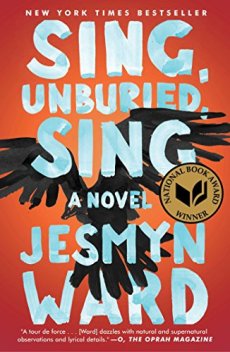
Book Review: Sing, Unburied, Sing

sing unburied singSing, Unburied, Sing
by Jesmyn Ward
Contemporary Fiction (Magical Realism?)
290 pages
Published September 2017

I know, I’m late to the party. This book made a big splash back in September – everyone was talking about it, and it won the National Book Award. My library, however, did not have enough copies to go around, and I was late putting a hold on it, so the hold I put on it in January finally came around to my turn!

In Sing, Unburied, Sing, Jesmyn Ward returns to the same neighborhood in Mississippi that Salvage the Bones was written about. (Two of the siblings from Salvage the Bones show up in a scene in Sing.) The story is told from three different viewpoints: Jojo, a thirteen-year-old boy and the main character of the novel, Leonie, his drug-addicted mother, and Richie, the ghost of a boy Jojo’s grandfather met in prison.

This book covers so much that it’s difficult to categorize – between discrimination and outright bigotry, bi-racial romance and children, drug addiction, poverty, prison life – deep south gothic, I suppose, would be the best description. Sing really only takes place over a couple of days, but it feels much longer, because Jojo’s grandfather tells stories of his time in prison decades prior, Leonie reminisces about high school, and there’s just this sense of timelessness over the entire novel.

It’s not an easy book. These are hard issues to grapple with, and too many people have to live with these issues. Poverty, bigotry, addiction – these things disproportionately affect the black community, and white people are to blame for the imbalance.

I’m not sure how I feel about the ghost aspect of the book; on one hand I feel like people will see the ghost and decide the book is fantasy – that they don’t really need to care about the problems the family faces. On the other hand, the ghost allows us to see even more bigotry and inhumanity targeted at black people. So it serves a purpose.

I’m not sure I like this book. But I’m glad I read it. And that’s pretty much going to be my recommendation; it’s not a fun read, but it’s an important one.

From the cover of Sing, Unburied, Sing

In Jesmyn Ward’s first novel since her National Book Award–winning Salvage the Bones, this singular American writer brings the archetypal road novel into rural twenty-first-century America. An intimate portrait of a family and an epic tale of hope and struggle, Sing, Unburied, Sing journeys through Mississippi’s past and present, examining the ugly truths at the heart of the American story and the power—and limitations—of family bonds.

Jojo is thirteen years old and trying to understand what it means to be a man. He doesn’t lack in fathers to study, chief among them his Black grandfather, Pop. But there are other men who complicate his understanding: his absent White father, Michael, who is being released from prison; his absent White grandfather, Big Joseph, who won’t acknowledge his existence; and the memories of his dead uncle, Given, who died as a teenager.

His mother, Leonie, is an inconsistent presence in his and his toddler sister’s lives. She is an imperfect mother in constant conflict with herself and those around her. She is Black and her children’s father is White. She wants to be a better mother but can’t put her children above her own needs, especially her drug use. Simultaneously tormented and comforted by visions of her dead brother, which only come to her when she’s high, Leonie is embattled in ways that reflect the brutal reality of her circumstances.

When the children’s father is released from prison, Leonie packs her kids and a friend into her car and drives north to the heart of Mississippi and Parchman Farm, the State Penitentiary. At Parchman, there is another thirteen-year-old boy, the ghost of a dead inmate who carries all of the ugly history of the South with him in his wandering. He too has something to teach Jojo about fathers and sons, about legacies, about violence, about love.

Rich with Ward’s distinctive, lyrical language, Sing, Unburied, Sing is a majestic new work and an unforgettable family story.

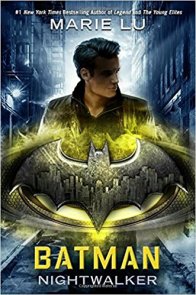
Book Review: Batman – Nightwalker

batman nightwalkerBatman: Nightwalker
by Marie Lu
Superheroes
250 pages
Published January 2018

So I didn’t actually realize, back when I reviewed Wonder Woman: Warbringer, that it was the start of a series of origin novels. The second is this one, about Batman, and the next is Catwoman: Soulstealer. (I can’t wait for that one, Wonder Woman, Hawkgirl, and Catwoman have been my three favorite superheroes for ages, even if Catwoman isn’t exactly a hero!) After Catwoman’s book, we get Superman’s book, and that’s all that’s been announced, so I don’t know if there will be any more. Though I hope there will be, because these first two have been excellent!

The name Batman is never actually mentioned in this book; he is Bruce Wayne the entire way through. He does get a suit, towards the end, and starts his career as Batman without really realizing he’s doing so. We get a few nods to the Batman mythos – he stops to watch a swarm of bats heading out to hunt, and he mentions the broken grandfather clock that he hasn’t fixed yet. But this is a Bruce around his high school graduation, just starting to learn about the kinds of tech that Wayne Tech produces. We do meet a few familiar faces beyond Alfred.

I had a few moments where I wanted to shake both Bruce and the adults around him because NO ONE IN THEIR RIGHT MIND WOULD DO THAT and if it needed to happen for plot’s sake make it more believable! But it was overall pretty good.

There’s no need to read this in order, from what I can tell – events in Wonder Woman have no effect on Gotham. Though the Catwoman book is also set in Gotham, so it will be interesting to see if they intertwine at all.

If you like DC Comics, these are definitely worth reading – if you don’t, skip them.

From the cover of Batman: Nightwalker:

Before he was Batman, he was Bruce Wayne. A reckless boy willing to break the rules for a girl who may be his worst enemy.

The Nightwalkers are terrorizing Gotham City, and Bruce Wayne is next on their list.
The city’s elites are being taken out one by one as their mansions’ security systems turn against them, trapping them like prey. Meanwhile, Bruce is about to become eighteen and inherit his family’s fortune, not to mention the keys to Wayne Industries and all the tech gadgetry that he loves. But on the way home from his birthday party, he makes an impulsive choice and is sentenced to community service at Arkham Asylum, the infamous prison that holds the city’s most nefarious criminals.

Madeleine Wallace is a brilliant killer . . . and Bruce’s only hope.
The most intriguing inmate in Arkham is Madeleine, a brilliant girl with ties to the Nightwalkers. A girl who will only speak to Bruce. She is the mystery he must unravel, but is he convincing her to divulge her secrets, or is he feeding her the information she needs to bring Gotham City to its knees?

In this second DC Icons book–following Leigh Bardugo’s Wonder Woman: Warbringer–Bruce Wayne is proof that you don’t need superpowers to be a super hero, but can he survive this game of tense intrigue, pulse-pounding action, and masterful deception?

Book Review: Star Wars: Ahsoka

ahsoka tanoStar Wars: Ahsoka
by E. K. Johnston
Space Fantasy (Star Wars)
356 pages
Published 2016

I’ve been wanting to read this novel for a long time, as Ahsoka Tano is my favorite character from the Clone Wars cartoon, and second-favorite in the entire Star Wars series. (Because General Leia exists.) I picked the book up at a used book store in Oregon when we went home from the holidays, but I’ve just had so many other things to read. I finally read it for May 4th, Star Wars Day.

I didn’t like it as much as I wanted to. I’ve read another book by Johnston, That Inevitable Victorian Thing, which I enjoyed but thought was too fluffy. And comparing this to the last Star Wars book I read – Phasma – this tilts that way too. It’s not as fluffy as TIVT – people die, and the Empire is the ever-looming possible doom that it always is – but it just didn’t feel as gritty as Phasma did. Perhaps it shouldn’t; Phasma is a villain, and her backstory is suitably dark. And Ahsoka, here, is floundering a little in the wake of Order 66, and being alive when none of her compatriots, to her knowledge, are.

I did enjoy learning how she got her lightsabers back, and the story should lead well into the Rebels cartoon, which I have yet to watch.

So I don’t know. It was an entertaining book, and it was effective at furthering Ahsoka’s story, it just…wasn’t quite what I wanted.

The book does, however, fit the Popsugar 2018 prompt of “Takes place on another planet.”

From the cover of Star Wars: Ahsoka:

She thought her war was over, but a new battle is just beginning…

Ahsoka Tano, once a loyal Jedi apprentice to Anakin Skywalker, planned to spend her life serving the Jedi Order. But after a heartbreaking betrayal, she turned her back on the Order to forge her own path, knowing Anakin and the other Jedi would still be there for her should she ever need them.

Then the Emperor took over the galaxy and the Jedi were ruthlessly murdered. Burdened with grief and guilt, Ahsoka is now truly on her own, unsure she can be part of something larger ever again. She takes refuge on the remote farming moon Raada, where she befriends a young woman named Kaedan and begins to carve out a life for herself. But Ahsoka cannot escape her past or the reach of the Empire. When Imperial forces occupy Raada, she must decide whether to become involved – even if it means exposing her Jedi past. Her choices will have devastating effects for those around her . . . and lead her to a new hope for the galaxy.


Book Review: The Female Persuasion

the female persuasionThe Female Persuasion
by Meg Wolitzer
Contemporary Fiction
454 pages
Published April 2018

So this book came to my attention through an ad on Facebook for Barnes & Noble’s first official book club meeting. I tossed around the idea of going – I haven’t had good experiences with book clubs (nor bad ones, just – ambivalent experiences) – but we wound up at a Barnes & Noble on Sunday, because we were bored, so I decided to snag the book and read it. And then I went to Book Club on Wednesday! We had a small turnout at my Barnes & Noble – only four of us, including the employee leading the discussion. But after seeing a couple photos of larger turnouts, I’m glad for it – I wasn’t afraid to speak up in the small group. I’m a pretty shy introvert, a bigger group would have led to me being pretty quiet.

I feel like I was more intrigued by our book club members than the book! S., who led the group, was a natural at it, and really got us talking. I.R. opened the meeting with “I want you guys to change my mind about this book” but wouldn’t tell us her original opinion of it! And T, who was the oldest of us, brought a completely different viewpoint to the discussion, which was invaluable. (I’m pretty sure IR and S, like me, are millennials.) At the end of the discussion, T revealed she has a Ph.D. in Sociology, specialized in Gender and Sexuality, and she’s writing a book! We all agreed we wish the Book Club was monthly instead of quarterly, so S. is going to talk to her bosses and see if we can’t do a monthly book club at our location, which would be AWESOME. She also said Barnes & Noble was hiring and encouraged us to apply, and – not gonna lie – that was tempting. It’s a bus ride and a short walk away, though, and while my health and energy levels are improving drastically, I’m not sure they’re quite up to holding down a job yet. Not and get anything done around the house.

Anyway. On to the book! The Female Persuasion was billed as a feminist novel, and in some ways it is, but we all agreed it’s not REALLY about feminism. The main character, Greer, works for a feminist foundation, but you could have changed what the foundation’s purpose was, or made her work for a corporation, and the essence of the book would have been exactly the same. It was only tangentially about feminism. It was about women supporting each other, though, and the mentor relationship between an older woman and a younger woman, so in some ways, yes. If I was asked to make a list of books about feminism, though, it certainly wouldn’t make the cut.

All of the characters have some major flaws. Greer is selfish, and doesn’t understand when things don’t go according to plan. Cory’s life gets entirely derailed by a tragedy he couldn’t prevent, but in some ways he lets the derailment happen. If he’d really wanted what he said he wanted (and perhaps he didn’t) he could have fixed his trajectory. Zee is a little brash and headstrong, but the most likable character in the book. Faith – oh, Faith. Faith is the older feminist mentor who turns out to be far more jaded than expected.

I have lots of conflicts about Faith. She is one of those feminists who doesn’t seem to care for individual women – she can’t even remember most of the women who credit her with changing their lives – but she keeps her eyes on the big picture. And as I brought up in book club, the movement does need people who see the big picture. Those people are important – but they still need certain principles that I think Faith lacks.

IR mentioned that Cory was a good foil to all the female characters in the book, and he needed his flaws, because otherwise he would be the perfect feminist boyfriend. And no one is perfect.

We were all a little disappointed with the ending; it felt like Wolitzer skipped a whole section of the story. How did Greer get from point A to point B? (Well, really, it’s more like the book covers Points A, B, C, and E. And skips D.)

I think one of my favorite quotes from the book (I misattributed it to Faith at the book club, it turns out it came from Greer) was the one about being given permission:

“I think that’s what the people who change our lives always do. They give us permission to be the person we secretly really long to be but maybe don’t feel we’re allowed to be. Many of you here in this room…..had someone like that, didn’t you? Someone who gave you permission. Someone who saw you and heard you. Heard your voice.”

I think that really sums up mentorship, in some ways. Women are often still socialized to not trust their own instincts, to lean on outside opinions for validation. (I know I was.) To be given permission and encouragement to trust yourself can be a life-changing event.

I really enjoyed this book. I saw bits of myself in all four characters – Faith’s practicality, Greer’s impressionability, Zee’s idealism, and even a little of Cory’s foggy despair and lack of ambition. I wouldn’t call it a feminist classic. But it was a good book.

From the cover of The Female Persuasion

Sometimes the person you admire most recognizes something unusual in you and draws it out, opening a door to a bigger, electrifying world.

Greer Kadetsky is a college freshman when she meets the woman who will change her life. Faith Frank, dazzlingly persuasive and elegant at sixty-three, has been a pillar of the women’s movement for decades, a figure who inspires others. Hearing Faith speak for the first time, in a crowded campus chapel, Greer feels her inner world light up. She and Cory, her high school boyfriend, have both been hardworking and ambitious, jokingly referred to as “twin rocket ships,” headed up and up and up. Yet for so long Greer has been full of longing, in search of a purpose she can’t quite name. And then, astonishingly, Faith invites her to make something out of her new sense of awakening. Over time, Faith leads Greer along the most exciting and rewarding path of her life, as it winds toward and away from her meant-to-be love story with Cory, and the future she’d always imagined. As Cory’s path, too, is altered in ways that feel beyond his control, both of them are asked to reckon with what they really want. What does it mean to be powerful? How do people measure their impact upon the world, and upon one another? Does all of this look different for men than it does for women?

With humor, wisdom, and profound intelligence, Meg Wolitzer weaves insights about power and influence, ego and loyalty, womanhood and ambition into a moving story that looks at the romantic ideals we pursue deep into adulthood: ideals relating not just to whom we want to be with, but who we want to be.