Book Review: This Will Be My Undoing

this will be my undoingThis Will Be My Undoing: Living at the intersection of Black, Female, and Feminist in (White) America
by Morgan Jerkins
Memoir/Black Feminism
258 pages
Published 2018

I have a tough time reviewing books about Black Feminism. I enjoy reading them – well, maybe “enjoy” isn’t quite the right word. They can be tough. I am glad to have read them. But how to review them? I’m a white woman, it’s not really my place to critique these works. But it would be remiss of me to not talk about them – denying them the same space on my blog that I give to everything else I read is its own kind of erasure. I’m not sure how best to resolve this, but for this specific book, at least, I can talk about what I learned from it.

What I learned is that some of my childhood was straight-up racist. I always thought of my childhood as pretty idyllic – my parents were high school sweethearts, and to this day still adore each other. We lived in a house my parents owned. (My most formative years were actually spent in the house my mother grew up in; my parents bought it from my grandparents when I was seven.) We got to run around and play on a quiet neighborhood street where we knew all of our neighbors. We had pets of various species, we got technology fairly quickly since my father was a computer geek, we had a garden out back that Mom canned beans out of every year.

But I was homeschooled until eighth grade. (With Bob Jones and Abeka Books, notoriously Christian curriculum. I thought humans lived with dinosaurs well into my twenties.) We went to a conservative Christian church every Sunday. (And Tuesday. And some Fridays.) While my parents taught that I could be anything I wanted to be, the church definitely over rode that with “women should be subservient to men” and “don’t trust your own judgment, ask God/your parents/the elders.”

The incident that Jerkins’ book brought back to mind, though, was a party I went to. I’m pretty sure it was someone’s birthday party, but at a church. Not our church. There were a lot of people, though, so I could be wrong about the birthday party. It was this party where I got the tiny scar in my eyebrow – some kid broke the bat on the pinata and threw it behind him, where it hit me in the face. Before that, though, was the cake walk. There were footprints laid out on the concrete floor, and we paced around them while music played, kind of like musical chairs, I think. (I was younger than ten, my memory is a little fuzzy.) I won the cake! I thought nothing of this until reading This Will Be My Undoing.

“The cakewalk was a dance performed in the late nineteenth century at slave get-togethers. You lean or rear back and kick your feet out left and right or vice versa as you move forward……White people would watch them dance, fascinated by the exoticness of it all. These spectacles were purposeful humiliations. But the cakewalk evolved as slaves’ own form of subversion. While serving at large and fancy parties in the early 1800s, they would watch well-to-do white people perform strict and stiff dances, like cotillions and quadrilles, and mimic them, exaggerating the bowing and small skips and hops and adding some high steps and jumps. In diaries kept by white people in the antebellum South, the cakewalk is not depicted as a form of satire. After all, why would a sweet slave mock his benevolent master? To white people’s eyes, this imitation seemed like flattery. They were delighted that the slaves were attempting their civilized dances. In fact, they would hold competitions and the winning slaves would receive a cake, hence the name. Yet they were being mocked, right in front of their faces.”

WHY WAS THIS BEING HELD AT A CHURCH PARTY? I don’t recall if it was all white kids, but it probably was. My hometown was not very ethnically diverse. The more I learn – academically, politically, socially, secularly – the more I realize my childhood was pretty fucked up in a lot of different ways. I don’t know if it was more or less fucked up than most white kids’ childhoods – white supremacy is insidious. I was an ignorant child at the time, but to realize, decades later, how racist holding a cakewalk is, stopped me in my tracks. (Incidentally, this means that calling something “a cakewalk” has its roots in racism, like so many other things in our language. Cakewalks weren’t easy – but the best dancers made them look that way.)

So that’s what I can say about this book. I learned something about my childhood. Beyond that, all I will offer is that Jerkins is an excellent writer; the book flows well and is an easy read, despite the subject matter not being easy. Read it. It’s important.

From the cover of This Will Be My Undoing:

From one of the fiercest critics writing today, Morgan Jerkins’ highly-anticipated collection of linked essays interweaves her incisive commentary on pop culture, feminism, black history, misogyny, and racism with her own experiences to confront the very real challenges of being a black woman today—perfect for fans of Roxane Gay’s Bad Feminist, Rebecca Solnit’s Men Explain Things to Me, and Chimamanda Ngozi Adichie’s We Should All Be Feminists.

Morgan Jerkins is only in her twenties, but she has already established herself as an insightful, brutally honest writer who isn’t afraid of tackling tough, controversial subjects. In This Will Be My Undoing, she takes on perhaps one of the most provocative contemporary topics: What does it mean to “be”—to live as, to exist as—a black woman today? This is a book about black women, but it’s necessary reading for all Americans.

Doubly disenfranchised by race and gender, often deprived of a place within the mostly white mainstream feminist movement, black women are objectified, silenced, and marginalized with devastating consequences, in ways both obvious and subtle, that are rarely acknowledged in our country’s larger discussion about inequality. In This Will Be My Undoing, Jerkins becomes both narrator and subject to expose the social, cultural, and historical story of black female oppression that influences the black community as well as the white, male-dominated world at large.

Book Review: Too Fat, Too Slutty, Too Loud

too fat too slutty too loudToo Fat, Too Slutty, Too Loud: The Rise and Reign of the Unruly Woman
by Anne Helen Petersen
Feminism Nonfiction
266 pages
Published 2017

This is the first book Book Riot chose for Persist, their Feminist Book Club. I only just learned about the book club, so I’m reading the first two books before diving into the third. (Second book is Eloquent Rage by Brittney Cooper, and the third book is Headscarves and Hymens by Mona Eltahawy.) I really wish I could have read this book with their book club, as it definitely would benefit from being able to discuss each chapter with other readers.

The book is divided into chapters focusing on individual women and what they are guilty of being too much of. So Too Strong – Serena Williams, or Too Shrill – Hillary Clinton, or Too Slutty – Nicki Minaj. Then it dives deeply into why people think the woman embodies that negative, and often, what the woman herself thinks of it. We get cultural background on the adjective; in Too Pregnant, Petersen examines how celebrity pregnancies have changed how we treat pregnant women – how pregnancy has changed from something to be hidden to something to be valued and publicized and adored. But when someone isn’t pregnant in the right way – Kim Kardashian, for instance, suffered from swollen feet and preeclampsia and general misery and “poor” fashion choices – we judge them for it.

Too Loud delves into the world of publishing and book reviewing, profiling Jennifer Weiner’s fight against sexism in publishing. The chapter educates us on how the genre of “chick lit” started, and how women authors and readers are too often relegated to “chick lit” when if the same story had been written by a man, about a man instead of a woman, it would just be “literature” and eligible for review by things like the The New York Times Book Review.

Too Fat, Too Slutty, Too Loud was a highly educational look at pop culture and how women are judged much harsher than men are for showing the same traits. It is imminently readable – I only started to fall asleep once, and I think that’s more because I only slept four hours last night! I had a fiction book on the table beside me, ready to dive into when I needed a break from the nonfiction – it’s still there, untouched. This is a great book, but I’d definitely read it as part of a book club or a buddy read if you can. Get a friend to read it so you can discuss it!

From the cover of Too Fat, Too Slutty, Too Loud:

You know the type: the woman who won’t shut up, who’s too brazen, too opinionated – too much. It’s not that she’s an outcast (she might even be your friend, or your wife, or your mother) so much as she’s a social variable. Sometimes, she’s the life of the party; others, she’s the center of gossip. She’s the unruly woman, and she’s one of the most provocative, powerful forms of womanhood today.

There have been unruly women for as long as there have been boundaries of what constitutes acceptable “feminine” behavior, but there’s evidence that she’s on the rise – more visible and less easily dismissed – than ever before. In Too Fat, Too Slutty, Too Loud, Anne Helen Petersen uses the lens of “unruliness” to explore the ascension of eleven contemporary pop culture powerhouses: Serena Williams, Melissa McCarthy, Abbi Jacobson, Ilana Glazer, Nicki Minaj, Madonna, Kim Kardashian, Hillary Clinton, Caitlyn Jenner, Jennifer Weiner, and Lena Dunham. Petersen explores why the public loves to love (and hate) these controversial figures, each of whom has been conceived as “too” something: too queer, too strong, too honest, too old, too pregnant, too shrill, too much. With its brisk, incisive analysis, Too Fat, Too Slutty, Too Loud will be a conversation-starting book on what makes and breaks celebrity today.

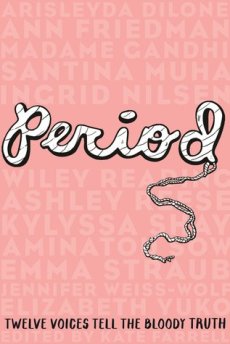
Book Review: Period

period twelve voices tell the bloody truthPeriod: Twelve Voices Tell The Bloody Truth
Edited by Kate Farrell
Nonfiction
208 pages
Published May 2018

Period consists of twelve essays about periods. The authors are wonderfully diverse, covering intersex, disabled, POC, and trans individuals. There are stories about fibroids, about wishing to have periods, wishing not to have periods, pads vs tampons, having periods at work, dealing with a period while being homeless, running a marathon while menstruating – just an amazing variety of experiences with periods. Some of the essays talk about how menstruation is treated in pop culture, from the famous “blue liquid” of pad commercials to the sitcom trope of “angry woman is irrational because she’s on her period.”

I think this is a book that every parent of a young daughter should read. I say that because it’s a little advanced, so perhaps not a book to hand to every pre-pubescent girl, but there’s a lot in it about what we teach our girls about their periods. Any person who has ever wondered if their period is normal should also read this book. There is SO. MUCH. VARIETY. when it comes to menstruation. But while there is plenty of variety that is normal, there is some that isn’t. The essay about the fibroids is an example of this. That level of bleeding is NOT normal, and it’s dangerous to tell people that it is. But because we don’t TALK about periods, people unfortunately assume things are normal that aren’t.

The book also makes me want to put together some hygiene kits for the homeless women I see in Baltimore. I’d never really thought about how difficult it is to deal with your period while homeless. Some pads/tampons, some hand sanitizer, and some cleaning wipes in a ziploc would go a long way towards making their lives a lot easier. The essay about having periods while homeless includes some ideas for kits to give out.

Overall, this is a very educating (and entertaining!) read. For those with periods AND those without. Menstruation should stop being a shameful topic. It’s a health issue.

From the cover of Period: Twelve Voices Tell The Bloody Truth:

Periods enter the spotlight, raising a diverse group of voices on a topic long shrouded in shame and secrecy.

In this collection, writers of various ages and across racial, cultural, and gender identities share stories about the period. Each of our twelve authors brings an individual perspective and sensibility. They write about homeless periods, nonexistent periods, male periods, political periods, and more. Told with warmth, humor, and purpose, these essays celebrate all kinds of period experiences. 

Periods are a fact of life. It’s time to talk about them. 

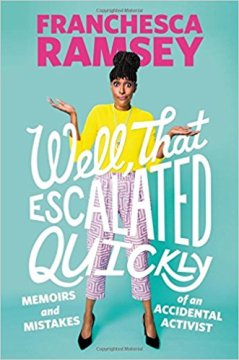
Book Review: Well, That Escalated Quickly

well that escalated quicklyWell, That Escalated Quickly: Memoirs and Mistakes of an Accidental Activist
by Franchesca Ramsey
Memoir/Comedy
244 pages
Published May 2018

This is the third comedic memoir I’ve read by a black comedian. I don’t really know what to make of that; I’ve certainly read non-comedic memoirs from African Americans, and comedic memoirs from white people, but three comedic memoirs from African-Americans in the last year seems a little surprising. They’re all fairly new, maybe it’s just what’s been getting published recently? Or maybe it’s just a coincidence and not yet a pattern. Or maybe it’s my way of giving my brain a bit of a break from current events while still trying to read inclusively. That last one might be it.

Anyway. While I didn’t like Ramsey’s book as much as I did Trevor Noah’s or Tiffany Haddish’s books, I did really enjoy it. I didn’t really know who Ramsey was before reading her book, and that might be why I didn’t like it quite as much. This book deal with internet culture a lot more than the other two do; and that pertains to my interests. What I really enjoyed is that she talks about her missteps, how she was criticized for them, and admits that she was wrong and much of the criticism was needed. She explains how she corrected her own behavior in response and strove to be better, and that’s something we don’t see a lot of. We see half-hearted apologies and no change in behavior from a lot of internet celebrities, and Ramsey definitely tries her best to rectify her mistakes. I really liked reading about her experiences with that, as it can be such a touchy issue. No one likes to be called out. But sometimes we need to be so we can learn to be better.

I really enjoyed this one. I wouldn’t say it dealt with racism more than Noah or Haddish’s books did, but it definitely dealt with combatting racism more than they did. It talked about the activist aspect of it, and how to help.

This is the third book I’ve read from my Summer TBR list.

From the cover of Well, That Escalated Quickly:

Franchesca Ramsey didn’t set out to be an activist. Or a commentator on identity, race, and culture, really. But then her YouTube video “What White Girls Say . . . to Black Girls” went viral. Twelve million views viral. Faced with an avalanche of media requests, fan letters, and hate mail, she had to make a choice: Go all in or step back and let others frame the conversation. After a crash course in social justice – and more than a few foot-in-mouth moments – she realized she had a passion for breaking down injustice in ways that could make people listen, laugh, and engage.

Ramsey uses her own experiences as an accidental activist to explore the ways we communicate with one another – from the highs of bridging gaps and making connections to the many pitfalls that accompany talking about race, power, sexuality, and gender in an unpredictable public space . . . the internet.

A sharp and timely collection of personal essays, WELL, THAT ESCALATED QUICKLY includes Ramsey’s advice on dealing with internet trolls and low-key racists, confessions about being a former online hater herself, and her personal hits and misses in activist debates with everyone from bigoted Facebook friends and misguided relatives to mainstream celebrities and YouTube influencers. Alongside useful guides to unfriending and a glossary of “not so simple concepts,” Ramsey shows readers that mistakes are inevitable, but what’s important is how we learn from them to make a better world.

Book Review: Invisible

invisibleInvisible: How Young Women With Serious Health Issues Navigate Work, Relationships, and the Pressure to Seem Just Fine
by Michele Lent Hirsch
Nonfiction – Health
230 pages
Published February 2018

I’ve been reading a lot of fiction lately, so it’s about time to sprinkle in a nonfiction volume! As soon as I learned this book existed, I knew I needed to get my hands on it. I’ve been living with two autoimmune disease most of my adult life, and in the past three or four years their impact on my life has grown quite a lot. I struggle with fatigue, with my weight, with muscle pain, with migraines, with intestinal issues if I eat the wrong thing. Some days it’s just hard to function like a normal person when my brain is full of fog and every movement hurts. So this book? This is my life.

The author of this book did a LOT of research. She’s not only disabled herself, but she interviewed SO MANY PEOPLE, with all kinds of different disabilities, diseases, and experiences. Mostly patients, but she also interviewed a few doctors.

The book is divided into six chapters: “Could Someone Love This Body of Mine,” “The (Foggy) Glass Ceiling and the Wall,” “It’s Cool Guys I’m Totally Fine,” “Why Don’t They Believe Me? or the Case of the Lady Lab Rat,” “To Raise Small Humans – Or Not,” and “Sick Like Miss America.” I really enjoyed her divisions here. The first chapter is about romantic relationships, the second about work, the third about friendships. “Why Don’t They Believe Me” covers women’s relationships with their doctors, the next chapter is obviously about fertility and parenting, and the last chapter is about society’s expectations of beauty and how to be sick.

“Could Someone Love This Body of Mine” touched on some of my personal insecurities, as one of my autoimmune diseases leaves pretty ugly scar tissue on my skin. It talks about how men tend to leave women with disabilities or chronic illness, but women don’t. (The book has extensive footnotes detailing sources and studies to back up claims like this one.)

I think the only chapter in this book that I didn’t really directly relate to was about raising children. I was child-free before being diagnosed, and it hasn’t changed my mind. We don’t want kids.

If you or someone you know has a chronic illness, I’d recommend reading this book. There’s valuable information and insight here, even if all you get out of it is “I’m not alone in this!”

Now I’m off to take a nap.

From the cover of Invisible:

Though young women with serious illness tend to be seen as outliers, young female patients are in fact the primary demographic for many illnesses. They are also one of the most ignored groups in our medical system—a system where young women, especially women of color and trans women, are invisible.

Michele Lent Hirsch knew she couldn’t be the only woman who’s faced serious health issues at a young age, as well as the resulting effects on her career, her relationships, and her sense of self. What she found while researching Invisible was a surprisingly large and overlooked population with important stories to tell. Miriam’s doctor didn’t believe she had breast cancer; she did. Sophie navigates being the only black scientist in her lab while studying the very disease, HIV, that she hides from her coworkers. For Victoria, coming out as a transgender woman was less difficult than coming out as bipolar. 

And because of expectations about gender and age, young women with health issues must often deal with bias in their careers and personal lives. Not only do they feel pressured to seem perfect and youthful, they also find themselves amid labyrinthine obstacles in a culture that has one narrow idea of womanhood.

Lent Hirsch weaves her own harrowing experiences together with stories from other women, perspectives from sociologists on structural inequality, and insights from neuroscientists on misogyny in health research. She shows how health issues and disabilities amplify what women in general already confront: warped beauty standards, workplace sexism, worries about romantic partners, and mistrust of their own bodies. By shining a light on this hidden demographic, Lent Hirsch explores the challenges that all women face.

Book Review: Pretending To Be Normal

pretending to be normal aspergerPretending To Be Normal (Expanded Edition)
by Liane Holliday Willey
Memoir
190 pages
Published 2014

First off, once again this is an older book that uses the term Asperger’s throughout. The book was originally published in 1999, but a few more chapters were added and it was republished in 2014.

Honestly I found it a little hard to get through. Unlike Nerdy, Shy, and Socially Inappropriate, it was pretty much entirely memoir, and didn’t really speak to the reader as if trying to have a conversation at all. It just told Willey’s story. Which is fine, it just wasn’t what I was expecting after reading Nerdy. The appendices are the only place that have tips and tricks for dealing with the neurotypical world as an autistic person, but there wasn’t really anything new or unique there.

I also just don’t think I like her writing style as much as I did the writing style in Nerdy, but that’s such a personal thing. It’s hard to make a recommendation based on that. Autistic people vary so widely in where their strengths and weaknesses are that it’s difficult to say which books will be useful to which people, in general.

So – it’s worth reading for yet another viewpoint on being autistic, and there are several parts on parenting as an autistic woman, so autistic parents might get more use out of the book than I did, as a childless spouse of an autistic man. But I personally did not like it nearly as much as Nerdy or The Journal of Best Practices.

From the cover of Pretending To Be Normal:

Compelling and witty, Liane Holliday Willey’s account of growing to adulthood as an undiagnosed ‘Aspie’ has been read by thousands of people on and off the autism spectrum since it was first published in 1999. Bringing her story up to date, including her diagnosis as an adult, and reflecting on the changes in attitude over 15 years, this expanded edition will continue to entertain (and inform) all those who would like to know a little more about how it feels to spend your life `pretending to be normal’.