Book Review: Autoboyography

autoboyographyAutoboyography
by Christina Lauren
YA LGBT Romance
416 pages
Published 2017

This book was EXCELLENT. I read this last minute, because the author tweeted that it was free to read on an online platform through the end of the month. It is absolutely adorable.

Autoboyography is the the story of Sebastian and Tanner falling in love, told mostly from Tanner’s point of view. He meets Sebastian in a class at school about writing a book, and the book we’re reading is supposedly the result. Tanner is a half-Jewish, bisexual kid moved from California to Utah, because his mother got a job offer she couldn’t refuse. He is surrounded by Mormons, whose religion doesn’t allow homosexuality. And Sebastian is Mormon.

The book unpacks so much, from stereotypes of bisexuality (and I LOVED the recognition that there are bisexuals who won’t be satisfied with one gender, and bisexuals who will, it’s an individual thing just like sexuality) to religious upbringing and the constraints that brings when someone is different, to unrequited love from a best friend, to how you can inadvertently let your other relationships suffer when falling in love.

The adorably sweet romance was a wonderful escape from current events, even with the hostility aimed at LGBT people by some of the characters. It was wonderfully done; enough to affect the characters and the plot, but not enough to spoil the uplifting, otherwise sweet nature of the novel.

I was slightly disturbed by an incident between Tanner and his best friend, Autumn. While they both seemed to take it in stride and move past it, it was a pretty shitty move on Autumn’s part, and could easily have gone very, VERY badly.

I really, really loved this book, and it’s going on my Favorites of 2018 list. I might need to buy my own copy. This is my last post for Pride Month, though definitely not my last book featuring LGBT characters! You can find all my Pride Month reads here.

From the cover of Autoboyography:

Three years ago, Tanner Scott’s family relocated from California to Utah, a move that nudged the bisexual teen temporarily back into the closet. Now, with one semester of high school to go, and no obstacles between him and out-of-state college freedom, Tanner plans to coast through his remaining classes and clear out of Utah.

But when his best friend Autumn dares him to take Provo High’s prestigious Seminar—where honor roll students diligently toil to draft a book in a semester—Tanner can’t resist going against his better judgment and having a go, if only to prove to Autumn how silly the whole thing is. Writing a book in four months sounds simple. Four months is an eternity.

It turns out, Tanner is only partly right: four months is a long time. After all, it takes only one second for him to notice Sebastian Brother, the Mormon prodigy who sold his own Seminar novel the year before and who now mentors the class. And it takes less than a month for Tanner to fall completely in love with him.

Book Review: Little Bee, and World Refugee Day

little bee refugeeLittle Bee
by Chris Cleave
Contemporary Fiction
267 pages
Published 2009

Today is World Refugee Day. First observed in 2001, it is dedicated to raising awareness of the plight of refugees all across the world. African Refugee Day had been observed in some countries prior to the UN declaring it World Refugee Day, but the Organization of African Unity agreed to have the two days coincide.

To honor World Refugee Day, today I’m going to talk about Little Bee. Little Bee is a Nigerian refugee in the United Kingdom. She and her sister witnessed the destruction of their village by an oil company’s thugs, and were hunted down to eliminate the witnesses. In a chance encounter on a Nigerian beach, she met Sarah and Andrew, a couple from London trying to save their marriage by going on an exotic holiday. The encounter changes the lives of all three of them, and when Little Bee makes it to the United Kingdom, they are the only people she knows. She arrives at their home on the day of Andrew’s funeral, and Sarah takes her in.

The book switches between the viewpoints of Sarah and Little Bee, and it does suffer from that, a bit. I couldn’t wait for Sarah’s chapters to be done so I could get back to Little Bee. Her viewpoint – her voice – was enthralling. Some first-person views are just the person thinking to themselves, while some first-person views are the person talking to the reader. Sarah was the first type, and Little Bee the second. Reading her explanations of the differences between her old life and her new life, and how the girls from her village wouldn’t understand things, was amazing. I was hooked within the first ten pages of the book, specifically her note about scars:

I ask you right here please to agree with me that a scar is never ugly. That is what the scar makers want us to think. But you and I, we must make an agreement to defy them. We must see all scars as beauty. Okay? This will be our secret. Because take it from me, a scar does not form on the dying. A scar means, I survived.

The events Little Bee talks about having witnessed are horrifying. And she recognizes that. She could be bitter, she could be depressed, she could be insane, but she is not. She manages to have hope, and even joy. She sees other refugees around her commit suicide, and in fact always has a plan for how to kill herself “if the men come.” Because the stories of refugees always begin with “the men came and they…” and she’d rather kill herself than let herself be taken. Despite this, she has hope for a future. Or perhaps she simply takes joy in the present.

The book is not a happy one. Like Sing, Unburied, Sing, it’s an important book but not exactly an enjoyable one. There are enjoyable parts. But there are very hard parts, too. (I should note, here, a TRIGGER WARNING for a graphic description of rape, when Little Bee tells Sarah what happened to Little Bee’s older sister.) It did not end the way I wanted it to, though it ended in an unexpected way. I suppose it was too much to hope for a Happy Ever After when the vast majority of refugees don’t get one.

For all that there were very tough scenes to get through in this book, I’m still putting it on my Best of 2018 list. Little Bee’s voice and viewpoint is amazing, the story is well researched, and the plot absorbing. This is a book I’d like to have on my shelf.

This book fills the “book talked about in another book” (Tolstoy and the Purple Chair) prompt for PopSugar 2018, and the “refugee MC” prompt for Booked 2018.

From the cover of Little Bee:

We don’t want to tell you what happens in this book.

It is a truly special story and we don’t want to spoil it.

Nevertheless, you need to know enough to buy it, so we will just say this:

This is the story of two women. Their lives collide one fateful day, and one of them has to make a terrible choice, the kind of choice we hope you never have to face. Two years later, they meet again – the story starts there . . .

Once you have read it, you’ll want to tell your friends about it. When you do, please don’t tell them what happens. The magic is in how the story unfolds. 

Book Review: The Kiss Quotient

kiss quotientThe Kiss Quotient
by Helen Hoang
Contemporary Romance
317 pages
Published June 2018

This was one of three books I got through Book of the Month this month – the other two were The Book of Essie and When Katie Met Cassidy. I’m reviewing this today instead of another Pride Month read because today is Autistic Pride Day! The Kiss Quotient both stars and is written by a woman on the autistic spectrum, so I thought today would be a fitting day to tell you about it!

So The Kiss Quotient is basically a gender-swapped Pretty Woman, as Hoang mentions in the Author’s Note. Our heroine, Stella Lane, books an escort to teach her about sex. Stella is thirty years old, has only had sex a couple of times, never enjoyed it, and is worried about not being good at it and therefore not being able to get or keep a boyfriend. She’s an incredibly successful econometrician, or someone who uses data and statistics to model and predict economic trends, in her case predicting what people will want to buy from clients. (She’s the kind of person responsible for those “Amazon started marketing baby products to me before I even knew I was pregnant!” incidents.) So she has more money than she knows what to do with, and offers Michael, an escort, $50,000 a month to teach her about sex and relationships.

Because this is a romance, we know what’s going to happen here. They fall in love with each other, but are sure that for the other one it’s just a business arrangement.

I was NOT expecting this book to be as explicit as it is! I think because it is a Book of the Month, I wasn’t expecting the standard trope of romance book with hot sex scenes. But that’s what I got! I can’t say I’m unhappy with that – god knows I like my guilty pleasure romance smut – but it was definitely unexpected. I’m not sure why it surprised me. The book’s premise is all about Stella wanting to learn about sex; if that wasn’t conducted on screen we’d lose a third of the book!

A sequel has already been announced, and it’s about the other autistic character in the book, the hero’s best friend’s little brother, Khai, who we only see in one scene. Who I’d also like to know more about is the best friend, Quan! So I’m holding out hope for a third book. (Update: a third book is on Goodreads, but without a title or synopsis. Hopefully it’s Quan! I have read and reviewed Khai’s book, The Bride Test.)

One last thing that I found important – in the Author’s Note, Hoang mentions her daughter was diagnosed with AS, and in reading about Autism, she realized she is also on the spectrum. This is something I’ve seen in three different books now. It’s so common for women, especially, to go undiagnosed. They might be better at modelling allistic (non-autistic) behavior, or their special interests might be more “acceptable” to allistics, or sometimes they just get looked at as introverts when they’re young instead of getting the help they might need. This is starting to change, as researchers and doctors are realizing Autism presents differently in women. But it seems autistic adult women are often discovering they’re autistic through a diagnosis of their children. I found that interesting.

I did really enjoy this book. I think it’s a great debut novel, and a great romance. I really like the recent trend of more diversity in lead characters in romance novels. Bring on the people of color! More disabled main characters! There’s got to be a romance somewhere with a deaf heroine, right? (Update 2: This is Kind of An Epic Love Story has a deaf hero.) More alternative sexualities and relationship structures! Everyone, everywhere, wants to be loved, and I want to read about it. The thing is, I’m sure these books exist, but they don’t get the kind of publicity they need for people to know about them. We have to actually go looking for them. I feel like I’ve been better about that recently, but it’s definitely a place where the publication industry could improve.

You can find my full list of Autism books, most of them by Autistic authors, here.

From the cover of The Kiss Quotient:

Stella Lane comes up with algorithms to predict customer purchases – a job that has given her more money than she knows what to do with, and way less experience in the dating department than the average thirty-year-old.

It doesn’t help that Stella has Asperger’s or that French kissing reminds her of a shark getting its teeth cleaned by pilot fish. Her conclusion: she needs lots of practice – with a professional – which is why she hires escort Michael Phan. With the looks of a K-drama star and the martial arts moves to match, the Vietnamese-Swedish stunner can’t afford to turn down Stella’s offer. And when she comes up with a lesson plan, he proves willing to help her check off all the boxes – from foreplay to more-than-missionary position.

Before long, Stella not only learns to appreciate his kisses, but to crave all of the other things he’s making her feel. Their no-nonsense partnership starts making a strange kind of sense. And the pattern that emerges will convince Stella that love is the best kind of logic…

Book Review: Love, Hate, and Other Filters

love hate and other filtersLove, Hate, and Other Filters
by Samira Ahmed
Young Adult Contemporary Fiction
280 pages
Published January 2018

This book made a big splash when it came out in January, and rightly so, as I’ve finally discovered for myself! Written by an Indian-American, Love, Hate, and Other Filters follows Maya Aziz, a seventeen-year-old born in America to Indian immigrant parents. She’s the only Muslim girl at her school, and while she feels like she sticks out, she doesn’t feel discriminated against until a terrorist attack happens in her state. She had -just- gotten most of her issues worked out before the attack, but in the aftermath of the attack, and the community’s response to it, her parents clamp down on her freedom, and she struggles to get her life back.

I really loved Maya in this book; I can understand her parents’ fears, but also her rebellion when they take away the freedom she values. I think my favorite character, though, was the side character Kareem. I kind of hope Ahmed writes another book and tells us his story. He was just so NICE.

I loved the writing and the characters overall, but there were a few sentences that made me pause and repeat them in my head because they were just outstanding.

“The vows are simple, the same kind of pledges I’ve heard at weddings of every faith. Except at the end, there is no kiss. I close in for the money shot anyway, hoping for a moment of rebellion from Ayesha and Saleem. But no. No public kissing allowed. Full stop. The no kissing is anticlimactic, but some taboos cross oceans, packed tightly into the corners of immigrant baggage, tucked away with packets of masala and memories of home.”

And also, about arranged marriages and being a good Indian daughter:

“And the Muslim? The Indian? That girl, she doesn’t even get the dream of the football captain. She gets a lifetime of being stopped by the FAA for random bag searches every time she flies. She gets the nice boy, the sensible boy, the one her parents approve of and who she will grow to love over years and children and necessity.”

Maya is a whip-smart young girl who wants to be a film maker, and she spends most of her time behind a camera, observing. Her observations are really what make this book shine, and her snark had me laughing throughout the book.

I really loved this book, if you couldn’t tell! I love minority-driven YA, and this one reminds me quite a lot of Saints and Misfits. Given how much I loved both of these, I really need to read When Dimple Met Rishi!

From the cover of Love, Hate, and Other Filters:

American-born seventeen-year-old Maya Aziz is torn between worlds. There’s the proper one her parents expect for their good Indian daughter: attending a college close to their suburban Chicago home, and being paired off with an older Muslim boy her mom deems “suitable.” And then there is the world of her dreams: going to film school and living in New York City – and maybe (just maybe) pursuing a boy she’s known from afar since grade school, a boy who’s finally falling into her orbit at school.

There’s also the real world, beyond Maya’s control. In the aftermath of a horrific crime perpetrated hundreds of miles away, her life is turned upside down. The community she’s known since birth becomes unrecognizable; neighbors and classmates alike are consumed with fear, bigotry, and hatred. Ultimately, Maya must find the strength within to determine where she truly belongs.

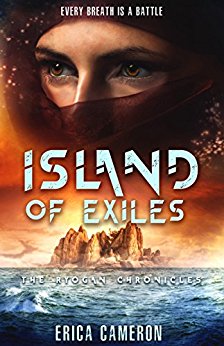
Book Review: Island of Exiles

island of exilesIsland of Exiles
by Erica Cameron
Fantasy
402 pages
Published 2017

This is a great read for Pride Month! Khya’s society has three genders – male, female, and ebet. They’re all equal, though ebet aren’t capable of having children. The ebets’ pronouns are ey/eir/em. No one cares what gender anyone else is, and soul bonds, which seem to be the only form of long term bonding, can be made between any two people who love and trust each other enough, whether that’s romantic or not. Siblings can form a soul bond if they wish, it doesn’t imply a sexual relationship. The main plot line follows Khya, Tessen (the man who loves her), and Sanii, Khya’s brother’s ebet lover, as they try to rescue Khya’s brother. In the process, they learn things about their society that only the ruling class knows, and have to make some hard decisions.

Khya’s home, Itagami, is separated by castes: The Miriseh, ten immortal rulers, the Kaigo, the Council below them, the Nyshin, or warriors (anyone with strong magic), the Ahdo, or city guards (anyone with weak magic), and the Yonin, who don’t have any magic and are little more than drudges. Yonin aren’t really allowed to associate with the higher classes and are kept out of most places by magic. The only movement between castes is the few Nyshin who get elected to the Kaigo. I generally dislike societies that are so rigidly separated by castes, but that makes it all the more satisfying when people rebel, I suppose.

I enjoyed the world building and magic system – Khya, in particular, is a Warding Mage, and can shield people from things like projectiles, lightning strikes, and even from water, giving them air to breathe underwater. Khya’s a little prickly for a main character, but she comes around eventually.

The book was a finalist in the Speculative Fiction category of the Bisexual Book Awards, but did not win. (Full list of finalists and winners in the link above, as well as previous years’ lists – Fair Warning, my To-Read listed exploded.)

I thought this was a great book and will be looking up the sequel, Sea of Strangers.

From the cover of Island of Exiles:

In Khya’s world, every breath is a battle.

On the isolated desert island of Shiara, dying young is inevitable. The clan comes before self, and protecting her home means Khya is a warrior above all else.

But when following the clan and obeying their leaders could cost her brother his life, Khya’s home becomes a deadly trap. The only person who can help is Tessen, her lifelong rival and the boy who challenges her at every turn. The council she hoped to join has betrayed her, and their secrets, hundreds of years deep, reach around a world she’s never seen.

To save her brother’s life and her island home, her only choice is to trust Tessen, turn against her clan, and go on the run―a betrayal and a death sentence.

Book Review: The Gentleman’s Guide to Vice and Virtue

gentleman's guide to vice and virtueThe Gentleman’s Guide to Vice and Virtue
Mackenzi Lee
YA Historical Fiction
513 pages
Published 2017

This was excellent! First, all the diversity here – between the bisexual main character, his best friend, who is biracial, has an “invisible” disability, and also likes men (or at least likes Monty!) and his seemingly asexual sister – the book covers so many facets, it’s great.

Given that it’s historical fiction, set in Victorian Europe, Percy’s biracial heritage has him just seen as black to most people they encounter. Monty doesn’t seem to understand what that means, most of the time, and is a little blinded by his rich white boy privilege. He gets talked to a couple of times about how he’s being blind to the problems his friend is facing.

I liked that we got to peek under Monty’s playboy facade a few times, when being punched has him flashing back to being beaten by his father for being a “disappointment.” An interaction between him and a pirate captain was particularly sweet, teaching him to fight back because he’s worth defending.

I LOVE Felicity, Monty’s sister, and I’m really eager to read her story in the sequel to this book, The Lady’s Guide to Petticoats and Piracy. She is so badass, and incredibly intelligent.

The writing was fun, the action well-paced, and the dialogue clever. I was a little put off at first by the size of the book, but I flew through it quickly. I especially liked Monty’s bisexuality – how he just cheerfully perved on practically everyone his age. It definitely reminded me of a few people I know!

Something that I noted, near the end of the book, was Percy not asking Monty to stop his perving. What he said was “if you ever go behind my back…” which implies as long as Percy knows, it’s not an issue. Yay for non-monogamy being present in YA! It’s nice to see alternative relationship structures being presented, though I wish it had been more than just implied.

This was an excellent read for Pride Month, and I loved the amount of diversity and intersectionality present in it. You can find the rest of my Pride Month reads listed here.

From the cover of The Gentleman’s Guide to Vice and Virtue:

Henry “Monty” Montague was born and bred to be a gentleman, but he was never one to be tamed. The finest boarding schools in England and the constant disapproval of his father haven’t been able to curb any of his roguish passions – not for gambling halls, late nights spent with a bottle of spirits, or waking up in the arms of women or men.

But as Monty embarks on his Grand Tour of Europe, his quest for a life filled with pleasure and vice is in danger of coming to an end. Not only does his father expect him to take over the family’s estate upon his return, but Monty is also nursing an impossible crush on his best friend and traveling companion, Percy.

Still, it isn’t in Monty’s nature to give up. Even with his younger sister, Felicity, in tow, he vows to make this yearlong escapade one last hedonistic hurrah and flirt with Percy from Paris to Rome. But when one of Monty’s reckless decisions turns their trip abroad into a harrowing manhunt that spans across Europe, it calls into question everything he knows, including his relationship with the boy he adores.