Library Loot and Book Haul

a light in the atticSo I only checked out one book from the Library this week – Shel Silverstein’s A Light in the Attic, because it turns out it was a bestseller the first week of 1982, so it hits the prompt of “Bestseller the year you were born” from PopSugar. And I’d much rather re-read that than any of the rest of the boring shit that was apparently good that year!

all the birds in the skyI did wind up with six books from the Baltimore Book Festival this weekend, though! Five of them from Friday, and one from Sunday. I talked about the first five in my post on Sunday, but the last one is All The Birds in the Sky, by Charlie Jane Anders. We got to listen to her at a couple of panels on Sunday, and she signed the book for me too!

That was all I picked up this week. Need to cut down on my physical To-Be-Read stack when I can!

TTT – Authors I’d Love To Meet

I actually got to meet a ton of authors this last weekend at the Baltimore Book Festival – several of which I didn’t know I wanted to meet until I met them! (Na’amen Gobert Tilihun, Sam Miller, Zoraida Córdova, and Charlie Jane Anders all come to mind, as well as Kenneth Rogers Jr. and Nibedita Sen!) But authors I’d love to meet that I haven’t met yet?

john and hank green

John (left) and Hank Green

Well, John Green and Hank Green, first. I’ve been watching them on Youtube forever – I’ve read most (maybe all) of John’s work, and I have Hank’s debut novel, An Absolutely Remarkable Thing, on my side table to read this month.

seanan mcguire

Seanan McGuire

Because I’ve been following her on Twitter, Seanan McGuire, oh my god. She is an absolute riot and a fabulous human being. Even if I come away from the meeting covered in glitter, it would be worth it! (She wrote Into The Drowning Deep as Mira Grant.)

I’d love to chat with S. A. Chakraborty and Rin Chupeco and Julie Dao. Strong women who write strong women! (Pictured in order, left to right.)

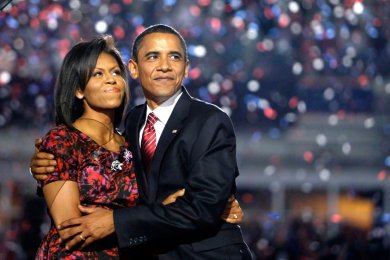
obamasDoes Barack Obama count? He’s written books. So has Michelle, I suppose, and I would LOVE to meet them both.

I’d also love to meet Ellen Oh, Meghan Maclean Weir, and Heidi Heilig. (Pictured left to right.) I keep hoping some of these authors will have events near me, but the closest most of them come is Boston! There’s been a few events scheduled in DC, but it’s really hard for me to get down into DC. I wish Baltimore attracted more author events! That’s part of why I enjoyed the Baltimore Book Festival so much, but it’s only once per year.

Book Review: Look Me In The Eye

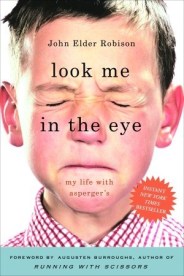
look me in the eye aspergersLook Me In The Eye: My Life with Asperger’s
by John Elder Robison
Memoir
288 pages
Published 2007

I try to make a habit of picking up books written by people on the autism spectrum – it’s part of my effort to read inclusively, but it also has a personal component, since my husband is on the spectrum. (You can see my list of books on this subject here.) Look Me In The Eye is a book about growing up in the 70s, when an autism diagnosis usually meant a kid entirely incapable of most communication – they didn’t really understand the spectrum yet. John Elder Robison was not that child, so he didn’t discover his diagnosis until his 40s. Autistic adults discovering the reason for their quirks is a very common story, though these days it’s more often women who fall through the cracks than men.

It’s always amusing to me spotting the similarities between autistic memoirs and my husband – one of them came very early in the book, when Robison is talking about a book shown to him by his father.

We looked at books together, especially the Boy Scout Woodsman manual. I can still remember the pictures that showed how to make a trap, and the correct way to step over a fallen log.
I dreamed about trapping wolves and bears, but garter snakes and frogs were as close as I got. And I’ve never forgotten the woodsman’s log-crossing techniques that I learned at five.

My husband, similarly, has mentioned a book of survival skills he read as a child, and was particularly fascinated by the traps. (He also still remembers those pages clearly.)

The blurb on the cover says Robison is a natural-born storyteller, which his brother also mentions in the Foreword to the book – and they’re right. This book just flows. Robison has a wonderful writing style. He’s funny but still shows the hardship of growing up with an alcoholic father and a mentally unstable mother. (He called them “Slave” and “Stupid” until he moved out at sixteen.) He maybe be critical of other peoples’ actions in his past, but he also admits to leaving his brother head-down in five-foot deep holes and pulling other “pranks” that probably weren’t as funny to the people around him. (The mannequin he wrapped up and hung from a powerline above a burning pentagram deep in the woods before calling the local police to report it was rather amazing, though. Teenagers, man.)

This was a great look at growing up before a diagnosis existed; struggling to make up for the ways an autistic mind works differently when the world won’t meet you halfway. My favorite kind of books about autism so far have been the memoirs. This is, I think, my fourth. The Journal of Best Practices was written by another man, and Pretending to be Normal and Nerdy, Shy, and Socially Inappropriate by women.

Excellent book.

From the cover of Look Me In The Eye:

Ever since he was small, John Robison had longed to connect with other people, but by the time he was a teenager, his odd habits – an inclination to blurt out non sequiturs, avoid eye contact, dismantle radios, and dig five-foot holes (and stick his younger brother in them) – had earned him the label “social deviant.” No guidance came from his mother, who conversed with light fixtures, or his father, who spent evenings pickling himself in sherry. It was no wonder he gravitated to machines, which could, at least, be counted on.

After fleeing his parents and dropping out of high school, his savant-like ability to visualize electronic circuits landed him a gig with KISS, for whom he created their legendary fire-breathing guitars. Later, he drifted into a “real” job, as an engineer for a major toy company. But the higher Robison rose in the company, the more he had to pretend to be “normal” and do what he simply couldn’t: communicate. It wasn’t worth the paycheck.

It was not until he was forty that an insightful therapist told him he had the form of autism called Asperger’s syndrome. That understanding transformed the way Robison saw himself – and the world.

Look Me In The Eye is the moving, darkly funny story of growing up with Asperger’s at a time when the diagnosis simply didn’t exist. A born storyteller, Robison takes you inside the head of a boy whom teachers and other adults regarded as “defective,” who could not avail himself of KISS’s endless supply of groupies, and who still has a peculiar aversion to using people’s given names (he calls his wife “Unit Two”). He also provides a fascinating reverse angle on the younger brother he left at the mercy of their nutty parents – the boy who would later change his name to Augusten Burroughs and write the bestselling memoir Running With Scissors.

Ultimately, this is the story of Robison’s journey from his world into ours, and his new life as a husband, father, and successful small business owner – repairing his beloved high-end automobiles. It’s a strange, sly, indelible account – sometimes alien, yet always deeply human.

Sunday Something

I’m still trying to decide exactly what I want to do with this space on Sundays. I’ve done link roundups, I’ve done short updates on life, I’ve even moved a review to Sunday on the rare occasion I didn’t have anything else planned by Saturday night, but nothing has really felt, I don’t know, right.

I’m mulling over the idea of doing opinion pieces on Sunday, or possibly snippets of fiction. (I’ve written a little bit of very short fiction, and would kind of like to practice more.) I’m just not really sure what I want to do here on Sundays.

img_20180928_203839_6531748061392757928666.jpg

In other news, I’ll be roaming around the Baltimore Book Festival today! We went Friday, and attended several panels. I’ve now listened to several authors from my To-Be-Read list, and I think my favorite so far is Na’amen Gobert Tilahun, author of The Root and The Tree. He was on two panels we watched Friday, and it turns out he’s on a few more today. (I’m not stalking him, I swear!) He’s really fun to listen to. Zoraida Cordova, author of The Brooklyn Brujas, was also really fun to watch.

One of my first panels today is about Author/Blogger relationships, so I’m hoping to get a lot out of that. I’m also planning to go to panels about how Cities can be their own characters; Politics, Resistance, and Spec Fic; Magic Systems; Literary Sci-Fi/Fantasy; and maybe a panel about the Marginalized Majority – how marginalized voices together actually become a majority.

On Friday I went to a panel about creating characters, one about worldbuilding, one about heroes and villains, and my last panel was about genres that people think have been overdone revived by marginalized authors. (Do we really need MORE vampire novels? Yes, if they’re not white, cis, and hetero!)

I’ve also been thinking about something Na’amen Tilihun said about dystopias – he likes them for the revolution part. He could do without the first third in which they’re setting up how terrible things are. Thinking about which dystopias I have and haven’t liked – Future Home of the Living God featured a failed, quickly squashed revolution. Hated it. Station Eleven had no revolution. Hated it. But The Power, American War, The Book of M – all featured revolutions. Loved them. Even The Bannerless Saga features people going against the status quo, and a main character who’s starting to realize maybe the status quo isn’t exactly fair. So it’s really the revolutions that I love, not the dystopias. There was a lot to think about from that panel, and I’m very glad I stayed long enough to go to it.

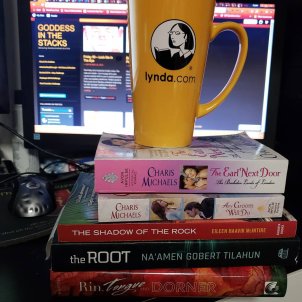
I came home Friday with five books and a mug – two of the books are even signed! (Na’amen Tilihun’s first, The Root, is one of those two, with The Shadow of The Rock being the other.) We’ll see what I bring home today. You can follow my Twitter for updates throughout the day!

Series Review: The Bannerless Saga

bannerlessBannerless/The Wild Dead
by Carrie Vaughn
Dystopia/Murder Mystery
274/264 pages
Published 2017/2018

I first fell in love with Carrie Vaughn’s work with the Kitty Norville series – a werewolf named Kitty who ran a late-night radio show. Kitty and the Midnight Hour. (Both the name of her show and the first book.) So when I discovered she’d starting writing a dystopia that revolved heavily around reproductive rights, I was SO ON BOARD. Bannerless and The Wild Dead are the first two books of the Bannerless saga. And they’re GREAT. They’re technically murder mysteries set in a dystopian society; Enid, our main character, is an investigator, the closest thing this society has to police.

The dystopia part of the society involves epidemics and natural disasters nearly eradicating humanity; with so few people left and less of the earth habitable, they’ve regressed to a mostly agrarian society. Farmers, weavers, hunters. To keep the population from exploding past the land’s ability to feed it, birth rates are strictly controlled. As civilization was falling, people realized birth rates were going to be massively important, and the birth control implant, and the technology to make it, was one thing they managed to save. They also have solar-powered cars, lights, and flashlights, though they’re uncommon enough to be notable.

the wild deadI find it a little improbable that they still have the tech to make the implants; they say that before the supplies from “before the Fall” ran out, the medics figured out how to make the hormone from “what they had on hand” – but – I feel like a more interesting plot point would be that they’re running out of implants, and how the society would have to deal with that changing. But that is not the case, at least not in the first two books.

Regardless of how improbable the birth control issue is, the rest of the plot is pretty good. There’s a good mix of salvaged goods and subsistence farming; of new houses built in low-tech ways and the occasional ruins from Before the Fall. They have some books and records of what it was like, and Enid often wishes she had the tools that forensic investigators had, Before. Fingerprints, and DNA, though she doesn’t call it DNA. They don’t have cameras, she has to sketch crime scenes and take notes.

I really enjoyed both books; Carrie Vaughn’s writing style is wonderful to read. The first book rambles a little bit, but while some of it doesn’t seem necessary for the first book, it’s important for the second. I’ll definitely be following this series.

From the cover of Bannerless:

Decades after economic and environmental collapse destroyed much of civilization in the United States, the Coast Road region isn’t just surviving, but thriving – built on a culture of population control where people are organized into households that must earn the right to bear and raise children by proving they can care for them. Those who are deemed worthy proudly display the symbolic banners that demonstrate this privilege, while those who are not are outcast, living alone and branded as “bannerless.”

Enid of Haven is an investigator, called on to mediate disputes and examine transgressions against the community. She’s young for the job and hasn’t yet handled a serious case. But now she’s summoned to investigate the suspicious death of a man rumored to be bannerless. Was it murder or an accident? Was he truly bannerless or simply a loner? As Enid races to answer these questions while confronting unhelpful townsfolk and her own past, the secrets she reveals could expose the cracks in the entire foundation of the Coast Road society.

From the cover of The Wild Dead:

A century after environmental and economic collapse, the people of the Coast Road have rebuilt their own sort of civilization, striving not to make the mistakes their ancestors did. They strictly ration and manage resources, including the ability to have children. Enid of Haven is an investigator who, with her new partner, Teeg, is called on to mediate a dispute over an old building in a far-flung settlement at the edge of Coast Road territory. 

The investigators’ decision seems straightforward – and then the body of a young woman turns up in the nearby marshland. Almost more shocking than that, she’s not from the Coast Road, but from one of the outsider camps belonging to the nomads and wild folk who live outside the Coast Road communities. Now one of them is dead, and Enid wants to find out who killed her, even as Teeg argues that the murder isn’t their problem. In a dystopian future of isolated communities, can our moral sense survive the worst hard times?

Friday 56 – Look Me In The Eye

look me in the eye aspergersThe Friday 56 is hosted by Freda’s Voice. The rules are simple – turn to page 56 in your current read (or 56% in your e-reader) and post a few non-spoilery sentences.

Today’s quote is from Look Me In The Eye, a memoir of growing up with Asperger’s before the diagnosis existed. (Varmint is his little brother.)

My parents often left me to watch the Varmint while they were out. But this time I was going, too. So I spoke to him before we left.

“Varmint, we’re all going out to talk about you with a shrink. I can’t stay with you because they want to ask me what to do. Come down here. We’ll chain you to the heating oil tank so you’ll be safe til we get back.”

“John Elder! Don’t you scare Chris like that. We have a babysitter for him.”