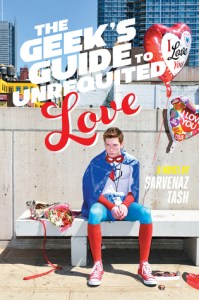
Book Review: The Geek’s Guide to Unrequited Love

3P JKT Geeks_Guide.inddThe Geek’s Guide to Unrequited Love
by Sarvenaz Tash
Young Adult
249 pages
Published 2016

The title of this book had me wary from the start, but I’d heard good things about it, and the author is a woman, so I hoped it wouldn’t be what it sounded like. Because seriously. We don’t need more books about angsty white guys complaining about the girl they love not liking them back.

Unfortunately that’s exactly what I got in this book.

First, the good points. The author has a very immersive writing style, and she captured the feeling of a Comic Con VERY impressively. I haven’t been to NYCC, but I’ve been to other nerdy cons, and the hectic pace of panels, and getting tickets, and standing in lines, but nerding out over ALL THE GEEKY STUFF – yeah, that was perfectly written. I really enjoyed that. The other characters – Casey and Felicia, specifically, and Samira, and the rest of Roxy and Graham’s families – those were also well done. The brief scene with Roxy’s Iranian family was especially nice, which is to be expected from an Iranian-American author!

But Graham irritated me. Roxy wasn’t well explored because we only saw things from Graham’s point of view, and her love interest Devin’s appeal wasn’t shown very well at ALL.

I spent most of the book wanting to yell at Graham to just TALK TO HER ALREADY. He’s all miffed that his plans aren’t going right and the obnoxious Brit is stealing his girl but he won’t. Just. TALK. To her.

I think the only reason I actually finished the book was because it was short. And for the description of Comic Con, that was actually really good. But the main character was just frustrating. I should have spent this time on another book.

From the cover of The Geek’s Guide to Unrequited Love:

Graham met his best friend, Roxy, when he moved into her neighborhood eight years ago and she asked him which Hogwarts house he’d be sorted into. Graham has been in love with her ever since. 

But now they’re sixteen, still neighbors, still best friends. And Graham and Roxy share more than ever – moving on from their Harry Potter obsession to a serious love of comic books.

When Graham learns that the creator of their favorite comic, The Chronicles of Althena, is making a rare appearance at this year’s New York Comic Con, he knows he must score tickets. And the event inspires Graham to come up with the perfect plan to tell Roxy how he really feels about her. He’s got three days to woo his best friend at the coolest, kookiest con full of superheroes and supervillains. But no one at a comic book convention is who they appear to be . . . even Roxy. And Graham is starting to realize his fictional love stories are way less complicated than real life ones. 
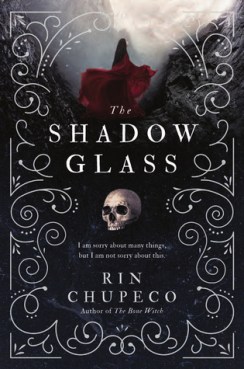
Book Review: The Shadowglass

shadow glassThe Shadowglass
by Rin Chupeco
Fantasy
456 pages
Published 2019

I wish I had the first two books in front of me to refer back to while reading this one. Specifically, the last few chapters of book two. Like the first two books, this one alternates chapters between the bard’s point of view, and the story told to the bard by Tea. The difference is that they have separated paths at this point; so instead of the bard’s chapters being very short, getting clarification on the story she’s telling, he’s now telling what’s happening to him in present day, interspersed with Tea’s letters that he’s carrying, with the rest of her story. This gets VERY confusing. It’s confusing even trying to explain the timeline! Okay, if we split up all three books between Tea’s story and the Bard’s viewpoint, chronologically they’d look like this:

The Bone Witch – Tea’s Story
The Heartforger – Tea’s Story
The Shadowglass – Tea’s Story
The Bone Witch – Bard’s Viewpoint
The Heartforger – Bard’s Viewpoint
The Shadowglass – Bard’s Viewpoint

See why I’d like to have the other two books to refer back to? This book is giving me part 3 and part 6. And while it was pretty easy to keep them straight in books one and two, because the Bard wasn’t doing much besides having a conversation with Tea, in this book, he’s off seeing OTHER important events that are happening while Tea is doing other things – and occasionally flitting in and out of his orbit too!

It is a good conclusion – the end, especially, had me crying into my book – but most of the book was very, VERY confusing. Like another conclusion I’ve read recently, if you moved straight through the trilogy with no waiting time, it might not be too bad.

What ESPECIALLY annoys me, is in the Bard’s viewpoint in the first two books, she does something that is supposed to be impossible. So in her story in The Shadowglass, this thing is impossible. But in the Bard’s viewpoint, she’s ALREADY DONE IT. And there’s no explanation of HOW. That’s really what I’d like to refer back to the other two books about. Having that particular task be in the time gap between the two parts of the book was poorly done. Like, really? I read Book 2 almost a YEAR AGO. I don’t remember how that part happened.

So that’s particularly frustrating. I wish Book 3 had condensed to one timeline. I don’t really see why it couldn’t have. It would have been much less confusing!

From the cover of The Shadowglass:

I had no plans of living forever.

In the Eight Kingdoms, none have greater strength or influence than the asha, who hold elemental magic. But only a bone witch has the power to raise the dead. Tea has used this dark magic to breathe life into those she has loved and lost . . . and those who would join her army against the deceitful royals. But Tea’s quest to conjure a shadowglass, to achieve immortality for the one person she loves most in the world, threatens to consume her.

In this dramatic conclusion to Tea’s journey, her heartsglass only grows darker with each new betrayal. She is haunted by blackouts and strange visions, and when she wakes with blood on her hands, Tea must answer to a power greater than she’s ever known. Tea’s life – and the fate of the kingdoms – hangs in the balance.

Book Review: Greywalker and Poltergeist

greywalkerGreywalker/Poltergeist
by Kat Richardson
Urban Fantasy
352 pages/349 pages
Published 2006/2007

I didn’t want to call this a series review, because there’s currently nine books in the series, and I’ve only read two of them. So this is a review of the first two books in the Greywalker series, because I don’t plan on reading more. I know that sounds ominous! Bear with me.

So Greywalker begins with our heroine, Harper, nearly being killed by a dude she’s been investigating. Well. Not nearly. She does die, but the EMTs bring her back. This experience gives her the ability to see into the Grey – a kind of fuzzy otherworld full of ghosts and other, scarier beings.

Now, this is a cool concept. I’m down with this. My problem, I think, is that Harper just seems to take this in stride. She finds a couple of people who know about the Grey, and teach her how to use it. But I feel like she never really emotionally dealt with this giant change. It felt like she basically went “Huh. Okay. That’s a thing. I need to learn how to use this.” She just went back to being a PI with this new ability. Fifty pages in, she’s back to investigating cases. It would be one thing if these were flashbacks – if the assault had happened prior to the book opening, and she’d done the emotional work. But to have the book open with that, and expect us to believe she’s just – okay with this? That a human could wrap their brain around this news so quickly? I don’t know. That requires a LOT of suspension of disbelief.

poltergeistIf I ignore the start, and the fact that she’s brand new to being a Greywalker and should be dealing with that, the rest of the book is a pretty standard urban fantasy mystery. I liked the world-building and the different takes on supernaturals. Vampires are, rightly, TERRIFYING. Despite being the protagonist, Harper is not magically immune to vampire wiles, which is a nice change. Personally, though, Book One is just spoiled for me because there should be a lot more emotional fallout. The character just falls flat and seems unrealistic.
The second book is better; possibly simply because this isn’t new for her by now, so I’m not expecting emotional work from her. The investigation seems more focused, and less scattered all over the place. It’s still pretty standard urban fantasy, though.

Overall, the concept is interesting, but the execution is lacking. It’s possible the series gets better in later books, but I’ve read two and just don’t have the desire to spend more time with Harper. She’s flat, lacks emotional depth, and is just uninteresting. I’m moving on to other books.

From the cover of Greywalker:

Harper Blaine was your average small-time PI until a two-bit perp’s savage assault left her dead – for two minutes, to be precise.

When Harper comes to in the hospital, she begins to feel a bit…strange. She sees things that can only be described as weird – shapes emerging from a foggy grey mist, snarling teeth, creatures roaring.

But Harper’s not crazy. Her “death” has made her a Greywalker – able to move between our world and the mysterious crossover zone where things that go bump in the night exist. And her new gift (or curse) is about to drag her into that world of vampires and ghosts, magic and witches, necromancers and sinister artifacts . . . 

Whether she likes it or not.


From the cover of Poltergeist:

In the days leading up to Halloween, Harper’s been hired by a university research group that’s attempting to create an artificial poltergeist. The head researcher suspects someone is faking the phenomena, but Harper’s investigation reveals something else entirely: They’ve succeeded.

When one of the group’s members is found dead in a brutal and inexplicable fashion, Harper must determine whether the killer is the ghost itself . . . or someone all too human.

Book Review: Pride

pridePride
by Ibi Zoboi
Young Adult/Retelling/Romance
289 pages
Published September 2018

I have very mixed feelings about this one. I’ve read several retellings of Pride & Prejudice, but I think this is the first one that aged the characters down to teenagers. And I don’t think it works as well. In both The Lizzie Bennett Diaries and Unmarriageable, the main character and her older sister were in their twenties. They were still living at home, but they were graduating college, starting careers – a completely different stage of their lives from the characters in Pride. In Pride, Zuri is a senior in high school and Janae, her older sister, is home after her first year of college. Which makes their younger sister, Layla, thirteen. And if you know the plot of Pride & Prejudice, you know why that squicks me a little bit. (Zoboi did change that plot point slightly so it’s not quite as bad as it could be, but still. Ew.) This is a good example of what should be a New Adult story feeling forced into a Young Adult mold.

Age issues aside, I really liked the other changes made in this retelling; class differences are alive and well in the modern day, and I especially liked how it addressed neighborhood gentrification. Because yes, improving neighborhoods is a worthy goal; but when it raises rent without raising the income of the people living there, it forces people out who have lived in the neighborhood their entire lives. Gentrification is classist and, because our class system is racist, racist.

I enjoyed the Afro-Latino racial change; just like Unmarriageable‘s Pakistani setting, it brings a new cultural wrapping to the plot, and adds racial tension to the lessons on class that the story usually tells.

The book skims over a lot of the normal Pride & Prejudice plot, which I rather expected for a Young Adult book. Unmarriageable was much better in that regard, but Pride is still very enjoyable. It’s definitely a worthy addition to the Pride & Prejudice….pantheon? Shelf? Canon? I do think it would have been much better as a New Adult story, though. I’m still stuck on that.

From the cover of Pride:

Zuri Benitez has pride. Brooklyn pride, family pride, and pride in her Afro-Latino roots. But pride might not be enough to save her rapidly gentrifying neighborhood from becoming unrecognizable. 

When the wealthy Darcy family moves in across the street, Zuri wants nothing to do with their two teenage sons, even as her older sister, Janae, starts to fall for the charming Ainsley. She especially can’t stand the judgmental and arrogant Darius. Yet as Zuri and Darius are forced to find common ground, their initial dislike shifts into an unexpected understanding. 

But with four wild sisters pulling her in different directions, cute boy Warren vying for her attention, and college applications hovering on the horizon – Zuri fights to find her place in Bushwick’s changing landscape or lose it all. 

In this timely update of Jane Austen’s Pride and Prejudice, critically acclaimed author Ibi Zoboi skillfully balances cultural identity, class, and gentrification against the heady magic of first love in her vibrant reimagining of this beloved classic. 

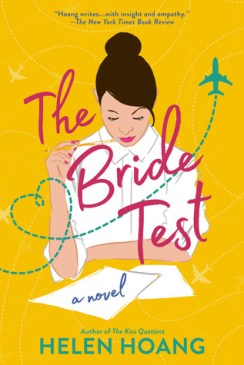
Book Review: The Bride Test

the bride testThe Bride Test
by Helen Hoang
Romance
300 pages
Published May 7, 2019

I received The Bride Test on Saturday, a few days before today’s release date, through Book of the Month. I’ve been really excited about this one, because it’s another adult romance with an autistic main character, like the first book, The Kiss Quotient. (The author is also autistic.) There’s actually a lot of #ownvoices representation here; Hoang has an author’s note at the end talking about how much of Esme’s personality and struggles are based on her own mother, who immigrated from Vietnam as a refugee at the end of the Vietnam war. I love that in writing the book, Hoang grew closer to her mother as she learned about her history. Definitely don’t miss the author’s note at the end of this book, if you read it!

I have mixed feelings about this one, but unfortunately the part I really have mixed feelings about is very spoilery, so I can’t talk about it without ruining major plot points! Overall, I did really like the book, and Khai showed a lot of the same traits my husband does. The first book’s autistic character is female, so it was nice to see a character so similar to my husband this time. The characters from The Kiss Quotient do make a token appearance in The Bride Test, and I’m hoping Hoang will finally write Quan’s story next! There is an untitled third book in the series due out in 2020, so I’m crossing fingers for Quan!

I absolutely adored Esme in this book. She is hardworking and strong-willed, and knows what she’s worth. I wish she’d been a little more honest with Khai, but I can understand being too afraid to be fully honest with someone who could have such control over your future. I did really enjoy this sequel, and I can’t wait to hear what the plot will be for the third book.

From the cover of The Bride Test:

Khai Diep has no feelings. Well, he feels irritation when people move his things or contentment when ledgers balance down to the penny, but he doesn’t experience big, important emotions like love and grief. Rather than believing he processes emotions differently due to being autistic, he concludes that he’s defective and decides to avoid romantic relationships. So his mother, driven to desperation, takes matters into her own hands and returns to Vietnam to find him the perfect mail-order bride.

As a mixed-race girl living in the slums of Ho Chi Minh City, Esme Tran has always felt out of place. When the opportunity to marry an American arises, she leaps at it, thinking that it could be the break her family needs. Seducing Khai, however, doesn’t go as planned. Esme’s lessons in love seem to be working . . . but only on herself. She’s hopelessly smitten with a man who believes he can never return her affection.

Esme must convince Khai that there is more than one way to love. And Khai must figure out the inner workings of his heart before Esme goes home and is an ocean away.

Book Review: The Poet X

the poet xThe Poet X
by Elizabeth Acevedo
Young Adult/Poetry
357 pages
Published 2018

This is another much-hyped book – and oh man, did it stand up to the hype. Told entirely through poetry, this novel was extraordinarily powerful, and had me sobbing near the end. Xiomara is an amazing character, and her poetry shows us her emotions more than prose ever could.

I’ve always loved poetry for that reason; especially poetry that plays with formatting – spacing and line breaks and size of stanzas. It’s so much more evocative than simple paragraphs of prose. (My favorite poet is probably e.e. cummings, who is rather infamous for unusual formatting.)

Acavedo does similar things, making Xiomara’s poetry explode across the page when necessary, and ordering it into simpler stanzas in calmer moments. It’s not rhyming, even poetry; this is written slam poetry. And I love it.

Xiomara is Dominican, living in Harlem, with a very strict, religious mother. Her twin brother is gay but not out to their parents; Xiomara is fine with this but knows their mother won’t be. Her poems cover her need to protect her brother and herself, both from their parents and from the outside world. She writes about street harassment and questioning God and falling in love with a boy, which is also against her mother’s rules. Her poems are at turns heartbreaking and joyous, but always beautiful.

This is an amazing book, and is the second book on my Best of the Year list. I am blown away.

From the cover of The Poet X:

Xiomara Batista feels unheard and unable to hide in her Harlem neighborhood. Ever since her body grew into curves, she has learned to let her fists and her fierceness do the talking.

But Xiomara has plenty she wants to say, and she pours her frustration onto the pages of a leather notebook, reciting the words to herself like prayers – especially after she catches feelings for a boy in her bio class. With Mami’s determination to force her daughter to obey the laws of the church, Xiomara understands that her thoughts are best kept to herself.

When she is invited to join her school’s slam poetry club, she knows that she could never get around Mami’s rules to attend, much less speak her words out loud. But still, she can’t stop thinking about performing her poems. 

Because in spite of a world that may not want to hear her, Xiomara refuses to be silent.