Book Review: Superman: Dawnbreaker

superman dawnbreakerSuperman: Dawnbreaker
by Matt De La Peña
Young Adult / Superhero
288 pages
Published March 2019

Update: it has come to my attention that Matt De La Peña has been accused of sexual harassment. I was not aware of this when I wrote this review. It has generally been my policy to NOT separate art from artist unless the artist is no longer profiting from the work. I will not be reading any more of his books.

I mulled over which book to review today – it’s the Fourth of July, or Independence Day if you’re in the United States. I think the only superhero more all-American than Superman would be Captain America, but it’s Superman that I recently read! This is the fourth in the DC Icons series, all of which I have now reviewed. It started with Wonder Woman, then moved through Batman and Catwoman before culminating in Superman. All four books have been written by popular young adult authors, from Leigh Bardugo to Marie Lu to Sarah J. Maas. Superman went to Matt De La Peña, who I had not actually heard of before. He apparently wrote a book called Ball Don’t Lie that was made into a movie in 2011, and another book titled Mexican Whiteboy. What I’m trying to say is that De La Peña’s Hispanic background makes him a perfect choice for this book. Because whatever else can be said about Superman, his is the ultimate immigrant story.

And this book not only tells Superman’s immigrant story, but deals heavily with immigrant issues around him as well. Smallville is deliberating a new law that is basically stop-and-frisk; Hispanic people are going missing; undocumented immigrants are getting beaten in the streets. Clark is rightly horrified, and vows to get to the bottom of the disappearances.

The book is very timely, and I like what it says about one of our country’s greatest fictional heroes. It reminds me of Justice League: Gods and Monsters, in which Superman is the son of General Zod, and was raised by illegal Mexican immigrants instead of the all-American Kents. (It’s a fantastic animated movie, and well worth watching.)

Lex Luthor makes an appearance, and for a while I thought Clark’s best friend, Lana, was a stand-in for Lois, but Lois is mentioned ever-so-briefly late in the book.

This is the fourth and final book in the DC Icons series, and taken as a whole, they’re quite good. I wish they were a little more entwined with one another, but I understand that would be difficult with four different authors. But they are a very neat re-work of the four characters’ origin stories.

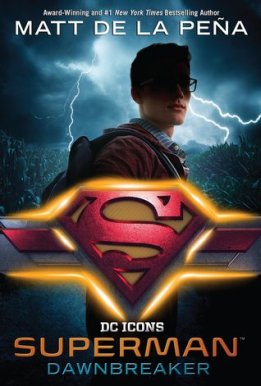
From the cover of Superman: Dawnbreaker:

HIS POWER IS BEYOND IMAGINING.

Clark Kent has always been faster, stronger – better – than everyone around him. But he wasn’t raised to show off, and drawing attention to himself could be dangerous. Plus, it’s not like he’s earned his powers . . . yet.

BUT POWER COMES WITH A PRICE.

Lately it’s becoming more difficult to hold back and keep his heroics in the shadows. When Clark follows the sound of a girl crying, he comes across Gloria Alvarez and learns that a dark secret lurks in Smallville. Turns out, Clark’s not the only one hiding something. Teaming up with his best friend, Lana Lang, he throws himself into the pursuit of the truth. What evil lies below the surface of his small town? And what will it cost Clark to face the truth about his past as he steps into the light to become the future Man of Steel?

BEFORE HE CAN SAVE THE WORLD, HE MUST SAVE SMALLVILLE.
Book Review: Frankenstein in Baghdad

frankenstein in baghdadFrankenstein in Baghdad
by Ahmed Saadawi (Trans. Jonathan Wright)
Contemporary Fiction / Magical Realism
281 pages
Published in Arabic in 2013, in English 2018

This book won at least two awards; the International Prize for Arabic Fiction and France’s Grand Prize for Fantasy, and the author had previously been named one of the 39 best Arab authors under the age of 39. I picked it up to read for the Year of the Asian Reading Challenge, since the Middle East is all-too-often neglected in regional groupings like that. People don’t think of it as Europe or Asia. I also try to read translated books on occasion, in an effort to diversify my reading. So this hit a number of my interests – I  wish I had actually liked the book more!

It’s an interesting retelling of Frankenstein – which I haven’t actually read, and now feel like I really should. But it bounces around between several viewpoints. It’s not too many to keep straight, but it’s definitely too many to truly care about. And it suffers from an unreliable narrator – it’s written as several stories told to an author from multiple people that he’s woven together into a single narrative, and while he does that well, it suffers from contradictions between how different characters recall things, scenes that don’t play a part in furthering the plot but the characters thought they were important, and no authoritative “this is what REALLY happened” to draw it all together.

And I very much dislike unreliable narrators, so that alone is enough to make me dislike the book. If you like ambiguous narratives and vigilante stories, however, you might enjoy this, and the writing style itself was quite engrossing.

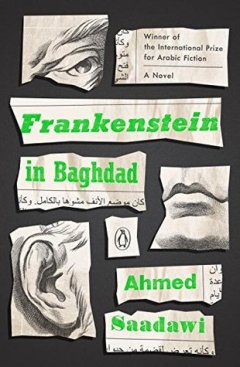
From the cover of Frankenstein in Baghdad:

From the rubble-strewn streets of U.S.-occupied Baghdad, Hadi – a scavenger and an oddball fixture at the local cafe – collects human body parts and stitches them together to create a corpse. His goal, he claims, is for the government to recognize the parts as people and to give them proper burial. But when the corpse goes missing, a wave of eerie murders sweeps the city. Hadi soon realizes he’s created a monster, one that needs human flesh to survive – first from the guilty, and then from anyone in its path. With white-knuckle horror and black humor, Frankenstein in Baghdad captures the surreal reality of contemporary Iraq.

Series Review: The Conqueror’s Saga

and i darkenAnd I Darken / Now I Rise / Bright We Burn
by Kiersten White
Alternate History
475 / 476 / 416 pages
Published 2016 / 2017 / 2018

I’ve heard a lot about this trilogy, but it was a close friend of mine gushing about it that finally brought it to the top of my reading list. Much like Bram Stoker’s Dracula, I wish I had read it sooner, as the entire trilogy is excellent. It’s a dark trilogy – it’s based on Vlad Dracul, not Dracula, and it doesn’t shy away from the brutality of his story. Except in this trilogy, it’s her story. And I Darken tells the story of Lada’s childhood alongside her brother, Radu. How their father left them with the Ottoman Empire’s sultan as hostages against his good behavior. How they found a place there and started to grow up and possibly even make friends, or at least allies. It specifically details their friendship with the Sultan’s son and heir, Mehmed.

now i riseThe second book, Now I Rise, covers the early years of Mehmed’s reign as sultan, and the siege of Constantinople. Most of this book is spent on Radu, as the siblings are doing different things in vastly different places at this point. We still get glimpses of Lada’s life, but Radu is definitely the star here, which is good, as I like him much more than Lada.

I don’t think Lada is supposed to be liked. She is vicious, and brutal, and while you can see where the brutality comes from, and why she thinks she must be this way, it’s still not exactly an easy trait to like. I much prefer Radu and his unusual marriage.

The third book, Bright We Burn, brings Radu and Lada back together again. There’s not much I can say here, for fear of spoiling things, but it is an epic and satisfying conclusion to the trilogy.

bright we burnTaken together, these three books are an epic story. They span the length of the Ottoman Empire, involve love affairs with powerful people, hidden passions, and bastard children. There is blood and death and plague. Cities fall and fortresses are built. The story is true to the bones of Vlad Dracul’s history; gender-swapping Vlad into Lada was an absolutely inspired bit of storytelling.
There’s no magic in these books, so it’s not exactly fantasy, it’s alternate history, but it reads like fantasy. Swords and shields and sieges and medieval politics.

If you like epic fantasy, and don’t mind a bit of brutal combat – if you like Game of Thrones – you’ll like these. I loved them.

There’s a good bit of LGBT rep – Radu is very gay, and Lada is aromantic. There’s also a lesbian pair.

From the cover of And I Darken:

NO ONE EXPECTS A PRINCESS TO BE BRUTAL.

And Lada Dragwlya likes it that way. Ever since she and her gentle younger brother, Radu, were wrenched from their homeland of Wallachia and abandoned by their father to be raised in the Ottoman courts, Lada has known that being ruthless is the key to survival. She and Radu are doomed to act as pawns in a vicious game, an unseen sword hovering over their every move. For the lineage that makes them special also makes them targets.

Lada despises the Ottomans and bides her time, planning her vengeance for the day when she can return to Wallachia and claim her birthright. Radu longs only for a place where he feels safe. And when they meet Mehmed, the defiant and lonely son of the sultan, Radu feels that he’s made a true friend – and Lada wonders if she’s finally found someone worthy of her passion.

But Mehmed is heir to the very empire that Lada has sworn to fight against – and that Radu now considers home. Together, Lada, Radu, and Mehmed form a toxic triangle that strains the bonds of love and loyalty to the breaking point. 

From New York Times bestselling author Kiersten White comes the first book in a dark, sweeping new series in which heads will roll, bodies will be impaled . . . and hearts will be broken.

Book Review: Juliet Takes a Breath

juliet takes a breathJuliet Takes a Breath
by Gabby Rivera
Young Adult / LGBT / Contemporary Fiction / Feminist
264 pages
Published 2016

Ohhhhhh my. This is a short book, and a quick read, but MAN is it great. It tackles racism, microaggressions, white feminism, coming out, “it’s just a phase!”, polyamory, breaking up, trans-exclusive language…and so much more.

The plot revolves around Juliet’s summer internship with an author in Portland, Harlowe Brisbane. Many of the chapters begin with an excerpt from Brisbane’s fictional treatise on feminism, Raging Flower: Empowering Your Pussy by Empowering Your Mind. One of these excerpts in particular took my breath away:

Read everything you can push into your skull. Read your mother’s diary. Read Assata. Read everything Gloria Steinem and bell hooks write. Read all of the poems your friends leave in your locker. Read books about your body written by people who have bodies like yours. Read everything that supports your growth as a vibrant, rebel girl human. Read because you’re tired of secrets.

Juliet reminds me a lot of me when I was detaching myself from Christianity and the conservatism I grew up with. Devouring books, learning about historical figures that I should have known about and was stunned that I’d never heard of. So I totally understand her wonder and shock at an entirely new world opening up before her.

Through Harlowe and her primary partner, Maxine, Juliet learns about polyamory. It’s a remarkably good example; even though Harlowe and Maxine have their issues, their arguments are reasonably healthy, and despite disagreeing on some topics, they still love each other and say as much.

In Harlowe, we have an example of a white feminist who tries to be intersectional, at least a little, but can still be blind to a lot of her own microaggressions. Maxine, her partner, is a woman of color, as are most of the other characters in the book, so Juliet has lots of opportunities to see how white feminism can be ignorant of issues and blind to its own faults.

As a white feminist myself, I took this portrayal for the warning it really is. I do my best to lift up voices of color by reviewing books by and about minorities on this blog as often as I can. I try to be as intersectional as possible, but I know I will make missteps, and I can always be better. But this book, though it’s meant for the other side of the equation, is a reminder to feminists like me to keep trying to be better, and the costs to other people when we screw up.

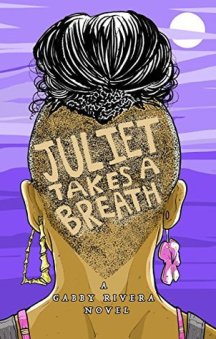
From the cover of Juliet Takes a Breath:

Juliet Milagros Palante is leaving the Bronx and headed to Portland, Oregon. She just came out to her family and isn’t sure if her mom will ever speak to her again. But Juliet has a plan, sort of, one that’s going to help her figure out this whole “Puerto Rican lesbian” thing. She’s interning with the author of her favorite book: Harlowe Brisbane, the ultimate authority on feminism, women’s bodies, and other gay-sounding stuff. 

Will Juliet be able to figure out her life over the course of one magical summer? Is that even possible? Or is she running away from all the problems that seem too big to handle?

With more questions than answers, Juliet takes on Portland, Harlowe, and most importantly, herself.

Book Review: The Rules and Regulations for Mediating Myths & Magic

rules and regulationsThe Rules & Regulations for Mediating Myths & Magic
by F. T. Lukens
Urban Fantasy / Young Adult / Romance / LGBT
287 pages
Published 2017

I loved this book. The wit is dry, the action easy to follow, the confusion of the main character absolutely warranted (Mermaids? in Lake Michigan?!), and it’s just wonderful. And it stars a bisexual teenage BOY. Male bisexuality could use more visibility, so this made me really happy. I picked this book for the M/M for Pride; I was really excited to find the main character is bisexual! It was a great surprise.

Bridger (an unusual name, but it fits him) is a senior in high school with a crush on his next door neighbor. He plans to go to school far away – Florida – where he can just BE himself instead of having to come out. But for that he needs money; so he answers an ad for an assistant doing….well he’s not sure exactly what. When he finally demands answers, he learns the truth about the world of myth and magic, and things snowball from there.

He wrestles with keeping it secret from his friends – because really, who would believe he saw mermaids in Lake Michigan? At the same time, he’s trying to wrap his head around his attraction to Leo, star football player, who just might like him back, and how to tell his mom he’s bisexual.

I loved Bridger, and his best friend, Astrid, who will kick the butt of anyone who looks wrong at Bridger, and Leo was an absolute dreamboat. I also want to know more about Pavel and his companions! I really really hope the author writes more books in this world, because I want to read them!

From the cover of The Rules & Regulations for Mediating Myths & Magic:

Desperate to pay for college, Bridger Whitt is willing to overlook the peculiarities of his new job – entering via the roof, the weird stacks of old books and even older scrolls, the seemingly incorporeal voices he hears from time to time – but it’s pretty hard to ignore being pulled under Lake Michigan by . . . mermaids? Worse yet, this happens in front of his new crush, Leo, the dreamy football star who just moved to town.

Fantastic.

When he discovers his eccentric employer Pavel Chudinov is an intermediary between the human world and its myths, Bridger is plunged into a world of pixies, werewolves, and Sasquatch. The realm of myths and magic is growing increasingly unstable, and it is up to Bridger to ascertain the cause of the chaos, eliminate the problem, and help his boss keep the real world from finding the world of myths.

Book Review: Ship It

ship itShip It
by Britta Lundin
Young Adult
375 pages
Published 2018

Claire’s an obsessed jerk. Let me just get that out ahead of everything else. Claire is one of two viewpoints in this book, and I won’t even call her a protagonist, because Forest, the male viewpoint character, is FAR more sympathetic. Yeah, he’s a touch homophobic at the beginning of the book, but he learns. Claire, on the other hand, has one goal that she’s obsessed with and Will. Not. Let. It. Go. Single-minded determination can be a great thing, but Claire doesn’t see or understand the harm she’s doing in pursuing her goal. The few times she does see, she doesn’t seem to care. Sure, she’s sixteen, but holy crap, girl. Maybe, when people tell you a thing can’t happen, you should stop and ask them why instead of stubbornly insisting it CAN happen if only they’ll let it.

Let me back up slightly. Claire is a superfan of a show called Demon Heart. In the show, a demon hunter and a demon-with-a-heart play off each other in what the fans see as a romantic manner. This comes as a huge surprise to at least one of the stars of the show, Forest Reed, who plays the demon hunter. Forest has a rather disastrous interaction with Claire at a Q&A (he’s an asshole about her question, which is about the two characters being gay) and the show decides, in order to salvage things, to have Claire travel with them to the next few public appearances, since she’s a big name in the fandom. Forest sees this as a job he has to put up with for a paycheck. Claire sees this as a chance to make her ship real, and goes to – well – ridiculous lengths to convince the showrunners and stars.

Ultimately, Claire is right that representation is incredibly important. And she’s probably even right that showrunners and stars should take risks with their careers to bring that representation to screen. But she’s such an asshole about it that I can’t even cheer her on. She’s even kind of a jerk to Tess, the cute fanartist she meets at the first convention (and keeps running into at the ensuing cons).

Claire aside, I actually enjoyed the book. There were a couple of twists at the end that I very much enjoyed.

One bit I did NOT enjoy was Tess identifying as pan “because bi means two.” That definition of bisexual – that it’s binary, only attracted to men and women – is biphobic and has NEVER been true. Bisexual means attracted to your own gender and others. That first definition tries to make bisexuals seem transphobic, and I’m frustrated that it persists. So it’s disappointing to see the statement made in the book go unchallenged.

There’s also an anxiety-inducing scene late in the book that I can’t say much about because it’s a major plot twist, but if you have issues with intimidating men, maayyyybe skip this one.

There is quite a bit of representation in the book, between Tess, the pansexual black girl, Claire, a questioning/queer white girl, and Forest, who is definitely questioning his sexuality, and learning about gender and sexuality representation issues from Claire. Oh, also Caty, a studio assistant, who is bisexual. (But who clarifies, unnecessarily, that she’s attracted to boys and girls.)

So I’m quite torn on this book. I liked it, but it has issues.

From the cover of Ship It:

Claire is a sixteen-year-old fangirl obsessed with the show Demon Heart. Forest is an actor on Demon Heart who dreams of bigger roles. When the two meet at a local Comic-Con panel, it’s a dream come true for Claire. Until the Q&A, that is, when Forest laughs off Claire’s assertion that his character is gay. Claire is devastated. After all, every last word of her super-popular fanfic revolves around the romance between Forest’s character and his male co-lead. She can’t believe her hero turned out to be a closed-minded jerk. Forest is mostly confused that anyone would think his character is gay. Because he’s not. Definitely not.

Unfortunately for Demon Heart, when the video of the disastrous Q&A goes viral, the producers have a PR nightmare on their hands. In order to help bolster their image within the LGBTQ+ community – as well as with their fans – they hire Claire to join the cast for the rest of the publicity tour. What ensues is a series of colorful Comic-Con clashes between the fans and the show that lead Forest to question his assumptions about sexuality and help Claire come out of her shell. But how far will Claire go to make her ship canon? To what lengths will Forest go to stop her and protect his career? And will Claire ever get the guts to make a move on Tess, the very cute, extremely cool fanartist she keeps running into? Ship It is a funny, tender, and honest look at all the feels that come with being a fan.