Book Review: Unbelievable

unbelievableUnbelievable: My Front-Row Seat to the Craziest Campaign in American History
Katy Tur
Memoir/Documentary/Current Politics
305 pages
Published September 2017

This was my pick for the “song lyrics in the title” prompt for the PopSugar 2018 Reading Challenge. I feel a little like “Unbelievable” is a bit of a cop-out for the prompt, but it was already on my to be read list, and it works. And the book is fantastic.

This is the story of Katy Tur’s time on the campaign trail as one of the journalists covering Donald Trump’s campaign. It is, as she says, unbelievable. When it begins, she thinks it will be very short – as most of the American public thought. No one thought Trump would wind up being the Republican nominee. But as she attends rallies, and watches the vitriol of his supporters – which occasionally gets turned on her, as a member of the “lying, fake media,” she begins to realize he could, in fact, win this thing.

We experience Tur’s shock as he calls her out by name multiple times, leading to death threats by Trump supporters, and security being assigned to her specifically. Through all of this, Tur continues to do her job as a journalist, reporting on the travel, the rallies, the information from sources within the campaign as they criss-cross the country and promise ridiculous things.

I was worried at first that the book would be a dry rehash of the events, but it is far from it. Tur speaks with a refreshing, absorbing voice. Even knowing the outcome – that Trump is elected president – it’s a page-turner that didn’t let me go until the last page. Unbelievable is a fast-paced, fascinating book by a first-class journalist.

From the cover of Unbelievable:

Called “disgraceful,” “third-rate,” and “not nice” by Donald Trump, NBC News correspondent Katy Tur reported on—and took flak from—the most captivating and volatile presidential candidate in American history.

Katy Tur lived out of a suitcase for a year and a half, following Trump around the country, powered by packets of peanut butter and kept clean with dry shampoo. She visited forty states with the candidate, made more than 3,800 live television reports, and tried to endure a gazillion loops of Elton John’s “Tiny Dancer”—a Trump rally playlist staple.

From day 1 to day 500, Tur documented Trump’s inconsistencies, fact-checked his falsities, and called him out on his lies. In return, Trump repeatedly singled Tur out. He tried to charm her, intimidate her, and shame her. At one point, he got a crowd so riled up against Tur, Secret Service agents had to walk her to her car.

None of it worked. Facts are stubborn. So was Tur. She was part of the first women-led politics team in the history of network news. The Boys on the Bus became the Girls on the Plane. But the circus remained. Through all the long nights, wild scoops, naked chauvinism, dodgy staffers, and fevered debates, no one had a better view than Tur.

Unbelievable is her darkly comic, fascinatingly bizarre, and often scary story of how America sent a former reality show host to the White House. It’s also the story of what it was like for Tur to be there as it happened, inside a no-rules world where reporters were spat on, demeaned, and discredited. Tur was a foreign correspondent who came home to her most foreign story of all. Unbelievable is a must-read for anyone who still wakes up and wonders, Is this real life?
Book Review: An American Family

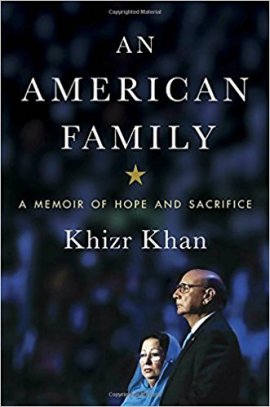
americanfamilyAn American Family: A Memoir of Hope and Sacrifice
by Khizr Khan
Memoir
271 pages
Published 2017

Like many people, I was inspired by the Khizr Khan’s speech at the Democratic Convention last year, and appalled by Trump’s reaction. As a Marine wife, the family members left behind when a service member dies get my utmost sympathy and compassion. That was my biggest fear while my husband was in the Marines, and it’s still a very emotional memory to look back on. So when I heard that Khan was writing a book, I knew I HAD to read it. I put a hold request in at the library before the book was published, and I’m glad I did. The book is definitely one of my favorites of 2017. (One of my next posts will be a round up of my favorites from this year.)

An American Family follows the Khans’ journey from Pakistan, to Dubai, to Texas, Maryland, and finally Virginia. And it’s fascinating. He says in the beginning of the book that he wrote it to answer the question he’s constantly asked: why do you love America? Why are you a Patriot? He couldn’t answer it in a few short sentences. This book is his answer, and what an answer it is. It’s impossible to summarize this book – it must be read.

It’s a very easy read – it flows beautifully, and Khan tells a story well. It’s easy, at least, until you get to the point where their son dies in action. Perhaps it wouldn’t have such an emotional effect on someone else, but that, and its aftermath, was pretty hard for me to read about. The event is important, however. Its repercussions ripple out through the Khans’ lives and affect everything they touch.

I can’t recommend this book highly enough. Especially if you’re American, and no matter where on the political spectrum you fall, this book is important. It might give you a different view on immigrants.

From the cover of An American Family:

“I am an American patriot not because I was born here but because I was not. I embraced American freedoms, raised my children to cherish and revere them, and lost a son who swore an oath to defend them, because I come from a place where they do not exist.”

In fewer than three hundred words, Muslim American Gold Star father Khizr Khan electrified viewers around the world when he took the stage at the 2016 Democratic National Convention. And when he offered to lend Donald Trump his own much-read and dog-eared pocket Constitution, his gesture perfectly encapsulated the feelings of millions. But who was that man, standing beside his wife, extolling the promises and virtues of the U.S. Constitution?

In this urgent and timeless immigrant story, we learn that Khizr Khan has been many things. He was the oldest of ten children born to farmers in Pakistan, and a curious and thoughtful boy who listened rapt as his grandfather recited Rumi beneath the moonlight. He was a university student who read the Declaration of Independence and was awestruck by what might be possible in life. He was a hopeful suitor, awkwardly but earnestly trying to win the heart of a woman far out of his league. He was a brilliant and diligent young family man who worked tow jobs to save enough money to put himself through Harvard Law School. He was a loving father who, having instilled in his children the ideals that brought him and his wife to America – the sense of shared dignity and mutual responsibility – tragically lost his son, an Army captain killed while protecting his base camp in Iraq. He was and is a patriot, and a fierce advocate for the rights, dignities, and values enshrined in the American system.

An American Family shows us who Khizr Khan and millions of other American immigrants are, and why – especially in these tumultuous times – we must not be afraid to step forward for what we believe in when it matters most.

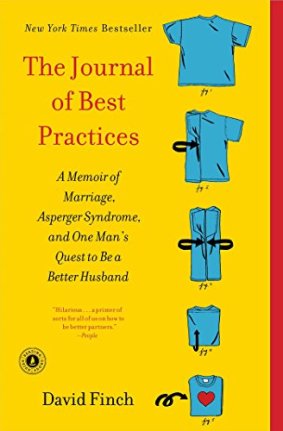
Book Review: The Journal of Best Practices

journalThe Journal of Best Practices: A Memoir of Marriage, Asperger Syndrome, and One Man’s Quest to Be a Better Husband
by David Finch
Memoir
222 pages
Published 2012

Well. I’m still not 100% back to health, but I’m well enough to get absorbed in a book again! This book was especially interesting to me because we are pretty sure that my husband is on the autism spectrum. What would have been called Asperger’s a few years ago, before they wrapped that back into autism, because it’s all the same syndrome – it just differs in how it impacts people. (The book was obviously written before that happened, though Asperger’s still seems to be shorthand for autistic people that don’t fit what most people think of as autistic – what some people would call high-functioning, I suppose, though that’s also not as cut and dried as it seems. Rebecca Burgess described it well in her comic on Tumblr.)

I read portions of this book aloud to my husband, because they described him to a T. The very first page mentions how Finch recalls his niece’s birthday, not because he’s a good uncle, but because it’s 3/14 – Pi. My husband remembers my birthday because it’s half a stick of RAM (well it used to be, anyway!) – 5/12. Now he remembers it as 2^9. The first chapter then goes on to describe how Finch’s wife sat him down with a self-diagnostic questionnaire (he received an official diagnosis later) and he was surprised at how many questions described him. While they didn’t list all 200 or so questions in the book, the ones that were mentioned I asked my husband. He was a Yes to all but one, and looked at me afterwards with a laugh and a joking “I’m feeling a little attacked right now!” That included questions like “Do you sometimes have an urge to jump over things?” (Yes) and “Have you been fascinated by making traps?” Husband told me about a book on survival he’d been given when he was 14 or so – he doesn’t remember much of it, but he can recall almost verbatim the chapter on traps and snares.

The book was a fascinating look into the mind of an adult with autism trying (and succeeding!) to navigate a relationship. It gave us a lot to talk about, and a few new strategies to try. If you know or love anyone on the autism spectrum, I highly recommend this book. It might help you understand how they see things.

I have another book on autism to read soon – Been There, Done That, Try This! – about coping strategies for autistic adults. I’m eager to see how much of that we can use in our daily lives.

From the cover of The Journal of Best Practices:

At some point in nearly every marriage, a wife finds herself asking, What the @#!% is wrong with my husband?! In David Finch’s case, this turns out to be an apt question. Five years after he married Kristen, the love of his life, they learn that he has Asperger syndrome. The diagnosis explains David’s ever-growing list of quirks and compulsions, his lifelong propensity to quack and otherwise melt down in social exchanges, and his clinical-strength inflexibility. But it doesn’t make him any easier to live with.

Determined to change, David sets out to understand Asperger syndrome and learn to be a better husband – no easy task for a guy whose inability to express himself rivals his two-year-old daughter’s, who thinks his responsibility for laundry extends no further than throwing things in (or at) the hamper, and whose autism-spectrum condition makes seeing his wife’s point of view a near impossibility.

Nevertheless, David devotes himself to improving his marriage with an endearing yet hilarious zeal that involves excessive note-taking, performance reviews, and most of all, the Journal of Best Practices: a collection of hundreds of maxims and hard-won epiphanies that result from self-reflection both comic and painful. They include “Don’t change the radio station when she’s singing along,” “Apologies do not count when you shout them,” and “Be her friend, first and always.” Guided by the Journal of Best Practices, David transforms himself over the course of two years from the world’s most trying husband to the husband who tries the hardest, the husband he’d always meant to be.

Book Review: This Common Secret

commonsecThis Common Secret
Susan Wicklund with Alan Kesselheim
Memoir
268 pages
Published 2007

Let me begin by saying I am a feminist. I am pro-choice. This was a difficult read because it talks about the lengths people will go to infringe on the rights of women like me to make that choice. Dr. Wicklund goes into detail about the dangers she personally has faced as an abortion provider – from stalking, to assault, to arson and death threats. The murders of Dr. Hill and Dr. Britton are mentioned, and the attempted murder of Dr. Tiller. (An attempt on Dr. Tiller’s life was successful two years after the publication of the book.) She resorted to wildly varying routines, different methods of transportation, elaborate disguises, as well as hiring private security guards, none of it really alleviating her fear that she could be next.

Running throughout the entire book is Dr. Wicklund’s concern for her patients. She is a dedicated, compassionate woman who wants nothing but the best for the women in her care. In many cases, that’s not actually abortion. One of the things that makes her an excellent doctor is ferreting out what is really in her patients’ best interests.

The book is mercifully short; I have no doubt she had many more stories she could have told, but the topic is brutal and hard to read, and keeping it concise and on-message was well done. I still had to set it down and play some mindless video games when I was done, as it was a little overwhelming.

In the ten years since the book was published, nothing has really changed. The New York Times has a short read on the major acts of violence against abortion clinics and providers. The National Abortion Federation has a longer database on all acts of violence against clinics. Their summary is eye-opening – all statistics below are from 1977 to present. (They have it broken down further by decade and year on a downloadable pdf.)

Murders – 11
Attempted Murders – 26
Bombing – 42
Arson – 186
Attempted Bombing/Arson – 98
Invasion – 411
Vandalism – 1643
Trespassing – 2925
Acid Attacks – 100
Anthrax/Bioterrorism Threats – 663
Assault & Battery – 239
Death Threats – 545
Kidnapping – 4
Burglary – 255
Stalking – 583

That doesn’t include the pure amounts of hate mail, picketers, hate mail, and blockades. This is what providers persevere through to give us health care. To provide a LEGAL PROCEDURE so women don’t die from performing it on themselves in an unsafe manner.

This Common Secret also touches on why people keep it a secret. Why people don’t talk about their abortion. And why people should. If more people realize that the women that get abortions are your neighbor, your sister, your grandmother – not just that “whore that slept around” – although she, too, deserves an abortion if that is the right choice for her. Maybe they would rethink their opposition to it.

I’m honestly probably not giving this book justice – it’s a decade old, but could have been written yesterday. And I am infuriated by anti-choice assholes.

From the cover of This Common Secret:

Susan Wicklund was twenty-two-years old and juggling three jobs in Portland, Oregon when she endured a difficult abortion. Partly in response to that experience, she later embarked on an improbable life journey devoted to women’s reproductive health, attending both undergraduate and medical school as a single mother. It was not until she became a doctor that she realized how many women share the ordeal of unwanted pregnancies – and how hidden this common experience remains.

Here is an emotional and dramatic story covering twenty years on the front lines of the abortion war. For years Wicklund commuted between clinics in different states and disguised herself from protesters – often wearing a bulletproof vest and carrying a .38 caliber revolver. Her daughter, Sonja, experienced seeing wanted posters with her mother’s face on them and riding to school in police cars to get through the human blockades at the end of their driveway.

Wicklund also tells the stories of the women she serves, women whose options are increasingly limited: counseling sessions in which women confide that they had used combinations of herbs – or worse – to attempt a miscarriage; or patients who have been protesters, but then find themselves bearing an unwanted pregnancy; and women who claim to want an abortion, but nothing they say or do convinces Wicklund that the decision is whole-hearted.

This Common Secret brims with the compassion and urgency of a woman who has witnessed the struggles of real patients. It also offers an honest portrait of the clinics that anti-abortion activists portray as little more than slaughterhouses for the unborn. As we enter the most fevered political fight over abortion that America has ever seen, Wicklund’s raw and revealing memoir shows us what is at stake.


Book Review: An Astronaut’s Guide to Life on Earth

astroAn Astronaut’s Guide to Life on Earth
Colonel Chris Hadfield
Memoir
284 pages
Published 2013

Wow. Just wow. I woke up far earlier than I wanted to this morning, so I picked up one of the nonfiction books I had from the library, expecting it to put me back to sleep. Three hours later I was still awake, nearly done with the book, and absolutely enthralled. I’m not sure why I thought it would be otherwise – I’d been one of the millions fascinated with Hadfield’s videos and tweets when he was Commander of the ISS. His particular voice is very clear throughout this book. In 284 pages he takes us from his childhood, through his career path to becoming an astronaut, to his 5 months in the International Space Station, and back home. Nothing felt rushed, nothing felt like it didn’t get the attention it deserved. I’m pretty sure this is going to be one of my favorite books of 2017 – I have several months to read more things, but this book just absolutely blew me away.

It does appeal to how I like to read about science, though. I love reading about scientists. How they worked, how they made their discoveries, the paths they took. Who they were. I’m less interested in the actual science. (As opposed to my husband, who cares only about the science, and isn’t interested in hearing much about the scientists.) This is part of why I loved A Short History of Nearly Everything, by Bill Bryson, so much. I borrowed that book from the library and read it cover to cover, fascinated. Finally had to buy my own copy.

Hadfield took space exploration and made it accessible to everyone. According to the book, he didn’t even quite realize how big of an impact he was making at first. But between tweeting pictures from the ISS, making videos of how different life was in space, and making music videos, he really did become the most well-known astronaut of our generation. I remember putting his video of I.S.S. (Is Somebody Singing) on repeat when it came out – and it STILL gives me chills today.

He only briefly talked about this video in the book, which I found surprising, given it was the one that hit me the hardest. He spent more time talking about filming and recording Space Oddity – which does have 36 million views, to I.S.S.’s 2 million. So I suppose that makes sense!

One thing he keeps coming back to in his book is his philosophy of trying to be a zero. That doesn’t sound very ambitious on the surface – but what he means is you can be one of three things in a group. You can be a negative impact (a -1) a neutral impact (a zero) or a positive impact (a +1). If you try to be a +1, it’s far likelier that you’ll try too hard, fuck up, and instead become a negative impact. So aim to be a zero. And most of the time you’ll wind up as a positive impact. I thought that was a very unique philosophy.

He’s also written a children’s book, The Darkest Dark, about a kid who wants to be an astronaut but is afraid of the dark.

This is the second book I’ve read for the Canadian Book Challenge, and I’m so glad I finally got around to it. (It’s the first one I’m reviewing, though, the first book I read I’ll be reviewing in August.)

My other Canadian reviews:
1. this book!
2. The Red Winter Trilogy
3. Station Eleven
4. The Courier
5. The Last Neanderthal
6. American War
7. Next Year, For Sure
8. That Inevitable Victorian Thing
9. All The Rage
10. The Clothesline Swing
11. Saints and Misfits
12. Tomboy Survival Guide
13. The Wolves of Winter

From the cover of An Astronaut’s Guide to Life on Earth:

Col. Chris Hadfield has spend decades training as an astronaut and has logged nearly four thousand hours in space. During this time he has broken into a space station with a Swiss Army knife, disposed of a live snake while piloting a plane, and been temporarily blinded while clinging to the exterior of an orbiting spacecraft. The secret to Col. Hadfield’s success – and survival – is an unconventional philosophy he learned at NASA: Prepare for the worst – and enjoy every moment of it.

In An Astronaut’s Guide to Life on Earth, Col. Hadfield takes readers deep into his years of training and space exploration to show how to make the impossible possible. Through eye-opening, entertaining stories that convey the adrenaline of launch, the mesmerizing wonder of space walks, and the measured, calm responses mandated by crises, he explains how conventional wisdom can get in the way of achievement – and happiness. His own extraordinary education in space has taught him some counterintuitive lessons: Don’t visualize success, do care what others think, and always sweat the small stuff. 

You may never be able to build a robot, pilot a spacecraft, make a music video, or perform basic surgery in zero gravity like Col. Hadfield. But his vivid and refreshing insights will teach you how to think like an astronaut and will change, completely, the way you view life on earth – especially your own.

#90sinJuly – July 3 – Whatta Man

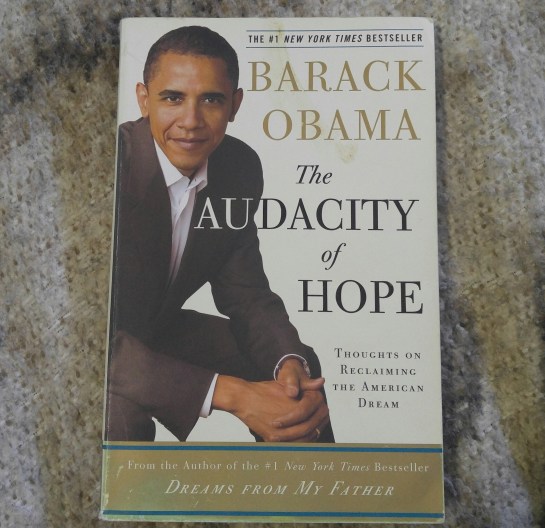
“What a man, what a man, what a man, what a mighty good maaaann….” Yeah, Obama immediately popped into my head. I miss him. He’s not completely without problems – drone strikes, privacy issues – but damn he was one of our best presidents in years. I read The Audacity of Hope during his first campaign for President. It was part of what won my vote.

20170625_162441