Book Review: Wonder Woman: Warbringer

WonderWomanWonder Woman: Warbringer
by Leigh Bardugo
Superhero Fiction
384 pages
Published 2017

WONDER WOMAN YASSSS. I might like Wonder Woman just a little bit. And the novel is written by Leigh Bardugo, the creator of the Grishaverse! (I reviewed her Six of Crows and Crooked Kingdom, and REALLY need to get my hands on the other trilogy!)

So this is basically a slightly different origin story for Wonder Woman – or at least the reason she leaves Themyscira is a little different for this book’s plot. One thing I’ve always enjoyed about DC, and superheroes in general, is that it’s not so much about the specific details of what they’ve done, so much as who they really are and what they believe in. And in that, Diana is very much true to herself in Warbringer. Given a choice between two outcomes, she opts for a third. Not “do I save these people, or those people” but “how do I save EVERYONE?”

Lego Wonder WomanI also really liked that The Warbringer – the girl Diana is trying to save – is no shrinking violet herself. She absorbs the knowledge of what she is in a bit of a shock, but once over that, she displays courage and competence as well, and is a fitting companion for Diana. Her friends were also fun characters, and I especially liked Nim.

Again we have representation, too! The Warbringer and Nim are both women of color. Diana mentions that her skin is brown, as well. Coming from Bardugo, I shouldn’t have been surprised that sexuality was also addressed in the book, but not as a plot point, which is lovely to see. It just is a facet of a character. I especially loved the shoutout to Diana’s bisexuality.
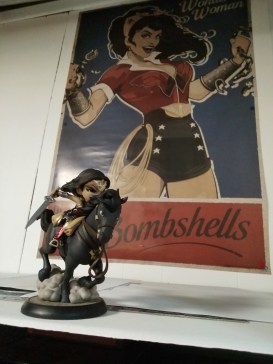
IMG_20171205_141958.jpgBardugo has quickly become one of my favorite authors. She tells great stories, with complex characters, and includes minority characters, both racial and GLBT. Her plots rocket right along, with well-thought-out action scenes that are easy to follow and emotionally impactful.

I’m not sure Warbringer quite makes my Best of 2017 list, but it was really good.

From the cover of Wonder Woman: Warbringer:

She will become one of the world’s greatest heroes: WONDER WOMAN. But first she is Diana, Princess of the Amazons. And her fight is just beginning. . . .
 
Diana longs to prove herself to her legendary warrior sisters. But when the opportunity finally comes, she throws away her chance at glory and breaks Amazon law—risking exile—to save a mere mortal. Even worse, Alia Keralis is no ordinary girl and with this single brave act, Diana may have doomed the world.
 
Alia just wanted to escape her overprotective brother with a semester at sea. She doesn’t know she is being hunted. When a bomb detonates aboard her ship, Alia is rescued by a mysterious girl of extraordinary strength and forced to confront a horrible truth: Alia is a Warbringer—a direct descendant of the infamous Helen of Troy, fated to bring about an age of bloodshed and misery.
 
Together, Diana and Alia will face an army of enemies—mortal and divine—determined to either destroy or possess the Warbringer. If they have any hope of saving both their worlds, they will have to stand side by side against the tide of war.
Book Review: An American Family

americanfamilyAn American Family: A Memoir of Hope and Sacrifice
by Khizr Khan
Memoir
271 pages
Published 2017

Like many people, I was inspired by the Khizr Khan’s speech at the Democratic Convention last year, and appalled by Trump’s reaction. As a Marine wife, the family members left behind when a service member dies get my utmost sympathy and compassion. That was my biggest fear while my husband was in the Marines, and it’s still a very emotional memory to look back on. So when I heard that Khan was writing a book, I knew I HAD to read it. I put a hold request in at the library before the book was published, and I’m glad I did. The book is definitely one of my favorites of 2017. (One of my next posts will be a round up of my favorites from this year.)

An American Family follows the Khans’ journey from Pakistan, to Dubai, to Texas, Maryland, and finally Virginia. And it’s fascinating. He says in the beginning of the book that he wrote it to answer the question he’s constantly asked: why do you love America? Why are you a Patriot? He couldn’t answer it in a few short sentences. This book is his answer, and what an answer it is. It’s impossible to summarize this book – it must be read.

It’s a very easy read – it flows beautifully, and Khan tells a story well. It’s easy, at least, until you get to the point where their son dies in action. Perhaps it wouldn’t have such an emotional effect on someone else, but that, and its aftermath, was pretty hard for me to read about. The event is important, however. Its repercussions ripple out through the Khans’ lives and affect everything they touch.

I can’t recommend this book highly enough. Especially if you’re American, and no matter where on the political spectrum you fall, this book is important. It might give you a different view on immigrants.

From the cover of An American Family:

“I am an American patriot not because I was born here but because I was not. I embraced American freedoms, raised my children to cherish and revere them, and lost a son who swore an oath to defend them, because I come from a place where they do not exist.”

In fewer than three hundred words, Muslim American Gold Star father Khizr Khan electrified viewers around the world when he took the stage at the 2016 Democratic National Convention. And when he offered to lend Donald Trump his own much-read and dog-eared pocket Constitution, his gesture perfectly encapsulated the feelings of millions. But who was that man, standing beside his wife, extolling the promises and virtues of the U.S. Constitution?

In this urgent and timeless immigrant story, we learn that Khizr Khan has been many things. He was the oldest of ten children born to farmers in Pakistan, and a curious and thoughtful boy who listened rapt as his grandfather recited Rumi beneath the moonlight. He was a university student who read the Declaration of Independence and was awestruck by what might be possible in life. He was a hopeful suitor, awkwardly but earnestly trying to win the heart of a woman far out of his league. He was a brilliant and diligent young family man who worked tow jobs to save enough money to put himself through Harvard Law School. He was a loving father who, having instilled in his children the ideals that brought him and his wife to America – the sense of shared dignity and mutual responsibility – tragically lost his son, an Army captain killed while protecting his base camp in Iraq. He was and is a patriot, and a fierce advocate for the rights, dignities, and values enshrined in the American system.

An American Family shows us who Khizr Khan and millions of other American immigrants are, and why – especially in these tumultuous times – we must not be afraid to step forward for what we believe in when it matters most.

Book Review: Star Wars: Phasma

Journey to the Last Jedi Star Wars PhasmaJourney to The Last Jedi: Phasma
or Star Wars: Phasma
by Delilah S. Dawson
Sci-fi
401 pages
Published 2017

Star Wars: Phasma is one of a series of books that is supposed to help us bridge the gap into The Force Awakens and The Last Jedi. They call them Journey to the Last Jedi, but given that Princess of Alderaan explores Leia’s early years, parts of them at least are set prior to the original trilogy. The Journey set includes Bloodline, about Leia’s struggles to organize the New Republic, and the birth of the First Order. It also includes Legends of Luke Skywalker, but as that is actually billed as legends and tall-tales told about Luke, and not necessarily true stories, I’m less inclined to read it.

Back to Phasma! So far, all we’ve seen of Phasma was the enigmatic Storm Trooper Captain, in chrome armor, powering down the shields when forced to in The Force Awakens. We never even saw her face. (Gwendolyn Christie had a wonderful opinion on why her face wasn’t shown, in an interview with Stephen Colbert the other night. You can watch the video below.)

So in the novel, we learn Phasma’s true origins. The story is told via a framework – a Resistance spy, Vi Moradi, is captured by Captain Cardinal, Phasma’s chief rival within the First Order. He forces her to tell him all she knows about Phasma, which she does, because it’s not info directly about The Resistance, and she’s hoping to turn him to her side. Phasma’s life began on a once thriving planet that had been decimated about 150 years before her birth by some force. (I don’t want to reveal too many surprises, and this book is full of them!) One of her old tribemates told the entire story of Phasma’s youth, rise to power in the tribe, and eventual escape from the planet to Moradi. It’s a story of survival at all costs, and illustrates just how good Phasma is at it.

I rather hope we see Captain Cardinal in The Last Jedi, as he grew on me even as he was interrogating Moradi. He goes from loyal First Order soldier with a grudge against Phasma to a conflicted man who’s beginning to see how much he’s been brainwashed. It’s intriguing to read. The revelation that The First Order rewards the ruthless while overlooking those who play by its own rules also breaks him a little bit.

I really enjoyed this book, and I will definitely be picking up Bloodline and Princess of Alderaan, because I can never get enough Leia. If you’re not a Star Wars fan, I’d definitely take a pass on this book, because it won’t really mean anything. But as a fan, it’s a fascinating look at the beginnings of a villain.

(If you’re interested in more Star Wars, I have also read and reviewed Ahsoka, by E. K. Johnston.)

From the cover of Star Wars: Phasma:

One of the most cunning and merciless officers of the First Order, Captain Phasma commands the favor of her superiors, the respect of her peers, and the terror of her enemies. But for all her renown, Phasma remains as virtually unknown as the impassive expression on her gleaming chrome helmet. Now, an adversary is bent on unearthing her mysterious origins—and exposing a secret she guards as zealously and ruthlessly as she serves her masters.

Deep inside the Battlecruiser Absolution, a captured Resistance spy endures brutal interrogation at the hands of a crimson-armored stormtrooper—Cardinal. But the information he desires has nothing to do with the Resistance or its covert operations against the First Order.

What the mysterious stormtrooper wants is Phasma’s past—and with it whatever long-buried scandal, treachery, or private demons he can wield against the hated rival who threatens his own power and privilege in the ranks of the First Order. His prisoner has what Cardinal so desperately seeks, but she won’t surrender it easily. As she wages a painstaking war of wills with her captor, bargaining for her life in exchange for every precious revelation, the spellbinding chronicle of the inscrutable Phasma unfolds. But this knowledge may prove more than just dangerous once Cardinal possesses it—and once his adversary unleashes the full measure of her fury.

Book Review: Forest of a Thousand Lanterns

forest1kForest of a Thousand Lanterns
by Julie C. Dao
Fairy Tale Retelling
363 pages
Published 2017

You know I love my Fairy Tales! Especially re-imagining the villains. Forest of a Thousand Lanterns is an Asian take on the evil queen from Snow White. The author is a Vietnamese American, and this is her debut novel. She has quite skillfully woven a new origin story for the wicked stepmother in a fantasy land heavily influenced by East Asian mythology and culture. I don’t know enough about the individual countries’ mythologies to tell you if the influences come specifically from Vietnam, or more generically from the area. I know that their beliefs can vary pretty wildly by locale.

That said, this is another superb debut novel. I’m eager to read the sequel – it’s billed as “A Rise of the Empress novel” so I’m sure there will be one or more. Xifeng is a pretty complex character – she is somewhat single-minded in what she wants, but conflicted in what to do to get it. (It being the position of Empress.) I was intrigued by who was chosen to fill the roles of the traditional tale; Xifeng, of course, would be the wicked stepmother. The Fool is Xifeng’s version of Snow White, and Xifeng thought for some time that she knew who The Fool was. The reader, of course, knows the Fool must be Snow White, and so not the people who Xifeng suspected. The one that surprised me was the identity of The Huntsman. I won’t spoil anything – but he was unexpected.

There’s also more going on than just the Snow White plot. There are gods and goddesses and spirits and an underlying war. I am quite eager to see how those play out.

There is a slow spot in the middle – I set the book down for a couple of days before picking it up again, and that’s always a sign I’m not as absorbed in the book as I could be. But I did pick it up again and read straight through to the end, so it’s not too bad!

If you like Fairy Tales and Asian mythology, this is definitely a neat blend of the two. I really liked it.

From the cover of Forest of a Thousand Lanterns:

Eighteen-year-old Xifeng is beautiful. The stars say she is destined for greatness, that she is meant to be Empress of Feng Lu. But only if she embraces the darkness within her. 

Growing up as a peasant in a forgotten village on the edge of the map, Xifeng longs to fulfill the destiny promised to her by her cruel aunt, the witch Guma, who has read the cards and seen glimmers of Xifeng’s majestic future. But is the price of the throne too high? Because in order to achieve greatness, she must spurn the young man who loves her and exploit the callous magic that runs through her veins – sorcery fueled by eating the hearts of the recently killed. For the god who has sent her on this journey will not be satisfied until his power is absolute.

Book Review: The Clockwork Dynasty

clockworkThe Clockwork Dynasty
Daniel H. Wilson
Fantasy
309 pages
Published 2017

Well. This one was unique! Pretty good, too. The story bounces between the present and the past, telling the story of a – race, I suppose – that has always lived alongside humans, but hidden. Typical urban fantasy, right? Except this – race – is robots. Automatons, they call themselves. Created by a race they call the progenitor race, or First Humans, they have waited alongside mankind for their creators to return. Their energy reserves are running low, however, and some have resorted to cannibalizing each other’s parts to stay alive. Enter our human protagonist, in possession of an ancient artifact passed down from her grandfather, who obtained it in World War II. Fascinated by it since she was a little girl, she’s made a career out of studying old clockwork toys, and has started to get a little too close to the truth.

The chapters of the book set in the present center on June Stefanov, the human woman who stumbles upon the truth. The chapters set in the past show history from the vantage point of Peter, her automaton companion. The bouncing back and forth happens a touch too quickly in some places, though it does do a good job of showing us what we need to know rather than telling us, which I always like. The details of how the automatons worked were fascinating, though obviously a bit magical. The automatons themselves don’t really understand much of it. The author has written other novels about robots, and in fact has a Ph.D. in robotics, so it’s pretty cohesive.

The plot rockets right along – I read the book in one sitting – and the action is pretty awesome. I wish there had been a bit more characterization of June. Other than being good at clockwork stuff, and a very curious person, we really don’t know much about her, and never find out. The book is more Peter’s story.

Overall, I really enjoyed this book. It was definitely a different spin on “hidden race existing beside humans.” Oh – and the villain’s armor was badass!

From the cover of The Clockwork Dynasty:

Present Day: When a young anthropologist specializing in ancient technology uncovers a terrible secret concealed in the workings of a three-hundred-year-old mechanical doll, she is thrown into a hidden world that lurks just under the surface of our own. With her career and her life at stake, June Stefanov will ally with a remarkable traveler who exposes her to a reality she never imagined as they embark on an around-the-world adventure and discover breathtaking secrets of the past…

Russia, 1710: In the depths of the Kremlin, the tsar’s loyal mechanician brings to life two astonishingly humanlike mechanical beings. Peter and Elena are a brother and sister fallen out of time, in possession of uncanny power, and destined to serve great empires. Struggling to blend into pre-Victorian society, they are pulled into a legendary war that has raged for centuries. 

Book Review: On Tyranny

tyrannyOn Tyranny: Twenty Lessons from the Twentieth Century
by Timothy Snyder
Nonfiction
126 pages
Published 2017

On Tyranny is a short little book. I don’t think it needs to be longer – it’s easy to read, succinct, and is meant to serve as a warning. If anyone wants to learn more about any of the twenty lessons, there are plenty of resources for that. It’s simply “HEY. This happened before. And this happened before. And this happened before and YOU NEED TO SEE THESE SIMILARITIES.” It was a very quick read, but has left me with a lot to think about.

The format is simple: Twenty sections, each beginning with a lesson title and a short summary paragraph, then going into more detail in the next two to three pages. For example:

Do Not Obey In Advance.
Most of the power of authoritarianism is freely given. In times like these, individuals think ahead about what a more repressive government will want, and then offer themselves without being asked. A citizen who adapts in this way is teaching power what it can do.

The next few pages talk about Austrian Nazis rounded up Jews and used them as forced labor, before the German government told them to. When Jewish businesses were marked as such, people immediately started avoiding them. Anticipatory obedience. (Relate this to the suddenly overt racism and Nazi marches we’re now facing in the US – where that used to be hidden.)

Another example:

Take Responsibility For The Face Of The World.
The symbols of today enable the reality of tomorrow. Notice the swastikas and the other signs of hate. Do not look away, and do not get used to them. Remove them yourself and set an example for others to do so.

The next pages talk about propaganda, and signs. If we tolerate swastikas, we imply that we accept them. That we support them. And if the oppressed groups that those swastikas are aimed at see everyone around them supporting them, who do they look to for help? All it takes is one person deciding to scrub off or paint over the swastika, for people around them to realize that’s a thing that can be done. This plays into another section, which talked about Standing Out. Do the thing that makes you stand out – whether that’s standing up for a minority, or scrubbing swastikas off walls, or attending a protest. If you don’t stand out, you’re too easily ignored as part of the problem.

This book had lots of holds at my local library – while I was sad to have to wait so long, I was pleased that so many people wanted to read it. I was 35th in line at one point! Just knowing that so many people want to read it is a little reassuring. The author has written several books on the Holocaust, WWII, and the rise of Hitler, so he knows what he’s talking about, and it shows in his writing.

On Tyranny is a quick read and does an amazing job of boiling a lot of complicated concepts down into very succinct little points. I definitely recommend it as a jumping off point. Just don’t let it be all you read.

From the cover of On Tyranny:

The Founding Fathers tried to protect us from the threat they knew, the tyranny that overcame ancient democracy. Today, our political order faces new threats, not unlike the totalitarianism of the twentieth century. We are no wiser than the Europeans who saw democracy yield to fascism, Nazism, or communism.  Our one advantage is that we might learn from their experience.