Book Review: The Power

thepowerThe Power
Naomi Alderman
Dystopia
416 pages
Published October 2017

Holy shit. I sat and stared at my Kindle for several minutes after finishing this book. The Power belongs on the same shelf as The Handmaid’s Tale and American War. It’s just amazing. The book begins in our world – but then takes a twist sideways. Teenage girls start manifesting an electrical power. They can zap people, with varying degrees of strength. It can be a pleasing, arousing tingle, or a warning jolt, or a breath-stealing, heart-stopping (literally) bolt. They soon discover that older women can also manifest the ability, but it has to be kick-started by a jolt from someone who already has it. (Even later in the book it’s revealed that there’s actually a muscle – they call it the skein – that controls the electricity, and women have, in the last twenty years or so, evolved to have that muscle.)

The book revolves between the points of view of a few different women and one man. The man is a journalist reporting on the emergence of the new power, while the women are prominent figures in the new world order that is emerging. Allie – Eve – becomes the leader of a new religion, Roxy is the daughter of a crime syndicate boss, and Margot is a mayor climbing the political ranks. Margot’s daughter also gets a few chapters.

It’s been pointed out that perhaps men are afraid of women having equal rights because they can’t picture a world in which powerful women don’t treat men the way powerful men have always treated women. They can only imagine men and women interacting as oppressors and oppressed, not as equals. Whereas feminism wants a world where we are truly equals. The Power imagines a world where women do become the oppressors, and men are forced into the feminine role. This is enforced by the framework the novel is told in – the novel itself is bracketed by letters between the “author,” presenting his historical novel, and a woman supposedly editing his work. Through the letters, you discover the novel is a slightly embellished history of their world, with about five thousand years between the events of the novel and the time of the letters. In the tone of the letters, you see the stereotypes switched – the man is apologetic and unsure while the woman is authoritative, patronizing, and a little bit sexist. “Oh, you silly boy, imagining a world where men were dominant! What a naughty idea! Don’t you think men as soldiers is preposterous? Men are homemakers, women are the aggressive ones!” I think, if feminism achieves its goals through legislation, we will find true equality. If something like this were to happen – a drastic change, giving women a physical way to dominate suddenly, the outcome might indeed be more like the novel. Enough women have been traumatized that they’ll want – need – to avenge themselves, and violent upheaval will result.

By the last third of the novel, we see powerful women and societies acting just the same as powerful men always have – I’d like to think we’d have learned from the men’s mistakes, but humans are only human. Perhaps this is more realistic.

The book is NOT for the faint of heart. There are graphic rape, abuse, and violence scenes. They’re not gratuitous – they serve the author’s point – but they are still disturbing, as those scenes should be.

I’ll be thinking about this book for a while. It’s excellent, and I highly recommend it, if you can handle the dark themes.

From the cover of The Power:

In THE POWER, the world is a recognizable place: there’s a rich Nigerian boy who lounges around the family pool; a foster kid whose religious parents hide their true nature; an ambitious American politician; a tough London girl from a tricky family. But then a vital new force takes root and flourishes, causing their lives to converge with devastating effect. Teenage girls now have immense physical power–they can cause agonizing pain and even death. And, with this small twist of nature, the world drastically resets.

From award-winning author Naomi Alderman, THE POWER is speculative fiction at its most ambitious and provocative, at once taking us on a thrilling journey to an alternate reality, and exposing our own world in bold and surprising ways.

Book Review: The True Confessions of Charlotte Doyle

true confessions of charlotte doyle aviThe True Confessions of Charlotte Doyle
Avi
Middle-grade historical fiction
229 pages
Published 1990

This was my husband’s suggestion for “A Book Set At Sea,” one of the categories on the PopSugar Reading Challenge. It was a book he’d read as a child, and one I’d never heard of. It was a quick, easy read, as it was meant for children. Late elementary school, would be my guess. (Husband read it in fifth grade for a class.)

The book is set in the summer of 1832. Charlotte Doyle is setting sail across the Atlantic to return to America and rejoin the rest of her family, after finishing the school year at her boarding school. Things are a bit suspicious from the beginning of the voyage – the other two families that were supposed to be on board the ship didn’t make it, so it’s just Charlotte and the crew. Deckhands at the dock warned her away from the ship and refused to carry her things to it.

As the voyage winds on, Charlotte discovers that the crew intensely dislikes their captain and thinks he’s far too strict – he beat one of their number so badly on the last voyage that the crewman lost his arm. Torn between the “noble” captain, who represents everything she’s used to, and her own sense of right and wrong, she starts to notice how cruel he is to the crew. Ultimately, her life, and the lives of the crew, hinge on her decisions as the captain uses her to spy on the crew and report back to him.

My favorite passage from the book turned out to be my husband’s favorite, as well:


“What’s a hurricane?”
“The worst storm of all.”
“Can’t we sail around?”
Barlow again glanced at the helm, the sails and then at the sky above. He frowned. “I heard Mr. Hollybrass and Jaggery arguing about it. To my understanding,” he said, “I don’t think the captain wants to avoid it.”
“Why not?”
“It’s what Grimes has been saying. The captain’s trying to move fast. If he sets us right at the hurricane’s edge, it’ll blow us home like a pound of shot in a two-pound cannon.”
“What if he doesn’t get it right?”
“Two pounds of shot in a one-pound cannon.”

I quite enjoyed this little book, and it’s a great example of a girl bucking tradition and doing what she’s good at, gender roles be damned. There is a fair bit of violence – in one scene a man is severely whipped – but it’s not graphic. No sexual themes at all. Pretty suitable for kids as soon as they’re decent enough readers.

From the cover of The True Confessions of Charlotte Doyle:

The Seahawk looms against a darkening sky, black and sinister. Manned by an angry, motley crew at the mercy of a ruthless captain, the rat-infested ship reeks of squalor, despair…and mutiny! It is no place for the lone passenger, thirteen-year-old Charlotte Doyle, yet for her there is no turning back. At first a trapped and powerless young girl, Charlotte dares to become the center of a daring and deadly voyage that will challenge her courage, her loyalties, and her very will to survive!

Book Review: Wonder Woman: Warbringer

WonderWomanWonder Woman: Warbringer
by Leigh Bardugo
Superhero Fiction
384 pages
Published 2017

WONDER WOMAN YASSSS. I might like Wonder Woman just a little bit. And the novel is written by Leigh Bardugo, the creator of the Grishaverse! (I reviewed her Six of Crows and Crooked Kingdom, and REALLY need to get my hands on the other trilogy!)

So this is basically a slightly different origin story for Wonder Woman – or at least the reason she leaves Themyscira is a little different for this book’s plot. One thing I’ve always enjoyed about DC, and superheroes in general, is that it’s not so much about the specific details of what they’ve done, so much as who they really are and what they believe in. And in that, Diana is very much true to herself in Warbringer. Given a choice between two outcomes, she opts for a third. Not “do I save these people, or those people” but “how do I save EVERYONE?”

Lego Wonder WomanI also really liked that The Warbringer – the girl Diana is trying to save – is no shrinking violet herself. She absorbs the knowledge of what she is in a bit of a shock, but once over that, she displays courage and competence as well, and is a fitting companion for Diana. Her friends were also fun characters, and I especially liked Nim.
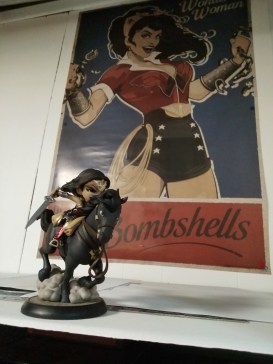
Again we have representation, too! The Warbringer and Nim are both women of color. Diana mentions that her skin is brown, as well. Coming from Bardugo, I shouldn’t have been surprised that sexuality was also addressed in the book, but not as a plot point, which is lovely to see. It just is a facet of a character. I especially loved the shoutout to Diana’s bisexuality.

IMG_20171205_141958.jpgBardugo has quickly become one of my favorite authors. She tells great stories, with complex characters, and includes minority characters, both racial and GLBT. Her plots rocket right along, with well-thought-out action scenes that are easy to follow and emotionally impactful.

I’m not sure Warbringer quite makes my Best of 2017 list, but it was really good.

From the cover of Wonder Woman: Warbringer:

She will become one of the world’s greatest heroes: WONDER WOMAN. But first she is Diana, Princess of the Amazons. And her fight is just beginning. . . .
 
Diana longs to prove herself to her legendary warrior sisters. But when the opportunity finally comes, she throws away her chance at glory and breaks Amazon law—risking exile—to save a mere mortal. Even worse, Alia Keralis is no ordinary girl and with this single brave act, Diana may have doomed the world.
 
Alia just wanted to escape her overprotective brother with a semester at sea. She doesn’t know she is being hunted. When a bomb detonates aboard her ship, Alia is rescued by a mysterious girl of extraordinary strength and forced to confront a horrible truth: Alia is a Warbringer—a direct descendant of the infamous Helen of Troy, fated to bring about an age of bloodshed and misery.
 
Together, Diana and Alia will face an army of enemies—mortal and divine—determined to either destroy or possess the Warbringer. If they have any hope of saving both their worlds, they will have to stand side by side against the tide of war.

Book Review: Star Wars: Phasma

Journey to the Last Jedi Star Wars PhasmaJourney to The Last Jedi: Phasma
or Star Wars: Phasma
by Delilah S. Dawson
Sci-fi
401 pages
Published 2017

Star Wars: Phasma is one of a series of books that is supposed to help us bridge the gap into The Force Awakens and The Last Jedi. They call them Journey to the Last Jedi, but given that Princess of Alderaan explores Leia’s early years, parts of them at least are set prior to the original trilogy. The Journey set includes Bloodline, about Leia’s struggles to organize the New Republic, and the birth of the First Order. It also includes Legends of Luke Skywalker, but as that is actually billed as legends and tall-tales told about Luke, and not necessarily true stories, I’m less inclined to read it.

Back to Phasma! So far, all we’ve seen of Phasma was the enigmatic Storm Trooper Captain, in chrome armor, powering down the shields when forced to in The Force Awakens. We never even saw her face. (Gwendolyn Christie had a wonderful opinion on why her face wasn’t shown, in an interview with Stephen Colbert the other night. You can watch the video below.)

So in the novel, we learn Phasma’s true origins. The story is told via a framework – a Resistance spy, Vi Moradi, is captured by Captain Cardinal, Phasma’s chief rival within the First Order. He forces her to tell him all she knows about Phasma, which she does, because it’s not info directly about The Resistance, and she’s hoping to turn him to her side. Phasma’s life began on a once thriving planet that had been decimated about 150 years before her birth by some force. (I don’t want to reveal too many surprises, and this book is full of them!) One of her old tribemates told the entire story of Phasma’s youth, rise to power in the tribe, and eventual escape from the planet to Moradi. It’s a story of survival at all costs, and illustrates just how good Phasma is at it.

I rather hope we see Captain Cardinal in The Last Jedi, as he grew on me even as he was interrogating Moradi. He goes from loyal First Order soldier with a grudge against Phasma to a conflicted man who’s beginning to see how much he’s been brainwashed. It’s intriguing to read. The revelation that The First Order rewards the ruthless while overlooking those who play by its own rules also breaks him a little bit.

I really enjoyed this book, and I will definitely be picking up Bloodline and Princess of Alderaan, because I can never get enough Leia. If you’re not a Star Wars fan, I’d definitely take a pass on this book, because it won’t really mean anything. But as a fan, it’s a fascinating look at the beginnings of a villain.

(If you’re interested in more Star Wars, I have also read and reviewed Ahsoka, by E. K. Johnston.)

From the cover of Star Wars: Phasma:

One of the most cunning and merciless officers of the First Order, Captain Phasma commands the favor of her superiors, the respect of her peers, and the terror of her enemies. But for all her renown, Phasma remains as virtually unknown as the impassive expression on her gleaming chrome helmet. Now, an adversary is bent on unearthing her mysterious origins—and exposing a secret she guards as zealously and ruthlessly as she serves her masters.

Deep inside the Battlecruiser Absolution, a captured Resistance spy endures brutal interrogation at the hands of a crimson-armored stormtrooper—Cardinal. But the information he desires has nothing to do with the Resistance or its covert operations against the First Order.

What the mysterious stormtrooper wants is Phasma’s past—and with it whatever long-buried scandal, treachery, or private demons he can wield against the hated rival who threatens his own power and privilege in the ranks of the First Order. His prisoner has what Cardinal so desperately seeks, but she won’t surrender it easily. As she wages a painstaking war of wills with her captor, bargaining for her life in exchange for every precious revelation, the spellbinding chronicle of the inscrutable Phasma unfolds. But this knowledge may prove more than just dangerous once Cardinal possesses it—and once his adversary unleashes the full measure of her fury.

Book Review: Forest of a Thousand Lanterns

forest1kForest of a Thousand Lanterns
by Julie C. Dao
Fairy Tale Retelling
363 pages
Published 2017

You know I love my Fairy Tales! Especially re-imagining the villains. Forest of a Thousand Lanterns is an Asian take on the evil queen from Snow White. The author is a Vietnamese American, and this is her debut novel. She has quite skillfully woven a new origin story for the wicked stepmother in a fantasy land heavily influenced by East Asian mythology and culture. I don’t know enough about the individual countries’ mythologies to tell you if the influences come specifically from Vietnam, or more generically from the area. I know that their beliefs can vary pretty wildly by locale.

That said, this is another superb debut novel. I’m eager to read the sequel – it’s billed as “A Rise of the Empress novel” so I’m sure there will be one or more. Xifeng is a pretty complex character – she is somewhat single-minded in what she wants, but conflicted in what to do to get it. (It being the position of Empress.) I was intrigued by who was chosen to fill the roles of the traditional tale; Xifeng, of course, would be the wicked stepmother. The Fool is Xifeng’s version of Snow White, and Xifeng thought for some time that she knew who The Fool was. The reader, of course, knows the Fool must be Snow White, and so not the people who Xifeng suspected. The one that surprised me was the identity of The Huntsman. I won’t spoil anything – but he was unexpected.

There’s also more going on than just the Snow White plot. There are gods and goddesses and spirits and an underlying war. I am quite eager to see how those play out.

There is a slow spot in the middle – I set the book down for a couple of days before picking it up again, and that’s always a sign I’m not as absorbed in the book as I could be. But I did pick it up again and read straight through to the end, so it’s not too bad!

If you like Fairy Tales and Asian mythology, this is definitely a neat blend of the two. I really liked it.

From the cover of Forest of a Thousand Lanterns:

Eighteen-year-old Xifeng is beautiful. The stars say she is destined for greatness, that she is meant to be Empress of Feng Lu. But only if she embraces the darkness within her. 

Growing up as a peasant in a forgotten village on the edge of the map, Xifeng longs to fulfill the destiny promised to her by her cruel aunt, the witch Guma, who has read the cards and seen glimmers of Xifeng’s majestic future. But is the price of the throne too high? Because in order to achieve greatness, she must spurn the young man who loves her and exploit the callous magic that runs through her veins – sorcery fueled by eating the hearts of the recently killed. For the god who has sent her on this journey will not be satisfied until his power is absolute.

Book Review: The Clockwork Dynasty

clockworkThe Clockwork Dynasty
Daniel H. Wilson
Fantasy
309 pages
Published 2017

Well. This one was unique! Pretty good, too. The story bounces between the present and the past, telling the story of a – race, I suppose – that has always lived alongside humans, but hidden. Typical urban fantasy, right? Except this – race – is robots. Automatons, they call themselves. Created by a race they call the progenitor race, or First Humans, they have waited alongside mankind for their creators to return. Their energy reserves are running low, however, and some have resorted to cannibalizing each other’s parts to stay alive. Enter our human protagonist, in possession of an ancient artifact passed down from her grandfather, who obtained it in World War II. Fascinated by it since she was a little girl, she’s made a career out of studying old clockwork toys, and has started to get a little too close to the truth.

The chapters of the book set in the present center on June Stefanov, the human woman who stumbles upon the truth. The chapters set in the past show history from the vantage point of Peter, her automaton companion. The bouncing back and forth happens a touch too quickly in some places, though it does do a good job of showing us what we need to know rather than telling us, which I always like. The details of how the automatons worked were fascinating, though obviously a bit magical. The automatons themselves don’t really understand much of it. The author has written other novels about robots, and in fact has a Ph.D. in robotics, so it’s pretty cohesive.

The plot rockets right along – I read the book in one sitting – and the action is pretty awesome. I wish there had been a bit more characterization of June. Other than being good at clockwork stuff, and a very curious person, we really don’t know much about her, and never find out. The book is more Peter’s story.

Overall, I really enjoyed this book. It was definitely a different spin on “hidden race existing beside humans.” Oh – and the villain’s armor was badass!

From the cover of The Clockwork Dynasty:

Present Day: When a young anthropologist specializing in ancient technology uncovers a terrible secret concealed in the workings of a three-hundred-year-old mechanical doll, she is thrown into a hidden world that lurks just under the surface of our own. With her career and her life at stake, June Stefanov will ally with a remarkable traveler who exposes her to a reality she never imagined as they embark on an around-the-world adventure and discover breathtaking secrets of the past…

Russia, 1710: In the depths of the Kremlin, the tsar’s loyal mechanician brings to life two astonishingly humanlike mechanical beings. Peter and Elena are a brother and sister fallen out of time, in possession of uncanny power, and destined to serve great empires. Struggling to blend into pre-Victorian society, they are pulled into a legendary war that has raged for centuries.